Italy Digital Food Delivery Ecosystem Market

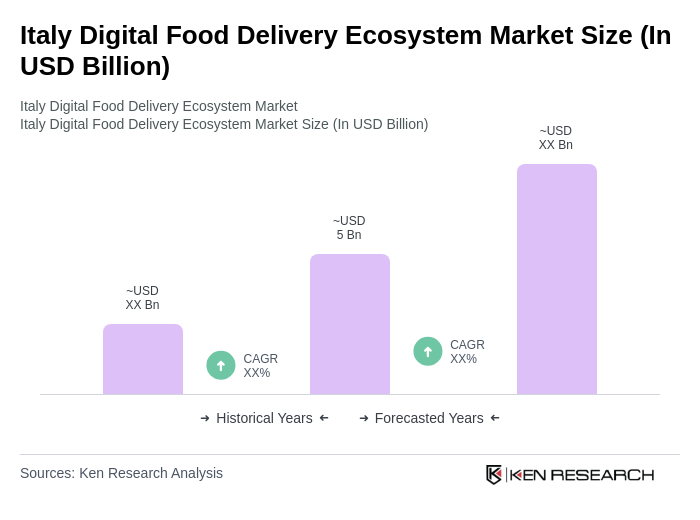
The Italy digital food delivery ecosystem market, valued at USD 5 Bn, is growing due to smartphone penetration, urbanization, and demand for convenient dining options.

Region:Europe

Author(s):Dev

Product Code:KRAB4306

Pages:89

Published On:October 2025
About the Report

Base Year 2024

Italy Digital Food Delivery Ecosystem Market Overview

  • The Italy Digital Food Delivery Ecosystem Market is valued at USD 5 billion, based on a five-year historical analysis. This growth is primarily driven by the increasing adoption of mobile technology, changing consumer lifestyles, and the growing demand for convenience in food procurement. The rise of online platforms and mobile applications has significantly transformed how consumers access food services, leading to a surge in digital transactions.
  • Key cities such as Milan, Rome, and Naples dominate the market due to their high population density, vibrant culinary scenes, and a strong culture of dining out. These urban centers have seen a rapid increase in the number of restaurants and food outlets, which, combined with a tech-savvy population, has created a fertile ground for digital food delivery services to thrive.
  • In 2023, the Italian government implemented regulations aimed at enhancing food safety and delivery standards within the digital food delivery sector. This includes mandatory compliance with hygiene protocols and the establishment of a digital tracking system for food deliveries to ensure quality and safety, thereby fostering consumer trust in online food services.
Italy Digital Food Delivery Ecosystem Market Size

Italy Digital Food Delivery Ecosystem Market Segmentation

By Type:The market is segmented into various types, including restaurant delivery, grocery delivery, meal kit delivery, alcohol delivery, and others. Among these, restaurant delivery is the most dominant segment, driven by the increasing preference for convenience and the growing number of restaurants partnering with delivery platforms. Grocery delivery is also gaining traction as consumers seek to save time on shopping. Meal kit delivery is emerging as a popular choice for those looking to cook at home without the hassle of meal planning.
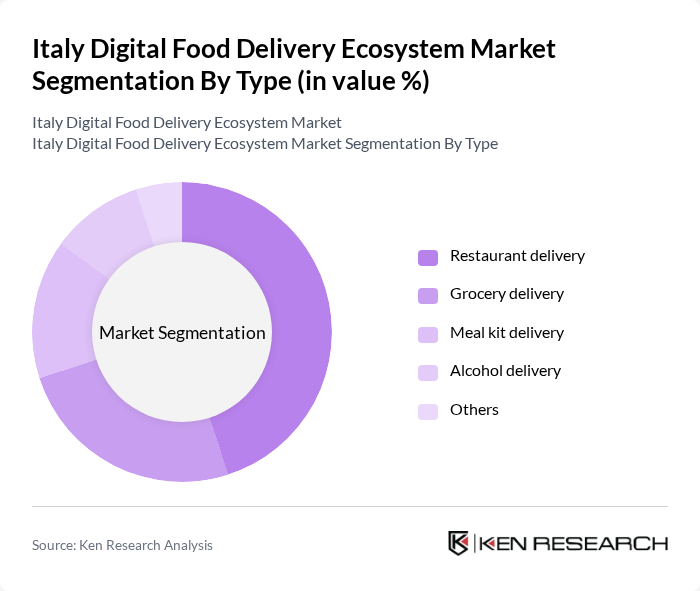
Italy Digital Food Delivery Ecosystem Market segmentation by Type.

By End-User:The end-user segmentation includes individual consumers, corporate clients, and event organizers. Individual consumers represent the largest segment, driven by the convenience of ordering food online for personal consumption. Corporate clients are increasingly utilizing food delivery services for meetings and events, while event organizers are leveraging these services to cater to larger gatherings. The trend towards remote work has further boosted the demand from corporate clients.

Italy Digital Food Delivery Ecosystem Market segmentation by End-User.

Italy Digital Food Delivery Ecosystem Market Competitive Landscape

The Italy Digital Food Delivery Ecosystem Market is characterized by a dynamic mix of regional and international players. Leading participants such as Just Eat, Deliveroo, Glovo, Uber Eats, Foodora, Takeaway.com, Domino's Pizza, McDonald's, Deliveroo Editions, Foorban, Cortilia, Sgnam, Tasty Box, Foodracers, Rappi contribute to innovation, geographic expansion, and service delivery in this space.

Just Eat

2001

London, UK

Deliveroo

2013

London, UK

Glovo

2015

Barcelona, Spain

Uber Eats

2014

San Francisco, USA

Foodora

2014

Berlin, Germany

Company

Establishment Year

Headquarters

Group Size (Large, Medium, or Small as per industry convention)

Revenue Growth Rate

Customer Acquisition Cost

Average Order Value

Customer Retention Rate

Delivery Time Efficiency

Italy Digital Food Delivery Ecosystem Market Industry Analysis

Growth Drivers

  • Increasing Smartphone Penetration:As of future, Italy boasts a smartphone penetration rate of approximately 85%, translating to around 52 million users. This widespread access to mobile technology facilitates the use of digital food delivery apps, driving consumer engagement. The convenience of ordering food via smartphones aligns with the growing trend of on-demand services, making it easier for consumers to access a variety of dining options at their fingertips, thus propelling market growth.
  • Rise in Urbanization:Italy's urban population is projected to reach 61% in future, with cities like Milan and Rome leading in density. This urbanization trend increases the demand for food delivery services as busy lifestyles prompt consumers to seek convenient dining solutions. The concentration of restaurants in urban areas also enhances the variety of options available, making food delivery an attractive choice for urban dwellers who prioritize convenience and speed in their dining experiences.
  • Growing Demand for Convenience:A significant shift in consumer behavior has been observed, with 71% of Italians indicating a preference for convenience in their dining choices. This trend is particularly pronounced among younger demographics, who favor quick and easy meal solutions. The rise of dual-income households and busy lifestyles further fuels this demand, leading to increased usage of food delivery services as consumers seek to save time while enjoying diverse culinary experiences from the comfort of their homes.

Market Challenges

  • Intense Competition Among Delivery Platforms:The Italian digital food delivery market is characterized by fierce competition, with over 21 major players vying for market share. This saturation leads to aggressive pricing strategies, which can erode profit margins. Companies like Deliveroo and Just Eat are constantly innovating to attract customers, making it challenging for new entrants to establish a foothold. The competitive landscape necessitates continuous investment in marketing and technology to remain relevant and capture consumer attention.
  • Regulatory Hurdles:The food delivery sector in Italy faces significant regulatory challenges, particularly concerning labor laws and food safety standards. In future, new regulations are expected to be implemented, impacting gig economy workers' rights and operational costs for delivery platforms. Compliance with these regulations can strain resources and complicate business operations, potentially hindering growth and innovation within the industry as companies navigate the evolving legal landscape.

Italy Digital Food Delivery Ecosystem Market Future Outlook

The future of the Italy digital food delivery ecosystem appears promising, driven by technological advancements and evolving consumer preferences. As the market adapts to increasing demand for sustainable practices, companies are likely to invest in eco-friendly packaging and delivery methods. Additionally, the integration of AI and machine learning will enhance operational efficiency and customer experience, allowing platforms to offer personalized recommendations and streamline logistics, ultimately shaping a more responsive and innovative market landscape.

Market Opportunities

  • Expansion into Underserved Regions:There is a significant opportunity for food delivery services to expand into rural and suburban areas, where current penetration is low. With approximately 31% of the population living outside major urban centers, targeting these regions can unlock new customer bases and drive revenue growth, particularly as internet access improves and consumer preferences shift towards convenience.
  • Development of Subscription Models:Subscription-based delivery services are gaining traction, with a projected increase in consumer interest. By offering monthly plans that provide discounts or exclusive deals, companies can enhance customer loyalty and predictability in revenue streams. This model aligns with the growing trend of consumers seeking value and convenience, presenting a lucrative opportunity for platforms to differentiate themselves in a competitive market.

Scope of the Report

SegmentSub-Segments
By Type

Restaurant delivery

Grocery delivery

Meal kit delivery

Alcohol delivery

Others

By End-User

Individual consumers

Corporate clients

Event organizers

By Sales Channel

Mobile applications

Websites

Third-party platforms

By Delivery Mode

Standard delivery

Express delivery

Scheduled delivery

By Cuisine Type

Italian

Asian

Fast food

Vegan/Vegetarian

By Payment Method

Credit/Debit cards

Digital wallets

Cash on delivery

By Subscription Model

Monthly subscriptions

Pay-per-order

Annual subscriptions

Key Target Audience

Investors and Venture Capitalist Firms

Government and Regulatory Bodies (e.g., Ministero delle Politiche Agricole Alimentari e Forestali)

Food Delivery Platform Operators

Restaurant Chains and Franchise Owners

Logistics and Supply Chain Companies

Payment Processing Service Providers

Food Safety and Quality Assurance Agencies (e.g., Istituto Superiore di Sanità)

Marketing and Advertising Agencies specializing in Food Services

Players Mentioned in the Report:

Just Eat

Deliveroo

Glovo

Uber Eats

Foodora

Takeaway.com

Domino's Pizza

McDonald's

Deliveroo Editions

Foorban

Cortilia

Sgnam

Tasty Box

Foodracers

Rappi

Table of Contents

Market Assessment Phase

1. Executive Summary and Approach


2. Italy Digital Food Delivery Ecosystem Market Overview

2.1 Key Insights and Strategic Recommendations

2.2 Italy Digital Food Delivery Ecosystem Market Overview

2.3 Definition and Scope

2.4 Evolution of Market Ecosystem

2.5 Timeline of Key Regulatory Milestones

2.6 Value Chain & Stakeholder Mapping

2.7 Business Cycle Analysis

2.8 Policy & Incentive Landscape


3. Italy Digital Food Delivery Ecosystem Market Analysis

3.1 Growth Drivers

3.1.1 Increasing smartphone penetration
3.1.2 Rise in urbanization
3.1.3 Growing demand for convenience
3.1.4 Expansion of restaurant partnerships

3.2 Market Challenges

3.2.1 Intense competition among delivery platforms
3.2.2 Regulatory hurdles
3.2.3 High operational costs
3.2.4 Consumer trust issues

3.3 Market Opportunities

3.3.1 Expansion into underserved regions
3.3.2 Integration of AI and machine learning
3.3.3 Partnerships with local businesses
3.3.4 Development of subscription models

3.4 Market Trends

3.4.1 Increased focus on sustainability
3.4.2 Growth of ghost kitchens
3.4.3 Rise of contactless delivery options
3.4.4 Enhanced user experience through technology

3.5 Government Regulation

3.5.1 Food safety regulations
3.5.2 Labor laws affecting gig economy
3.5.3 Taxation policies for delivery services
3.5.4 Data protection regulations

4. SWOT Analysis


5. Stakeholder Analysis


6. Porter's Five Forces Analysis


7. Italy Digital Food Delivery Ecosystem Market Market Size, 2019-2024

7.1 By Value

7.2 By Volume

7.3 By Average Selling Price


8. Italy Digital Food Delivery Ecosystem Market Segmentation

8.1 By Type

8.1.1 Restaurant delivery
8.1.2 Grocery delivery
8.1.3 Meal kit delivery
8.1.4 Alcohol delivery
8.1.5 Others

8.2 By End-User

8.2.1 Individual consumers
8.2.2 Corporate clients
8.2.3 Event organizers

8.3 By Sales Channel

8.3.1 Mobile applications
8.3.2 Websites
8.3.3 Third-party platforms

8.4 By Delivery Mode

8.4.1 Standard delivery
8.4.2 Express delivery
8.4.3 Scheduled delivery

8.5 By Cuisine Type

8.5.1 Italian
8.5.2 Asian
8.5.3 Fast food
8.5.4 Vegan/Vegetarian

8.6 By Payment Method

8.6.1 Credit/Debit cards
8.6.2 Digital wallets
8.6.3 Cash on delivery

8.7 By Subscription Model

8.7.1 Monthly subscriptions
8.7.2 Pay-per-order
8.7.3 Annual subscriptions

9. Italy Digital Food Delivery Ecosystem Market Competitive Analysis

9.1 Market Share of Key Players

9.2 Cross Comparison of Key Players

9.2.1 Company Name
9.2.2 Group Size (Large, Medium, or Small as per industry convention)
9.2.3 Revenue Growth Rate
9.2.4 Customer Acquisition Cost
9.2.5 Average Order Value
9.2.6 Customer Retention Rate
9.2.7 Delivery Time Efficiency
9.2.8 Pricing Strategy
9.2.9 Market Penetration Rate
9.2.10 User Satisfaction Score

9.3 SWOT Analysis of Top Players

9.4 Pricing Analysis

9.5 Detailed Profile of Major Companies

9.5.1 Just Eat
9.5.2 Deliveroo
9.5.3 Glovo
9.5.4 Uber Eats
9.5.5 Foodora
9.5.6 Takeaway.com
9.5.7 Domino's Pizza
9.5.8 McDonald's
9.5.9 Deliveroo Editions
9.5.10 Foorban
9.5.11 Cortilia
9.5.12 Sgnam
9.5.13 Tasty Box
9.5.14 Foodracers
9.5.15 Rappi

10. Italy Digital Food Delivery Ecosystem Market End-User Analysis

10.1 Procurement Behavior of Key Ministries

10.1.1 Engagement with local food suppliers
10.1.2 Preference for sustainable delivery options
10.1.3 Budget allocation for food services

10.2 Corporate Spend on Infrastructure & Energy

10.2.1 Investment in delivery logistics
10.2.2 Budget for technology integration
10.2.3 Expenditure on marketing and promotions

10.3 Pain Point Analysis by End-User Category

10.3.1 Delivery delays
10.3.2 Quality of food upon delivery
10.3.3 Limited payment options

10.4 User Readiness for Adoption

10.4.1 Familiarity with digital platforms
10.4.2 Willingness to pay for convenience
10.4.3 Trust in delivery services

10.5 Post-Deployment ROI and Use Case Expansion

10.5.1 Analysis of cost savings
10.5.2 User feedback for service improvement
10.5.3 Opportunities for upselling

11. Italy Digital Food Delivery Ecosystem Market Future Size, 2025-2030

11.1 By Value

11.2 By Volume

11.3 By Average Selling Price


Go-To-Market Strategy Phase

1. Whitespace Analysis + Business Model Canvas

1.1 Identification of market gaps

1.2 Value proposition development

1.3 Revenue stream analysis

1.4 Customer segment identification

1.5 Key partnerships

1.6 Cost structure evaluation

1.7 Channels for delivery


2. Marketing and Positioning Recommendations

2.1 Branding strategies

2.2 Product USPs

2.3 Target audience segmentation

2.4 Digital marketing tactics

2.5 Offline marketing strategies


3. Distribution Plan

3.1 Urban retail strategies

3.2 Rural NGO tie-ups

3.3 Logistics optimization

3.4 Partnership with local businesses


4. Channel & Pricing Gaps

4.1 Underserved routes

4.2 Pricing bands analysis

4.3 Competitor pricing comparison


5. Unmet Demand & Latent Needs

5.1 Category gaps identification

5.2 Consumer segments analysis

5.3 Emerging trends


6. Customer Relationship

6.1 Loyalty programs

6.2 After-sales service

6.3 Customer feedback mechanisms


7. Value Proposition

7.1 Sustainability initiatives

7.2 Integrated supply chains

7.3 Unique selling points


8. Key Activities

8.1 Regulatory compliance

8.2 Branding efforts

8.3 Distribution setup


9. Entry Strategy Evaluation

9.1 Domestic Market Entry Strategy

9.1.1 Product mix considerations
9.1.2 Pricing band analysis
9.1.3 Packaging strategies

9.2 Export Entry Strategy

9.2.1 Target countries identification
9.2.2 Compliance roadmap

10. Entry Mode Assessment

10.1 Joint Ventures

10.2 Greenfield investments

10.3 Mergers & Acquisitions

10.4 Distributor Model


11. Capital and Timeline Estimation

11.1 Capital requirements

11.2 Timelines for market entry


12. Control vs Risk Trade-Off

12.1 Ownership considerations

12.2 Partnerships evaluation


13. Profitability Outlook

13.1 Breakeven analysis

13.2 Long-term sustainability strategies


14. Potential Partner List

14.1 Distributors

14.2 Joint Ventures

14.3 Acquisition targets


15. Execution Roadmap

15.1 Phased Plan for Market Entry

15.1.1 Market Setup
15.1.2 Market Entry
15.1.3 Growth Acceleration
15.1.4 Scale & Stabilize

15.2 Key Activities and Milestones

15.2.1 Milestone tracking
15.2.2 Activity scheduling

Research Methodology

ApproachModellingSample

Phase 1: Approach1

Desk Research

  • Analysis of industry reports from Italian food delivery associations and market research firms
  • Review of government publications and statistics on food delivery trends in Italy
  • Examination of consumer behavior studies and surveys related to online food ordering

Primary Research

  • Interviews with key stakeholders in the food delivery ecosystem, including restaurant owners and delivery service managers
  • Surveys targeting consumers to understand preferences, frequency of use, and satisfaction levels
  • Focus groups with food delivery users to gather qualitative insights on their experiences and expectations

Validation & Triangulation

  • Cross-validation of findings through comparison with existing market data and trends
  • Triangulation of insights from primary interviews with secondary research findings
  • Sanity checks conducted through expert panel reviews to ensure data accuracy and relevance

Phase 2: Market Size Estimation1

Top-down Assessment

  • Estimation of total market size based on national food service revenue and digital penetration rates
  • Segmentation of the market by cuisine type, delivery method, and consumer demographics
  • Incorporation of growth rates from related sectors such as e-commerce and mobile payments

Bottom-up Modeling

  • Collection of data on average order values and frequency of orders from leading food delivery platforms
  • Estimation of market share for various players based on transaction volume and revenue
  • Analysis of operational costs and pricing strategies of food delivery services

Forecasting & Scenario Analysis

  • Multi-factor regression analysis incorporating economic indicators, consumer trends, and technological advancements
  • Scenario modeling based on potential regulatory changes and shifts in consumer behavior post-pandemic
  • Development of baseline, optimistic, and pessimistic forecasts through 2030

Phase 3: CATI Sample Composition1

Scope Item/SegmentSample SizeTarget Respondent Profiles
Consumer Preferences in Food Delivery150Regular Users, Occasional Users, Non-Users
Restaurant Partnerships and Collaborations100Restaurant Owners, Managers, Franchise Operators
Delivery Service Operations80Logistics Managers, Delivery Coordinators
Market Trends and Innovations70Industry Analysts, Technology Providers
Consumer Satisfaction and Feedback120Frequent Users, Feedback Providers, Social Media Influencers

Frequently Asked Questions

What is the current value of the Italy Digital Food Delivery Ecosystem Market?

The Italy Digital Food Delivery Ecosystem Market is valued at approximately USD 5 billion, reflecting significant growth driven by mobile technology adoption, changing consumer lifestyles, and a rising demand for convenience in food procurement.

Which cities are the primary markets for digital food delivery in Italy?

What types of food delivery services are available in Italy?

Who are the main end-users of food delivery services in Italy?

Other Regional/Country Reports

Indonesia Digital Food Delivery Ecosystem Market

Malaysia Digital Food Delivery Ecosystem Market

KSA Digital Food Delivery Ecosystem Market

APAC Digital Food Delivery Ecosystem Market

SEA Digital Food Delivery Ecosystem Market

Vietnam Digital Food Delivery Ecosystem Market

Why Buy From Us?

Refine Robust Result (RRR) Framework

What makes us stand out is that our consultants follow Robust, Refine and Result (RRR) methodology. Robust for clear definitions, approaches and sanity checking, Refine for differentiating respondents' facts and opinions, and Result for presenting data with story.

Our Reach Is Unmatched

We have set a benchmark in the industry by offering our clients with syndicated and customized market research reports featuring coverage of entire market as well as meticulous research and analyst insights.

Shifting the Research Paradigm

While we don't replace traditional research, we flip the method upside down. Our dual approach of Top Bottom & Bottom Top ensures quality deliverable by not just verifying company fundamentals but also looking at the sector and macroeconomic factors.

More Insights-Better Decisions

With one step in the future, our research team constantly tries to show you the bigger picture. We help with some of the tough questions you may encounter along the way: How is the industry positioned? Best marketing channel? KPI's of competitors? By aligning every element, we help maximize success.

Transparency and Trust

Our report gives you instant access to the answers and sources that other companies might choose to hide. We elaborate each steps of research methodology we have used and showcase you the sample size to earn your trust.

Round the Clock Support

If you need any support, we are here! We pride ourselves on universe strength, data quality, and quick, friendly, and professional service.

Why Clients Choose Us?

400000+
Reports in repository
150+
Consulting projects a year
100+
Analysts
8000+
Client Queries in 2022








