Japan Acetylene Gas Market Report Size Share Growth Drivers Trends Opportunities & Forecast 2025–2030

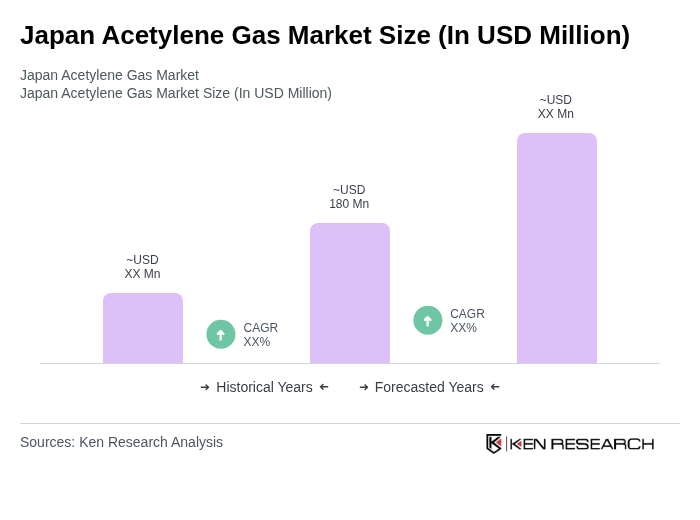
The Japan acetylene gas market, worth USD 180 million, is growing due to industrial applications in welding, chemicals, and automotive sectors, with key hubs in Tokyo, Osaka, and Nagoya.

Region:Asia

Author(s):Shubham

Product Code:KRAD2953

Pages:82

Published On:January 2026
About the Report

Base Year 2024

Japan Acetylene Gas Market Overview

  • The Japan Acetylene Gas Market is valued at USD 180 million, based on a five-year historical analysis and its share within the broader Japan industrial gases market and global acetylene market. This growth is primarily driven by the increasing demand for acetylene in various industrial applications, including welding, metal cutting, and chemical synthesis, particularly in metal fabrication and machinery. The market has seen a steady rise supported by advancements in manufacturing processes, ongoing investments in automotive and machinery production, and sustained construction and infrastructure maintenance activity in key industrial regions.
  • Key players in this market operate mainly out of major industrial hubs such as Tokyo, Osaka, and Nagoya. These cities dominate the market due to their robust industrial infrastructure, high concentration of automotive, metalworking, electronics, and chemical manufacturing facilities, and proximity to key port and logistics networks. The presence of leading gas companies, trading houses, and research institutions in these regions further enhances their role as primary demand and distribution centers for acetylene.
  • Safety and handling of acetylene in Japan are governed by the High Pressure Gas Safety Act, issued by the Ministry of Economy, Trade and Industry (METI), which sets binding requirements for manufacturing, storage, transportation, and sale of high?pressure gases including acetylene. Under this framework, acetylene production and filling facilities must obtain licenses, comply with design and equipment standards, undergo periodic inspections by certified bodies, and implement monitoring and emergency systems to prevent explosions and leaks while ensuring environmental and occupational safety compliance.
Japan Acetylene Gas Market Size

Japan Acetylene Gas Market Segmentation

By Purity:The market is segmented based on the purity of acetylene, which includes Industrial Grade Acetylene, High Purity Acetylene, and Other Grades. Industrial Grade Acetylene is widely used in oxy?acetylene welding, cutting, brazing, and metal fabrication due to its high flame temperature and suitability for manual and repair operations, particularly in construction, shipbuilding, and general engineering. High Purity Acetylene is essential for specialized chemical processes, including synthesis of fine chemicals, intermediates, and certain semiconductor?related applications, where strict impurity control is required. The demand for these grades is influenced by the specific requirements of various industries and by the shift towards higher value?added manufacturing and precision processing in Japan.
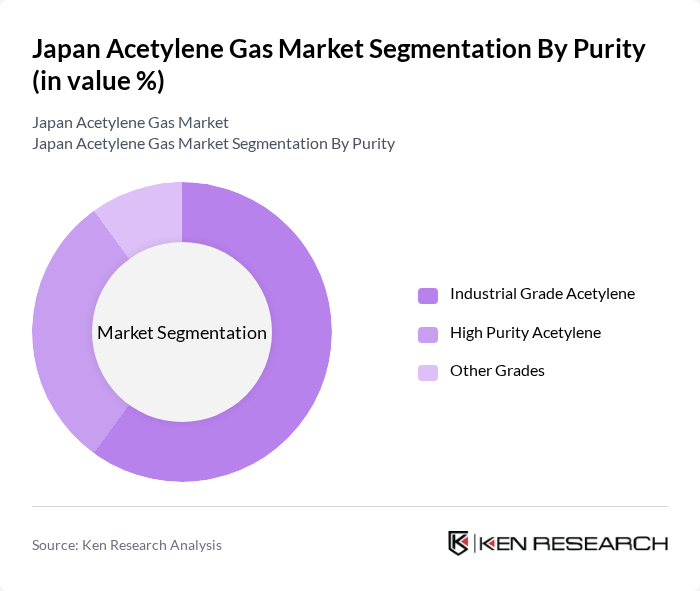
Japan Acetylene Gas Market segmentation by Purity.

By End-Use Industry:The acetylene market is further segmented by end-use industries, including Metal Working (Cutting, Welding, Brazing), Chemicals & Intermediate Manufacturing, Automotive and Transportation, Pharmaceuticals and Specialty Chemicals, Building & Construction, and Other Industrial End-Uses. The Metal Working segment is particularly dominant due to the extensive use of acetylene in welding and cutting processes across fabrication shops, maintenance services, and heavy engineering, where portability and high-temperature flames are critical. Chemicals & Intermediate Manufacturing uses acetylene as a feedstock for producing intermediates and specialty chemicals, while the automotive and transportation sector consumes acetylene through tiered supply chains in body shops, component manufacturing, and maintenance and repair operations. Building & Construction, pharmaceuticals and specialty chemicals, and other industrial end-uses account for smaller but stable demand tied to infrastructure maintenance, equipment servicing, and niche synthesis applications.
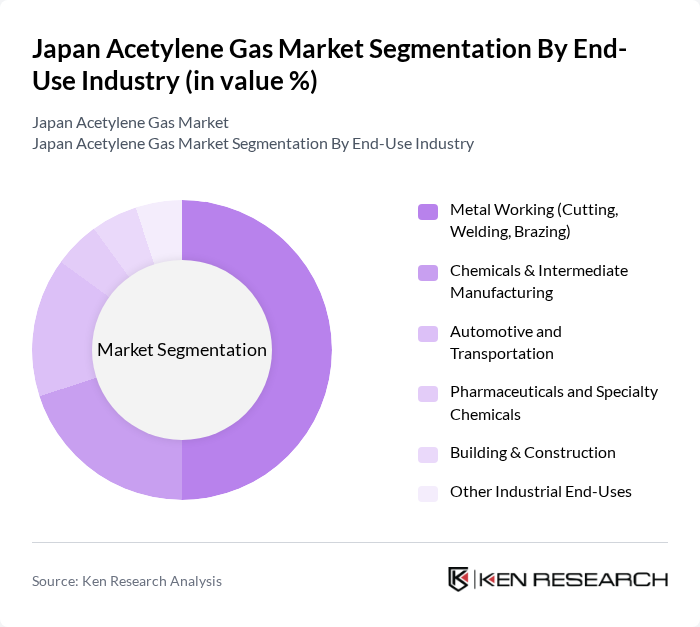
Japan Acetylene Gas Market segmentation by End-Use Industry.

Japan Acetylene Gas Market Competitive Landscape

The Japan Acetylene Gas Market is characterized by a dynamic mix of regional and international players. Leading participants such as Showa Denko K.K. (Resonac Holdings Corporation), Air Liquide Japan Ltd., Nippon Sanso Holdings Corporation (Taiyo Nippon Sanso), Linde Japan K.K., Iwatani Corporation, Nippon Gases Co., Ltd., Sumitomo Seika Chemicals Co., Ltd., Kanto Denka Kogyo Co., Ltd., Kanto Chemical Co., Inc., Mitsubishi Gas Chemical Company, Inc., Asahi Kasei Corporation, JFE Chemical Corporation, Daido Steel Co., Ltd., Matsumoto Yushi-Seiyaku Co., Ltd., and other notable local acetylene producers and distributors contribute to innovation, geographic expansion, and service delivery in this space.

Showa Denko K.K.

1939

Tokyo, Japan

Air Liquide Japan Ltd.

1902

Tokyo, Japan

Nippon Sanso Holdings Corporation

1910

Tokyo, Japan

Linde Japan K.K.

1907

Tokyo, Japan

Iwatani Corporation

1930

Osaka, Japan

Company

Establishment Year

Headquarters

Revenue (Japan Acetylene Business, Latest Year, USD Million)

3-Year CAGR of Acetylene Revenue (%)

Japan Acetylene Market Share (%)

Installed Acetylene Production Capacity (Kilo Tons per Year)

Capacity Utilization Rate (%)

Average Realized Price (USD per Nm³ / Kg)

Japan Acetylene Gas Market Industry Analysis

Growth Drivers

  • Increasing Demand from the Welding Industry:The welding industry in Japan is projected to consume approximately 1.2 million tons of acetylene gas in future, driven by the construction and manufacturing sectors. The country's construction output is expected to reach ¥20 trillion, reflecting a 5% increase from the previous period. This growth is primarily fueled by infrastructure projects and the automotive sector's demand for welding applications, which significantly boosts acetylene consumption.
  • Expansion of Chemical Manufacturing:Japan's chemical manufacturing sector is anticipated to grow by 3% annually, reaching a market value of ¥15 trillion in future. This expansion is largely due to increased production of specialty chemicals and polymers, which utilize acetylene as a key raw material. The rise in chemical production is expected to drive acetylene demand, with an estimated 800,000 tons required for various chemical processes in the coming period.
  • Rising Applications in the Pharmaceutical Sector:The pharmaceutical industry in Japan is projected to grow to ¥10 trillion in future, with acetylene gas playing a crucial role in the synthesis of active pharmaceutical ingredients (APIs). The increasing focus on innovative drug development and biopharmaceuticals is expected to elevate acetylene usage, with an estimated 200,000 tons utilized for pharmaceutical applications, reflecting a growing trend towards advanced healthcare solutions.

Market Challenges

  • Stringent Environmental Regulations:Japan's environmental regulations are becoming increasingly stringent, particularly concerning emissions from acetylene production. The government has set a target to reduce greenhouse gas emissions by 26% by 2030, impacting production processes. Compliance with these regulations may require significant investment in cleaner technologies, which could hinder market growth and increase operational costs for acetylene manufacturers.
  • High Production Costs:The production of acetylene gas involves high operational costs, primarily due to energy-intensive processes and raw material expenses. In future, the average production cost is expected to be around ¥150,000 per ton, influenced by fluctuating energy prices and supply chain disruptions. These high costs can limit profitability and deter new entrants into the acetylene market, posing a significant challenge for existing players.

Japan Acetylene Gas Market Future Outlook

The Japan acetylene gas market is poised for significant transformation, driven by technological advancements and a shift towards sustainable practices. As manufacturers adopt cleaner production methods, the market is likely to see increased efficiency and reduced environmental impact. Additionally, the growing focus on high-purity acetylene for specialized applications will create new avenues for growth. The integration of automation in production processes is expected to enhance productivity, further shaping the market landscape in the coming years.

Market Opportunities

  • Technological Advancements in Production:Innovations in acetylene production technologies, such as more efficient gasification methods, present significant opportunities. These advancements can reduce production costs and environmental impact, potentially increasing market competitiveness and attracting investments in cleaner technologies.
  • Expansion into Emerging Markets:Japan's acetylene producers have the opportunity to expand into emerging markets in Southeast Asia, where industrial growth is accelerating. With a projected increase in demand for acetylene in these regions, Japanese companies can leverage their expertise to capture new market share and drive revenue growth.

Scope of the Report

SegmentSub-Segments
By Purity

Industrial Grade Acetylene

High Purity Acetylene

Other Grades

By End-Use Industry

Metal Working (Cutting, Welding, Brazing)

Chemicals & Intermediate Manufacturing

Automotive and Transportation

Pharmaceuticals and Specialty Chemicals

Building & Construction

Other Industrial End-Uses

By Application

Welding and Metal Fabrication

Chemical Synthesis

Lighting and Lamps

Other Applications

By Sales Channel

Direct Company Sales

Distributors & Traders

Direct Import

By Production Method

Calcium Carbide Production

Thermal Cracking / Hydrocarbon Pyrolysis

Other Production Methods

By Region

Kanto Region

Kansai Region

Chubu Region

Other Regions

Key Target Audience

Investors and Venture Capitalist Firms

Government and Regulatory Bodies (e.g., Ministry of Economy, Trade and Industry)

Manufacturers and Producers

Distributors and Retailers

Industrial Gas Companies

Petrochemical Companies

Environmental Agencies (e.g., Japan Environmental Agency)

Trade Associations (e.g., Japan Industrial Gases Association)

Players Mentioned in the Report:

Showa Denko K.K. (Resonac Holdings Corporation)

Air Liquide Japan Ltd.

Nippon Sanso Holdings Corporation (Taiyo Nippon Sanso)

Linde Japan K.K.

Iwatani Corporation

Nippon Gases Co., Ltd.

Sumitomo Seika Chemicals Co., Ltd.

Kanto Denka Kogyo Co., Ltd.

Kanto Chemical Co., Inc.

Mitsubishi Gas Chemical Company, Inc.

Asahi Kasei Corporation

JFE Chemical Corporation

Daido Steel Co., Ltd.

Matsumoto Yushi-Seiyaku Co., Ltd.

Other Notable Local Acetylene Producers and Distributors

Table of Contents

Market Assessment Phase

1. Executive Summary and Approach


2. Japan Acetylene Gas Market Overview

2.1 Key Insights and Strategic Recommendations

2.2 Japan Acetylene Gas Market Overview

2.3 Definition and Scope

2.4 Evolution of Market Ecosystem

2.5 Timeline of Key Regulatory Milestones

2.6 Value Chain & Stakeholder Mapping

2.7 Business Cycle Analysis

2.8 Policy & Incentive Landscape


3. Japan Acetylene Gas Market Analysis

3.1 Growth Drivers

3.1.1 Increasing demand from the welding industry
3.1.2 Expansion of chemical manufacturing
3.1.3 Rising applications in the pharmaceutical sector
3.1.4 Growth in automotive applications

3.2 Market Challenges

3.2.1 Stringent environmental regulations
3.2.2 High production costs
3.2.3 Safety concerns associated with acetylene gas
3.2.4 Competition from alternative gases

3.3 Market Opportunities

3.3.1 Technological advancements in production
3.3.2 Increasing investments in infrastructure
3.3.3 Expansion into emerging markets
3.3.4 Development of new applications

3.4 Market Trends

3.4.1 Shift towards sustainable production methods
3.4.2 Growing focus on safety and compliance
3.4.3 Increasing automation in production processes
3.4.4 Rising demand for high-purity acetylene

3.5 Government Regulation

3.5.1 Regulations on emissions and safety standards
3.5.2 Licensing requirements for production facilities
3.5.3 Import/export regulations for acetylene
3.5.4 Incentives for cleaner production technologies

4. SWOT Analysis


5. Stakeholder Analysis


6. Porter's Five Forces Analysis


7. Japan Acetylene Gas Market Market Size, 2019-2024

7.1 By Value

7.2 By Volume

7.3 By Average Selling Price


8. Japan Acetylene Gas Market Segmentation

8.1 By Purity

8.1.1 Industrial Grade Acetylene
8.1.2 High Purity Acetylene
8.1.3 Other Grades

8.2 By End-Use Industry

8.2.1 Metal Working (Cutting, Welding, Brazing)
8.2.2 Chemicals & Intermediate Manufacturing
8.2.3 Automotive and Transportation
8.2.4 Pharmaceuticals and Specialty Chemicals
8.2.5 Building & Construction
8.2.6 Other Industrial End-Uses

8.3 By Application

8.3.1 Welding and Metal Fabrication
8.3.2 Chemical Synthesis
8.3.3 Lighting and Lamps
8.3.4 Other Applications

8.4 By Sales Channel

8.4.1 Direct Company Sales
8.4.2 Distributors & Traders
8.4.3 Direct Import

8.5 By Production Method

8.5.1 Calcium Carbide Production
8.5.2 Thermal Cracking / Hydrocarbon Pyrolysis
8.5.3 Other Production Methods

8.6 By Region

8.6.1 Kanto Region
8.6.2 Kansai Region
8.6.3 Chubu Region
8.6.4 Other Regions

9. Japan Acetylene Gas Market Competitive Analysis

9.1 Market Share of Key Players

9.2 Cross Comparison of Key Players

9.2.1 Company Name
9.2.2 Revenue (Japan Acetylene Business, Latest Year, USD Million)
9.2.3 3-Year CAGR of Acetylene Revenue (%)
9.2.4 Japan Acetylene Market Share (%)
9.2.5 Installed Acetylene Production Capacity (Kilo Tons per Year)
9.2.6 Capacity Utilization Rate (%)
9.2.7 Average Realized Price (USD per Nm³ / Kg)
9.2.8 EBITDA Margin from Acetylene Business (%)
9.2.9 R&D Intensity (% of Revenue)
9.2.10 Capital Expenditure on Acetylene (USD Million per Year)
9.2.11 Number of Production Sites and Filling Stations in Japan
9.2.12 Contract Coverage (Share of Revenue from Long-Term Contracts, %)
9.2.13 HSE / Incident Rate (Recordable Incidents per Million Man-hours)
9.2.14 Scope 1 Emissions Intensity for Acetylene Operations (tCO?e per Kilo Ton)

9.3 SWOT Analysis of Top Players

9.4 Pricing Analysis

9.5 Detailed Profile of Major Companies

9.5.1 Showa Denko K.K. (Resonac Holdings Corporation)
9.5.2 Air Liquide Japan Ltd.
9.5.3 Nippon Sanso Holdings Corporation (Taiyo Nippon Sanso)
9.5.4 Linde Japan K.K.
9.5.5 Iwatani Corporation
9.5.6 Nippon Gases Co., Ltd.
9.5.7 Sumitomo Seika Chemicals Co., Ltd.
9.5.8 Kanto Denka Kogyo Co., Ltd.
9.5.9 Kanto Chemical Co., Inc.
9.5.10 Mitsubishi Gas Chemical Company, Inc.
9.5.11 Asahi Kasei Corporation
9.5.12 JFE Chemical Corporation
9.5.13 Daido Steel Co., Ltd.
9.5.14 Matsumoto Yushi-Seiyaku Co., Ltd.
9.5.15 Other Notable Local Acetylene Producers and Distributors

10. Japan Acetylene Gas Market End-User Analysis

10.1 Procurement Behavior of Key Ministries

10.1.1 Government procurement policies
10.1.2 Budget allocation for acetylene
10.1.3 Supplier selection criteria
10.1.4 Contract management practices

10.2 Corporate Spend on Infrastructure & Energy

10.2.1 Investment trends in energy projects
10.2.2 Corporate budgets for acetylene usage
10.2.3 Infrastructure development plans
10.2.4 Energy efficiency initiatives

10.3 Pain Point Analysis by End-User Category

10.3.1 Challenges faced by the welding industry
10.3.2 Issues in chemical manufacturing
10.3.3 Concerns in the pharmaceutical sector
10.3.4 Automotive industry pain points

10.4 User Readiness for Adoption

10.4.1 Awareness of acetylene applications
10.4.2 Training and skill development needs
10.4.3 Infrastructure readiness
10.4.4 Financial readiness for adoption

10.5 Post-Deployment ROI and Use Case Expansion

10.5.1 Measurement of ROI in welding applications
10.5.2 Expansion of use cases in chemical processes
10.5.3 Long-term benefits in automotive applications
10.5.4 Future trends in pharmaceutical use

11. Japan Acetylene Gas Market Future Size, 2025-2030

11.1 By Value

11.2 By Volume

11.3 By Average Selling Price


Go-To-Market Strategy Phase

1. Whitespace Analysis + Business Model Canvas

1.1 Market gaps identification

1.2 Business model development


2. Marketing and Positioning Recommendations

2.1 Branding strategies

2.2 Product USPs


3. Distribution Plan

3.1 Urban retail vs rural NGO tie-ups


4. Channel & Pricing Gaps

4.1 Underserved routes

4.2 Pricing bands


5. Unmet Demand & Latent Needs

5.1 Category gaps

5.2 Consumer segments


6. Customer Relationship

6.1 Loyalty programs

6.2 After-sales service


7. Value Proposition

7.1 Sustainability

7.2 Integrated supply chains


8. Key Activities

8.1 Regulatory compliance

8.2 Branding

8.3 Distribution setup


9. Entry Strategy Evaluation

9.1 Domestic Market Entry Strategy

9.1.1 Product mix
9.1.2 Pricing band
9.1.3 Packaging

9.2 Export Entry Strategy

9.2.1 Target countries
9.2.2 Compliance roadmap

10. Entry Mode Assessment

10.1 JV, Greenfield, M&A, Distributor Model


11. Capital and Timeline Estimation

11.1 Capital requirements

11.2 Timelines


12. Control vs Risk Trade-Off

12.1 Ownership vs Partnerships


13. Profitability Outlook

13.1 Breakeven analysis

13.2 Long-term sustainability


14. Potential Partner List

14.1 Distributors

14.2 JVs

14.3 Acquisition targets


15. Execution Roadmap

15.1 Phased Plan for Market Entry

15.1.1 Market Setup
15.1.2 Market Entry
15.1.3 Growth Acceleration
15.1.4 Scale & Stabilize

15.2 Key Activities and Milestones

15.2.1 Milestone tracking
15.2.2 Activity scheduling

Research Methodology

ApproachModellingSample

Phase 1: Approach1

Desk Research

  • Analysis of industry reports from the Japan Chemical Industry Association
  • Review of government publications on energy and gas regulations
  • Examination of market trends through academic journals and trade publications

Primary Research

  • Interviews with executives from leading acetylene gas producers in Japan
  • Surveys targeting industrial users of acetylene gas across various sectors
  • Field visits to manufacturing plants utilizing acetylene gas for production

Validation & Triangulation

  • Cross-verification of data from multiple industry sources and reports
  • Triangulation of findings from primary interviews with secondary data insights
  • Expert panel reviews to ensure data accuracy and relevance

Phase 2: Market Size Estimation1

Top-down Assessment

  • Estimation of total market size based on national gas consumption statistics
  • Segmentation of market by end-user industries such as welding, chemicals, and pharmaceuticals
  • Incorporation of government initiatives promoting acetylene gas applications

Bottom-up Modeling

  • Volume estimates derived from production capacities of major acetylene gas manufacturers
  • Cost analysis based on pricing models from key suppliers in the market
  • Calculation of market size using production volume multiplied by average selling price

Forecasting & Scenario Analysis

  • Utilization of historical growth rates to project future market trends
  • Scenario modeling based on potential regulatory changes affecting gas usage
  • Development of optimistic, pessimistic, and realistic forecasts through 2030

Phase 3: CATI Sample Composition1

Scope Item/SegmentSample SizeTarget Respondent Profiles
Industrial Gas Users120Production Managers, Operations Directors
Welding and Fabrication Sector90Welding Supervisors, Safety Officers
Chemical Manufacturing70Process Engineers, R&D Managers
Pharmaceutical Applications60Quality Control Managers, Production Supervisors
Research Institutions50Research Scientists, Lab Managers

Frequently Asked Questions

What is the current value of the Japan Acetylene Gas Market?

The Japan Acetylene Gas Market is valued at approximately USD 180 million, reflecting its significance within the broader industrial gases market and the global acetylene market, driven by increasing demand in various industrial applications.

What are the primary applications of acetylene gas in Japan?

Which regions in Japan dominate the acetylene gas market?

What regulations govern the safety of acetylene gas in Japan?

Why Buy From Us?

Refine Robust Result (RRR) Framework

What makes us stand out is that our consultants follow Robust, Refine and Result (RRR) methodology. Robust for clear definitions, approaches and sanity checking, Refine for differentiating respondents' facts and opinions, and Result for presenting data with story.

Our Reach Is Unmatched

We have set a benchmark in the industry by offering our clients with syndicated and customized market research reports featuring coverage of entire market as well as meticulous research and analyst insights.

Shifting the Research Paradigm

While we don't replace traditional research, we flip the method upside down. Our dual approach of Top Bottom & Bottom Top ensures quality deliverable by not just verifying company fundamentals but also looking at the sector and macroeconomic factors.

More Insights-Better Decisions

With one step in the future, our research team constantly tries to show you the bigger picture. We help with some of the tough questions you may encounter along the way: How is the industry positioned? Best marketing channel? KPI's of competitors? By aligning every element, we help maximize success.

Transparency and Trust

Our report gives you instant access to the answers and sources that other companies might choose to hide. We elaborate each steps of research methodology we have used and showcase you the sample size to earn your trust.

Round the Clock Support

If you need any support, we are here! We pride ourselves on universe strength, data quality, and quick, friendly, and professional service.

Why Clients Choose Us?

400000+
Reports in repository
150+
Consulting projects a year
100+
Analysts
8000+
Client Queries in 2022








