Region:Asia
Author(s):Shubham
Product Code:KRAB5585
Pages:86
Published On:October 2025

By Type:The market is segmented into various types, including Dietary Supplements, Functional Beverages, Fortified Foods, Sports Nutrition Products, Weight Management Products, Probiotics and Prebiotics, and Others. Among these, Dietary Supplements are leading the market due to their convenience and the growing trend of self-medication among consumers. Functional Beverages are also gaining traction, driven by the demand for on-the-go health solutions.

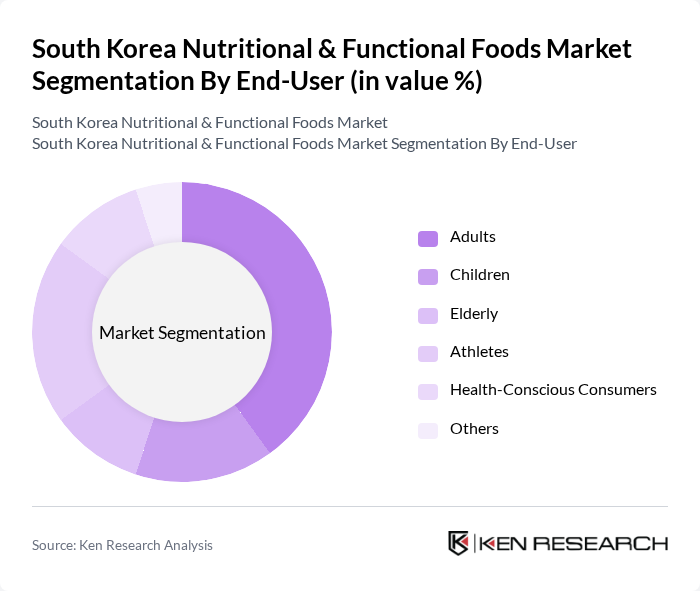
By End-User:The end-user segmentation includes Adults, Children, Elderly, Athletes, Health-Conscious Consumers, and Others. Adults represent the largest segment, driven by increasing health awareness and the need for nutritional support in busy lifestyles. Athletes also form a significant portion of the market, seeking specialized nutrition products to enhance performance and recovery.
The South Korea Nutritional & Functional Foods Market is characterized by a dynamic mix of regional and international players. Leading participants such as Amway Korea Co., Ltd., Herbalife Korea, Inc., LG Household & Health Care Ltd., CJ CheilJedang Corporation, Daesang Corporation, Dong Suh Companies, Inc., NutraBlast, Inc., Yuhan Corporation, Korea Yakult Co., Ltd., Samyang Foods Co., Ltd., Dongwon Industries Co., Ltd., HiteJinro Co., Ltd., Amorepacific Corporation, Green Cross Corporation, Aekyung Industrial Co., Ltd. contribute to innovation, geographic expansion, and service delivery in this space.
The South Korean nutritional and functional foods market is poised for continued evolution, driven by consumer preferences for health and wellness. Innovations in product formulation, particularly in plant-based and personalized nutrition, are expected to gain traction. Additionally, the integration of technology in product development, such as AI-driven health assessments, will enhance consumer engagement. Sustainability practices in sourcing and packaging will also become increasingly important, aligning with global trends towards environmental responsibility.
| Segment | Sub-Segments |
|---|---|
| By Type | Dietary Supplements Functional Beverages Fortified Foods Sports Nutrition Products Weight Management Products Probiotics and Prebiotics Others |
| By End-User | Adults Children Elderly Athletes Health-Conscious Consumers Others |
| By Distribution Channel | Supermarkets/Hypermarkets Online Retail Health Food Stores Pharmacies Direct Sales Others |
| By Ingredient Source | Natural Ingredients Synthetic Ingredients Organic Ingredients Non-GMO Ingredients Others |
| By Price Range | Economy Mid-Range Premium Luxury Others |
| By Packaging Type | Bottles Pouches Tubs Sachets Others |
| By Brand Type | National Brands Private Labels International Brands Others |
| Scope Item/Segment | Sample Size | Target Respondent Profiles |
|---|---|---|
| Consumer Preferences in Nutritional Supplements | 150 | Health-conscious Consumers, Fitness Enthusiasts |
| Retail Insights on Functional Foods | 100 | Store Managers, Product Buyers |
| Healthcare Professionals' Perspectives | 80 | Nutritionists, Dietitians, General Practitioners |
| Market Trends in Herbal Supplements | 70 | Herbal Product Manufacturers, Retailers |
| Consumer Attitudes Towards Probiotics | 90 | Parents, Elderly Consumers, Health Advocates |
The South Korea Nutritional & Functional Foods Market is valued at approximately USD 5 billion, reflecting a significant growth trend driven by increasing health awareness and a preference for preventive healthcare solutions among consumers.

What makes us stand out is that our consultants follow Robust, Refine and Result (RRR) methodology. Robust for clear definitions, approaches and sanity checking, Refine for differentiating respondents' facts and opinions, and Result for presenting data with story.

We have set a benchmark in the industry by offering our clients with syndicated and customized market research reports featuring coverage of entire market as well as meticulous research and analyst insights.

While we don't replace traditional research, we flip the method upside down. Our dual approach of Top Bottom & Bottom Top ensures quality deliverable by not just verifying company fundamentals but also looking at the sector and macroeconomic factors.

With one step in the future, our research team constantly tries to show you the bigger picture. We help with some of the tough questions you may encounter along the way: How is the industry positioned? Best marketing channel? KPI's of competitors? By aligning every element, we help maximize success.

Our report gives you instant access to the answers and sources that other companies might choose to hide. We elaborate each steps of research methodology we have used and showcase you the sample size to earn your trust.

If you need any support, we are here! We pride ourselves on universe strength, data quality, and quick, friendly, and professional service.













