About the Report
Base Year 2024Japan Cleanrooms Market Overview
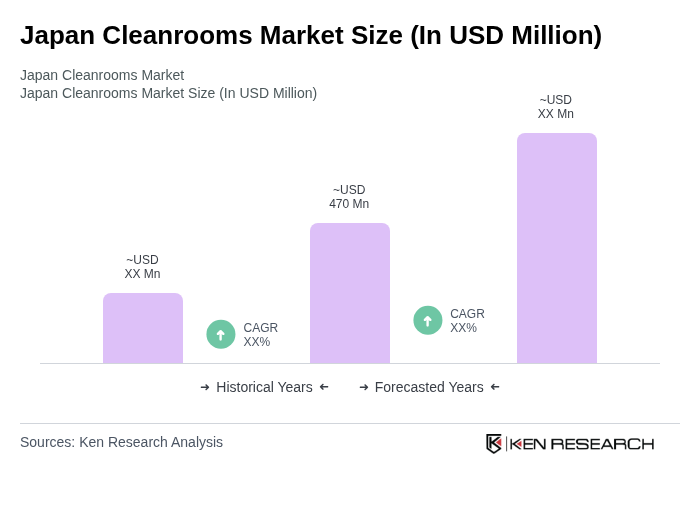
- The Japan Cleanrooms Market is valued at USD 470 million, based on a five-year historical analysis of cleanroom technology revenues in the country. This growth is primarily driven by the increasing demand for high-quality manufacturing processes in industries such as pharmaceuticals, biotechnology, and electronics, where contamination control is critical. The market is also supported by advancements in cleanroom technology, including modular cleanroom systems, high-efficiency filtration, and digital environmental monitoring, as well as stringent regulatory requirements for GMP-compliant production environments in Japan.
- Tokyo and Osaka are the dominant cities in the Japan Cleanrooms Market due to their status as major industrial and technological hubs. Tokyo, being the capital, hosts numerous pharmaceutical, biotechnology, and advanced electronics companies, including major semiconductor and medical device manufacturers that rely heavily on controlled environments. Osaka is known for its strong manufacturing base and concentration of chemical, machinery, and electronics production facilities, many of which use cleanrooms for precision manufacturing and contamination-sensitive processes. The concentration of research and development facilities and high-tech industrial clusters in these cities further enhances their market dominance, as they require advanced cleanroom solutions to maintain product integrity and meet global quality standards.
- Cleanroom environments in Japan are governed by a combination of international and domestic standards, including the JIS B 9920:2019 “Classification of air cleanliness by particle concentration” issued by the Japanese Industrial Standards Committee, which aligns with ISO 14644-1 and specifies particle-based cleanliness classes and test methods for cleanrooms and associated controlled environments. For pharmaceutical applications, facilities must comply with the Ministerial Ordinance on Standards for Manufacturing Control and Quality Control for Drugs and Quasi-drugs (GMP Ordinance) issued by the Ministry of Health, Labour and Welfare, which requires validated cleanroom design, monitoring of environmental parameters, and documented contamination control procedures in production areas. These binding instruments collectively aim to enhance product safety and quality across industries such as pharmaceuticals, biotechnology, and electronics by ensuring that cleanroom environments meet stringent contamination control and operational standards consistent with international best practices.
Japan Cleanrooms Market Segmentation
By Product Type:The product type segmentation includes various categories essential for cleanroom operations. The subsegments are Cleanroom Equipment (HVAC, Fan Filter Units, Laminar Airflow Systems, Biosafety Cabinets), Cleanroom Consumables (Apparel, Gloves, Wipes, Disinfectants), Cleanroom Construction & Enclosures (Hardwall, Softwall, Modular Cleanrooms, Pass-through Cabinets), Cleanroom Filters (HEPA, ULPA and Other High-Efficiency Filters), and Other Ancillary Systems (Monitoring, Controls, Air Showers, Diffusers).
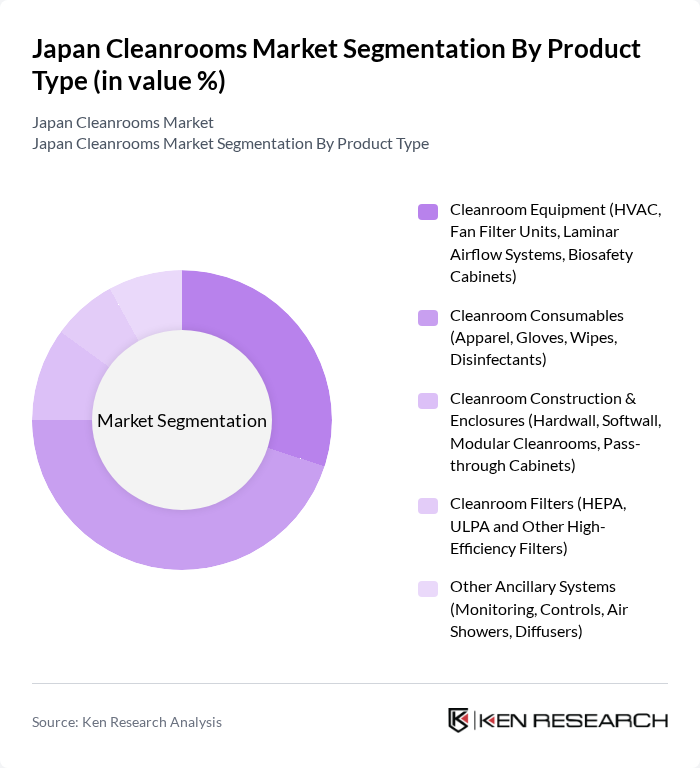
The Cleanroom Equipment segment is currently experiencing strong growth due to the increasing need for advanced HVAC systems, fan filter units, laminar airflow systems, and integrated control solutions that ensure optimal cleanroom conditions. The rise in pharmaceutical, biotechnology, and semiconductor manufacturing in Japan has led to higher demand for sophisticated cleanroom equipment that supports tighter environmental tolerances, continuous monitoring, and energy-efficient operation. Additionally, the trend towards automation, Internet of Things-based sensor networks, and smart cleanroom solutions with real-time analytics and predictive maintenance is further propelling the growth of this segment.
By End-User Industry:The end-user industry segmentation encompasses key sectors utilizing cleanroom environments. The subsegments include Pharmaceutical Manufacturing, Biotechnology & Life Sciences, Semiconductor & Electronics, Medical Devices & Healthcare Facilities, and Food & Beverage and Other Industrial Applications.
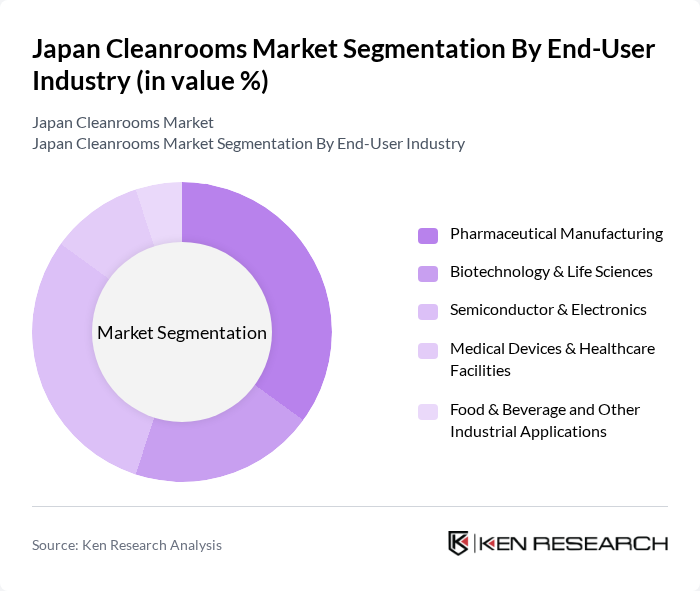
The Pharmaceutical Manufacturing sector is a leading end-user industry in the cleanrooms market in Japan, driven by stringent GMP requirements, periodic inspections, and the need for contamination-free environments in sterile and aseptic production. The increasing focus on drug safety, efficacy, and quality-by-design has led to a surge in demand for cleanroom facilities that comply with international and national regulatory standards, including controlled environments for sterile injectables, biopharmaceuticals, and cell and gene therapies. At the same time, the Semiconductor & Electronics segment also accounts for a significant share of cleanroom usage in Japan, reflecting the country’s strong position in advanced chip, display, and precision electronics manufacturing where ultra-clean environments are essential for yield and reliability.
Japan Cleanrooms Market Competitive Landscape
The Japan Cleanrooms Market is characterized by a dynamic mix of regional and international players. Leading participants such as Taikisha Ltd., Takasago Thermal Engineering Co., Ltd., Azbil Corporation, Nihon Sekkei, Inc. (Cleanroom & Facility Design), Daikin Industries, Ltd., AIRTECH Japan, Ltd., Nitta Corporation (Cleanroom Products), Nitto Denko Corporation, SMC Corporation, Kyowa Exeo Corporation (Engineering & Cleanroom Solutions), Ebara Corporation (Cleanroom-related Vacuum & Environmental Systems), Hitachi, Ltd. (Industrial & Cleanroom Solutions), Shimano Manufacturing Co., Ltd. (Cleanroom Components & Systems), International Players Active in Japan – Camfil AB, International Players Active in Japan – AAF International / AAF Flanders contribute to innovation, geographic expansion, and service delivery in this space.
Japan Cleanrooms Market Industry Analysis
Growth Drivers
- Increasing Demand from the Pharmaceutical Industry:The pharmaceutical sector in Japan is projected to reach ¥10 trillion by 2025, driven by an aging population and rising healthcare needs. This surge necessitates stringent cleanroom environments to ensure product safety and efficacy. The demand for sterile manufacturing processes is further amplified by Japan's commitment to high-quality standards, leading to increased investments in cleanroom technologies and infrastructure to meet regulatory requirements and consumer expectations.
- Rising Focus on Quality Control in Manufacturing:Japan's manufacturing sector, valued at approximately ¥200 trillion, emphasizes quality control to maintain its global competitiveness. Cleanrooms play a crucial role in this context, as they help minimize contamination risks and enhance product integrity. With the implementation of advanced quality management systems, companies are increasingly adopting cleanroom solutions to comply with international standards, thereby driving market growth and ensuring operational excellence across various industries.
- Technological Advancements in Cleanroom Design:The cleanroom technology market in Japan is witnessing innovations, with investments in advanced filtration systems and energy-efficient designs. In future, the market for cleanroom technology is expected to grow by ¥50 billion, driven by the integration of automation and smart technologies. These advancements not only improve operational efficiency but also reduce energy consumption, aligning with Japan's sustainability goals and enhancing the overall appeal of cleanroom solutions in various sectors.
Market Challenges
- High Initial Setup Costs:Establishing a cleanroom facility in Japan can require an investment of ¥100 million to ¥500 million, depending on the size and specifications. These high initial costs pose a significant barrier for small and medium-sized enterprises (SMEs) looking to enter the market. The financial burden can deter potential investments, limiting the growth of cleanroom infrastructure and technology adoption, particularly in less capital-intensive industries.
- Stringent Regulatory Requirements:Japan's cleanroom industry is subject to rigorous regulations, including compliance with ISO 14644 standards. Meeting these standards often requires extensive documentation and validation processes, which can be time-consuming and costly. Companies may face delays in project timelines and increased operational costs, hindering their ability to adapt quickly to market demands and technological advancements, ultimately impacting their competitiveness in the global market.
Japan Cleanrooms Market Future Outlook
The Japan cleanrooms market is poised for significant evolution, driven by technological advancements and increasing regulatory pressures. As industries prioritize contamination control and quality assurance, the integration of IoT and automation in cleanroom environments will become more prevalent. Additionally, the focus on energy efficiency and sustainability will shape future cleanroom designs, encouraging manufacturers to adopt innovative solutions that align with environmental goals while maintaining high operational standards.
Market Opportunities
- Expansion in Biotechnology and Life Sciences:The biotechnology sector in Japan is expected to grow to ¥3 trillion in future, creating substantial demand for cleanroom facilities. This growth presents opportunities for cleanroom providers to develop specialized environments tailored to the unique needs of biopharmaceutical manufacturing, enhancing product safety and compliance with stringent regulations.
- Adoption of Modular Cleanroom Solutions:Modular cleanrooms are gaining traction due to their flexibility and cost-effectiveness. With an estimated market value of ¥20 billion in future, these solutions allow companies to scale operations quickly and efficiently. This trend is particularly beneficial for SMEs, enabling them to enter the cleanroom market with lower initial investments while maintaining compliance with industry standards.
Scope of the Report
| Segment | Sub-Segments |
|---|---|
| By Product Type | Cleanroom Equipment (HVAC, Fan Filter Units, Laminar Airflow Systems, Biosafety Cabinets) Cleanroom Consumables (Apparel, Gloves, Wipes, Disinfectants) Cleanroom Construction & Enclosures (Hardwall, Softwall, Modular Cleanrooms, Pass-through Cabinets) Cleanroom Filters (HEPA, ULPA and Other High-Efficiency Filters) Other Ancillary Systems (Monitoring, Controls, Air Showers, Diffusers) |
| By End-User Industry | Pharmaceutical Manufacturing Biotechnology & Life Sciences Semiconductor & Electronics Medical Devices & Healthcare Facilities Food & Beverage and Other Industrial Applications |
| By Application | Manufacturing & Assembly Areas Research & Development Laboratories Quality Control & Testing Laboratories Packaging, Filling & Compounding Areas Other Critical Controlled Environments |
| By Cleanliness Class (ISO Standard) | ISO Class 1–3 ISO Class 4–5 ISO Class 6–7 ISO Class 8 and Above |
| By Region (Japan) | Kanto Kinki (Kansai) Chubu Kyushu & Okinawa Tohoku Rest of Japan |
| By Technology | Air Filtration & Ventilation Systems Airflow & Pressure Control Systems Real-time Monitoring & Control Systems Modular & Prefabricated Cleanroom Solutions Other Supporting Technologies |
| By Service Type | Design & Engineering Services Installation & Commissioning Services Validation, Certification & Compliance Services Operation & Maintenance Services Retrofit & Upgrade Services |
Key Target Audience
Investors and Venture Capitalist Firms
Government and Regulatory Bodies (e.g., Ministry of Health, Labour and Welfare; Japan Environmental Protection Agency)
Manufacturers and Producers
Distributors and Retailers
Pharmaceutical Companies
Biotechnology Firms
Semiconductor Manufacturers
Healthcare Facilities and Hospitals
Players Mentioned in the Report:
Taikisha Ltd.
Takasago Thermal Engineering Co., Ltd.
Azbil Corporation
Nihon Sekkei, Inc. (Cleanroom & Facility Design)
Daikin Industries, Ltd.
AIRTECH Japan, Ltd.
Nitta Corporation (Cleanroom Products)
Nitto Denko Corporation
SMC Corporation
Kyowa Exeo Corporation (Engineering & Cleanroom Solutions)
Ebara Corporation (Cleanroom-related Vacuum & Environmental Systems)
Hitachi, Ltd. (Industrial & Cleanroom Solutions)
Shimano Manufacturing Co., Ltd. (Cleanroom Components & Systems)
International Players Active in Japan Camfil AB
International Players Active in Japan AAF International / AAF Flanders
Table of Contents
Market Assessment Phase
1. Executive Summary and Approach
2. Japan Cleanrooms Market Overview
2.1 Key Insights and Strategic Recommendations
2.2 Japan Cleanrooms Market Overview
2.3 Definition and Scope
2.4 Evolution of Market Ecosystem
2.5 Timeline of Key Regulatory Milestones
2.6 Value Chain & Stakeholder Mapping
2.7 Business Cycle Analysis
2.8 Policy & Incentive Landscape
3. Japan Cleanrooms Market Analysis
3.1 Growth Drivers
3.1.1 Increasing demand from the pharmaceutical industry
3.1.2 Rising focus on quality control in manufacturing
3.1.3 Technological advancements in cleanroom design
3.1.4 Growing awareness of contamination control
3.2 Market Challenges
3.2.1 High initial setup costs
3.2.2 Stringent regulatory requirements
3.2.3 Limited availability of skilled workforce
3.2.4 Maintenance and operational complexities
3.3 Market Opportunities
3.3.1 Expansion in biotechnology and life sciences
3.3.2 Adoption of modular cleanroom solutions
3.3.3 Increasing investments in R&D
3.3.4 Growth in the semiconductor manufacturing sector
3.4 Market Trends
3.4.1 Shift towards energy-efficient cleanroom technologies
3.4.2 Integration of IoT in cleanroom monitoring
3.4.3 Customization of cleanroom solutions
3.4.4 Focus on sustainability and eco-friendly materials
3.5 Government Regulation
3.5.1 Compliance with ISO standards
3.5.2 Regulations on air quality and contamination control
3.5.3 Guidelines for cleanroom construction and operation
3.5.4 Safety regulations for cleanroom personnel
4. SWOT Analysis
5. Stakeholder Analysis
6. Porter's Five Forces Analysis
7. Japan Cleanrooms Market Market Size, 2019-2024
7.1 By Value
7.2 By Volume
7.3 By Average Selling Price
8. Japan Cleanrooms Market Segmentation
8.1 By Product Type
8.1.1 Cleanroom Equipment (HVAC, Fan Filter Units, Laminar Airflow Systems, Biosafety Cabinets)
8.1.2 Cleanroom Consumables (Apparel, Gloves, Wipes, Disinfectants)
8.1.3 Cleanroom Construction & Enclosures (Hardwall, Softwall, Modular Cleanrooms, Pass-through Cabinets)
8.1.4 Cleanroom Filters (HEPA, ULPA and Other High-Efficiency Filters)
8.1.5 Other Ancillary Systems (Monitoring, Controls, Air Showers, Diffusers)
8.2 By End-User Industry
8.2.1 Pharmaceutical Manufacturing
8.2.2 Biotechnology & Life Sciences
8.2.3 Semiconductor & Electronics
8.2.4 Medical Devices & Healthcare Facilities
8.2.5 Food & Beverage and Other Industrial Applications
8.3 By Application
8.3.1 Manufacturing & Assembly Areas
8.3.2 Research & Development Laboratories
8.3.3 Quality Control & Testing Laboratories
8.3.4 Packaging, Filling & Compounding Areas
8.3.5 Other Critical Controlled Environments
8.4 By Cleanliness Class (ISO Standard)
8.4.1 ISO Class 1–3
8.4.2 ISO Class 4–5
8.4.3 ISO Class 6–7
8.4.4 ISO Class 8 and Above
8.5 By Region (Japan)
8.5.1 Kanto
8.5.2 Kinki (Kansai)
8.5.3 Chubu
8.5.4 Kyushu & Okinawa
8.5.5 Tohoku
8.5.6 Rest of Japan
8.6 By Technology
8.6.1 Air Filtration & Ventilation Systems
8.6.2 Airflow & Pressure Control Systems
8.6.3 Real-time Monitoring & Control Systems
8.6.4 Modular & Prefabricated Cleanroom Solutions
8.6.5 Other Supporting Technologies
8.7 By Service Type
8.7.1 Design & Engineering Services
8.7.2 Installation & Commissioning Services
8.7.3 Validation, Certification & Compliance Services
8.7.4 Operation & Maintenance Services
8.7.5 Retrofit & Upgrade Services
9. Japan Cleanrooms Market Competitive Analysis
9.1 Market Share of Key Players
9.2 Cross Comparison of Key Players
9.2.1 Company Name
9.2.2 Group Size (Large, Medium, or Small as per industry convention)
9.2.3 Japan Cleanroom Revenue (USD Million)
9.2.4 3-year Revenue CAGR in Japan (%)
9.2.5 Japan Market Share (%)
9.2.6 R&D Intensity (% of Revenue)
9.2.7 Capex-to-Sales Ratio (%)
9.2.8 EBITDA Margin (%)
9.2.9 Return on Invested Capital (ROIC, %)
9.2.10 Order Backlog / Book-to-Bill Ratio
9.2.11 Average Contract Size (USD, Japan)
9.2.12 Customer Retention Rate (%)
9.2.13 Cleanroom Installed Base in Japan (Number of Facilities / sqm)
9.2.14 New Project Wins in Last 12–24 Months (Japan)
9.3 SWOT Analysis of Top Players
9.4 Pricing Analysis
9.5 Detailed Profile of Major Companies
9.5.1 Taikisha Ltd.
9.5.2 Takasago Thermal Engineering Co., Ltd.
9.5.3 Azbil Corporation
9.5.4 Nihon Sekkei, Inc. (Cleanroom & Facility Design)
9.5.5 Daikin Industries, Ltd.
9.5.6 AIRTECH Japan, Ltd.
9.5.7 Nitta Corporation (Cleanroom Products)
9.5.8 Nitto Denko Corporation
9.5.9 SMC Corporation
9.5.10 Kyowa Exeo Corporation (Engineering & Cleanroom Solutions)
9.5.11 Ebara Corporation (Cleanroom-related Vacuum & Environmental Systems)
9.5.12 Hitachi, Ltd. (Industrial & Cleanroom Solutions)
9.5.13 Shimano Manufacturing Co., Ltd. (Cleanroom Components & Systems)
9.5.14 International Players Active in Japan – Camfil AB
9.5.15 International Players Active in Japan – AAF International / AAF Flanders
10. Japan Cleanrooms Market End-User Analysis
10.1 Procurement Behavior of Key Ministries
10.1.1 Budget Allocation Trends
10.1.2 Procurement Processes
10.1.3 Key Decision-Makers
10.1.4 Contracting Strategies
10.2 Corporate Spend on Infrastructure & Energy
10.2.1 Investment Trends
10.2.2 Budget Prioritization
10.2.3 Long-term Contracts
10.2.4 Cost Management Strategies
10.3 Pain Point Analysis by End-User Category
10.3.1 Compliance Challenges
10.3.2 Operational Inefficiencies
10.3.3 Technology Integration Issues
10.3.4 Cost Constraints
10.4 User Readiness for Adoption
10.4.1 Training Needs
10.4.2 Technology Familiarity
10.4.3 Change Management
10.4.4 Support Requirements
10.5 Post-Deployment ROI and Use Case Expansion
10.5.1 Performance Metrics
10.5.2 Use Case Diversification
10.5.3 Feedback Mechanisms
10.5.4 Long-term Value Assessment
11. Japan Cleanrooms Market Future Size, 2025-2030
11.1 By Value
11.2 By Volume
11.3 By Average Selling Price
Go-To-Market Strategy Phase
1. Whitespace Analysis + Business Model Canvas
1.1 Market Gaps Identification
1.2 Business Model Development
2. Marketing and Positioning Recommendations
2.1 Branding Strategies
2.2 Product USPs
3. Distribution Plan
3.1 Urban Retail Strategies
3.2 Rural NGO Tie-ups
4. Channel & Pricing Gaps
4.1 Underserved Routes
4.2 Pricing Bands
5. Unmet Demand & Latent Needs
5.1 Category Gaps
5.2 Consumer Segments
6. Customer Relationship
6.1 Loyalty Programs
6.2 After-sales Service
7. Value Proposition
7.1 Sustainability Initiatives
7.2 Integrated Supply Chains
8. Key Activities
8.1 Regulatory Compliance
8.2 Branding Efforts
8.3 Distribution Setup
9. Entry Strategy Evaluation
9.1 Domestic Market Entry Strategy
9.1.1 Product Mix Considerations
9.1.2 Pricing Band Analysis
9.1.3 Packaging Strategies
9.2 Export Entry Strategy
9.2.1 Target Countries
9.2.2 Compliance Roadmap
10. Entry Mode Assessment
10.1 Joint Ventures
10.2 Greenfield Investments
10.3 Mergers & Acquisitions
10.4 Distributor Model
11. Capital and Timeline Estimation
11.1 Capital Requirements
11.2 Timelines for Implementation
12. Control vs Risk Trade-Off
12.1 Ownership Considerations
12.2 Partnerships Evaluation
13. Profitability Outlook
13.1 Breakeven Analysis
13.2 Long-term Sustainability
14. Potential Partner List
14.1 Distributors
14.2 Joint Ventures
14.3 Acquisition Targets
15. Execution Roadmap
15.1 Phased Plan for Market Entry
15.1.1 Market Setup
15.1.2 Market Entry
15.1.3 Growth Acceleration
15.1.4 Scale & Stabilize
15.2 Key Activities and Milestones
15.2.1 Milestone Planning
15.2.2 Activity Tracking
Research Methodology
Phase 1: Approach1
Desk Research
- Analysis of industry reports from Japanese cleanroom associations and regulatory bodies
- Review of market trends and forecasts from government publications and trade journals
- Examination of academic papers and case studies related to cleanroom technologies and applications
Primary Research
- Interviews with facility managers and engineers in semiconductor and pharmaceutical sectors
- Surveys targeting cleanroom equipment manufacturers and suppliers
- Field visits to cleanroom installations for observational insights and expert discussions
Validation & Triangulation
- Cross-validation of findings through multiple data sources including industry reports and expert opinions
- Triangulation of quantitative data with qualitative insights from industry experts
- Sanity checks through feedback from a panel of cleanroom technology specialists
Phase 2: Market Size Estimation1
Top-down Assessment
- Estimation of market size based on national cleanroom standards and regulations
- Segmentation of the market by end-user industries such as pharmaceuticals, electronics, and biotechnology
- Incorporation of growth rates from historical data and projected industry expansions
Bottom-up Modeling
- Collection of sales data from leading cleanroom equipment manufacturers in Japan
- Estimation of market share based on unit sales and pricing strategies of key players
- Volume and cost analysis of cleanroom consumables and maintenance services
Forecasting & Scenario Analysis
- Multi-variable forecasting using factors such as technological advancements and regulatory changes
- Scenario analysis based on potential market disruptions and economic conditions
- Development of baseline, optimistic, and pessimistic market growth projections through 2030
Phase 3: CATI Sample Composition1
| Scope Item/Segment | Sample Size | Target Respondent Profiles |
|---|---|---|
| Pharmaceutical Cleanroom Operations | 80 | Quality Control Managers, Production Supervisors |
| Semiconductor Manufacturing Facilities | 70 | Process Engineers, Facility Managers |
| Biotechnology Research Labs | 60 | Lab Managers, Research Scientists |
| Cleanroom Equipment Suppliers | 50 | Sales Directors, Product Managers |
| Cleanroom Maintenance Services | 40 | Service Managers, Technical Support Staff |
Frequently Asked Questions
What is the current value of the Japan Cleanrooms Market?
The Japan Cleanrooms Market is valued at approximately USD 470 million, driven by the increasing demand for high-quality manufacturing processes in sectors such as pharmaceuticals, biotechnology, and electronics, where contamination control is essential.
Which cities dominate the Japan Cleanrooms Market?
What are the key regulatory standards for cleanrooms in Japan?
What are the main product types in the Japan Cleanrooms Market?
Other Regional/Country Reports
Other Adjacent Reports
Germany Semiconductor Manufacturing Market
Bahrain Electronics Manufacturing Market
Thailand Medical Device Manufacturing Market
Kuwait Food and Beverage Processing Market
U.S. HVAC Systems Market Size, Share & Forecast, By Equipment Type, End-Use Industry & Technology, 2026-2031Philippines Air Filtration Market
Indonesia Environmental Monitoring Market Size, Share & Forecast, By Monitoring Type, Component & End-Use Industry, 2025-2032Kuwait sterilization equipment market size, share, growth drivers, trends, opportunities & forecast 2025–2030Why Buy From Us?

What makes us stand out is that our consultants follow Robust, Refine and Result (RRR) methodology. Robust for clear definitions, approaches and sanity checking, Refine for differentiating respondents' facts and opinions, and Result for presenting data with story.

We have set a benchmark in the industry by offering our clients with syndicated and customized market research reports featuring coverage of entire market as well as meticulous research and analyst insights.

While we don't replace traditional research, we flip the method upside down. Our dual approach of Top Bottom & Bottom Top ensures quality deliverable by not just verifying company fundamentals but also looking at the sector and macroeconomic factors.

With one step in the future, our research team constantly tries to show you the bigger picture. We help with some of the tough questions you may encounter along the way: How is the industry positioned? Best marketing channel? KPI's of competitors? By aligning every element, we help maximize success.

Our report gives you instant access to the answers and sources that other companies might choose to hide. We elaborate each steps of research methodology we have used and showcase you the sample size to earn your trust.

If you need any support, we are here! We pride ourselves on universe strength, data quality, and quick, friendly, and professional service.