About the Report
Base Year 2024Australia Cleanrooms Market Overview
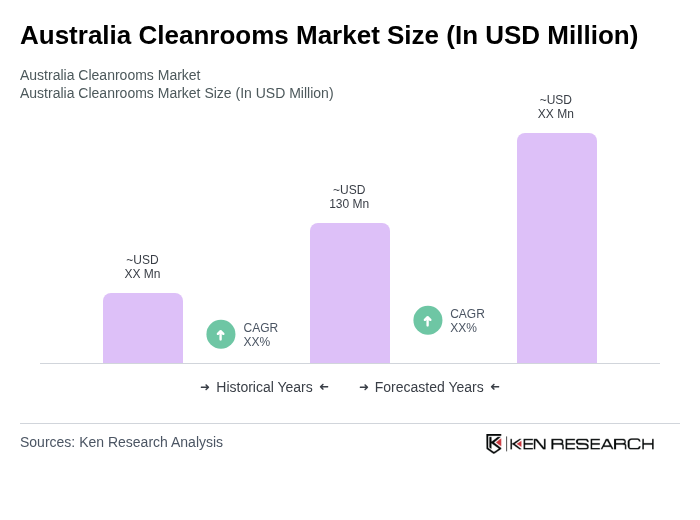
- The Australia Cleanrooms Market is valued at USD 130 million, based on a five-year historical analysis of national cleanroom technology revenues. This growth is primarily driven by the increasing demand for sterile environments in industries such as pharmaceuticals, biotechnology, healthcare, and electronics, where contamination control is critical. The rise in healthcare spending, expansion of biologics and cell and gene therapy manufacturing, and advancements in modular cleanroom designs, automation, and real-time environmental monitoring have further fueled market expansion.
- Key players in this market include New South Wales and Victoria, which account for a substantial portion of Australia’s cleanroom technology demand due to their robust pharmaceutical, biotechnology, medical research, and advanced manufacturing clusters. The presence of leading research institutions, large hospital networks, and a growing number of biopharmaceutical and semiconductor facilities in these regions contributes significantly to the market's growth, making them pivotal hubs for cleanroom operations.
- Cleanroom design, qualification, and operation in Australia are guided by binding statutory and standard frameworks, including the current PIC/S Guide to Good Manufacturing Practice for Medicinal Products adopted by the Therapeutic Goods Administration (TGA) under the Therapeutic Goods Act 1989, and the AS/NZS ISO 14644 series on cleanrooms and associated controlled environments issued by Standards Australia and Standards New Zealand. These instruments mandate classified cleanroom environments, environmental monitoring, air cleanliness by particle concentration, and documented validation for facilities involved in the manufacture of medicines and medical devices, thereby driving investments in compliant cleanroom infrastructure and upgraded air-handling and filtration systems.
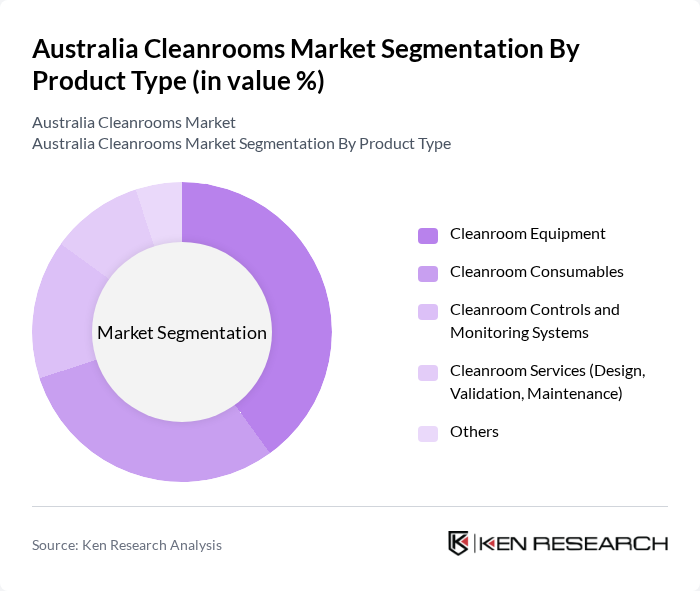
Australia Cleanrooms Market Segmentation
By Product Type:The product type segmentation includes various categories such as cleanroom equipment, consumables, controls and monitoring systems, services, and others. Cleanroom consumables, including garments, gloves, wipes, and disinfectants, represent the largest revenue-generating product category in the Australian market, reflecting their recurring use across healthcare, pharmaceutical, and electronics facilities. Cleanroom equipment, such as HVAC systems, HEPA/ULPA filtration units, laminar airflow systems, and modular cleanroom structures, is also a high-growth segment, supported by upgrades to existing facilities and the adoption of flexible, modular designs. Controls and monitoring systems, along with specialized services (design, validation, and maintenance), are gaining importance as end users prioritize continuous environmental monitoring, data integrity, and regulatory compliance.
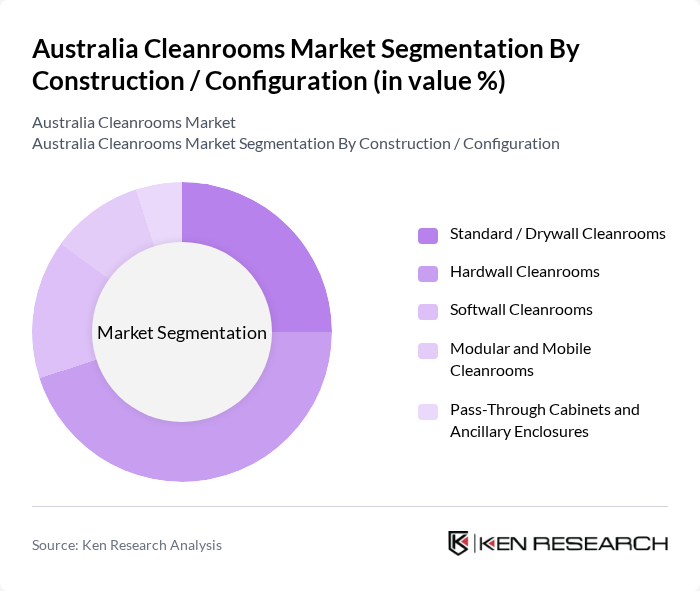
By Construction / Configuration:The construction/configuration segmentation includes standard/drywall cleanrooms, hardwall cleanrooms, softwall cleanrooms, modular and mobile cleanrooms, and pass-through cabinets. Hardwall and modular cleanrooms together account for a major share of installed capacity in regulated pharmaceutical, biotechnology, and semiconductor facilities, as they offer high structural integrity, integration with advanced HVAC and filtration systems, and easier validation to international GMP and ISO 14644 requirements. Softwall and mobile cleanrooms are increasingly used for pilot-scale production, temporary expansions, and R&D labs where flexibility and faster deployment are critical.
Australia Cleanrooms Market Competitive Landscape
The Australia Cleanrooms Market is characterized by a dynamic mix of regional and international players. Leading participants such as Cleanrooms Australia Pty Ltd, Arden Cleanrooms, Trotek Controlled Environments, MECHVAC Engineering, Forme Technologies, Terra Universal, Inc., STERIS Life Sciences, Ansell Limited, Micronclean, Elis Cleanroom, T3 Cleanrooms, Micronova Manufacturing, Cleanroom Technology Pty Ltd, AAF International, Ecolab Inc. contribute to innovation, geographic expansion, and service delivery in this space.
Australia Cleanrooms Market Industry Analysis
Growth Drivers
- Increasing Demand for Sterile Environments in Pharmaceuticals:The Australian pharmaceutical sector is projected to reach AUD 6.5 billion, driven by a growing emphasis on sterile production environments. This demand is fueled by the rising prevalence of chronic diseases, necessitating stringent contamination control measures. The Therapeutic Goods Administration (TGA) enforces rigorous standards, further propelling the need for cleanroom facilities to ensure product safety and efficacy, thereby enhancing market growth.
- Rising Awareness of Contamination Control in Manufacturing:With the Australian manufacturing sector valued at AUD 100 billion, there is an increasing focus on contamination control across various industries. The need for cleanroom environments is underscored by the potential financial losses associated with product recalls due to contamination. This awareness is driving investments in cleanroom technologies, as manufacturers seek to enhance product quality and comply with industry regulations, thus fostering market expansion.
- Technological Advancements in Cleanroom Design and Construction:The cleanroom technology market in Australia is witnessing innovations, with investments in advanced materials and construction techniques projected to exceed AUD 1 billion. These advancements include energy-efficient systems and modular cleanroom designs that reduce construction time and costs. As industries increasingly adopt these technologies, the demand for modern cleanroom solutions is expected to rise, significantly contributing to market growth.
Market Challenges
- High Initial Investment Costs for Cleanroom Facilities:Establishing cleanroom facilities in Australia requires substantial capital investment, often exceeding AUD 2 million for a standard setup. This high initial cost can deter smaller companies from entering the market, limiting competition and innovation. Additionally, the financial burden of ongoing maintenance and operational expenses can strain budgets, posing a significant challenge for businesses aiming to implement cleanroom solutions.
- Stringent Regulatory Requirements and Compliance Issues:The cleanroom industry in Australia is subject to strict regulatory frameworks, including compliance with AS 1386 and ISO 14644 standards. Navigating these regulations can be complex and time-consuming, often requiring specialized knowledge and resources. Companies face challenges in maintaining compliance, which can lead to costly delays and potential penalties, hindering market growth and operational efficiency.
Australia Cleanrooms Market Future Outlook
The future of the cleanroom market in Australia appears promising, driven by the increasing demand for advanced cleanroom solutions across various sectors. As industries prioritize contamination control and regulatory compliance, investments in innovative technologies and sustainable practices are expected to rise. Furthermore, the expansion of the biopharmaceutical and electronics sectors will likely create new opportunities for cleanroom applications, fostering a dynamic and competitive market landscape in the future.
Market Opportunities
- Growth in the Biopharmaceutical Industry:The biopharmaceutical sector in Australia is anticipated to grow significantly, with investments projected to reach AUD 3 billion. This growth presents substantial opportunities for cleanroom providers, as biopharmaceutical companies require stringent contamination control measures to ensure product safety and efficacy, driving demand for specialized cleanroom environments.
- Increasing Adoption of Modular Cleanroom Solutions:Modular cleanroom solutions are gaining traction in Australia, with the market expected to expand by AUD 500 million. These flexible and cost-effective systems allow for rapid deployment and scalability, making them attractive to various industries. As companies seek to optimize their operations, the demand for modular cleanrooms is likely to increase, presenting a significant market opportunity.
Scope of the Report
| Segment | Sub-Segments |
|---|---|
| By Product Type | Cleanroom Equipment Cleanroom Consumables Cleanroom Controls and Monitoring Systems Cleanroom Services (Design, Validation, Maintenance) Others |
| By Construction / Configuration | Standard / Drywall Cleanrooms Hardwall Cleanrooms Softwall Cleanrooms Modular and Mobile Cleanrooms Pass-Through Cabinets and Ancillary Enclosures |
| By End-User Industry | Pharmaceutical Industry Biotechnology Industry Semiconductor & Electronics Medical Devices Healthcare Providers and Hospitals Food & Beverage Aerospace & Automotive Research & Academic Laboratories Others |
| By Cleanliness Level (ISO Class) | ISO Class 1–3 ISO Class 4–5 ISO Class 6–7 ISO Class 8 and Controlled Environments Non-Classified / Ancillary Areas |
| By Service Offering | Design & Engineering Turnkey Construction & Installation Validation, Qualification & Certification Maintenance, Upgrades & Retrofit Services Cleanroom Laundry, Consumables Management & Other Services |
| By Region in Australia | New South Wales Victoria Queensland Western Australia South Australia Australian Capital Territory Tasmania & Others |
Key Target Audience
Investors and Venture Capitalist Firms
Government and Regulatory Bodies (e.g., Therapeutic Goods Administration, National Industrial Chemicals Notification and Assessment Scheme)
Manufacturers and Producers
Distributors and Retailers
Pharmaceutical Companies
Biotechnology Firms
Medical Device Manufacturers
Cleanroom Equipment Suppliers
Players Mentioned in the Report:
Cleanrooms Australia Pty Ltd
Arden Cleanrooms
Trotek Controlled Environments
MECHVAC Engineering
Forme Technologies
Terra Universal, Inc.
STERIS Life Sciences
Ansell Limited
Micronclean
Elis Cleanroom
T3 Cleanrooms
Micronova Manufacturing
Cleanroom Technology Pty Ltd
AAF International
Ecolab Inc.
Table of Contents
Market Assessment Phase
1. Executive Summary and Approach
2. Australia Cleanrooms Market Overview
2.1 Key Insights and Strategic Recommendations
2.2 Australia Cleanrooms Market Overview
2.3 Definition and Scope
2.4 Evolution of Market Ecosystem
2.5 Timeline of Key Regulatory Milestones
2.6 Value Chain & Stakeholder Mapping
2.7 Business Cycle Analysis
2.8 Policy & Incentive Landscape
3. Australia Cleanrooms Market Analysis
3.1 Growth Drivers
3.1.1 Increasing demand for sterile environments in pharmaceuticals
3.1.2 Rising awareness of contamination control in manufacturing
3.1.3 Technological advancements in cleanroom design and construction
3.1.4 Expansion of biotechnology and healthcare sectors
3.2 Market Challenges
3.2.1 High initial investment costs for cleanroom facilities
3.2.2 Stringent regulatory requirements and compliance issues
3.2.3 Limited availability of skilled workforce
3.2.4 Maintenance and operational costs of cleanroom environments
3.3 Market Opportunities
3.3.1 Growth in the biopharmaceutical industry
3.3.2 Increasing adoption of modular cleanroom solutions
3.3.3 Expansion of research and development activities
3.3.4 Rising demand for cleanrooms in electronics manufacturing
3.4 Market Trends
3.4.1 Shift towards energy-efficient cleanroom technologies
3.4.2 Integration of IoT in cleanroom monitoring systems
3.4.3 Customization of cleanroom solutions for specific industries
3.4.4 Increasing focus on sustainability and eco-friendly practices
3.5 Government Regulation
3.5.1 Compliance with AS 1386: Cleanrooms and associated controlled environments
3.5.2 Adherence to TGA guidelines for pharmaceutical cleanrooms
3.5.3 Implementation of ISO 14644 standards for cleanroom classification
3.5.4 Regulatory requirements for cleanroom validation and monitoring
4. SWOT Analysis
5. Stakeholder Analysis
6. Porter's Five Forces Analysis
7. Australia Cleanrooms Market Market Size, 2019-2024
7.1 By Value
7.2 By Volume
7.3 By Average Selling Price
8. Australia Cleanrooms Market Segmentation
8.1 By Product Type
8.1.1 Cleanroom Equipment
8.1.2 Cleanroom Consumables
8.1.3 Cleanroom Controls and Monitoring Systems
8.1.4 Cleanroom Services (Design, Validation, Maintenance)
8.1.5 Others
8.2 By Construction / Configuration
8.2.1 Standard / Drywall Cleanrooms
8.2.2 Hardwall Cleanrooms
8.2.3 Softwall Cleanrooms
8.2.4 Modular and Mobile Cleanrooms
8.2.5 Pass-Through Cabinets and Ancillary Enclosures
8.3 By End-User Industry
8.3.1 Pharmaceutical Industry
8.3.2 Biotechnology Industry
8.3.3 Semiconductor & Electronics
8.3.4 Medical Devices
8.3.5 Healthcare Providers and Hospitals
8.3.6 Food & Beverage
8.3.7 Aerospace & Automotive
8.3.8 Research & Academic Laboratories
8.3.9 Others
8.4 By Cleanliness Level (ISO Class)
8.4.1 ISO Class 1–3
8.4.2 ISO Class 4–5
8.4.3 ISO Class 6–7
8.4.4 ISO Class 8 and Controlled Environments
8.4.5 Non-Classified / Ancillary Areas
8.5 By Service Offering
8.5.1 Design & Engineering
8.5.2 Turnkey Construction & Installation
8.5.3 Validation, Qualification & Certification
8.5.4 Maintenance, Upgrades & Retrofit Services
8.5.5 Cleanroom Laundry, Consumables Management & Other Services
8.6 By Region in Australia
8.6.1 New South Wales
8.6.2 Victoria
8.6.3 Queensland
8.6.4 Western Australia
8.6.5 South Australia
8.6.6 Australian Capital Territory
8.6.7 Tasmania & Others
9. Australia Cleanrooms Market Competitive Analysis
9.1 Market Share of Key Players
9.2 Cross Comparison of Key Players
9.2.1 Company Name
9.2.2 Group Size (Large, Medium, or Small as per industry convention)
9.2.3 Australia Cleanrooms Market Revenue (Latest Year)
9.2.4 3-Year Revenue CAGR in Australia
9.2.5 Australia Cleanrooms Market Share (%)
9.2.6 Order Backlog / Book-to-Bill Ratio
9.2.7 EBITDA Margin (%) – Australia Operations
9.2.8 R&D Spend as % of Revenue
9.2.9 Capex Intensity (Capex as % of Revenue)
9.2.10 Installed Cleanroom Floor Space in Australia (m²)
9.2.11 Average Project Ticket Size (AUD)
9.2.12 Revenue Mix by Segment (Equipment vs Consumables vs Services)
9.2.13 Exposure to Regulated End-Markets (% of revenue from pharma, biotech, healthcare)
9.2.14 Customer Concentration (Top-5 customers’ share of revenue)
9.2.15 Tender Win Rate / Bid Success Ratio
9.2.16 Cleanroom Compliance Rate (Successful Audits / Total Audits)
9.2.17 On-Time Project Delivery Rate
9.2.18 Recurring Revenue Share (Contracts, Service, Consumables)
9.2.19 Innovation Pipeline (No. of new products/solutions launched in last 3 years)
9.2.20 Net Promoter Score (NPS) / Customer Satisfaction Index
9.3 SWOT Analysis of Top Players
9.4 Pricing Analysis
9.5 Detailed Profile of Major Companies
9.5.1 Cleanrooms Australia Pty Ltd
9.5.2 Arden Cleanrooms
9.5.3 Trotek Controlled Environments
9.5.4 MECHVAC Engineering
9.5.5 Forme Technologies
9.5.6 Terra Universal, Inc.
9.5.7 STERIS Life Sciences
9.5.8 Ansell Limited
9.5.9 Micronclean
9.5.10 Elis Cleanroom
9.5.11 T3 Cleanrooms
9.5.12 Micronova Manufacturing
9.5.13 Cleanroom Technology Pty Ltd
9.5.14 AAF International
9.5.15 Ecolab Inc.
10. Australia Cleanrooms Market End-User Analysis
10.1 Procurement Behavior of Key Ministries
10.1.1 Government procurement policies
10.1.2 Budget allocation for cleanroom facilities
10.1.3 Evaluation criteria for cleanroom suppliers
10.1.4 Collaboration with industry stakeholders
10.2 Corporate Spend on Infrastructure & Energy
10.2.1 Investment trends in cleanroom infrastructure
10.2.2 Energy efficiency initiatives in cleanroom operations
10.2.3 Budgeting for cleanroom maintenance
10.2.4 Corporate sustainability goals
10.3 Pain Point Analysis by End-User Category
10.3.1 Challenges faced by pharmaceutical companies
10.3.2 Issues in biotechnology cleanroom operations
10.3.3 Concerns in electronics manufacturing
10.3.4 Needs of research laboratories
10.4 User Readiness for Adoption
10.4.1 Awareness of cleanroom benefits
10.4.2 Training and skill development
10.4.3 Financial readiness for cleanroom investment
10.4.4 Technological readiness for cleanroom integration
10.5 Post-Deployment ROI and Use Case Expansion
10.5.1 Measurement of ROI in cleanroom investments
10.5.2 Case studies of successful cleanroom implementations
10.5.3 Expansion opportunities post-deployment
10.5.4 Long-term benefits of cleanroom adoption
11. Australia Cleanrooms Market Future Size, 2025-2030
11.1 By Value
11.2 By Volume
11.3 By Average Selling Price
Go-To-Market Strategy Phase
1. Whitespace Analysis + Business Model Canvas
1.1 Market gaps and opportunities
1.2 Business model components
2. Marketing and Positioning Recommendations
2.1 Branding strategies
2.2 Product USPs
3. Distribution Plan
3.1 Urban retail vs rural NGO tie-ups
4. Channel & Pricing Gaps
4.1 Underserved routes
4.2 Pricing bands
5. Unmet Demand & Latent Needs
5.1 Category gaps
5.2 Consumer segments
6. Customer Relationship
6.1 Loyalty programs
6.2 After-sales service
7. Value Proposition
7.1 Sustainability
7.2 Integrated supply chains
8. Key Activities
8.1 Regulatory compliance
8.2 Branding
8.3 Distribution setup
9. Entry Strategy Evaluation
9.1 Domestic Market Entry Strategy
9.1.1 Product mix
9.1.2 Pricing band
9.1.3 Packaging
9.2 Export Entry Strategy
9.2.1 Target countries
9.2.2 Compliance roadmap
10. Entry Mode Assessment
10.1 JV, Greenfield, M&A, Distributor Model
11. Capital and Timeline Estimation
11.1 Capital requirements
11.2 Timelines
12. Control vs Risk Trade-Off
12.1 Ownership vs Partnerships
13. Profitability Outlook
13.1 Breakeven analysis
13.2 Long-term sustainability
14. Potential Partner List
14.1 Distributors
14.2 JVs
14.3 Acquisition targets
15. Execution Roadmap
15.1 Phased Plan for Market Entry
15.1.1 Market Setup
15.1.2 Market Entry
15.1.3 Growth Acceleration
15.1.4 Scale & Stabilize
15.2 Key Activities and Milestones
15.2.1 Milestone tracking
15.2.2 Activity scheduling
Research Methodology
Phase 1: Approach1
Desk Research
- Industry reports from Australian Cleanroom Association and relevant trade publications
- Market statistics from government databases and cleanroom standards organizations
- Analysis of academic journals focusing on cleanroom technology and applications
Primary Research
- Interviews with facility managers in pharmaceutical and biotechnology sectors
- Surveys with cleanroom equipment suppliers and manufacturers
- Field interviews with quality assurance professionals in semiconductor companies
Validation & Triangulation
- Cross-validation of data through multiple industry sources and expert opinions
- Triangulation of market size estimates from both top-down and bottom-up approaches
- Sanity checks conducted through expert panel discussions and feedback sessions
Phase 2: Market Size Estimation1
Top-down Assessment
- Estimation of cleanroom market size based on national healthcare and manufacturing expenditures
- Segmentation by end-user industries such as pharmaceuticals, electronics, and aerospace
- Incorporation of government initiatives promoting cleanroom standards and compliance
Bottom-up Modeling
- Volume estimates derived from cleanroom installations and operational capacities
- Cost analysis based on equipment pricing and maintenance expenses
- Revenue projections based on service contracts and consumables used in cleanrooms
Forecasting & Scenario Analysis
- Multi-variable regression analysis incorporating technological advancements and regulatory changes
- Scenario modeling based on market trends, including shifts towards automation and sustainability
- Development of baseline, optimistic, and pessimistic forecasts through 2030
Phase 3: CATI Sample Composition1
| Scope Item/Segment | Sample Size | Target Respondent Profiles |
|---|---|---|
| Pharmaceutical Cleanroom Operations | 120 | Facility Managers, Quality Control Officers |
| Semiconductor Manufacturing Cleanrooms | 90 | Process Engineers, Production Managers |
| Biotechnology Research Facilities | 80 | Lab Managers, Research Scientists |
| Aerospace Cleanroom Standards | 60 | Compliance Officers, Engineering Managers |
| Cleanroom Equipment Suppliers | 70 | Sales Managers, Product Development Leads |
Frequently Asked Questions
What is the current value of the Australia Cleanrooms Market?
The Australia Cleanrooms Market is valued at approximately USD 130 million, driven by the increasing demand for sterile environments in sectors such as pharmaceuticals, biotechnology, healthcare, and electronics, where contamination control is essential.
What are the key drivers of growth in the Australia Cleanrooms Market?
Which regions in Australia have the highest demand for cleanroom technology?
What are the main product types in the Australia Cleanrooms Market?
Other Regional/Country Reports
Other Adjacent Reports
Oman Semiconductor Manufacturing Market
Bahrain Medical Device Manufacturing Market
Kuwait Air Filtration Systems Market
U.S. HVAC Systems Market Size, Share & Forecast, By Equipment Type, End-Use Industry & Technology, 2026-2031Indonesia Environmental Monitoring Systems Market
Australia Modular Construction Market Size, Share & Forecast, By Project Type, End-Use Sector & Technology, 2026-2031Global infection control market Size, Share, Growth Drivers, Trends, Opportunities & Forecast 2025–2030Kuwait ASEAN Laboratory Equipment Market Report Size Share Growth Drivers Trends Opportunities & Forecast 2025–2030Why Buy From Us?

What makes us stand out is that our consultants follow Robust, Refine and Result (RRR) methodology. Robust for clear definitions, approaches and sanity checking, Refine for differentiating respondents' facts and opinions, and Result for presenting data with story.

We have set a benchmark in the industry by offering our clients with syndicated and customized market research reports featuring coverage of entire market as well as meticulous research and analyst insights.

While we don't replace traditional research, we flip the method upside down. Our dual approach of Top Bottom & Bottom Top ensures quality deliverable by not just verifying company fundamentals but also looking at the sector and macroeconomic factors.

With one step in the future, our research team constantly tries to show you the bigger picture. We help with some of the tough questions you may encounter along the way: How is the industry positioned? Best marketing channel? KPI's of competitors? By aligning every element, we help maximize success.

Our report gives you instant access to the answers and sources that other companies might choose to hide. We elaborate each steps of research methodology we have used and showcase you the sample size to earn your trust.

If you need any support, we are here! We pride ourselves on universe strength, data quality, and quick, friendly, and professional service.