About the Report
Base Year 2024Thailand Cleanrooms Market Overview
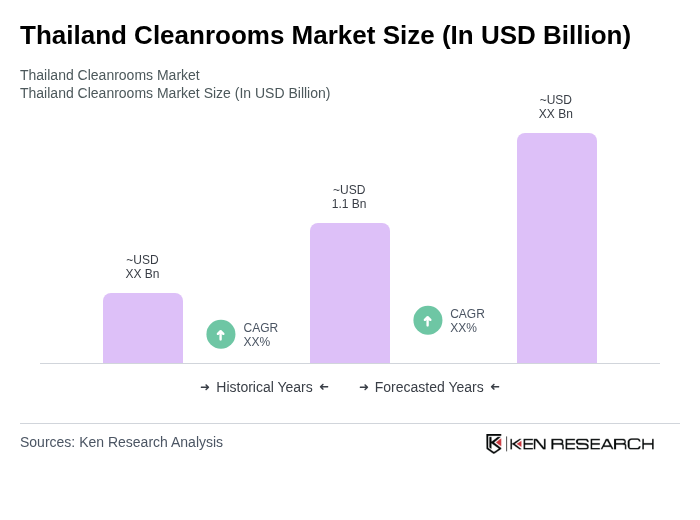
- The Thailand Cleanrooms Market is valued at USD 1.1 billion, based on a five-year historical analysis. This growth is primarily driven by the increasing demand for cleanroom facilities in the pharmaceutical, biotechnology, electronics, and semiconductor industries, which require stringent contamination control measures. The rise in healthcare spending, expansion of pharmaceutical and medical device manufacturing, and growing electronics and semiconductor production in Thailand have further fueled the market's growth.
- Key cities such as Bangkok and Chonburi dominate the market due to their strategic locations, advanced infrastructure, and concentration of industries that require cleanroom environments, including pharmaceutical plants, medical device factories, electronics assembly, and R&D centers. The Eastern Economic Corridor (EEC), covering Chachoengsao, Chonburi, and Rayong, is also a significant contributor, attracting investments in high-tech manufacturing, biotechnology, EV and electronics production, and healthcare-related facilities, thereby enhancing the demand for cleanroom solutions.
- Cleanroom design, construction, and operation in Thailand are guided by a combination of international and national standards and sector-specific regulations. A key binding instrument is the Ministerial Regulation Prescribing Standards for Production, Premises and Equipment of Manufacturers of Modern Drugs B.E. 2559 (2016), issued by the Ministry of Public Health, which requires pharmaceutical manufacturing facilities to comply with Good Manufacturing Practice (GMP) standards, including controlled cleanroom classifications, HVAC and filtration performance, environmental monitoring, and validation of contamination control systems. In practice, cleanroom facilities in pharmaceuticals, medical devices, and electronics in Thailand align with ISO 14644 series standards and relevant Thai FDA and Ministry of Industry requirements on air cleanliness, pressure differentials, temperature and humidity control, and documentation, thereby supporting consistent product quality and safety and promoting further adoption of cleanroom technologies.
Thailand Cleanrooms Market Segmentation
By Product Type:The cleanrooms market can be segmented into two main categories: Cleanroom Equipment and Cleanroom Consumables. Cleanroom Equipment includes various systems and devices essential for maintaining a controlled environment, such as HVAC systems, air filters, laminar airflow units, air showers, and monitoring instruments, while Cleanroom Consumables encompass items that are used within cleanrooms to ensure cleanliness and compliance with industry standards, including garments, gloves, wipes, disinfectants, and masks.
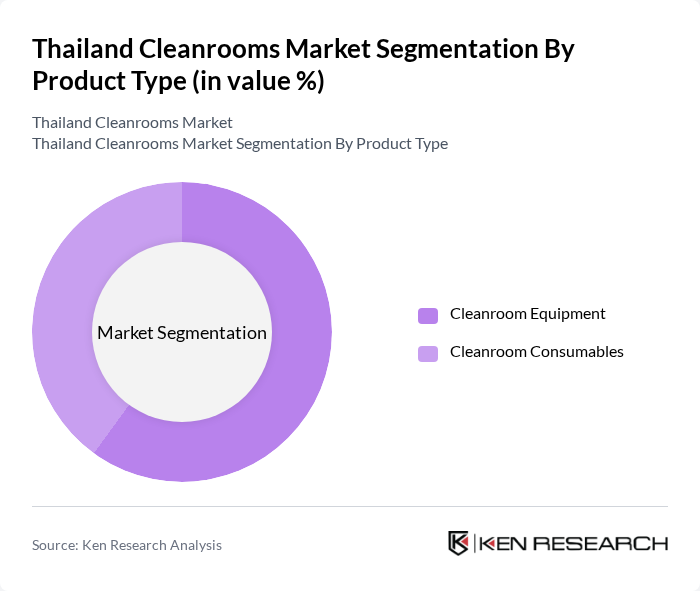
The Cleanroom Equipment segment is dominating the market due to the increasing investments in advanced cleanroom technologies and the growing need for high-quality manufacturing processes in sectors such as pharmaceuticals, biotechnology, and electronics. The demand for modular cleanrooms, high-efficiency HVAC and air handling systems, and high-performance filtration is particularly high, as they offer flexibility and efficiency in maintaining controlled environments. Additionally, the trend towards automation and the use of cleanroom robots, environmental monitoring systems, and digital controls in cleanroom operations is further driving the growth of this segment.
By Equipment Type:The cleanrooms market can also be segmented by equipment type, which includes Modular / Prefabricated Cleanrooms, Stick-Built / Conventional Cleanrooms, Hybrid Cleanrooms, Cleanroom HVAC and Air Handling Systems, and Others (Air Showers, Pass-Throughs, Cabinets, etc.). Each of these types serves specific needs within the cleanroom environment, from core room structures to supporting airflow, filtration, and personnel/material transfer.
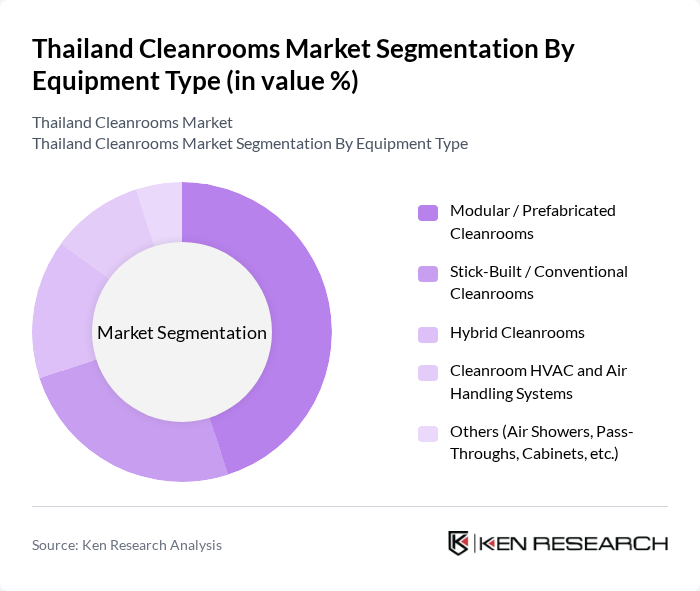
Among the equipment types, Modular / Prefabricated Cleanrooms are leading the market due to their ease of installation, scalability, and cost-effectiveness, which align well with expansion and upgrade needs in Thailand’s pharmaceutical, medical device, and electronics manufacturing clusters. These cleanrooms are increasingly preferred by companies looking to expand their operations without significant downtime, and the flexibility offered by modular designs allows for quick adjustments to meet changing production needs and regulatory requirements, making them a popular choice in the rapidly evolving cleanroom landscape.
Thailand Cleanrooms Market Competitive Landscape
The Thailand Cleanrooms Market is characterized by a dynamic mix of regional and international players. Leading participants such as Cleanroom Technology Co., Ltd., AAF International (Daikin Applied Group), Terumo (Thailand) Co., Ltd., Ecolab Inc., Exyte Group (formerly M+W Group), Clean Air Products, AAF Flanders, Clestra Hauserman, Labconco Corporation, STERIS Corporation, HEMCO Corporation, Kleanlabs, ABN Cleanroom Technology, Envair, Local Engineering, Procurement, and Construction (EPC) Partners contribute to innovation, geographic expansion, and service delivery in this space.
Thailand Cleanrooms Market Industry Analysis
Growth Drivers
- Increasing Demand from the Pharmaceutical Industry:The pharmaceutical sector in Thailand is projected to reach THB 350 billion by the future, driven by a growing population and increased healthcare spending. This surge in demand necessitates stringent contamination control measures, leading to a heightened need for cleanroom facilities. The Thai government’s support for pharmaceutical innovation further amplifies this trend, as it aims to enhance local production capabilities and reduce reliance on imports, thereby boosting cleanroom installations.
- Rising Awareness of Contamination Control:With the Thai healthcare market expected to grow at a rate of 12% annually, awareness regarding contamination control is becoming paramount. Hospitals and laboratories are increasingly investing in cleanroom technologies to ensure compliance with international standards. The Ministry of Public Health has reported a 20% increase in funding for cleanroom infrastructure, reflecting the growing recognition of the importance of maintaining sterile environments in medical and research facilities.
- Expansion of Biotechnology and Life Sciences Sectors:Thailand's biotechnology sector is anticipated to contribute THB 60 billion to the economy by the future, driven by advancements in research and development. This growth is fostering a demand for specialized cleanroom environments tailored to biotech applications. The government’s initiatives to promote life sciences, including tax incentives for biotech firms, are expected to further stimulate investments in cleanroom technologies, enhancing the overall market landscape.
Market Challenges
- High Initial Investment Costs:Establishing cleanroom facilities involves significant capital expenditure, often exceeding THB 25 million for a standard setup. This financial barrier can deter small and medium-sized enterprises from investing in cleanroom technologies. Additionally, ongoing operational costs, including maintenance and compliance with stringent regulations, further complicate the financial landscape, making it challenging for businesses to justify such investments in the current economic climate.
- Stringent Regulatory Requirements:The cleanroom industry in Thailand faces rigorous regulatory frameworks, including compliance with ISO 14644 standards. Meeting these requirements necessitates continuous monitoring and validation, which can be resource-intensive. Companies often struggle to navigate the complex regulatory landscape, leading to delays in project timelines and increased costs. The need for specialized knowledge to ensure compliance adds another layer of challenge for market participants.
Thailand Cleanrooms Market Future Outlook
The Thailand cleanrooms market is poised for significant growth, driven by advancements in technology and increasing regulatory pressures. The integration of IoT for real-time monitoring and the shift towards energy-efficient designs are expected to redefine cleanroom standards. As industries such as pharmaceuticals and biotechnology expand, the demand for customized cleanroom solutions will rise. Furthermore, the government's commitment to enhancing healthcare infrastructure will likely create a favorable environment for cleanroom investments, ensuring sustained market momentum in the future.
Market Opportunities
- Growth in the Electronics Manufacturing Sector:Thailand's electronics manufacturing sector is projected to reach THB 1.2 trillion by the future, creating substantial demand for cleanroom environments. As manufacturers seek to minimize contamination risks in semiconductor production, investments in cleanroom technologies will become increasingly vital, presenting a lucrative opportunity for cleanroom providers.
- Increasing Adoption of Cleanroom Technology in Food Processing:The food processing industry in Thailand is expected to grow by 10% annually, with a rising focus on hygiene and safety standards. This trend is driving the adoption of cleanroom technologies to ensure contamination-free production environments, offering cleanroom manufacturers a new avenue for growth and innovation in this sector.
Scope of the Report
| Segment | Sub-Segments |
|---|---|
| By Product Type | Cleanroom Equipment Cleanroom Consumables |
| By Equipment Type | Modular / Prefabricated Cleanrooms Stick-Built / Conventional Cleanrooms Hybrid Cleanrooms Cleanroom HVAC and Air Handling Systems Others (Air Showers, Pass-Throughs, Cabinets, etc.) |
| By Consumable Type | Apparel (Coveralls, Gowns, Hoods, Shoe Covers) Gloves Wipes and Swabs Disinfectants and Cleaning Chemicals Other Consumables (Masks, Goggles, Tapes, etc.) |
| By End-Use Industry | Pharmaceuticals and Biopharmaceuticals Medical Devices Biotechnology and Life Sciences Research Electronics and Semiconductor Manufacturing Food & Beverage and Nutraceuticals Hospitals, Clinics, and Diagnostic Centers Others (Automotive, Aerospace, Universities, etc.) |
| By Cleanliness Class (ISO) | ISO Class 3–4 ISO Class 5 ISO Class 6 ISO Class 7 ISO Class 8 and Above |
| By Region | Central Thailand (incl. Bangkok) Eastern Economic Corridor (EEC) Northern Thailand Northeastern Thailand Southern Thailand |
| By Service Type | Design and Engineering Installation and Commissioning Validation and Certification Operation & Maintenance Services Retrofit & Upgrade Services |
Key Target Audience
Investors and Venture Capitalist Firms
Government and Regulatory Bodies (e.g., Ministry of Industry, Food and Drug Administration Thailand)
Manufacturers and Producers
Distributors and Retailers
Pharmaceutical Companies
Biotechnology Firms
Medical Device Manufacturers
Construction and Engineering Firms specializing in Cleanroom Design
Players Mentioned in the Report:
Cleanroom Technology Co., Ltd.
AAF International (Daikin Applied Group)
Terumo (Thailand) Co., Ltd.
Ecolab Inc.
Exyte Group (formerly M+W Group)
Clean Air Products
AAF Flanders
Clestra Hauserman
Labconco Corporation
STERIS Corporation
HEMCO Corporation
Kleanlabs
ABN Cleanroom Technology
Envair
Local Engineering, Procurement, and Construction (EPC) Partners
Table of Contents
Market Assessment Phase
1. Executive Summary and Approach
2. Thailand Cleanrooms Market Overview
2.1 Key Insights and Strategic Recommendations
2.2 Thailand Cleanrooms Market Overview
2.3 Definition and Scope
2.4 Evolution of Market Ecosystem
2.5 Timeline of Key Regulatory Milestones
2.6 Value Chain & Stakeholder Mapping
2.7 Business Cycle Analysis
2.8 Policy & Incentive Landscape
3. Thailand Cleanrooms Market Analysis
3.1 Growth Drivers
3.1.1 Increasing demand from the pharmaceutical industry
3.1.2 Rising awareness of contamination control
3.1.3 Expansion of biotechnology and life sciences sectors
3.1.4 Government initiatives promoting cleanroom standards
3.2 Market Challenges
3.2.1 High initial investment costs
3.2.2 Stringent regulatory requirements
3.2.3 Limited skilled workforce
3.2.4 Competition from alternative technologies
3.3 Market Opportunities
3.3.1 Growth in the electronics manufacturing sector
3.3.2 Increasing adoption of cleanroom technology in food processing
3.3.3 Potential for retrofitting existing facilities
3.3.4 Expansion into emerging markets within Southeast Asia
3.4 Market Trends
3.4.1 Adoption of modular cleanroom solutions
3.4.2 Integration of IoT in cleanroom monitoring
3.4.3 Focus on energy-efficient cleanroom designs
3.4.4 Customization of cleanroom environments for specific industries
3.5 Government Regulation
3.5.1 Compliance with ISO standards
3.5.2 Regulations on air quality and contamination control
3.5.3 Guidelines for cleanroom construction and maintenance
3.5.4 Incentives for adopting cleanroom technologies
4. SWOT Analysis
5. Stakeholder Analysis
6. Porter's Five Forces Analysis
7. Thailand Cleanrooms Market Market Size, 2019-2024
7.1 By Value
7.2 By Volume
7.3 By Average Selling Price
8. Thailand Cleanrooms Market Segmentation
8.1 By Product Type
8.1.1 Cleanroom Equipment
8.1.2 Cleanroom Consumables
8.2 By Equipment Type
8.2.1 Modular / Prefabricated Cleanrooms
8.2.2 Stick-Built / Conventional Cleanrooms
8.2.3 Hybrid Cleanrooms
8.2.4 Cleanroom HVAC and Air Handling Systems
8.2.5 Others (Air Showers, Pass-Throughs, Cabinets, etc.)
8.3 By Consumable Type
8.3.1 Apparel (Coveralls, Gowns, Hoods, Shoe Covers)
8.3.2 Gloves
8.3.3 Wipes and Swabs
8.3.4 Disinfectants and Cleaning Chemicals
8.3.5 Other Consumables (Masks, Goggles, Tapes, etc.)
8.4 By End-Use Industry
8.4.1 Pharmaceuticals and Biopharmaceuticals
8.4.2 Medical Devices
8.4.3 Biotechnology and Life Sciences Research
8.4.4 Electronics and Semiconductor Manufacturing
8.4.5 Food & Beverage and Nutraceuticals
8.4.6 Hospitals, Clinics, and Diagnostic Centers
8.4.7 Others (Automotive, Aerospace, Universities, etc.)
8.5 By Cleanliness Class (ISO)
8.5.1 ISO Class 3–4
8.5.2 ISO Class 5
8.5.3 ISO Class 6
8.5.4 ISO Class 7
8.5.5 ISO Class 8 and Above
8.6 By Region
8.6.1 Central Thailand (incl. Bangkok)
8.6.2 Eastern Economic Corridor (EEC)
8.6.3 Northern Thailand
8.6.4 Northeastern Thailand
8.6.5 Southern Thailand
8.7 By Service Type
8.7.1 Design and Engineering
8.7.2 Installation and Commissioning
8.7.3 Validation and Certification
8.7.4 Operation & Maintenance Services
8.7.5 Retrofit & Upgrade Services
9. Thailand Cleanrooms Market Competitive Analysis
9.1 Market Share of Key Players
9.2 Cross Comparison of Key Players
9.2.1 Company Name
9.2.2 Group Size (Large, Medium, or Small as per industry convention)
9.2.3 Thailand Cleanroom Revenue (US$ Million)
9.2.4 3-Year Revenue CAGR in Thailand (%)
9.2.5 EBITDA Margin (%)
9.2.6 Order Backlog / Book-to-Bill Ratio
9.2.7 Market Share in Thailand Cleanrooms (%)
9.2.8 Installed Cleanroom Floor Area in Thailand (sq. meters)
9.2.9 Average Project Size (US$ / Project)
9.2.10 R&D / Innovation Spend (% of Revenue)
9.2.11 Win Rate in Competitive Bids (%)
9.2.12 On-Time Project Delivery Rate (%)
9.2.13 Customer Retention / Renewal Rate (%)
9.2.14 Net Promoter Score (NPS)
9.3 SWOT Analysis of Top Players
9.4 Pricing Analysis
9.5 Detailed Profile of Major Companies
9.5.1 Cleanroom Technology Co., Ltd.
9.5.2 AAF International (Daikin Applied Group)
9.5.3 Terumo (Thailand) Co., Ltd.
9.5.4 Ecolab Inc.
9.5.5 Exyte Group (formerly M+W Group)
9.5.6 Clean Air Products
9.5.7 AAF Flanders
9.5.8 Clestra Hauserman
9.5.9 Labconco Corporation
9.5.10 STERIS Corporation
9.5.11 HEMCO Corporation
9.5.12 Kleanlabs
9.5.13 ABN Cleanroom Technology
9.5.14 Envair
9.5.15 Local Engineering, Procurement, and Construction (EPC) Partners
10. Thailand Cleanrooms Market End-User Analysis
10.1 Procurement Behavior of Key Ministries
10.1.1 Ministry of Public Health
10.1.2 Ministry of Industry
10.1.3 Ministry of Science and Technology
10.1.4 Ministry of Agriculture and Cooperatives
10.2 Corporate Spend on Infrastructure & Energy
10.2.1 Pharmaceutical Sector Investments
10.2.2 Electronics Manufacturing Expenditures
10.2.3 Biotechnology Research Funding
10.2.4 Food Safety Initiatives
10.3 Pain Point Analysis by End-User Category
10.3.1 Pharmaceutical Industry Challenges
10.3.2 Electronics Sector Issues
10.3.3 Biotechnology Sector Concerns
10.3.4 Food Processing Industry Pain Points
10.4 User Readiness for Adoption
10.4.1 Awareness of Cleanroom Standards
10.4.2 Training and Skill Development Needs
10.4.3 Financial Readiness for Investment
10.4.4 Technological Adaptability
10.5 Post-Deployment ROI and Use Case Expansion
10.5.1 Measurement of Cleanroom Efficiency
10.5.2 Expansion into New Applications
10.5.3 Long-term Cost Savings Analysis
10.5.4 User Feedback and Improvement Cycles
11. Thailand Cleanrooms Market Future Size, 2025-2030
11.1 By Value
11.2 By Volume
11.3 By Average Selling Price
Go-To-Market Strategy Phase
1. Whitespace Analysis + Business Model Canvas
1.1 Market Gaps Identification
1.2 Business Model Development
2. Marketing and Positioning Recommendations
2.1 Branding Strategies
2.2 Product USPs
3. Distribution Plan
3.1 Urban Retail Strategies
3.2 Rural NGO Tie-ups
4. Channel & Pricing Gaps
4.1 Underserved Routes
4.2 Pricing Bands Analysis
5. Unmet Demand & Latent Needs
5.1 Category Gaps
5.2 Consumer Segments
6. Customer Relationship
6.1 Loyalty Programs
6.2 After-sales Service
7. Value Proposition
7.1 Sustainability Initiatives
7.2 Integrated Supply Chains
8. Key Activities
8.1 Regulatory Compliance
8.2 Branding Efforts
8.3 Distribution Setup
9. Entry Strategy Evaluation
9.1 Domestic Market Entry Strategy
9.1.1 Product Mix Considerations
9.1.2 Pricing Band Strategy
9.1.3 Packaging Solutions
9.2 Export Entry Strategy
9.2.1 Target Countries Identification
9.2.2 Compliance Roadmap Development
10. Entry Mode Assessment
10.1 Joint Ventures
10.2 Greenfield Investments
10.3 Mergers & Acquisitions
10.4 Distributor Model Evaluation
11. Capital and Timeline Estimation
11.1 Capital Requirements
11.2 Timelines for Implementation
12. Control vs Risk Trade-Off
12.1 Ownership Considerations
12.2 Partnerships Evaluation
13. Profitability Outlook
13.1 Breakeven Analysis
13.2 Long-term Sustainability Strategies
14. Potential Partner List
14.1 Distributors
14.2 Joint Ventures
14.3 Acquisition Targets
15. Execution Roadmap
15.1 Phased Plan for Market Entry
15.1.1 Market Setup
15.1.2 Market Entry
15.1.3 Growth Acceleration
15.1.4 Scale & Stabilize
15.2 Key Activities and Milestones
15.2.1 Activity Planning
15.2.2 Milestone Tracking
Research Methodology
Phase 1: Approach1
Desk Research
- Industry reports from Thai government agencies and cleanroom associations
- Market analysis publications from research firms focusing on cleanroom technology
- Academic journals and white papers on cleanroom standards and innovations
Primary Research
- Interviews with facility managers in pharmaceutical and biotechnology sectors
- Surveys with cleanroom equipment suppliers and manufacturers
- Field visits to operational cleanroom facilities for observational insights
Validation & Triangulation
- Cross-validation of data from multiple industry sources and expert opinions
- Triangulation of market size estimates using both top-down and bottom-up approaches
- Sanity checks through feedback from industry experts and stakeholders
Phase 2: Market Size Estimation1
Top-down Assessment
- Analysis of national healthcare expenditure and its impact on cleanroom demand
- Segmentation of the market by end-user industries such as pharmaceuticals, electronics, and food processing
- Incorporation of government regulations and standards affecting cleanroom operations
Bottom-up Modeling
- Estimation of cleanroom space requirements based on industry-specific needs
- Cost analysis of cleanroom construction and maintenance from leading contractors
- Volume and pricing data from cleanroom consumables and equipment suppliers
Forecasting & Scenario Analysis
- Multi-variable regression analysis considering factors like technological advancements and regulatory changes
- Scenario modeling based on potential market disruptions and economic conditions
- Projections for market growth through 2030 under various adoption rates
Phase 3: CATI Sample Composition1
| Scope Item/Segment | Sample Size | Target Respondent Profiles |
|---|---|---|
| Pharmaceutical Cleanroom Operations | 120 | Quality Assurance Managers, Facility Directors |
| Electronics Manufacturing Cleanrooms | 90 | Production Managers, Engineering Leads |
| Food Processing Cleanroom Standards | 60 | Food Safety Officers, Operations Managers |
| Research Laboratory Cleanroom Usage | 70 | Lab Managers, Research Scientists |
| Cleanroom Equipment Suppliers | 80 | Sales Managers, Product Development Heads |
Frequently Asked Questions
What is the current value of the Thailand Cleanrooms Market?
The Thailand Cleanrooms Market is valued at approximately USD 1.1 billion, driven by the increasing demand for cleanroom facilities in sectors such as pharmaceuticals, biotechnology, electronics, and semiconductors, which require stringent contamination control measures.
Which industries are the primary drivers of cleanroom demand in Thailand?
What are the key cities contributing to the Thailand Cleanrooms Market?
What regulations govern cleanroom operations in Thailand?
Other Regional/Country Reports
Other Adjacent Reports
Singapore Semiconductor Manufacturing Market
Kuwait Electronics Manufacturing Market
Japan Medical Device Manufacturing Market
United States HVAC Systems Market Outlook to 2030: Size, Share, Growth and TrendsOman Air Filtration Market
Mexico Cleanroom Consumables Market
New Zealand Modular Construction Market Report Size Share Growth Drivers Trends Opportunities & Forecast 2025–2030Bahrain Contamination Control Market
Why Buy From Us?

What makes us stand out is that our consultants follow Robust, Refine and Result (RRR) methodology. Robust for clear definitions, approaches and sanity checking, Refine for differentiating respondents' facts and opinions, and Result for presenting data with story.

We have set a benchmark in the industry by offering our clients with syndicated and customized market research reports featuring coverage of entire market as well as meticulous research and analyst insights.

While we don't replace traditional research, we flip the method upside down. Our dual approach of Top Bottom & Bottom Top ensures quality deliverable by not just verifying company fundamentals but also looking at the sector and macroeconomic factors.

With one step in the future, our research team constantly tries to show you the bigger picture. We help with some of the tough questions you may encounter along the way: How is the industry positioned? Best marketing channel? KPI's of competitors? By aligning every element, we help maximize success.

Our report gives you instant access to the answers and sources that other companies might choose to hide. We elaborate each steps of research methodology we have used and showcase you the sample size to earn your trust.

If you need any support, we are here! We pride ourselves on universe strength, data quality, and quick, friendly, and professional service.