Japan Facility Management Market

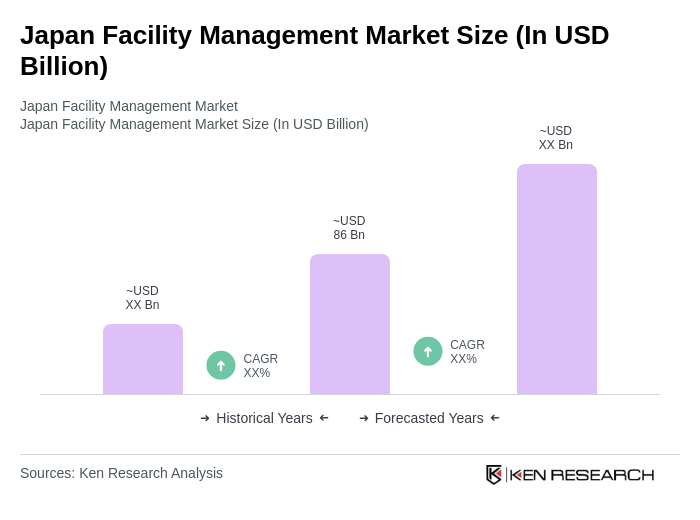
Japan facility management market, valued at USD 86 Bn, grows with demand for efficient solutions, tech advancements, and sustainability focus in cities like Tokyo and Osaka.

Region:Asia

Author(s):Geetanshi

Product Code:KRAA0156

Pages:91

Published On:August 2025
About the Report

Base Year 2024

Japan Facility Management Market Overview

  • The Japan Facility Management Market is valued at USD 86 billion, based on a five-year historical analysis. This growth is primarily driven by the increasing demand for efficient building management solutions, technological advancements such as smart building technologies, and a growing emphasis on sustainability and regulatory compliance in facility operations. The market has seen a significant rise in the adoption of integrated facility management services, which optimize resources, reduce operational costs, and extend asset life for businesses .
  • Key cities dominating the market include Tokyo, Osaka, and Yokohama. Tokyo, as the capital, is a major business hub with a high concentration of corporate offices and commercial spaces, while Osaka and Yokohama are vital for their industrial and logistics sectors. The urbanization and economic activities in these cities continue to create robust demand for facility management services .
  • While there is no formal "Green Building Law" implemented in 2023, Japan has strengthened energy efficiency regulations and sustainability requirements for new public buildings, driving demand for facility management services that ensure compliance with these standards and support sustainable construction practices .
Japan Facility Management Market Size

Japan Facility Management Market Segmentation

By Type:The facility management market can be segmented into various types, including Hard Services, Soft Services, Integrated Facility Management (IFM), and Specialized Services. Hard Services encompass essential maintenance tasks such as HVAC, electrical, plumbing, and building maintenance, while Soft Services include cleaning, security, landscaping, and waste management. Integrated Facility Management combines multiple services into a single contract, enhancing efficiency. Specialized Services focus on niche areas like energy management and workspace management. Hard Services hold the largest share, driven by Japan's mandatory seismic upgrades and energy efficiency requirements .
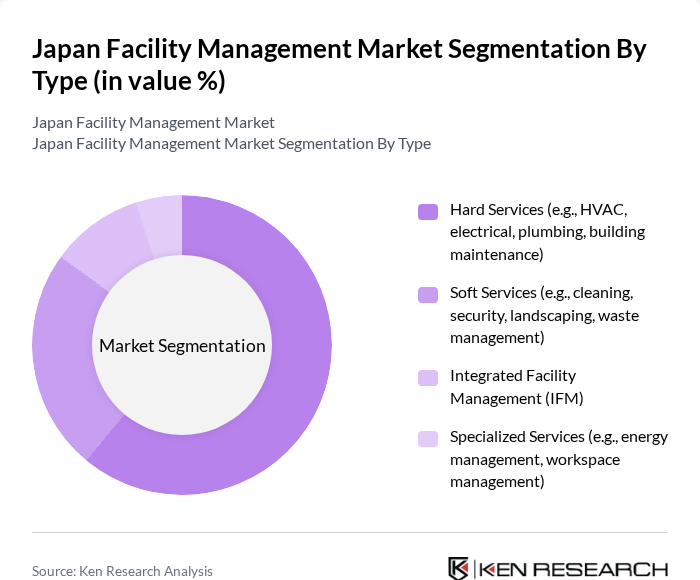
Japan Facility Management Market segmentation by Type.

By End-User:The end-user segmentation of the facility management market includes Commercial, Residential, Industrial, Public Sector & Infrastructure, and Others. The Commercial sector, which includes offices, retail, and hospitality, is the largest segment due to the high demand for professional management services in urban areas. The Residential segment covers apartment complexes and condominiums, while the Industrial segment focuses on manufacturing and logistics. The Public Sector encompasses government buildings, schools, hospitals, and transportation hubs. Industrial and process facilities are among the fastest-growing end-user segments, driven by digitalization and predictive maintenance adoption .
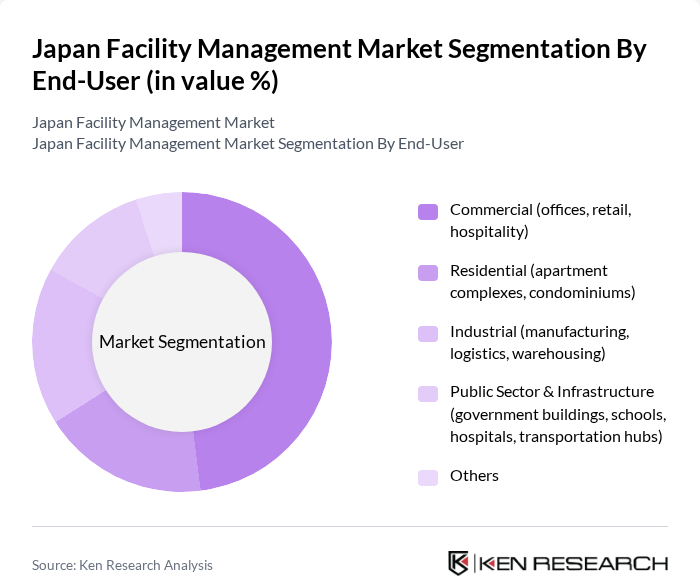
Japan Facility Management Market segmentation by End-User.

Japan Facility Management Market Competitive Landscape

The Japan Facility Management Market is characterized by a dynamic mix of regional and international players. Leading participants such as CBRE Group K.K., JLL Japan (Jones Lang LaSalle K.K.), ISS Facility Services Inc. (Japan), Sodexo Japan Co., Ltd., Cushman & Wakefield K.K., Nippon Kanzai Co., Ltd., Tokyu Community Corp., Secom Co., Ltd., ALSOK (Sohgo Security Services Co., Ltd.), Mitsubishi Estate Co., Ltd., Mitsui Fudosan Facilities Co., Ltd., Aramark Corporation (Japan operations), Daiwa House Group (Daiwa LifeNext Co., Ltd.), Sumitomo Realty & Development Building Management Co., Ltd., Tokyu Fudosan Holdings Corp. (Tokyu Facilities Inc.) contribute to innovation, geographic expansion, and service delivery in this space.

Company

Establishment Year

Headquarters

Group Size (Large, Medium, Small)

Market Share (%)

Revenue (Japan FM operations, latest fiscal year)

Number of Facilities Managed

Customer Retention Rate

Average Contract Value

CBRE Group K.K.

1906

Tokyo, Japan

JLL Japan (Jones Lang LaSalle K.K.)

1976

Tokyo, Japan

ISS Facility Services Inc. (Japan)

1960

Tokyo, Japan

Sodexo Japan Co., Ltd.

1966

Tokyo, Japan

Cushman & Wakefield K.K.

1917

Tokyo, Japan

Japan Facility Management Market Industry Analysis

Growth Drivers

  • Increasing Demand for Outsourced Services:The Japanese facility management market is experiencing a surge in demand for outsourced services, driven by the need for operational efficiency. In future, the outsourcing market is projected to reach ¥3.8 trillion, reflecting a 10% increase from the previous year. This trend is fueled by businesses seeking to focus on core competencies while leveraging specialized service providers for facility management, thereby enhancing productivity and reducing costs.
  • Technological Advancements in Facility Management:The integration of advanced technologies is revolutionizing facility management in Japan. In future, investments in smart building technologies are expected to exceed ¥1.2 trillion, driven by the adoption of IoT and AI solutions. These technologies enhance operational efficiency, reduce energy consumption, and improve service delivery, making them essential for modern facility management practices in urban environments.
  • Rising Focus on Sustainability and Energy Efficiency:Japan's commitment to sustainability is a significant growth driver for the facility management sector. The government aims to reduce greenhouse gas emissions by 26% by 2030, prompting businesses to adopt energy-efficient practices. In future, the market for green building solutions is anticipated to grow to ¥900 billion, as companies increasingly prioritize sustainable operations and seek certifications like LEED and BREEAM.

Market Challenges

  • High Competition Among Service Providers:The facility management market in Japan is characterized by intense competition, with over 1,500 registered service providers. This saturation leads to price wars and reduced profit margins, making it challenging for companies to differentiate their services. In future, the average profit margin for facility management firms is projected to decline to 5%, pressuring providers to innovate and enhance service quality to maintain market share.
  • Regulatory Compliance and Standards:Navigating the complex regulatory landscape poses a significant challenge for facility management companies in Japan. Compliance with stringent building codes and safety regulations requires substantial investment in training and technology. In future, the cost of compliance is expected to rise by 15%, impacting operational budgets and potentially hindering the growth of smaller firms that may lack the resources to meet these standards.

Japan Facility Management Market Future Outlook

The future of the facility management market in Japan appears promising, driven by technological innovations and a strong emphasis on sustainability. As companies increasingly adopt integrated facility management solutions, the demand for skilled professionals in this sector will rise. Additionally, the ongoing expansion of smart building technologies will likely enhance operational efficiencies, leading to improved service delivery. The focus on employee well-being will also shape future strategies, as organizations recognize the importance of creating conducive work environments.

Market Opportunities

  • Expansion of Smart Building Technologies:The growing trend towards smart buildings presents a significant opportunity for facility management firms. With an expected investment of ¥1.2 trillion in smart technologies in future, companies can leverage IoT and AI to optimize building operations, enhance energy efficiency, and improve tenant experiences, positioning themselves as leaders in a rapidly evolving market.
  • Growth in Green Building Initiatives:The increasing emphasis on green building practices offers substantial opportunities for facility management providers. As the market for sustainable construction is projected to reach ¥900 billion in future, firms that specialize in green certifications and energy-efficient solutions will be well-positioned to capture a growing segment of environmentally conscious clients, driving long-term growth.

Scope of the Report

SegmentSub-Segments
By Type

Hard Services (e.g., HVAC, electrical, plumbing, building maintenance)

Soft Services (e.g., cleaning, security, landscaping, waste management)

Integrated Facility Management (IFM)

Specialized Services (e.g., energy management, workspace management)

By End-User

Commercial (offices, retail, hospitality)

Residential (apartment complexes, condominiums)

Industrial (manufacturing, logistics, warehousing)

Public Sector & Infrastructure (government buildings, schools, hospitals, transportation hubs)

Others

By Service Model

Outsourced (single, bundled, integrated FM)

In-House

Hybrid

Others

By Region

Kanto (Tokyo, Yokohama, etc.)

Kansai (Osaka, Kyoto, Kobe, etc.)

Chubu (Nagoya, etc.)

Others (Hokkaido, Kyushu, Tohoku, Shikoku, etc.)

By Technology

Building Management Systems (BMS)

Energy Management Systems (EMS)

Security & Surveillance Systems

IoT & Smart Building Solutions

Others

By Application

Facility Maintenance & Operations

Cleaning & Environmental Services

Security & Access Control

Workspace Management

Others

By Policy Support

Subsidies

Tax Incentives

Grants

Others

Key Target Audience

Investors and Venture Capitalist Firms

Government and Regulatory Bodies (e.g., Ministry of Land, Infrastructure, Transport and Tourism)

Real Estate Developers

Property Management Companies

Facility Management Service Providers

Construction Firms

Building Owners and Operators

Utility Service Providers

Players Mentioned in the Report:

CBRE Group K.K.

JLL Japan (Jones Lang LaSalle K.K.)

ISS Facility Services Inc. (Japan)

Sodexo Japan Co., Ltd.

Cushman & Wakefield K.K.

Nippon Kanzai Co., Ltd.

Tokyu Community Corp.

Secom Co., Ltd.

ALSOK (Sohgo Security Services Co., Ltd.)

Mitsubishi Estate Co., Ltd.

Mitsui Fudosan Facilities Co., Ltd.

Aramark Corporation (Japan operations)

Daiwa House Group (Daiwa LifeNext Co., Ltd.)

Sumitomo Realty & Development Building Management Co., Ltd.

Tokyu Fudosan Holdings Corp. (Tokyu Facilities Inc.)

Table of Contents

Market Assessment Phase

1. Executive Summary and Approach


2. Japan Facility Management Market Overview

2.1 Key Insights and Strategic Recommendations

2.2 Japan Facility Management Market Overview

2.3 Definition and Scope

2.4 Evolution of Market Ecosystem

2.5 Timeline of Key Regulatory Milestones

2.6 Value Chain & Stakeholder Mapping

2.7 Business Cycle Analysis

2.8 Policy & Incentive Landscape


3. Japan Facility Management Market Analysis

3.1 Growth Drivers

3.1.1 Increasing Demand for Outsourced Services
3.1.2 Technological Advancements in Facility Management
3.1.3 Rising Focus on Sustainability and Energy Efficiency
3.1.4 Government Initiatives Promoting Smart Buildings

3.2 Market Challenges

3.2.1 High Competition Among Service Providers
3.2.2 Regulatory Compliance and Standards
3.2.3 Fluctuating Economic Conditions
3.2.4 Skilled Labor Shortage in the Industry

3.3 Market Opportunities

3.3.1 Expansion of Smart Building Technologies
3.3.2 Growth in Green Building Initiatives
3.3.3 Increasing Investment in Infrastructure Development
3.3.4 Rising Demand for Integrated Facility Management Solutions

3.4 Market Trends

3.4.1 Adoption of IoT in Facility Management
3.4.2 Shift Towards Preventive Maintenance
3.4.3 Integration of AI and Machine Learning
3.4.4 Focus on Employee Well-being and Experience

3.5 Government Regulation

3.5.1 Building Energy Efficiency Standards
3.5.2 Waste Management Regulations
3.5.3 Occupational Safety and Health Regulations
3.5.4 Environmental Protection Laws

4. SWOT Analysis


5. Stakeholder Analysis


6. Porter's Five Forces Analysis


7. Japan Facility Management Market Market Size, 2019-2024

7.1 By Value

7.2 By Volume

7.3 By Average Selling Price


8. Japan Facility Management Market Segmentation

8.1 By Type

8.1.1 Hard Services (e.g., HVAC, electrical, plumbing, building maintenance)
8.1.2 Soft Services (e.g., cleaning, security, landscaping, waste management)
8.1.3 Integrated Facility Management (IFM)
8.1.4 Specialized Services (e.g., energy management, workspace management)

8.2 By End-User

8.2.1 Commercial (offices, retail, hospitality)
8.2.2 Residential (apartment complexes, condominiums)
8.2.3 Industrial (manufacturing, logistics, warehousing)
8.2.4 Public Sector & Infrastructure (government buildings, schools, hospitals, transportation hubs)
8.2.5 Others

8.3 By Service Model

8.3.1 Outsourced (single, bundled, integrated FM)
8.3.2 In-House
8.3.3 Hybrid
8.3.4 Others

8.4 By Region

8.4.1 Kanto (Tokyo, Yokohama, etc.)
8.4.2 Kansai (Osaka, Kyoto, Kobe, etc.)
8.4.3 Chubu (Nagoya, etc.)
8.4.4 Others (Hokkaido, Kyushu, Tohoku, Shikoku, etc.)

8.5 By Technology

8.5.1 Building Management Systems (BMS)
8.5.2 Energy Management Systems (EMS)
8.5.3 Security & Surveillance Systems
8.5.4 IoT & Smart Building Solutions
8.5.5 Others

8.6 By Application

8.6.1 Facility Maintenance & Operations
8.6.2 Cleaning & Environmental Services
8.6.3 Security & Access Control
8.6.4 Workspace Management
8.6.5 Others

8.7 By Policy Support

8.7.1 Subsidies
8.7.2 Tax Incentives
8.7.3 Grants
8.7.4 Others

9. Japan Facility Management Market Competitive Analysis

9.1 Market Share of Key Players

9.2 Cross Comparison of Key Players

9.2.1 Company Name
9.2.2 Group Size (Large, Medium, Small)
9.2.3 Market Share (%)
9.2.4 Revenue (Japan FM operations, latest fiscal year)
9.2.5 Number of Facilities Managed
9.2.6 Customer Retention Rate
9.2.7 Average Contract Value
9.2.8 Service Portfolio Breadth (number of service lines)
9.2.9 Technology Adoption Index (e.g., % of contracts using smart/FM tech)
9.2.10 Employee Headcount (Japan FM segment)
9.2.11 Sustainability Initiatives (e.g., % green-certified contracts)
9.2.12 Revenue Growth Rate (CAGR, 3 or 5 years)

9.3 SWOT Analysis of Top Players

9.4 Pricing Analysis

9.5 Detailed Profile of Major Companies

9.5.1 CBRE Group K.K.
9.5.2 JLL Japan (Jones Lang LaSalle K.K.)
9.5.3 ISS Facility Services Inc. (Japan)
9.5.4 Sodexo Japan Co., Ltd.
9.5.5 Cushman & Wakefield K.K.
9.5.6 Nippon Kanzai Co., Ltd.
9.5.7 Tokyu Community Corp.
9.5.8 Secom Co., Ltd.
9.5.9 ALSOK (Sohgo Security Services Co., Ltd.)
9.5.10 Mitsubishi Estate Co., Ltd.
9.5.11 Mitsui Fudosan Facilities Co., Ltd.
9.5.12 Aramark Corporation (Japan operations)
9.5.13 Daiwa House Group (Daiwa LifeNext Co., Ltd.)
9.5.14 Sumitomo Realty & Development Building Management Co., Ltd.
9.5.15 Tokyu Fudosan Holdings Corp. (Tokyu Facilities Inc.)

10. Japan Facility Management Market End-User Analysis

10.1 Procurement Behavior of Key Ministries

10.1.1 Ministry of Land, Infrastructure, Transport and Tourism
10.1.2 Ministry of the Environment
10.1.3 Ministry of Health, Labour and Welfare
10.1.4 Others

10.2 Corporate Spend on Infrastructure & Energy

10.2.1 Corporate Investment Trends
10.2.2 Budget Allocation for Facility Management
10.2.3 Energy Efficiency Initiatives
10.2.4 Others

10.3 Pain Point Analysis by End-User Category

10.3.1 Cost Management
10.3.2 Service Quality
10.3.3 Compliance Issues
10.3.4 Others

10.4 User Readiness for Adoption

10.4.1 Technology Adoption Levels
10.4.2 Training and Support Needs
10.4.3 Budget Constraints
10.4.4 Others

10.5 Post-Deployment ROI and Use Case Expansion

10.5.1 ROI Measurement Techniques
10.5.2 Use Case Success Stories
10.5.3 Future Expansion Opportunities
10.5.4 Others

11. Japan Facility Management Market Future Size, 2025-2030

11.1 By Value

11.2 By Volume

11.3 By Average Selling Price


Go-To-Market Strategy Phase

1. Whitespace Analysis + Business Model Canvas

1.1 Market Gaps Identification

1.2 Business Model Development


2. Marketing and Positioning Recommendations

2.1 Branding Strategies

2.2 Product USPs


3. Distribution Plan

3.1 Urban Retail Strategies

3.2 Rural NGO Tie-ups


4. Channel & Pricing Gaps

4.1 Underserved Routes

4.2 Pricing Bands


5. Unmet Demand & Latent Needs

5.1 Category Gaps

5.2 Consumer Segments


6. Customer Relationship

6.1 Loyalty Programs

6.2 After-sales Service


7. Value Proposition

7.1 Sustainability Initiatives

7.2 Integrated Supply Chains


8. Key Activities

8.1 Regulatory Compliance

8.2 Branding Efforts

8.3 Distribution Setup


9. Entry Strategy Evaluation

9.1 Domestic Market Entry Strategy

9.1.1 Product Mix
9.1.2 Pricing Band
9.1.3 Packaging

9.2 Export Entry Strategy

9.2.1 Target Countries
9.2.2 Compliance Roadmap

10. Entry Mode Assessment

10.1 JV

10.2 Greenfield

10.3 M&A

10.4 Distributor Model


11. Capital and Timeline Estimation

11.1 Capital Requirements

11.2 Timelines


12. Control vs Risk Trade-Off

12.1 Ownership vs Partnerships


13. Profitability Outlook

13.1 Breakeven Analysis

13.2 Long-term Sustainability


14. Potential Partner List

14.1 Distributors

14.2 JVs

14.3 Acquisition Targets


15. Execution Roadmap

15.1 Phased Plan for Market Entry

15.1.1 Market Setup
15.1.2 Market Entry
15.1.3 Growth Acceleration
15.1.4 Scale & Stabilize

15.2 Key Activities and Milestones

15.2.1 Milestone Planning
15.2.2 Activity Tracking

Research Methodology

ApproachModellingSample

Phase 1: Approach1

Desk Research

  • Analysis of industry reports from Japanese facility management associations
  • Review of government publications on infrastructure and real estate trends
  • Examination of market studies and white papers from leading consulting firms

Primary Research

  • Interviews with facility management executives from major corporations
  • Surveys targeting facility management service providers and contractors
  • Field interviews with facility managers in various sectors such as healthcare and education

Validation & Triangulation

  • Cross-validation of data through multiple industry sources and reports
  • Triangulation of findings from primary interviews and secondary data
  • Sanity checks conducted with a panel of industry experts

Phase 2: Market Size Estimation1

Top-down Assessment

  • Estimation of total facility management market size based on GDP contribution
  • Segmentation by service type, including cleaning, maintenance, and security
  • Incorporation of trends in smart building technologies and sustainability initiatives

Bottom-up Modeling

  • Data collection from leading facility management firms on service contracts
  • Operational cost analysis based on service pricing and service delivery models
  • Volume and frequency analysis of service requests across different sectors

Forecasting & Scenario Analysis

  • Multi-factor regression analysis incorporating economic indicators and market trends
  • Scenario modeling based on potential regulatory changes and technological advancements
  • Development of baseline, optimistic, and pessimistic forecasts through 2030

Phase 3: CATI Sample Composition1

Scope Item/SegmentSample SizeTarget Respondent Profiles
Corporate Facility Management60Facility Managers, Operations Directors
Healthcare Facility Services50Healthcare Administrators, Facility Coordinators
Educational Institution Management40Campus Facility Managers, Procurement Officers
Retail Facility Management40Store Managers, Regional Facility Directors
Government Building Services40Public Sector Facility Managers, Compliance Officers

Frequently Asked Questions

What is the current value of the Japan Facility Management Market?

The Japan Facility Management Market is valued at approximately USD 86 billion, reflecting a significant growth driven by the demand for efficient building management solutions and technological advancements, particularly in smart building technologies and sustainability practices.

Which cities are the key players in the Japan Facility Management Market?

What types of services are included in the Japan Facility Management Market?

What are the main growth drivers for the Japan Facility Management Market?

Why Buy From Us?

Refine Robust Result (RRR) Framework

What makes us stand out is that our consultants follow Robust, Refine and Result (RRR) methodology. Robust for clear definitions, approaches and sanity checking, Refine for differentiating respondents' facts and opinions, and Result for presenting data with story.

Our Reach Is Unmatched

We have set a benchmark in the industry by offering our clients with syndicated and customized market research reports featuring coverage of entire market as well as meticulous research and analyst insights.

Shifting the Research Paradigm

While we don't replace traditional research, we flip the method upside down. Our dual approach of Top Bottom & Bottom Top ensures quality deliverable by not just verifying company fundamentals but also looking at the sector and macroeconomic factors.

More Insights-Better Decisions

With one step in the future, our research team constantly tries to show you the bigger picture. We help with some of the tough questions you may encounter along the way: How is the industry positioned? Best marketing channel? KPI's of competitors? By aligning every element, we help maximize success.

Transparency and Trust

Our report gives you instant access to the answers and sources that other companies might choose to hide. We elaborate each steps of research methodology we have used and showcase you the sample size to earn your trust.

Round the Clock Support

If you need any support, we are here! We pride ourselves on universe strength, data quality, and quick, friendly, and professional service.

Why Clients Choose Us?

400000+
Reports in repository
150+
Consulting projects a year
100+
Analysts
8000+
Client Queries in 2022








