About the Report
Base Year 2024Japan Legal Cannabis Market Overview
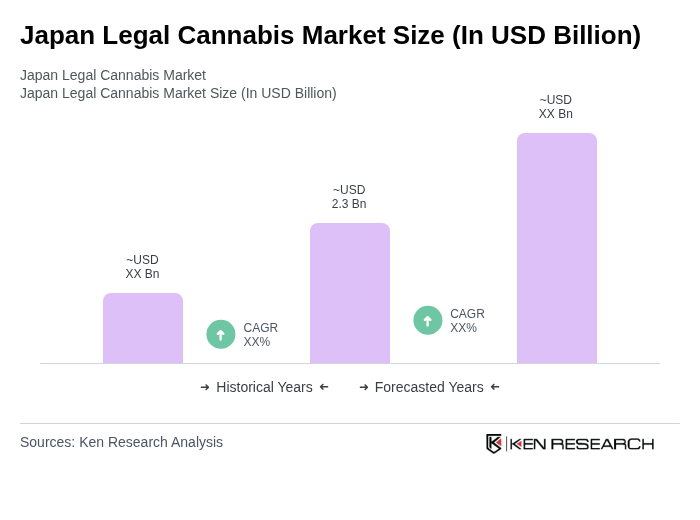
- The Japan Legal Cannabis Market is valued at USD 2.3 billion, based on a five-year historical analysis. This growth is primarily driven by increasing acceptance of cannabis for medical purposes, coupled with a rising demand for CBD products among consumers seeking natural remedies for health issues. The market is also influenced by changing societal attitudes towards cannabis, leading to a gradual shift in regulatory frameworks.
- Tokyo and Osaka are the dominant cities in the Japan Legal Cannabis Market due to their large urban populations and progressive consumer attitudes towards cannabis. These cities serve as cultural and economic hubs, fostering innovation and attracting investments in the cannabis sector. Additionally, the presence of numerous healthcare facilities and research institutions in these areas supports the growth of medical cannabis applications.
- The Cannabis Control Act, 2024 issued by the Ministry of Health, Labour and Welfare, amended in December 2024, permits the cultivation of cannabis-derived pharmaceuticals including CBD for medical use under strict licensing requirements, limited to approved clinical applications with THC content thresholds below 0.001% and mandatory quality testing.
Japan Legal Cannabis Market Segmentation
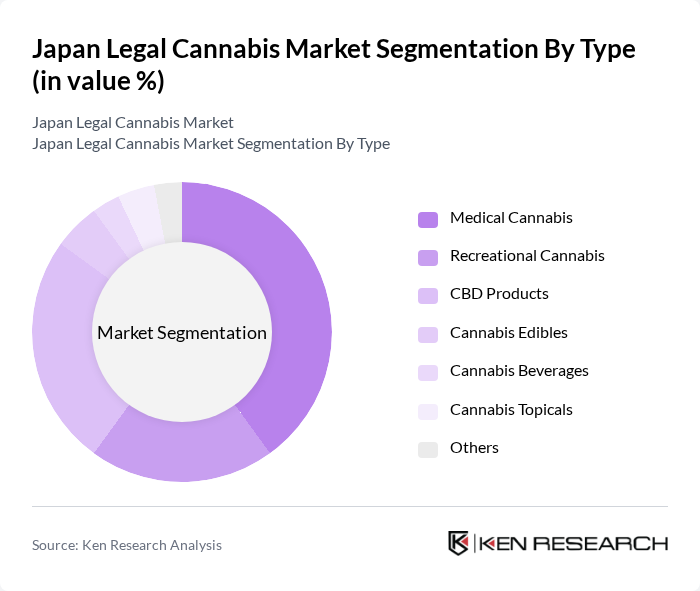
By Type:The market is segmented into various types, including Medical Cannabis, Recreational Cannabis, CBD Products, Cannabis Edibles, Cannabis Beverages, Cannabis Topicals, and Others. Among these, Medical Cannabis is currently the leading segment, driven by increasing recognition of its therapeutic benefits and a growing number of patients seeking alternative treatments. The demand for CBD products is also on the rise, particularly among health-conscious consumers looking for natural wellness solutions.
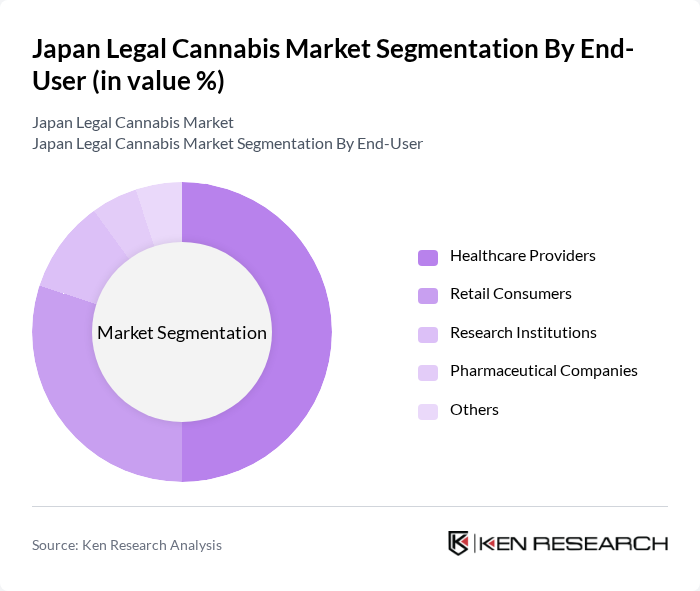
By End-User:The end-user segmentation includes Healthcare Providers, Retail Consumers, Research Institutions, Pharmaceutical Companies, and Others. Healthcare Providers are the dominant end-user segment, as they are increasingly prescribing medical cannabis for various health conditions. Retail Consumers are also a significant segment, driven by the growing popularity of CBD products and recreational cannabis among the general public.
Japan Legal Cannabis Market Competitive Landscape
The Japan Legal Cannabis Market is characterized by a dynamic mix of regional and international players. Leading participants such as Canopy Growth Corporation, Aurora Cannabis Inc., Tilray, Inc., Cronos Group Inc., HEXO Corp., Organigram Holdings Inc., GW Pharmaceuticals, MedMen Enterprises Inc., Curaleaf Holdings, Inc., Trulieve Cannabis Corp., Aphria Inc., Harvest Health & Recreation Inc., Green Thumb Industries Inc., Cresco Labs Inc., and Acreage Holdings, Inc. contribute to innovation, geographic expansion, and service delivery in this space.
Japan Legal Cannabis Market Industry Analysis
Growth Drivers
- Increasing Acceptance of Cannabis for Medical Use:The Japanese government has recognized the therapeutic potential of cannabis, leading to a rise in medical cannabis prescriptions. In future, approximately 12,000 patients were reported to have received medical cannabis, a significant increase from 5,000 in 2021. This growing acceptance is supported by a future survey indicating that 60% of healthcare professionals now advocate for cannabis in treatment plans, reflecting a shift in public and professional attitudes towards its medical use.
- Expansion of Research and Development Activities:Japan's investment in cannabis research has surged, with funding reaching ¥3.5 billion (approximately $31 million) in future. This investment is aimed at exploring the medicinal benefits of cannabinoids, particularly CBD. Notably, 15 universities and research institutions are currently engaged in cannabis-related studies, fostering innovation and potentially leading to new therapeutic products that could enhance market growth and consumer acceptance.
- Rising Demand for CBD Products:The demand for CBD products in Japan has seen a remarkable increase, with sales projected to reach ¥12 billion (around $108 million) in future, up from ¥5 billion in 2022. This surge is driven by a growing consumer interest in wellness and natural remedies, with 45% of Japanese consumers expressing a preference for CBD-infused products. The trend is further supported by the increasing availability of CBD in retail outlets and online platforms, enhancing accessibility for consumers.
Market Challenges
- Strict Regulatory Environment:Japan's cannabis market is heavily regulated, with stringent laws governing cultivation, distribution, and use. The Cannabis Control Act imposes severe penalties for violations, creating a challenging landscape for businesses. In future, only 20 licenses for medical cannabis production were issued, limiting market entry and stifling innovation. This regulatory framework poses significant hurdles for potential investors and new entrants seeking to capitalize on the emerging market.
- Stigma Associated with Cannabis Use:Despite increasing acceptance, a significant stigma surrounding cannabis persists in Japanese society. A future study revealed that 55% of the population still associates cannabis with illegal drug use, hindering broader acceptance. This societal perception affects consumer behavior and limits market growth, as many potential users remain hesitant to engage with cannabis products due to fear of social repercussions and misinformation about its effects.
Japan Legal Cannabis Market Future Outlook
The future of the Japan legal cannabis market appears promising, driven by evolving consumer attitudes and increasing medical applications. As public awareness grows, particularly regarding the benefits of CBD and medical cannabis, the market is likely to expand significantly in future. Additionally, advancements in technology and research will facilitate product innovation, while collaborations with pharmaceutical companies may enhance credibility and acceptance. Overall, the market is poised for growth, with a focus on sustainability and wellness trends shaping its trajectory.
Market Opportunities
- Development of Innovative Cannabis Products:There is a substantial opportunity for companies to create unique cannabis-infused products, such as edibles and beverages. With the market for cannabis-infused beverages projected to grow in future, innovative offerings could capture consumer interest and drive sales, particularly among health-conscious individuals seeking natural alternatives.
- Collaborations with Pharmaceutical Companies:Partnerships with established pharmaceutical firms can enhance research capabilities and market reach. By leveraging existing distribution networks and expertise, cannabis companies can effectively navigate regulatory challenges and accelerate product development, ultimately leading to a more robust market presence and increased consumer trust.
Scope of the Report
| Segment | Sub-Segments |
|---|---|
| By Type | Medical Cannabis Recreational Cannabis CBD Products Cannabis Edibles Cannabis Beverages Cannabis Topicals Others |
| By End-User | Healthcare Providers Retail Consumers Research Institutions Pharmaceutical Companies Others |
| By Distribution Channel | Online Retail Physical Dispensaries Pharmacies Specialty Stores Others |
| By Product Form | Dried Flower Oils and Tinctures Capsules Concentrates Others |
| By Consumer Demographics | Age Group (18-24, 25-34, 35-44, 45+) Gender Income Level Lifestyle Preferences Others |
| By Geographic Distribution | Urban Areas Suburban Areas Rural Areas Others |
| By Regulatory Compliance Level | Fully Compliant Products Partially Compliant Products Non-Compliant Products Others |
Key Target Audience
Investors and Venture Capitalist Firms
Government and Regulatory Bodies (e.g., Ministry of Health, Labour and Welfare)
Manufacturers and Producers
Distributors and Retailers
Pharmaceutical Companies
Health and Wellness Brands
Industry Associations (e.g., Japan Cannabis Association)
Financial Institutions
Players Mentioned in the Report:
Canopy Growth Corporation
Aurora Cannabis Inc.
Tilray, Inc.
Cronos Group Inc.
HEXO Corp.
Organigram Holdings Inc.
GW Pharmaceuticals
MedMen Enterprises Inc.
Curaleaf Holdings, Inc.
Trulieve Cannabis Corp.
Aphria Inc.
Harvest Health & Recreation Inc.
Green Thumb Industries Inc.
Cresco Labs Inc.
Acreage Holdings, Inc.
Table of Contents
Market Assessment Phase
1. Executive Summary and Approach
2. Japan Legal Cannabis Market Overview
2.1 Key Insights and Strategic Recommendations
2.2 Japan Legal Cannabis Market Overview
2.3 Definition and Scope
2.4 Evolution of Market Ecosystem
2.5 Timeline of Key Regulatory Milestones
2.6 Value Chain & Stakeholder Mapping
2.7 Business Cycle Analysis
2.8 Policy & Incentive Landscape
3. Japan Legal Cannabis Market Analysis
3.1 Growth Drivers
3.1.1 Increasing Acceptance of Cannabis for Medical Use
3.1.2 Expansion of Research and Development Activities
3.1.3 Rising Demand for CBD Products
3.1.4 Potential for Export Opportunities
3.2 Market Challenges
3.2.1 Strict Regulatory Environment
3.2.2 Stigma Associated with Cannabis Use
3.2.3 Limited Public Awareness and Education
3.2.4 High Entry Barriers for New Players
3.3 Market Opportunities
3.3.1 Development of Innovative Cannabis Products
3.3.2 Collaborations with Pharmaceutical Companies
3.3.3 Growth of E-commerce Platforms
3.3.4 Increasing Interest in Wellness and Natural Remedies
3.4 Market Trends
3.4.1 Shift Towards Sustainable and Organic Products
3.4.2 Rise of Cannabis Tourism
3.4.3 Integration of Technology in Cultivation
3.4.4 Emergence of Cannabis-Infused Beverages
3.5 Government Regulation
3.5.1 Medical Cannabis Legalization Framework
3.5.2 Licensing Requirements for Producers
3.5.3 Advertising and Marketing Restrictions
3.5.4 Import and Export Regulations
4. SWOT Analysis
5. Stakeholder Analysis
6. Porter's Five Forces Analysis
7. Japan Legal Cannabis Market Market Size, 2019-2024
7.1 By Value
7.2 By Volume
7.3 By Average Selling Price
8. Japan Legal Cannabis Market Segmentation
8.1 By Type
8.1.1 Medical Cannabis
8.1.2 Recreational Cannabis
8.1.3 CBD Products
8.1.4 Cannabis Edibles
8.1.5 Cannabis Beverages
8.1.6 Cannabis Topicals
8.1.7 Others
8.2 By End-User
8.2.1 Healthcare Providers
8.2.2 Retail Consumers
8.2.3 Research Institutions
8.2.4 Pharmaceutical Companies
8.2.5 Others
8.3 By Distribution Channel
8.3.1 Online Retail
8.3.2 Physical Dispensaries
8.3.3 Pharmacies
8.3.4 Specialty Stores
8.3.5 Others
8.4 By Product Form
8.4.1 Dried Flower
8.4.2 Oils and Tinctures
8.4.3 Capsules
8.4.4 Concentrates
8.4.5 Others
8.5 By Consumer Demographics
8.5.1 Age Group (18-24, 25-34, 35-44, 45+)
8.5.2 Gender
8.5.3 Income Level
8.5.4 Lifestyle Preferences
8.5.5 Others
8.6 By Geographic Distribution
8.6.1 Urban Areas
8.6.2 Suburban Areas
8.6.3 Rural Areas
8.6.4 Others
8.7 By Regulatory Compliance Level
8.7.1 Fully Compliant Products
8.7.2 Partially Compliant Products
8.7.3 Non-Compliant Products
8.7.4 Others
9. Japan Legal Cannabis Market Competitive Analysis
9.1 Market Share of Key Players
9.2 Cross Comparison of Key Players
9.2.1 Company Name
9.2.2 Group Size (Large, Medium, or Small as per industry convention)
9.2.3 Revenue Growth Rate
9.2.4 Market Penetration Rate
9.2.5 Customer Retention Rate
9.2.6 Product Diversification Index
9.2.7 Pricing Strategy
9.2.8 Brand Recognition Score
9.2.9 Distribution Network Efficiency
9.2.10 Innovation Rate
9.3 SWOT Analysis of Top Players
9.4 Pricing Analysis
9.5 Detailed Profile of Major Companies
9.5.1 Canopy Growth Corporation
9.5.2 Aurora Cannabis Inc.
9.5.3 Tilray, Inc.
9.5.4 Cronos Group Inc.
9.5.5 HEXO Corp.
9.5.6 Organigram Holdings Inc.
9.5.7 GW Pharmaceuticals
9.5.8 MedMen Enterprises Inc.
9.5.9 Curaleaf Holdings, Inc.
9.5.10 Trulieve Cannabis Corp.
9.5.11 Aphria Inc.
9.5.12 Harvest Health & Recreation Inc.
9.5.13 Green Thumb Industries Inc.
9.5.14 Cresco Labs Inc.
9.5.15 Acreage Holdings, Inc.
10. Japan Legal Cannabis Market End-User Analysis
10.1 Procurement Behavior of Key Ministries
10.1.1 Ministry of Health, Labour and Welfare
10.1.2 Ministry of Agriculture, Forestry and Fisheries
10.1.3 Ministry of Economy, Trade and Industry
10.1.4 Others
10.2 Corporate Spend on Infrastructure & Energy
10.2.1 Investment in Cultivation Facilities
10.2.2 Expenditure on Research and Development
10.2.3 Budget for Marketing and Branding
10.2.4 Others
10.3 Pain Point Analysis by End-User Category
10.3.1 Healthcare Providers
10.3.2 Retail Consumers
10.3.3 Research Institutions
10.3.4 Others
10.4 User Readiness for Adoption
10.4.1 Awareness Levels
10.4.2 Perceived Benefits
10.4.3 Barriers to Adoption
10.4.4 Others
10.5 Post-Deployment ROI and Use Case Expansion
10.5.1 Measurement of ROI
10.5.2 Expansion into New Use Cases
10.5.3 Customer Feedback and Iteration
10.5.4 Others
11. Japan Legal Cannabis Market Future Size, 2025-2030
11.1 By Value
11.2 By Volume
11.3 By Average Selling Price
Go-To-Market Strategy Phase
1. Whitespace Analysis + Business Model Canvas
1.1 Market Gaps Identification
1.2 Business Model Development
1.3 Value Proposition Articulation
1.4 Competitive Advantage Analysis
2. Marketing and Positioning Recommendations
2.1 Branding Strategies
2.2 Product USPs
3. Distribution Plan
3.1 Urban Retail vs Rural NGO Tie-ups
4. Channel & Pricing Gaps
4.1 Underserved Routes
4.2 Pricing Bands
5. Unmet Demand & Latent Needs
5.1 Category Gaps
5.2 Consumer Segments
6. Customer Relationship
6.1 Loyalty Programs
6.2 After-sales Service
7. Value Proposition
7.1 Sustainability
7.2 Integrated Supply Chains
8. Key Activities
8.1 Regulatory Compliance
8.2 Branding
8.3 Distribution Setup
9. Entry Strategy Evaluation
9.1 Domestic Market Entry Strategy
9.1.1 Product Mix
9.1.2 Pricing Band
9.1.3 Packaging
9.2 Export Entry Strategy
9.2.1 Target Countries
9.2.2 Compliance Roadmap
10. Entry Mode Assessment
10.1 JV
10.2 Greenfield
10.3 M&A
10.4 Distributor Model
11. Capital and Timeline Estimation
11.1 Capital Requirements
11.2 Timelines
12. Control vs Risk Trade-Off
12.1 Ownership vs Partnerships
13. Profitability Outlook
13.1 Breakeven Analysis
13.2 Long-term Sustainability
14. Potential Partner List
14.1 Distributors
14.2 JVs
14.3 Acquisition Targets
15. Execution Roadmap
15.1 Phased Plan for Market Entry
15.1.1 Market Setup
15.1.2 Market Entry
15.1.3 Growth Acceleration
15.1.4 Scale & Stabilize
15.2 Key Activities and Milestones
15.2.1 Activity Planning
15.2.2 Milestone Tracking
Research Methodology
Phase 1: Approach1
Desk Research
- Analysis of government publications and regulatory frameworks regarding cannabis legalization in Japan
- Review of market reports and white papers from industry associations and research firms
- Examination of consumer behavior studies and demographic data related to cannabis use
Primary Research
- Interviews with legal experts and policymakers involved in cannabis legislation
- Surveys targeting potential consumers to gauge attitudes and preferences towards cannabis products
- Focus groups with industry stakeholders, including producers, distributors, and retailers
Validation & Triangulation
- Cross-validation of findings through multiple data sources, including academic studies and market analyses
- Triangulation of consumer insights with sales data from existing legal cannabis markets
- Sanity checks conducted through expert panel reviews and feedback sessions
Phase 2: Market Size Estimation1
Top-down Assessment
- Estimation of market size based on projected consumer spending on cannabis products in Japan
- Analysis of potential market segments, including medical, recreational, and CBD products
- Incorporation of demographic trends and population growth projections in Japan
Bottom-up Modeling
- Collection of sales data from existing cannabis dispensaries and retailers in regions where cannabis is legal
- Estimation of average transaction values and frequency of purchases among consumers
- Volume estimates based on production capacities of licensed cultivators and manufacturers
Forecasting & Scenario Analysis
- Multi-factor regression analysis incorporating economic indicators, consumer trends, and regulatory changes
- Scenario modeling based on varying levels of market acceptance and potential policy shifts
- Development of baseline, optimistic, and pessimistic forecasts through 2030
Phase 3: CATI Sample Composition1
| Scope Item/Segment | Sample Size | Target Respondent Profiles |
|---|---|---|
| Consumer Attitudes towards Legal Cannabis | 120 | General Public, Potential Cannabis Users |
| Industry Stakeholder Insights | 80 | Producers, Distributors, Retailers |
| Medical Cannabis Usage Patterns | 60 | Healthcare Professionals, Patients |
| Regulatory Perspectives | 40 | Policymakers, Legal Experts |
| Market Entry Strategies | 50 | Business Development Managers, Entrepreneurs |
Frequently Asked Questions
What is the current value of the Japan Legal Cannabis Market?
The Japan Legal Cannabis Market is valued at approximately USD 2.3 billion, driven by increasing acceptance of cannabis for medical purposes and a rising demand for CBD products among consumers seeking natural health remedies.
Which cities are leading in the Japan Legal Cannabis Market?
What are the key regulations governing cannabis in Japan?
What types of cannabis products are available in Japan?
Other Regional/Country Reports
Other Adjacent Reports
Qatar Dietary Supplement Market
Philippines Alternative Medicine Market
Indonesia Wellness Product Market
UAE Functional Beverage MarketSaudi Arabia cosmeceutical market size, share, growth drivers, trends, opportunities & forecast 2025–2030Saudi Arabia biotechnology market Size, Share, Growth Drivers, Trends, Opportunities & Forecast 2025–2030Egypt Clinical Research Market
Middle East Herbal Extract MarketWhy Buy From Us?

What makes us stand out is that our consultants follow Robust, Refine and Result (RRR) methodology. Robust for clear definitions, approaches and sanity checking, Refine for differentiating respondents' facts and opinions, and Result for presenting data with story.

We have set a benchmark in the industry by offering our clients with syndicated and customized market research reports featuring coverage of entire market as well as meticulous research and analyst insights.

While we don't replace traditional research, we flip the method upside down. Our dual approach of Top Bottom & Bottom Top ensures quality deliverable by not just verifying company fundamentals but also looking at the sector and macroeconomic factors.

With one step in the future, our research team constantly tries to show you the bigger picture. We help with some of the tough questions you may encounter along the way: How is the industry positioned? Best marketing channel? KPI's of competitors? By aligning every element, we help maximize success.

Our report gives you instant access to the answers and sources that other companies might choose to hide. We elaborate each steps of research methodology we have used and showcase you the sample size to earn your trust.

If you need any support, we are here! We pride ourselves on universe strength, data quality, and quick, friendly, and professional service.