About the Report
Base Year 2024Japan Paper Bag Market Overview
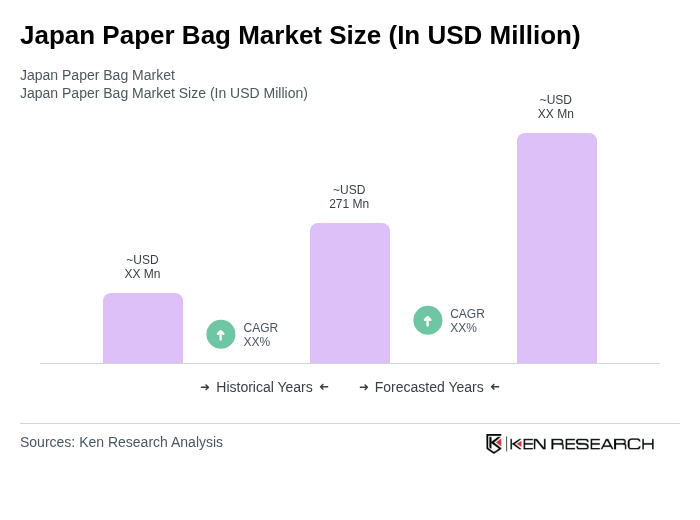
- The Japan Paper Bag Market is valued at approximately USD 271 million, based on a five-year historical analysis. This growth is primarily driven by increasing consumer preference for sustainable packaging solutions, as well as government regulations aimed at reducing plastic waste. The rising awareness of environmental issues has led to a significant shift towards paper bags, which are perceived as eco-friendly alternatives to plastic. The market is witnessing consistent growth as a result of heightening environmental concern and government campaigns to minimize the use of plastic, with increased adoption by the retail, food, and e-commerce sectors further supporting market expansion as businesses shift toward eco-friendly alternatives to enhance brand image and comply with sustainability goals.
- Tokyo and Osaka are the dominant cities in the Japan Paper Bag Market due to their high population density and robust retail sectors. These urban centers have a strong demand for packaging solutions in various industries, including food and beverages, retail, and pharmaceuticals. The concentration of businesses and consumers in these cities fosters a competitive environment that drives innovation and growth in the market.
- The Japanese government has implemented regulations mandating that retail establishments charge customers for plastic bags, encouraging the use of paper bags instead. This initiative aims to reduce plastic waste and promote sustainable practices among consumers and businesses alike, significantly impacting the demand for paper bags in the market. For instance, in April 2024, SoftBank Corp. revealed the replacement of around 6.5 million yearly plastic-coated paper shopping bags with 100% recycled paper bags, with the aim of cutting plastic usage by 55.8 tons and CO? emissions by 67.8 tons annually.
Japan Paper Bag Market Segmentation
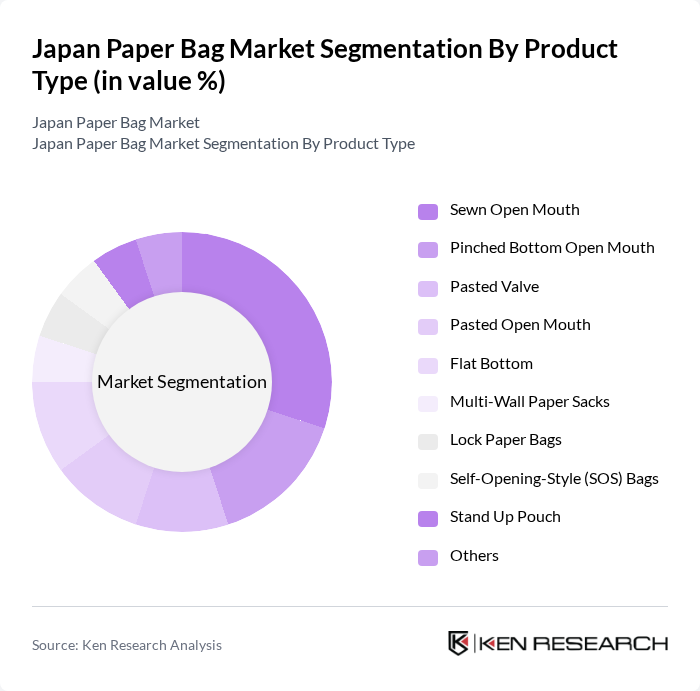
By Product Type:The product type segmentation of the Japan Paper Bag Market includes various subsegments such as Sewn Open Mouth, Pinched Bottom Open Mouth, Pasted Valve, Pasted Open Mouth, Flat Bottom, Multi-Wall Paper Sacks, Lock Paper Bags, Self-Opening-Style (SOS) Bags, Stand Up Pouch, and Others. Among these, the Sewn Open Mouth bags are currently dominating the market due to their versatility and strength, making them suitable for a wide range of applications, particularly in the food and beverage sector. The increasing demand for durable and reliable packaging solutions is driving the growth of this subsegment.
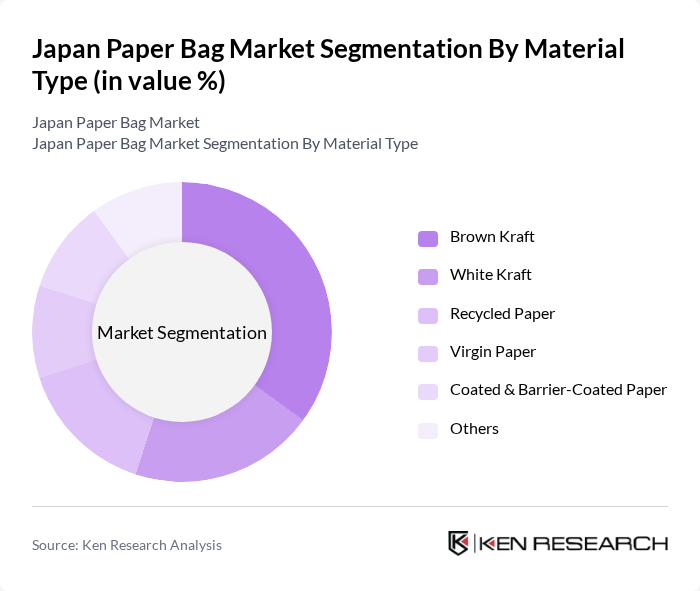
By Material Type:The material type segmentation includes Brown Kraft, White Kraft, Recycled Paper, Virgin Paper, Coated & Barrier-Coated Paper, and Others. Recycled Paper has emerged as the largest revenue-generating segment due to growing sustainability focus and consumer demand for environmentally responsible packaging solutions. Brown Kraft paper remains a strong performer due to its cost-effectiveness and strong durability, making it a preferred choice for various applications, especially in the food and retail sectors. The increasing focus on sustainability and the use of recycled materials are contributing significantly to market growth.
Japan Paper Bag Market Competitive Landscape
The Japan Paper Bag Market is characterized by a dynamic mix of regional and international players. Leading participants such as Daio Paper Corporation, Nippon Paper Industries Co., Ltd., Oji Holdings Corporation, Toyo Seikan Group Holdings Ltd., Seiko PMC Corporation, Kokusai Pulp & Paper Co., Ltd., Marubeni Corporation, Sappi Lanaken Mill, Mitsubishi Paper Mills Limited, Rengo Co., Ltd., Kawai Paper Co., Ltd., Hokuetsu Kishu Paper Co., Ltd., Kishu Giken Kogyo Co., Ltd., Kanto Paper Co., Ltd., Shikoku Kakoki Co., Ltd. contribute to innovation, geographic expansion, and service delivery in this space.
Japan Paper Bag Market Industry Analysis
Growth Drivers
- Increasing Environmental Awareness:The Japanese population is increasingly prioritizing sustainability, with 75% of consumers expressing a preference for eco-friendly products in future. This shift is supported by a 20% rise in sales of paper bags over the past year, reflecting a growing commitment to reducing plastic waste. The government’s initiatives, including educational campaigns, have further heightened awareness, leading to a significant increase in demand for sustainable packaging solutions across various sectors.
- Government Regulations Promoting Sustainable Packaging:Japan's government is expected to implement stricter regulations on single-use plastics, with a target to reduce plastic waste by 30% by future. This regulatory environment is driving businesses to adopt paper bags as a compliant alternative. The introduction of subsidies for companies transitioning to sustainable packaging has also resulted in a 25% increase in paper bag production, highlighting the positive impact of government policies on market growth.
- Shift in Consumer Preferences Towards Eco-Friendly Products:A survey conducted in future revealed that 70% of Japanese consumers are willing to pay up to 15% more for eco-friendly packaging options. This trend is particularly evident in the retail and food sectors, where paper bags are increasingly favored. The e-commerce sector has also seen a 35% increase in the use of paper bags, driven by consumer demand for sustainable packaging solutions that align with their values and lifestyle choices.
Market Challenges
- Competition from Plastic Bags:Despite the growing popularity of paper bags, plastic bags still dominate the market, accounting for approximately 55% of total bag usage in Japan as of future. The lower cost and convenience of plastic bags pose significant challenges for paper bag manufacturers. Additionally, many consumers remain unaware of the environmental impact of plastic, which complicates efforts to shift preferences towards paper alternatives in certain demographics.
- Fluctuating Raw Material Prices:The paper industry is currently facing volatility in raw material prices, with costs for recycled paper increasing by 15% in future due to supply chain disruptions. This fluctuation can lead to unpredictable pricing for paper bags, making it difficult for manufacturers to maintain competitive pricing. As a result, some companies may struggle to balance profitability while adhering to sustainable practices, potentially hindering market growth.
Japan Paper Bag Market Future Outlook
The Japan paper bag market is poised for significant growth as sustainability becomes a core value for consumers and businesses alike. With government regulations tightening around plastic usage, the demand for paper bags is expected to rise sharply. Innovations in design and functionality will likely enhance the appeal of paper bags, while collaborations with retailers will create tailored solutions. As consumer awareness continues to grow, the market is set to evolve, driven by a collective commitment to environmental responsibility and sustainable practices.
Market Opportunities
- Expansion in the Food and Beverage Sector:The food and beverage industry is increasingly adopting paper bags, with a projected increase of 30% in usage by future. This shift is driven by consumer demand for sustainable packaging options, presenting a lucrative opportunity for manufacturers to cater to this growing segment.
- Innovations in Paper Bag Design and Functionality:There is a rising demand for innovative paper bag designs that enhance usability, such as moisture-resistant and reusable options. This trend is expected to create new market opportunities, with an estimated 20% increase in sales for companies that invest in research and development of advanced paper bag solutions by future.
Scope of the Report
| Segment | Sub-Segments |
|---|---|
| By Product Type | Sewn Open Mouth Pinched Bottom Open Mouth Pasted Valve Pasted Open Mouth Flat Bottom Multi-Wall Paper Sacks Lock Paper Bags Self-Opening-Style (SOS) Bags Stand Up Pouch Others |
| By Material Type | Brown Kraft White Kraft Recycled Paper Virgin Paper Coated & Barrier-Coated Paper Others |
| By Thickness | Ply Ply Ply Greater Than 3 Ply |
| By Capacity | Less Than 1 Kg Kg–5 Kg Kg–10 Kg More Than 10 Kg |
| By Size | Small Size Medium Size Large Size Extra-Large Size |
| By Sealing and Handle | Heat Seal Hand Length Handle Ziplock Twisted Handle Flat Handle Others |
| By Shape | Rectangle Square Circular Others |
| By Distribution Channel | Online Offline Direct (Mill/Converter to Brand) B2B Portals Distributors Wholesalers Others |
| By End-Use Industry | Food and Beverages Pharmaceutical Retail Construction Chemicals Animal Feed Cosmetic Products Agriculture Others |
| By Usage | Single Use Re-Usable |
Key Target Audience
Investors and Venture Capitalist Firms
Government and Regulatory Bodies (e.g., Ministry of the Environment, Japan)
Manufacturers and Producers
Distributors and Retailers
Packaging Industry Associations
Environmental NGOs and Advocacy Groups
Logistics and Supply Chain Companies
Financial Institutions
Players Mentioned in the Report:
Daio Paper Corporation
Nippon Paper Industries Co., Ltd.
Oji Holdings Corporation
Toyo Seikan Group Holdings Ltd.
Seiko PMC Corporation
Kokusai Pulp & Paper Co., Ltd.
Marubeni Corporation
Sappi Lanaken Mill
Mitsubishi Paper Mills Limited
Rengo Co., Ltd.
Kawai Paper Co., Ltd.
Hokuetsu Kishu Paper Co., Ltd.
Kishu Giken Kogyo Co., Ltd.
Kanto Paper Co., Ltd.
Shikoku Kakoki Co., Ltd.
Table of Contents
Market Assessment Phase
1. Executive Summary and Approach
2. Japan Paper Bag Market Overview
2.1 Key Insights and Strategic Recommendations
2.2 Japan Paper Bag Market Overview
2.3 Definition and Scope
2.4 Evolution of Market Ecosystem
2.5 Timeline of Key Regulatory Milestones
2.6 Value Chain & Stakeholder Mapping
2.7 Business Cycle Analysis
2.8 Policy & Incentive Landscape
3. Japan Paper Bag Market Analysis
3.1 Growth Drivers
3.1.1 Increasing Environmental Awareness
3.1.2 Government Regulations Promoting Sustainable Packaging
3.1.3 Shift in Consumer Preferences Towards Eco-Friendly Products
3.1.4 Growth of E-commerce and Retail Sectors
3.2 Market Challenges
3.2.1 Competition from Plastic Bags
3.2.2 Fluctuating Raw Material Prices
3.2.3 Limited Consumer Awareness in Certain Segments
3.2.4 Supply Chain Disruptions
3.3 Market Opportunities
3.3.1 Expansion in the Food and Beverage Sector
3.3.2 Innovations in Paper Bag Design and Functionality
3.3.3 Collaborations with Retailers for Custom Solutions
3.3.4 Growing Demand for Biodegradable Options
3.4 Market Trends
3.4.1 Rise of Online Shopping and Delivery Services
3.4.2 Increased Focus on Brand Sustainability
3.4.3 Adoption of Smart Packaging Solutions
3.4.4 Customization and Personalization in Packaging
3.5 Government Regulation
3.5.1 Ban on Single-Use Plastics
3.5.2 Incentives for Sustainable Packaging Solutions
3.5.3 Standards for Paper Bag Production
3.5.4 Labeling Requirements for Eco-Friendly Products
4. SWOT Analysis
5. Stakeholder Analysis
6. Porter's Five Forces Analysis
7. Japan Paper Bag Market Market Size, 2019-2024
7.1 By Value
7.2 By Volume
7.3 By Average Selling Price
8. Japan Paper Bag Market Segmentation
8.1 By Product Type
8.1.1 Sewn Open Mouth
8.1.2 Pinched Bottom Open Mouth
8.1.3 Pasted Valve
8.1.4 Pasted Open Mouth
8.1.5 Flat Bottom
8.1.6 Multi-Wall Paper Sacks
8.1.7 Lock Paper Bags
8.1.8 Self-Opening-Style (SOS) Bags
8.1.9 Stand Up Pouch
8.1.10 Others
8.2 By Material Type
8.2.1 Brown Kraft
8.2.2 White Kraft
8.2.3 Recycled Paper
8.2.4 Virgin Paper
8.2.5 Coated & Barrier-Coated Paper
8.2.6 Others
8.3 By Thickness
8.3.1 1 Ply
8.3.2 2 Ply
8.3.3 3 Ply
8.3.4 Greater Than 3 Ply
8.4 By Capacity
8.4.1 Less Than 1 Kg
8.4.2 1 Kg–5 Kg
8.4.3 5 Kg–10 Kg
8.4.4 More Than 10 Kg
8.5 By Size
8.5.1 Small Size
8.5.2 Medium Size
8.5.3 Large Size
8.5.4 Extra-Large Size
8.6 By Sealing and Handle
8.6.1 Heat Seal
8.6.2 Hand Length Handle
8.6.3 Ziplock
8.6.4 Twisted Handle
8.6.5 Flat Handle
8.6.6 Others
8.7 By Shape
8.7.1 Rectangle
8.7.2 Square
8.7.3 Circular
8.7.4 Others
8.8 By Distribution Channel
8.8.1 Online
8.8.2 Offline
8.8.3 Direct (Mill/Converter to Brand)
8.8.4 B2B Portals
8.8.5 Distributors
8.8.6 Wholesalers
8.8.7 Others
8.9 By End-Use Industry
8.9.1 Food and Beverages
8.9.2 Pharmaceutical
8.9.3 Retail
8.9.4 Construction
8.9.5 Chemicals
8.9.6 Animal Feed
8.9.7 Cosmetic Products
8.9.8 Agriculture
8.9.9 Others
8.10 By Usage
8.10.1 Single Use
8.10.2 Re-Usable
9. Japan Paper Bag Market Competitive Analysis
9.1 Market Share of Key Players
9.2 Cross Comparison of Key Players
9.2.1 Company Name
9.2.2 Group Size (Large, Medium, or Small as per industry convention)
9.2.3 Year-over-Year Revenue Growth Rate (%)
9.2.4 Market Share (%)
9.2.5 Production Capacity (Metric Tons/Annum)
9.2.6 Production Capacity Utilization Rate (%)
9.2.7 Average Selling Price (JPY/Unit)
9.2.8 Distribution Network Reach (Number of Distribution Points)
9.2.9 New Product Launches (Count per Year)
9.2.10 Sustainability Certifications (ISO, FSC, etc.)
9.3 SWOT Analysis of Top Players
9.4 Pricing Analysis
9.5 Detailed Profile of Major Companies
9.5.1 Daio Paper Corporation
9.5.2 Nippon Paper Industries Co., Ltd.
9.5.3 Oji Holdings Corporation
9.5.4 Toyo Seikan Group Holdings Ltd.
9.5.5 Seiko PMC Corporation
9.5.6 Kokusai Pulp & Paper Co., Ltd.
9.5.7 Marubeni Corporation
9.5.8 Sappi Lanaken Mill
9.5.9 Mitsubishi Paper Mills Limited
9.5.10 Rengo Co., Ltd.
9.5.11 Kawai Paper Co., Ltd.
9.5.12 Hokuetsu Kishu Paper Co., Ltd.
9.5.13 Kishu Giken Kogyo Co., Ltd.
9.5.14 Kanto Paper Co., Ltd.
9.5.15 Shikoku Kakoki Co., Ltd.
10. Japan Paper Bag Market End-User Analysis
10.1 Procurement Behavior of Key Ministries
10.1.1 Ministry of Environment
10.1.2 Ministry of Economy, Trade and Industry
10.1.3 Ministry of Agriculture, Forestry and Fisheries
10.1.4 Others
10.2 Corporate Spend on Infrastructure & Energy
10.2.1 Retail Sector Investments
10.2.2 Food and Beverage Sector Investments
10.2.3 E-commerce Sector Investments
10.2.4 Others
10.3 Pain Point Analysis by End-User Category
10.3.1 Retail Challenges
10.3.2 Food Service Challenges
10.3.3 E-commerce Challenges
10.3.4 Others
10.4 User Readiness for Adoption
10.4.1 Retail Readiness
10.4.2 Food Service Readiness
10.4.3 E-commerce Readiness
10.4.4 Others
10.5 Post-Deployment ROI and Use Case Expansion
10.5.1 Retail Use Cases
10.5.2 Food Service Use Cases
10.5.3 E-commerce Use Cases
10.5.4 Others
11. Japan Paper Bag Market Future Size, 2025-2030
11.1 By Value
11.2 By Volume
11.3 By Average Selling Price
Go-To-Market Strategy Phase
12. Whitespace Analysis + Business Model Canvas
12.1 Market Gaps Identification
12.2 Business Model Development
13. Marketing and Positioning Recommendations
13.1 Branding Strategies
13.2 Product USPs
14. Distribution Plan
14.1 Urban Retail Strategies
14.2 Rural NGO Tie-ups
15. Channel & Pricing Gaps
15.1 Underserved Routes
15.2 Pricing Bands
16. Unmet Demand & Latent Needs
16.1 Category Gaps
16.2 Consumer Segments
17. Customer Relationship
17.1 Loyalty Programs
17.2 After-sales Service
18. Value Proposition
18.1 Sustainability
18.2 Integrated Supply Chains
19. Key Activities
19.1 Regulatory Compliance
19.2 Branding
19.3 Distribution Setup
20. Entry Strategy Evaluation
20.1 Domestic Market Entry Strategy
20.1.1 Product Mix
20.1.2 Pricing Band
20.1.3 Packaging
20.2 Export Entry Strategy
20.2.1 Target Countries
20.2.2 Compliance Roadmap
21. Entry Mode Assessment
21.1 JV
21.2 Greenfield
21.3 M&A
21.4 Distributor Model
22. Capital and Timeline Estimation
22.1 Capital Requirements
22.2 Timelines
23. Control vs Risk Trade-Off
23.1 Ownership vs Partnerships
24. Profitability Outlook
24.1 Breakeven Analysis
24.2 Long-term Sustainability
25. Potential Partner List
25.1 Distributors
25.2 JVs
25.3 Acquisition Targets
26. Execution Roadmap
26.1 Phased Plan for Market Entry
26.1.1 Market Setup
26.1.2 Market Entry
26.1.3 Growth Acceleration
26.1.4 Scale & Stabilize
26.2 Key Activities and Milestones
26.2.1 Milestone Planning
26.2.2 Activity Tracking
27. Disclaimer
Research Methodology
Phase 1: Approach1
Desk Research
- Analysis of industry reports from Japanese packaging associations and market research firms
- Review of government publications on environmental regulations affecting paper bag usage
- Examination of trade statistics and import/export data related to paper products
Primary Research
- Interviews with key stakeholders in the retail and food service sectors
- Surveys conducted with manufacturers of paper bags to understand production capacities
- Focus groups with consumers to gauge preferences and perceptions of paper bags
Validation & Triangulation
- Cross-validation of findings through multiple data sources, including sales data and market trends
- Triangulation of insights from industry experts and academic research on sustainability
- Sanity checks through expert panel discussions to validate assumptions and findings
Phase 2: Market Size Estimation1
Top-down Assessment
- Estimation of total market size based on national consumption data of paper products
- Segmentation by end-user industries such as retail, food service, and e-commerce
- Incorporation of growth rates from sustainability initiatives and consumer trends
Bottom-up Modeling
- Collection of production volume data from leading paper bag manufacturers
- Cost analysis based on material prices and production processes
- Estimation of market share distribution among various manufacturers and sectors
Forecasting & Scenario Analysis
- Development of forecasting models based on historical growth rates and market drivers
- Scenario analysis considering regulatory changes and shifts in consumer behavior
- Projections for market growth through 2030 under different economic conditions
Phase 3: CATI Sample Composition1
| Scope Item/Segment | Sample Size | Target Respondent Profiles |
|---|---|---|
| Retail Sector Paper Bag Usage | 150 | Store Managers, Procurement Officers |
| Food Service Industry Insights | 100 | Restaurant Owners, Supply Chain Managers |
| E-commerce Packaging Preferences | 80 | E-commerce Managers, Logistics Coordinators |
| Consumer Attitudes Towards Sustainability | 120 | General Consumers, Environmental Advocates |
| Manufacturers of Paper Bags | 70 | Production Managers, Sales Directors |
Frequently Asked Questions
What is the current value of the Japan Paper Bag Market?
The Japan Paper Bag Market is valued at approximately USD 271 million, reflecting a significant shift towards sustainable packaging solutions driven by consumer preferences and government regulations aimed at reducing plastic waste.
What factors are driving the growth of the Japan Paper Bag Market?
Which cities are the largest markets for paper bags in Japan?
How has the Japanese government influenced the paper bag market?
Other Regional/Country Reports
Other Adjacent Reports
KSA Recycled Paper Market
Japan Kraft Paper Market
Saudi Arabia biodegradable packaging market report Size, Share, Growth Drivers, Trends, Opportunities & Forecast 2025–2030South Africa Retail Packaging Market
KSA food packaging market size, share, growth drivers, trends, opportunities & forecast 2025–2030Vietnam E-Commerce Packaging Market
Global Pharmaceutical Packaging Market Size, Share & Forecast, By Packaging Type, Material & Drug Delivery Mode, 2025-2032KSA Pulp and Paper Market Outlook to 2030Why Buy From Us?

What makes us stand out is that our consultants follow Robust, Refine and Result (RRR) methodology. Robust for clear definitions, approaches and sanity checking, Refine for differentiating respondents' facts and opinions, and Result for presenting data with story.

We have set a benchmark in the industry by offering our clients with syndicated and customized market research reports featuring coverage of entire market as well as meticulous research and analyst insights.

While we don't replace traditional research, we flip the method upside down. Our dual approach of Top Bottom & Bottom Top ensures quality deliverable by not just verifying company fundamentals but also looking at the sector and macroeconomic factors.

With one step in the future, our research team constantly tries to show you the bigger picture. We help with some of the tough questions you may encounter along the way: How is the industry positioned? Best marketing channel? KPI's of competitors? By aligning every element, we help maximize success.

Our report gives you instant access to the answers and sources that other companies might choose to hide. We elaborate each steps of research methodology we have used and showcase you the sample size to earn your trust.

If you need any support, we are here! We pride ourselves on universe strength, data quality, and quick, friendly, and professional service.