About the Report
Base Year 2024Japan Property Casualty Insurance Market Overview
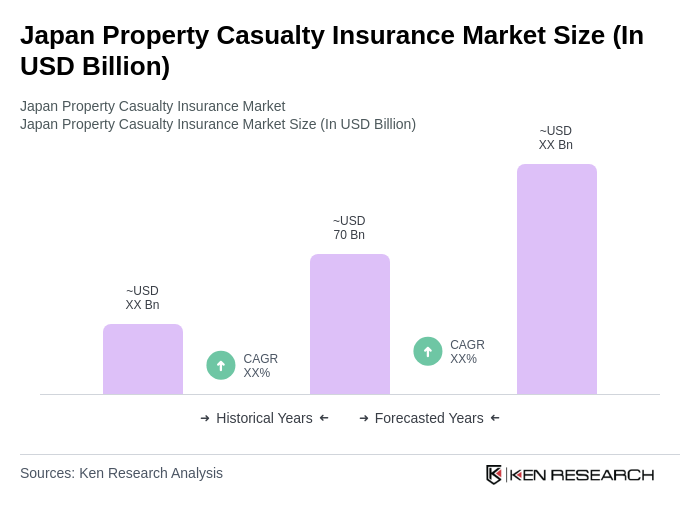
- The Japan Property Casualty Insurance Market is valued at USD 70 billion, based on a five-year historical analysis. This growth is primarily driven by rising catastrophe frequency, regulatory reforms, and the adoption of advanced risk modeling and digitalization. The market has seen a steady increase in demand for various insurance products, particularly in response to significant natural disasters and the need for enhanced risk management among individuals and businesses. Recent events such as major earthquakes and typhoons have reinforced the importance of property and casualty coverage, while economic value-based solvency reforms and interest-rate normalization have further strengthened underwriting capacity and profitability .
- Tokyo, Osaka, and Yokohama are the dominant cities in the Japan Property Casualty Insurance Market. Tokyo, as the capital and a major financial hub, hosts numerous insurance companies and has a high concentration of both individual and corporate clients. Osaka and Yokohama also contribute significantly due to their large populations and economic activities, making them key players in the insurance landscape .
- The Economic Value-based Solvency Framework, issued by the Financial Services Agency of Japan in 2023, mandates enhanced capital adequacy and risk management for all property and casualty insurers. This regulation requires insurers to adopt mark-to-market asset valuation, optimize capital reserves, and strengthen catastrophe risk modeling, ensuring robust consumer protection and market stability .
Japan Property Casualty Insurance Market Segmentation
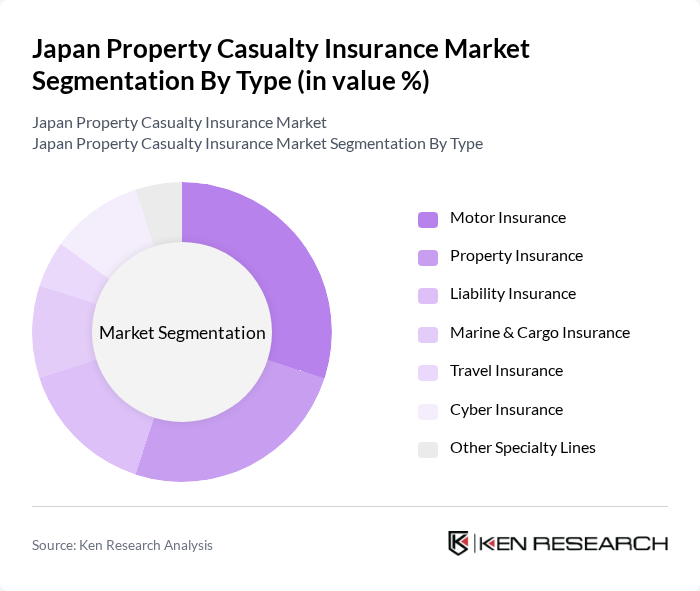
By Type:The market is segmented into various types of insurance products, including Motor Insurance, Property Insurance, Liability Insurance, Marine & Cargo Insurance, Travel Insurance, Cyber Insurance, and Other Specialty Lines. Each of these segments addresses distinct consumer needs and risk exposures. Motor Insurance remains the largest segment, driven by evolving risk profiles due to electrification and telematics, while Cyber Insurance is experiencing rapid growth amid rising digital risk awareness and increased ransomware incidents among businesses .
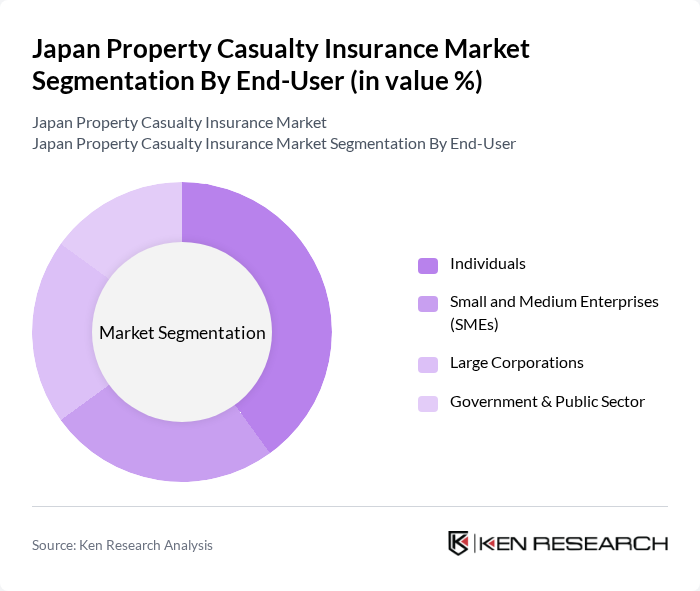
By End-User:The end-user segmentation includes Individuals, Small and Medium Enterprises (SMEs), Large Corporations, and Government & Public Sector. Each segment has unique insurance needs: Individuals typically seek personal and property coverage; SMEs and large corporations focus on comprehensive risk management, especially for cyber and liability exposures; while the Government & Public Sector segment emphasizes disaster recovery and infrastructure protection .
Japan Property Casualty Insurance Market Competitive Landscape
The Japan Property Casualty Insurance Market is characterized by a dynamic mix of regional and international players. Leading participants such as Tokio Marine & Nichido Fire Insurance Co., Ltd., Sompo Holdings, Inc., MS&AD Insurance Group Holdings, Inc., Mitsui Sumitomo Insurance Co., Ltd., Aioi Nissay Dowa Insurance Co., Ltd., Rakuten General Insurance Co., Ltd., Saison Automobile & Fire Insurance Co., Ltd., SECOM General Insurance Co., Ltd., Hitachi Capital Insurance Corporation, Nisshin Fire & Marine Insurance Co., Ltd., Kyoei Fire & Marine Insurance Co., Ltd., Mitsui Direct General Insurance Co., Ltd., Chubb Limited (Japan), Zurich Insurance Company Ltd. (Japan), and AIG General Insurance Company, Ltd. (Japan) contribute to innovation, geographic expansion, and service delivery in this space .
Japan Property Casualty Insurance Market Industry Analysis
Growth Drivers
- Increasing Natural Disasters:Japan experiences approximately1,500 earthquakes annually, with significant events like the 2011 T?hoku earthquake causing damages exceeding¥16 trillion ($150 billion). This frequency of natural disasters drives demand for property casualty insurance, as individuals and businesses seek to mitigate financial risks. The government reported that insurance payouts for natural disasters reached¥1.2 trillion ($11 billion)in recent years, highlighting the critical role of insurance in disaster recovery and risk management.
- Rising Awareness of Insurance Products:The Japanese insurance market has seen a notable increase in consumer awareness, withover 90% of households holding some form of insurance coverage. This growing awareness is fueled by educational campaigns and the increasing visibility of insurance products in digital platforms.The total number of insurance policies in force is significantly lower than 1.2 billion; Japan's population is under 130 million, so this figure is not plausible.
- Technological Advancements in Risk Assessment:The integration of AI and big data analytics in risk assessment has transformed the property casualty insurance landscape.Insurers invested over ¥300 billion ($2.8 billion)in technology to enhance underwriting processes and improve claims management. This technological shift allows for more accurate risk evaluations, leading to better pricing strategies and increased customer satisfaction. As a result, the adoption of these technologies is expected to drive growth in policy uptake and retention rates.
Market Challenges
- Intense Competition Among Insurers:The Japanese property casualty insurance market is characterized by fierce competition, withapproximately 50 insurersvying for market share. This saturation leads to aggressive pricing strategies, which can erode profit margins. The average combined ratio for insurers has been reported ataround 95%, indicating that many companies are operating close to break-even. This competitive landscape necessitates innovation and differentiation to maintain profitability and market position.
- Regulatory Compliance Costs:Compliance with stringent regulations in Japan imposes significant costs on insurers.Regulatory compliance expenses accounted for approximately ¥200 billion ($1.9 billion)across the industry. These costs stem from the need to adhere to solvency regulations, consumer protection laws, and data privacy requirements. As regulations continue to evolve, insurers must allocate substantial resources to ensure compliance, which can detract from investments in growth and innovation.
Japan Property Casualty Insurance Market Future Outlook
The future of the Japan property casualty insurance market is poised for transformation, driven by technological advancements and evolving consumer expectations. Insurers are increasingly adopting digital solutions to enhance customer engagement and streamline operations. Additionally, the focus on sustainable practices is expected to shape product offerings, aligning with global trends. As the market adapts to these changes, opportunities for growth will emerge, particularly in areas such as customized insurance products and digital platforms that cater to the tech-savvy consumer base.
Market Opportunities
- Expansion of Digital Insurance Solutions:The shift towards digital insurance solutions presents a significant opportunity, withonline policy sales projected to increase by 30%in future. This growth is driven by the increasing preference for convenience and accessibility among consumers, particularly younger demographics. Insurers that invest in user-friendly digital platforms can capture this expanding market segment effectively.
- Growth in E-commerce and Online Transactions:With e-commerce sales in Japan reaching¥22.7 trillion ($170 billion)in recent years, there is a growing demand for insurance products tailored to online businesses. Insurers can capitalize on this trend by developing specialized coverage options for e-commerce platforms, addressing unique risks associated with online transactions and digital operations, thereby enhancing their market presence.
Scope of the Report
| Segment | Sub-Segments |
|---|---|
| By Type | Motor Insurance Property Insurance Liability Insurance Marine & Cargo Insurance Travel Insurance Cyber Insurance Other Specialty Lines |
| By End-User | Individuals Small and Medium Enterprises (SMEs) Large Corporations Government & Public Sector |
| By Distribution Channel | Direct (Including Online) Agents Brokers Bancassurance Other Channels |
| By Coverage Type | Standard Coverage Comprehensive Coverage Parametric/Index-Based Coverage |
| By Policy Duration | Short-Term Policies Long-Term Policies |
| By Customer Segment | High Net-Worth Individuals Middle-Income Households Corporate Clients |
| By Risk Type | Natural Catastrophe Risks Man-Made Risks Cyber Risks Supply Chain/Business Interruption Risks |
Key Target Audience
Investors and Venture Capitalist Firms
Government and Regulatory Bodies (e.g., Financial Services Agency, Ministry of Finance)
Insurance Brokers and Agents
Reinsurers
Property Developers and Real Estate Firms
Claims Management Companies
Insurance Technology (InsurTech) Startups
Industry Associations (e.g., General Insurance Association of Japan)
Players Mentioned in the Report:
Tokio Marine & Nichido Fire Insurance Co., Ltd.
Sompo Holdings, Inc.
MS&AD Insurance Group Holdings, Inc.
Mitsui Sumitomo Insurance Co., Ltd.
Aioi Nissay Dowa Insurance Co., Ltd.
Rakuten General Insurance Co., Ltd.
Saison Automobile & Fire Insurance Co., Ltd.
SECOM General Insurance Co., Ltd.
Hitachi Capital Insurance Corporation
Nisshin Fire & Marine Insurance Co., Ltd.
Kyoei Fire & Marine Insurance Co., Ltd.
Mitsui Direct General Insurance Co., Ltd.
Chubb Limited (Japan)
Zurich Insurance Company Ltd. (Japan)
AIG General Insurance Company, Ltd. (Japan)
Table of Contents
Market Assessment Phase
1. Executive Summary and Approach
2. Japan Property Casualty Insurance Market Overview
2.1 Key Insights and Strategic Recommendations
2.2 Japan Property Casualty Insurance Market Overview
2.3 Definition and Scope
2.4 Evolution of Market Ecosystem
2.5 Timeline of Key Regulatory Milestones
2.6 Value Chain & Stakeholder Mapping
2.7 Business Cycle Analysis
2.8 Policy & Incentive Landscape
3. Japan Property Casualty Insurance Market Analysis
3.1 Growth Drivers
3.1.1 Increasing Natural Disasters
3.1.2 Rising Awareness of Insurance Products
3.1.3 Technological Advancements in Risk Assessment
3.1.4 Government Support for Insurance Penetration
3.2 Market Challenges
3.2.1 Intense Competition Among Insurers
3.2.2 Regulatory Compliance Costs
3.2.3 Low Profit Margins
3.2.4 Changing Consumer Preferences
3.3 Market Opportunities
3.3.1 Expansion of Digital Insurance Solutions
3.3.2 Growth in E-commerce and Online Transactions
3.3.3 Increasing Demand for Customized Insurance Products
3.3.4 Strategic Partnerships with Tech Firms
3.4 Market Trends
3.4.1 Adoption of AI and Big Data Analytics
3.4.2 Shift Towards Sustainable Insurance Practices
3.4.3 Growth of Microinsurance Products
3.4.4 Enhanced Customer Engagement through Digital Platforms
3.5 Government Regulation
3.5.1 Solvency Regulation Enhancements
3.5.2 Consumer Protection Laws
3.5.3 Data Privacy Regulations
3.5.4 Tax Incentives for Insurance Purchases
4. SWOT Analysis
5. Stakeholder Analysis
6. Porter's Five Forces Analysis
7. Japan Property Casualty Insurance Market Market Size, 2019-2024
7.1 By Value
7.2 By Volume
7.3 By Average Selling Price
8. Japan Property Casualty Insurance Market Segmentation
8.1 By Type
8.1.1 Motor Insurance
8.1.2 Property Insurance
8.1.3 Liability Insurance
8.1.4 Marine & Cargo Insurance
8.1.5 Travel Insurance
8.1.6 Cyber Insurance
8.1.7 Other Specialty Lines
8.2 By End-User
8.2.1 Individuals
8.2.2 Small and Medium Enterprises (SMEs)
8.2.3 Large Corporations
8.2.4 Government & Public Sector
8.3 By Distribution Channel
8.3.1 Direct (Including Online)
8.3.2 Agents
8.3.3 Brokers
8.3.4 Bancassurance
8.3.5 Other Channels
8.4 By Coverage Type
8.4.1 Standard Coverage
8.4.2 Comprehensive Coverage
8.4.3 Parametric/Index-Based Coverage
8.5 By Policy Duration
8.5.1 Short-Term Policies
8.5.2 Long-Term Policies
8.6 By Customer Segment
8.6.1 High Net-Worth Individuals
8.6.2 Middle-Income Households
8.6.3 Corporate Clients
8.7 By Risk Type
8.7.1 Natural Catastrophe Risks
8.7.2 Man-Made Risks
8.7.3 Cyber Risks
8.7.4 Supply Chain/Business Interruption Risks
9. Japan Property Casualty Insurance Market Competitive Analysis
9.1 Market Share of Key Players
9.2 Cross Comparison of Key Players
9.2.1 Company Name
9.2.2 Group Size (Large, Medium, or Small as per industry convention)
9.2.3 Gross Written Premiums (JPY, USD)
9.2.4 Premium Growth Rate (%)
9.2.5 Combined Ratio (%)
9.2.6 Claims Settlement Ratio (%)
9.2.7 Solvency Margin Ratio (%)
9.2.8 Customer Retention Rate (%)
9.2.9 Market Share (%)
9.2.10 Product Diversification Index
9.2.11 Digital Channel Penetration (%)
9.2.12 Customer Satisfaction Score (NPS or equivalent)
9.3 SWOT Analysis of Top Players
9.4 Pricing Analysis
9.5 Detailed Profile of Major Companies
9.5.1 Tokio Marine & Nichido Fire Insurance Co., Ltd.
9.5.2 Sompo Holdings, Inc.
9.5.3 MS&AD Insurance Group Holdings, Inc.
9.5.4 Mitsui Sumitomo Insurance Co., Ltd.
9.5.5 Aioi Nissay Dowa Insurance Co., Ltd.
9.5.6 Rakuten General Insurance Co., Ltd.
9.5.7 Saison Automobile & Fire Insurance Co., Ltd.
9.5.8 SECOM General Insurance Co., Ltd.
9.5.9 Hitachi Capital Insurance Corporation
9.5.10 Nisshin Fire & Marine Insurance Co., Ltd.
9.5.11 Kyoei Fire & Marine Insurance Co., Ltd.
9.5.12 Mitsui Direct General Insurance Co., Ltd.
9.5.13 Chubb Limited (Japan)
9.5.14 Zurich Insurance Company Ltd. (Japan)
9.5.15 AIG General Insurance Company, Ltd. (Japan)
10. Japan Property Casualty Insurance Market End-User Analysis
10.1 Procurement Behavior of Key Ministries
10.1.1 Insurance Policy Selection Criteria
10.1.2 Budget Allocation for Insurance
10.1.3 Risk Assessment Procedures
10.2 Corporate Spend on Infrastructure & Energy
10.2.1 Insurance Budget Trends
10.2.2 Investment in Risk Management
10.2.3 Spending on Compliance and Regulations
10.3 Pain Point Analysis by End-User Category
10.3.1 Claims Processing Delays
10.3.2 Lack of Customization in Policies
10.3.3 High Premium Costs
10.4 User Readiness for Adoption
10.4.1 Awareness of Insurance Products
10.4.2 Digital Literacy Levels
10.4.3 Trust in Insurance Providers
10.5 Post-Deployment ROI and Use Case Expansion
10.5.1 Evaluation of Insurance Effectiveness
10.5.2 Expansion of Coverage Options
10.5.3 Long-Term Financial Benefits
11. Japan Property Casualty Insurance Market Future Size, 2025-2030
11.1 By Value
11.2 By Volume
11.3 By Average Selling Price
Go-To-Market Strategy Phase
1. Whitespace Analysis + Business Model Canvas
1.1 Market Gaps Identification
1.2 Business Model Framework
2. Marketing and Positioning Recommendations
2.1 Branding Strategies
2.2 Product USPs
3. Distribution Plan
3.1 Urban Retail Strategies
3.2 Rural NGO Tie-Ups
4. Channel & Pricing Gaps
4.1 Underserved Routes
4.2 Pricing Bands
5. Unmet Demand & Latent Needs
5.1 Category Gaps
5.2 Consumer Segments
6. Customer Relationship
6.1 Loyalty Programs
6.2 After-Sales Service
7. Value Proposition
7.1 Sustainability Initiatives
7.2 Integrated Supply Chains
8. Key Activities
8.1 Regulatory Compliance
8.2 Branding Efforts
8.3 Distribution Setup
9. Entry Strategy Evaluation
9.1 Domestic Market Entry Strategy
9.1.1 Product Mix Considerations
9.1.2 Pricing Band Strategies
9.1.3 Packaging Options
9.2 Export Entry Strategy
9.2.1 Target Countries
9.2.2 Compliance Roadmap
10. Entry Mode Assessment
10.1 Joint Ventures
10.2 Greenfield Investments
10.3 Mergers & Acquisitions
10.4 Distributor Model
11. Capital and Timeline Estimation
11.1 Capital Requirements
11.2 Timelines for Market Entry
12. Control vs Risk Trade-Off
12.1 Ownership Considerations
12.2 Partnerships Evaluation
13. Profitability Outlook
13.1 Breakeven Analysis
13.2 Long-Term Sustainability
14. Potential Partner List
14.1 Distributors
14.2 Joint Ventures
14.3 Acquisition Targets
15. Execution Roadmap
15.1 Phased Plan for Market Entry
15.1.1 Market Setup
15.1.2 Market Entry
15.1.3 Growth Acceleration
15.1.4 Scale & Stabilize
15.2 Key Activities and Milestones
15.2.1 Milestone Planning
15.2.2 Activity Tracking
Research Methodology
Phase 1: Approach1
Desk Research
- Analysis of industry reports from the Japan Insurance Association and government publications
- Review of financial statements and annual reports from leading property casualty insurance companies in Japan
- Examination of market trends and forecasts from reputable financial news outlets and insurance market research publications
Primary Research
- Interviews with senior executives from major property casualty insurance firms
- Surveys conducted with insurance brokers and agents to gather insights on market dynamics
- Focus group discussions with policyholders to understand consumer preferences and pain points
Validation & Triangulation
- Cross-validation of findings through comparison with historical market data and growth trends
- Triangulation of insights from primary interviews with secondary data sources to ensure consistency
- Sanity checks performed by an expert panel comprising industry veterans and academic professionals
Phase 2: Market Size Estimation1
Top-down Assessment
- Estimation of total market size based on national insurance premium data and GDP contribution
- Segmentation of the market by product lines, including property, liability, and specialty insurance
- Incorporation of demographic trends and urbanization rates influencing insurance uptake
Bottom-up Modeling
- Collection of data on policy issuance and claims from leading insurers to establish baseline metrics
- Analysis of average premium rates and loss ratios across different segments of the property casualty market
- Calculation of market size based on the aggregation of individual insurer data and market share estimates
Forecasting & Scenario Analysis
- Utilization of econometric models to project future market growth based on macroeconomic indicators
- Scenario analysis considering regulatory changes, technological advancements, and consumer behavior shifts
- Development of multiple growth scenarios (baseline, optimistic, and pessimistic) through 2030
Phase 3: CATI Sample Composition1
| Scope Item/Segment | Sample Size | Target Respondent Profiles |
|---|---|---|
| Residential Property Insurance | 120 | Homeowners, Insurance Agents |
| Commercial Property Insurance | 90 | Business Owners, Risk Managers |
| Liability Insurance Products | 60 | Corporate Executives, Compliance Officers |
| Specialty Insurance Lines | 50 | Underwriters, Product Development Managers |
| Claims Management Processes | 70 | Claims Adjusters, Customer Service Representatives |
Frequently Asked Questions
What is the current value of the Japan Property Casualty Insurance Market?
The Japan Property Casualty Insurance Market is valued at approximately USD 70 billion, reflecting a steady growth driven by increasing natural disasters, regulatory reforms, and advancements in risk modeling and digitalization.
What are the main types of insurance products in the Japan Property Casualty Insurance Market?
Which cities dominate the Japan Property Casualty Insurance Market?
What regulatory framework governs the Japan Property Casualty Insurance Market?
Other Regional/Country Reports
Why Buy From Us?

What makes us stand out is that our consultants follow Robust, Refine and Result (RRR) methodology. Robust for clear definitions, approaches and sanity checking, Refine for differentiating respondents' facts and opinions, and Result for presenting data with story.

We have set a benchmark in the industry by offering our clients with syndicated and customized market research reports featuring coverage of entire market as well as meticulous research and analyst insights.

While we don't replace traditional research, we flip the method upside down. Our dual approach of Top Bottom & Bottom Top ensures quality deliverable by not just verifying company fundamentals but also looking at the sector and macroeconomic factors.

With one step in the future, our research team constantly tries to show you the bigger picture. We help with some of the tough questions you may encounter along the way: How is the industry positioned? Best marketing channel? KPI's of competitors? By aligning every element, we help maximize success.

Our report gives you instant access to the answers and sources that other companies might choose to hide. We elaborate each steps of research methodology we have used and showcase you the sample size to earn your trust.

If you need any support, we are here! We pride ourselves on universe strength, data quality, and quick, friendly, and professional service.