About the Report
Base Year 2024KSA Property Casualty Insurance Market Overview
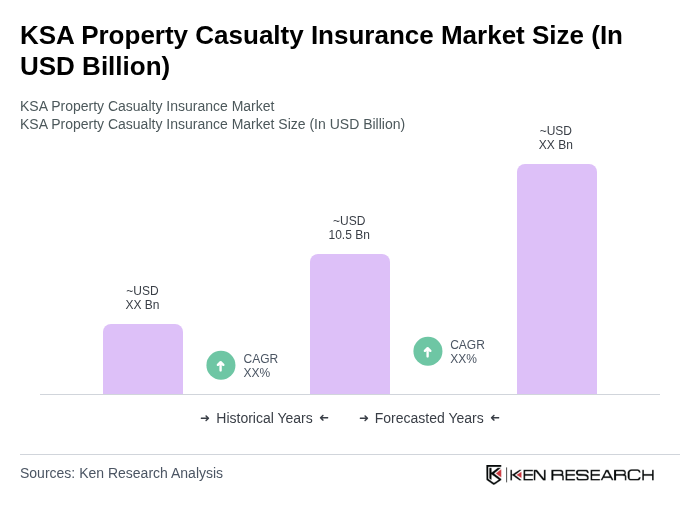
- The KSA Property Casualty Insurance Market is valued at approximately USD 10.5 billion, based on a five-year historical analysis. This value should be cross-checked and aligned with the latest available data on gross written premiums for non-life (general) insurance in Saudi Arabia from regulatory disclosures and reputable market research before final use. The market’s expansion is primarily associated with ongoing urbanization, rising household incomes, growing awareness of risk management among individuals and businesses, and continued investment under national transformation programs, all of which support higher demand for property, motor, and liability coverage.
- Key cities such as Riyadh, Jeddah, and Dammam dominate the KSA Property Casualty Insurance Market due to their concentration of economic activity, infrastructure projects, and population density. Riyadh, as the capital, is a center for government bodies, financial institutions, and large corporates, while Jeddah functions as a major commercial and logistics hub on the Red Sea. Dammam and the wider Eastern Province benefit from the presence of oil and gas, petrochemicals, and industrial clusters, which require substantial property, engineering, energy, and liability insurance to support operations and large-scale projects.
- In 2023, the Saudi Arabian Monetary Authority (now operating in its insurance supervisory role through the unified Insurance Authority) was reported to be strengthening regulations around motor insurance coverage and consumer protection, including requirements linked to personal injury and minimum limits. The specific statement that a single new 2023 regulation “mandated that all motor insurance policies include coverage for personal injury” should be verified directly against the latest official regulatory circulars and rulebooks, as motor bodily injury has historically been a core component of compulsory third-party motor insurance in the Kingdom. The broader policy direction clearly aims to improve policyholder protection, enhance claims handling, promote safer driving, and raise overall confidence in the insurance system.
KSA Property Casualty Insurance Market Segmentation
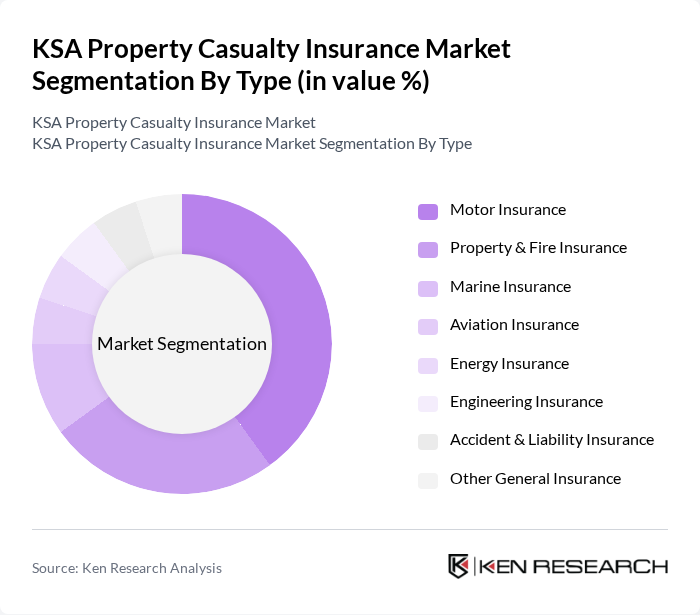
By Type:The KSA Property Casualty Insurance Market can be segmented into Motor Insurance, Property & Fire Insurance, Marine Insurance, Aviation Insurance, Energy Insurance, Engineering Insurance, Accident & Liability Insurance, and Other General Insurance. Each of these segments targets specific risk profiles and industry needs, with Motor Insurance typically representing the largest single line in many non-life portfolios due to high vehicle ownership and compulsory third-party coverage requirements. To ensure accuracy, the dominance of motor insurance and the relative sizes of other segments should be confirmed against the most recent non-life line-of-business breakdown published by regulators or leading industry analysts before final publication.
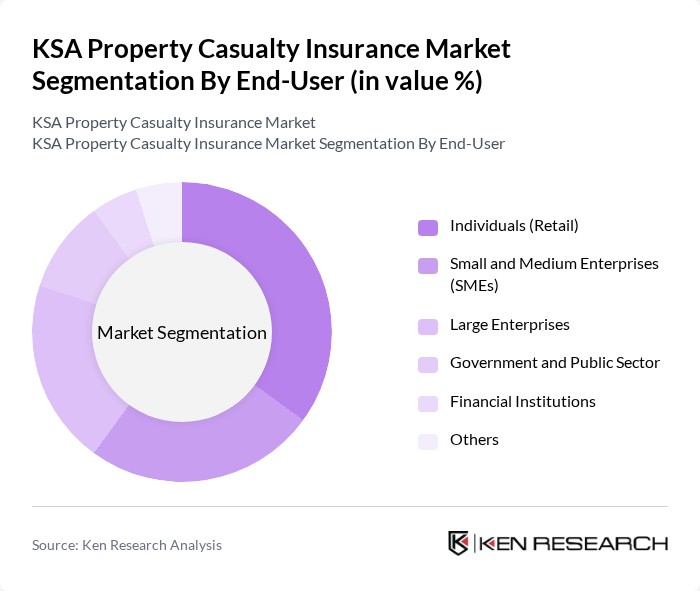
By End-User:The market can also be segmented by end-user categories, including Individuals (Retail), Small and Medium Enterprises (SMEs), Large Enterprises, Government and Public Sector, Financial Institutions, and Others. The retail segment is particularly important, influenced by greater risk awareness among individuals, rising car ownership, and broader uptake of property and liability products, while SMEs and large enterprises drive demand for specialized covers such as property damage, business interruption, engineering, energy, and professional liability. Before relying on the numerical distribution across end-user categories, the listed market shares should be reconciled with the latest available breakdowns of non-life premiums by customer type from regulatory or independent industry reports.
KSA Property Casualty Insurance Market Competitive Landscape
The KSA Property Casualty Insurance Market is characterized by a mix of regional and international insurers operating under a cooperative and takaful framework, with a number of publicly listed entities on the local stock exchange. Leading participants such as The Company for Cooperative Insurance (Tawuniya), Bupa Arabia for Cooperative Insurance, Al Rajhi Company for Cooperative Insurance (Al Rajhi Takaful), Gulf Insurance Group – Saudi Arabia (GIG Saudi), Allianz Saudi Fransi Cooperative Insurance Company, Saudi Arabian Cooperative Insurance Company (SAICO), Mediterranean and Gulf Cooperative Insurance and Reinsurance Company (Medgulf), Alinma Tokio Marine Company, United Cooperative Assurance Company (UCA), Al Ahlia for Cooperative Insurance Company, Al Etihad Cooperative Insurance Co., AlJazira Takaful Taawuni Company, Walaa Cooperative Insurance Co., Arabian Shield Cooperative Insurance Co., and Malath Cooperative Insurance Co. contribute to product innovation, digital distribution, and customer service enhancement across motor, property, and specialty lines. The relative positions of these companies in the property and casualty segment can shift over time due to mergers, portfolio restructuring, and regulatory-driven consolidation, so any ranking or market share statement should be checked against the latest publicly available financial statements and supervisory statistics.
KSA Property Casualty Insurance Market Industry Analysis
Growth Drivers
- Increasing Urbanization and Population Growth:The Kingdom of Saudi Arabia (KSA) is experiencing rapid urbanization, with urban population growth projected to reach 85% in the future, up from 83% in 2020. This urban expansion is driving demand for property casualty insurance, as more individuals and businesses seek coverage for their assets. Additionally, the population is expected to grow to approximately 38 million in the future, further increasing the need for comprehensive insurance solutions to protect against various risks associated with urban living.
- Rising Awareness of Insurance Products:As KSA's economy diversifies, there is a notable increase in public awareness regarding the importance of insurance. In the future, it is estimated that around 60% of the population will have a basic understanding of insurance products, compared to just 40% in 2020. This growing awareness is fueled by educational campaigns and the increasing visibility of insurance providers, leading to higher adoption rates of property casualty insurance among both individuals and businesses.
- Government Initiatives Promoting Insurance Coverage:The Saudi government is actively promoting insurance coverage through various initiatives, including the implementation of mandatory insurance policies for vehicles and health. In the future, the government aims to increase insurance penetration from 2.5% to 4% of GDP, encouraging citizens to secure their properties and assets. These initiatives are expected to enhance the overall insurance landscape, making property casualty insurance more accessible and appealing to the general public.
Market Challenges
- Regulatory Compliance Complexities:The KSA property casualty insurance market faces significant regulatory compliance challenges, with over 30 regulations governing the sector. Insurers must navigate these complex regulations, which can lead to increased operational costs and potential penalties for non-compliance. In the future, the cost of compliance is projected to account for approximately 15% of insurers' operational budgets, impacting profitability and market entry for new players.
- High Competition Among Insurers:The KSA insurance market is characterized by intense competition, with over 30 licensed insurers vying for market share. This competitive landscape has led to aggressive pricing strategies, which can erode profit margins. In the future, it is estimated that the top five insurers will hold only 40% of the market share, indicating a fragmented market where smaller players struggle to differentiate themselves and maintain profitability amidst price wars.
KSA Property Casualty Insurance Market Future Outlook
The KSA property casualty insurance market is poised for significant transformation driven by technological advancements and evolving consumer preferences. InsurTech innovations are expected to streamline operations and enhance customer experiences, while a shift towards personalized insurance products will cater to diverse consumer needs. Additionally, sustainability trends will likely influence product offerings, with insurers increasingly focusing on green insurance solutions. These developments will create a more dynamic and responsive market, fostering growth and improving overall insurance penetration in the Kingdom.
Market Opportunities
- Expansion of Digital Insurance Platforms:The rise of digital insurance platforms presents a significant opportunity for insurers in KSA. In the future, it is projected that 50% of insurance transactions will occur online, driven by increased internet penetration and smartphone usage. This shift allows insurers to reach a broader audience, streamline processes, and reduce operational costs, ultimately enhancing customer satisfaction and retention.
- Development of Tailored Insurance Products:There is a growing demand for customized insurance solutions in KSA, particularly among millennials and small businesses. In the future, it is anticipated that tailored insurance products will account for 30% of new policy sales. Insurers that invest in data analytics to understand customer preferences and develop niche products will be well-positioned to capture this emerging market segment and drive revenue growth.
Scope of the Report
| Segment | Sub-Segments |
|---|---|
| By Type | Motor Insurance Property & Fire Insurance Marine Insurance Aviation Insurance Energy Insurance Engineering Insurance Accident & Liability Insurance Other General Insurance |
| By End-User | Individuals (Retail) Small and Medium Enterprises (SMEs) Large Enterprises Government and Public Sector Financial Institutions Others |
| By Region | Central Region Western Region Eastern Region Northern Region Southern Region |
| By Distribution Channel | Insurance Agencies Brokers Bancassurance Direct Sales (Including Online) Other Distribution Channels |
| By Coverage Type | Comprehensive Coverage Third-Party Liability Coverage Named Perils / Limited Coverage Others |
| By Policy Duration | Short-Term Policies (? 1 Year) Long-Term Policies (> 1 Year) Others |
| By Customer Segment | Retail Customers Corporate Clients Institutional and Government Clients High-Net-Worth Individuals (HNWIs) |
Key Target Audience
Investors and Venture Capitalist Firms
Government and Regulatory Bodies (e.g., Saudi Arabian Monetary Authority, Ministry of Finance)
Insurance Brokers and Agents
Reinsurers
Property Developers and Real Estate Firms
Corporate Risk Managers
Insurance Technology (InsurTech) Startups
Industry Associations (e.g., Saudi Arabian Insurance Association)
Players Mentioned in the Report:
The Company for Cooperative Insurance (Tawuniya)
Bupa Arabia for Cooperative Insurance
Al Rajhi Company for Cooperative Insurance (Al Rajhi Takaful)
Gulf Insurance Group Saudi Arabia (GIG Saudi)
Allianz Saudi Fransi Cooperative Insurance Company
Saudi Arabian Cooperative Insurance Company (SAICO)
Mediterranean and Gulf Cooperative Insurance and Reinsurance Company (Medgulf)
Alinma Tokio Marine Company
United Cooperative Assurance Company (UCA)
Al Ahlia for Cooperative Insurance Company
Al Etihad Cooperative Insurance Co.
AlJazira Takaful Taawuni Company
Walaa Cooperative Insurance Co.
Arabian Shield Cooperative Insurance Co.
Malath Cooperative Insurance Co.
Table of Contents
Market Assessment Phase
1. Executive Summary and Approach
2. KSA Property Casualty Insurance Market Overview
2.1 Key Insights and Strategic Recommendations
2.2 KSA Property Casualty Insurance Market Overview
2.3 Definition and Scope
2.4 Evolution of Market Ecosystem
2.5 Timeline of Key Regulatory Milestones
2.6 Value Chain & Stakeholder Mapping
2.7 Business Cycle Analysis
2.8 Policy & Incentive Landscape
3. KSA Property Casualty Insurance Market Analysis
3.1 Growth Drivers
3.1.1 Increasing urbanization and population growth
3.1.2 Rising awareness of insurance products
3.1.3 Government initiatives promoting insurance coverage
3.1.4 Economic diversification efforts
3.2 Market Challenges
3.2.1 Regulatory compliance complexities
3.2.2 High competition among insurers
3.2.3 Limited consumer trust in insurance products
3.2.4 Economic fluctuations impacting disposable income
3.3 Market Opportunities
3.3.1 Expansion of digital insurance platforms
3.3.2 Development of tailored insurance products
3.3.3 Partnerships with fintech companies
3.3.4 Growing demand for environmental insurance
3.4 Market Trends
3.4.1 Increased adoption of InsurTech solutions
3.4.2 Shift towards customer-centric insurance models
3.4.3 Rise in usage-based insurance products
3.4.4 Focus on sustainability and green insurance
3.5 Government Regulation
3.5.1 Implementation of mandatory insurance policies
3.5.2 Regulatory frameworks for digital insurance
3.5.3 Consumer protection regulations
3.5.4 Tax incentives for insurance providers
4. SWOT Analysis
5. Stakeholder Analysis
6. Porter's Five Forces Analysis
7. KSA Property Casualty Insurance Market Market Size, 2019-2024
7.1 By Value
7.2 By Volume
7.3 By Average Selling Price
8. KSA Property Casualty Insurance Market Segmentation
8.1 By Type
8.1.1 Motor Insurance
8.1.2 Property & Fire Insurance
8.1.3 Marine Insurance
8.1.4 Aviation Insurance
8.1.5 Energy Insurance
8.1.6 Engineering Insurance
8.1.7 Accident & Liability Insurance
8.1.8 Other General Insurance
8.2 By End-User
8.2.1 Individuals (Retail)
8.2.2 Small and Medium Enterprises (SMEs)
8.2.3 Large Enterprises
8.2.4 Government and Public Sector
8.2.5 Financial Institutions
8.2.6 Others
8.3 By Region
8.3.1 Central Region
8.3.2 Western Region
8.3.3 Eastern Region
8.3.4 Northern Region
8.3.5 Southern Region
8.4 By Distribution Channel
8.4.1 Insurance Agencies
8.4.2 Brokers
8.4.3 Bancassurance
8.4.4 Direct Sales (Including Online)
8.4.5 Other Distribution Channels
8.5 By Coverage Type
8.5.1 Comprehensive Coverage
8.5.2 Third-Party Liability Coverage
8.5.3 Named Perils / Limited Coverage
8.5.4 Others
8.6 By Policy Duration
8.6.1 Short-Term Policies (? 1 Year)
8.6.2 Long-Term Policies (> 1 Year)
8.6.3 Others
8.7 By Customer Segment
8.7.1 Retail Customers
8.7.2 Corporate Clients
8.7.3 Institutional and Government Clients
8.7.4 High-Net-Worth Individuals (HNWIs)
9. KSA Property Casualty Insurance Market Competitive Analysis
9.1 Market Share of Key Players
9.2 Cross Comparison of Key Players
9.2.1 Company Name
9.2.2 Group Size (Large, Medium, or Small as per industry convention)
9.2.3 Gross Written Premium (GWP) Growth Rate
9.2.4 Market Share in KSA P&C Segment
9.2.5 Claims Ratio (Loss Ratio)
9.2.6 Combined Ratio
9.2.7 Solvency Margin / Capital Adequacy
9.2.8 Customer Retention Rate
9.2.9 Claims Settlement Turnaround Time
9.2.10 Distribution Mix (Agency/Broker/Bancassurance/Direct)
9.2.11 Product Diversification Across P&C Lines
9.2.12 Digital Channel Penetration
9.2.13 Customer Satisfaction / NPS
9.3 SWOT Analysis of Top Players
9.4 Pricing Analysis
9.5 Detailed Profile of Major Companies
9.5.1 The Company for Cooperative Insurance (Tawuniya)
9.5.2 Bupa Arabia for Cooperative Insurance
9.5.3 Al Rajhi Company for Cooperative Insurance (Al Rajhi Takaful)
9.5.4 Gulf Insurance Group – Saudi Arabia (GIG Saudi)
9.5.5 Allianz Saudi Fransi Cooperative Insurance Company
9.5.6 Saudi Arabian Cooperative Insurance Company (SAICO)
9.5.7 Mediterranean and Gulf Cooperative Insurance and Reinsurance Company (Medgulf)
9.5.8 Alinma Tokio Marine Company
9.5.9 United Cooperative Assurance Company (UCA)
9.5.10 Al Ahlia for Cooperative Insurance Company
9.5.11 Al Etihad Cooperative Insurance Co.
9.5.12 AlJazira Takaful Taawuni Company
9.5.13 Walaa Cooperative Insurance Co.
9.5.14 Arabian Shield Cooperative Insurance Co.
9.5.15 Malath Cooperative Insurance Co.
10. KSA Property Casualty Insurance Market End-User Analysis
10.1 Procurement Behavior of Key Ministries
10.1.1 Ministry of Finance
10.1.2 Ministry of Health
10.1.3 Ministry of Education
10.1.4 Ministry of Interior
10.2 Corporate Spend on Infrastructure & Energy
10.2.1 Investment in Construction Projects
10.2.2 Expenditure on Renewable Energy Initiatives
10.2.3 Budget Allocation for Public Safety
10.2.4 Insurance Coverage for Infrastructure Projects
10.3 Pain Point Analysis by End-User Category
10.3.1 Individual Consumers
10.3.2 Small Businesses
10.3.3 Large Corporations
10.3.4 Government Entities
10.4 User Readiness for Adoption
10.4.1 Awareness of Insurance Products
10.4.2 Digital Literacy Levels
10.4.3 Trust in Insurance Providers
10.4.4 Financial Capability
10.5 Post-Deployment ROI and Use Case Expansion
10.5.1 Evaluation of Insurance Claims Process
10.5.2 Customer Feedback Mechanisms
10.5.3 Expansion of Coverage Options
10.5.4 Long-term Customer Engagement Strategies
11. KSA Property Casualty Insurance Market Future Size, 2025-2030
11.1 By Value
11.2 By Volume
11.3 By Average Selling Price
Go-To-Market Strategy Phase
1. Whitespace Analysis + Business Model Canvas
1.1 Market Gaps Identification
1.2 Business Model Framework
2. Marketing and Positioning Recommendations
2.1 Branding Strategies
2.2 Product USPs
3. Distribution Plan
3.1 Urban Retail vs Rural NGO Tie-ups
4. Channel & Pricing Gaps
4.1 Underserved Routes
4.2 Pricing Bands
5. Unmet Demand & Latent Needs
5.1 Category Gaps
5.2 Consumer Segments
6. Customer Relationship
6.1 Loyalty Programs
6.2 After-sales Service
7. Value Proposition
7.1 Sustainability
7.2 Integrated Supply Chains
8. Key Activities
8.1 Regulatory Compliance
8.2 Branding
8.3 Distribution Setup
9. Entry Strategy Evaluation
9.1 Domestic Market Entry Strategy
9.1.1 Product Mix
9.1.2 Pricing Band
9.1.3 Packaging
9.2 Export Entry Strategy
9.2.1 Target Countries
9.2.2 Compliance Roadmap
10. Entry Mode Assessment
10.1 JV
10.2 Greenfield
10.3 M&A
10.4 Distributor Model
11. Capital and Timeline Estimation
11.1 Capital Requirements
11.2 Timelines
12. Control vs Risk Trade-Off
12.1 Ownership vs Partnerships
13. Profitability Outlook
13.1 Breakeven Analysis
13.2 Long-term Sustainability
14. Potential Partner List
14.1 Distributors
14.2 JVs
14.3 Acquisition Targets
15. Execution Roadmap
15.1 Phased Plan for Market Entry
15.1.1 Market Setup
15.1.2 Market Entry
15.1.3 Growth Acceleration
15.1.4 Scale & Stabilize
15.2 Key Activities and Milestones
15.2.1 Milestone Planning
15.2.2 Activity Tracking
Research Methodology
Phase 1: Approach1
Desk Research
- Analysis of industry reports from the Saudi Arabian Monetary Authority (SAMA)
- Review of market trends and statistics from the Council of Cooperative Health Insurance (CCHI)
- Examination of regulatory frameworks and updates from the Saudi Insurance Institute
Primary Research
- Interviews with senior executives from leading property casualty insurance firms
- Surveys targeting risk assessment professionals and underwriters
- Field interviews with claims adjusters and customer service representatives
Validation & Triangulation
- Cross-validation of findings through multiple data sources including government publications and industry surveys
- Triangulation of qualitative insights from interviews with quantitative data from market reports
- Sanity checks conducted through expert panel discussions and feedback sessions
Phase 2: Market Size Estimation1
Top-down Assessment
- Estimation of total market size based on GDP contribution from the insurance sector
- Segmentation of the market by product lines such as property, liability, and motor insurance
- Incorporation of growth rates derived from historical data and economic forecasts
Bottom-up Modeling
- Collection of premium data from major insurance providers in the KSA
- Analysis of claims data to assess loss ratios and profitability
- Estimation of market penetration rates across different customer segments
Forecasting & Scenario Analysis
- Development of predictive models using historical growth trends and economic indicators
- Scenario analysis based on potential regulatory changes and market disruptions
- Creation of baseline, optimistic, and pessimistic forecasts through 2030
Phase 3: CATI Sample Composition1
| Scope Item/Segment | Sample Size | Target Respondent Profiles |
|---|---|---|
| Residential Property Insurance | 120 | Insurance Agents, Homeowners, Risk Managers |
| Commercial Property Insurance | 110 | Business Owners, CFOs, Insurance Brokers |
| Liability Insurance Products | 70 | Legal Advisors, Claims Adjusters, Underwriters |
| Motor Insurance Sector | 130 | Fleet Managers, Insurance Sales Representatives, Policyholders |
| Insurance Technology Adoption | 60 | IT Managers, Digital Transformation Officers, InsurTech Startups |
Frequently Asked Questions
What is the current value of the KSA Property Casualty Insurance Market?
The KSA Property Casualty Insurance Market is valued at approximately USD 10.5 billion, based on a five-year historical analysis. This figure should be verified with the latest data on gross written premiums for non-life insurance in Saudi Arabia.
What factors are driving the growth of the KSA Property Casualty Insurance Market?
Which cities dominate the KSA Property Casualty Insurance Market?
What recent regulatory changes have impacted motor insurance in Saudi Arabia?
Other Regional/Country Reports
Other Adjacent Reports
Philippines Risk Management Services Market
India Automotive Market (2023-2029APAC Real Estate Market Report Size Share Growth Drivers Trends Opportunities & Forecast 2025–2030UAE Riyadh Construction MarketMexico Energy Sector Market
Why Buy From Us?

What makes us stand out is that our consultants follow Robust, Refine and Result (RRR) methodology. Robust for clear definitions, approaches and sanity checking, Refine for differentiating respondents' facts and opinions, and Result for presenting data with story.

We have set a benchmark in the industry by offering our clients with syndicated and customized market research reports featuring coverage of entire market as well as meticulous research and analyst insights.

While we don't replace traditional research, we flip the method upside down. Our dual approach of Top Bottom & Bottom Top ensures quality deliverable by not just verifying company fundamentals but also looking at the sector and macroeconomic factors.

With one step in the future, our research team constantly tries to show you the bigger picture. We help with some of the tough questions you may encounter along the way: How is the industry positioned? Best marketing channel? KPI's of competitors? By aligning every element, we help maximize success.

Our report gives you instant access to the answers and sources that other companies might choose to hide. We elaborate each steps of research methodology we have used and showcase you the sample size to earn your trust.

If you need any support, we are here! We pride ourselves on universe strength, data quality, and quick, friendly, and professional service.