About the Report
Base Year 2024South Africa Property Casualty Insurance Market Overview
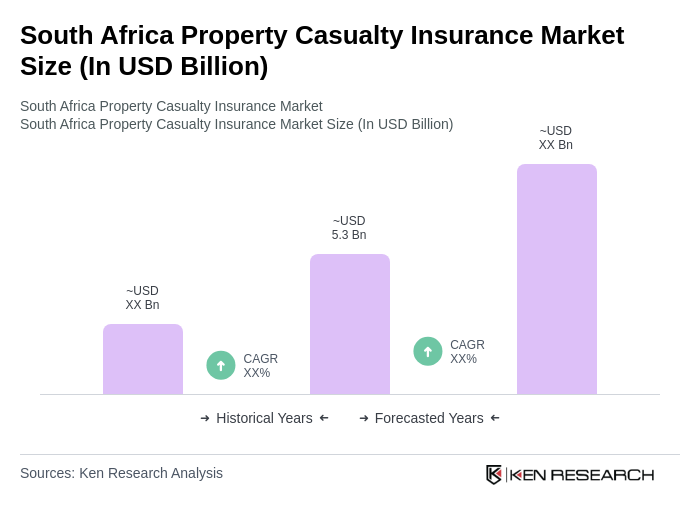
- The South Africa Property Casualty Insurance Market is valued at approximately USD 5.3 billion, based on a five-year historical analysis. This aligns with recent industry estimates for non-life (property and casualty) premiums in South Africa and reflects the scale of short-term insurance activity in the country . Growth is supported by motor premium recalibration amid claims inflation, increased NatCat-related property risks, and the adoption of telematics and data analytics in underwriting and pricing .
- Key cities such as Johannesburg, Cape Town, and Durban dominate the South African Property Casualty Insurance Market due to their economic significance and high population density. Johannesburg serves as the country’s primary financial and commercial hub, while Cape Town and Durban contribute significant insured exposure through trade, logistics, tourism, and port-linked activities that require robust property and liability coverage .
- South Africa’s prudential and market conduct framework for non-life insurers is governed by the Insurance Act and Twin Peaks architecture implemented prior to 2023; ongoing implementation of IFRS 17 and conduct standards has further emphasized clear disclosure, fair treatment of policyholders, and transparency in policy wording and claims handling. These measures collectively enhance consumer protection and market confidence .
South Africa Property Casualty Insurance Market Segmentation
By Type:
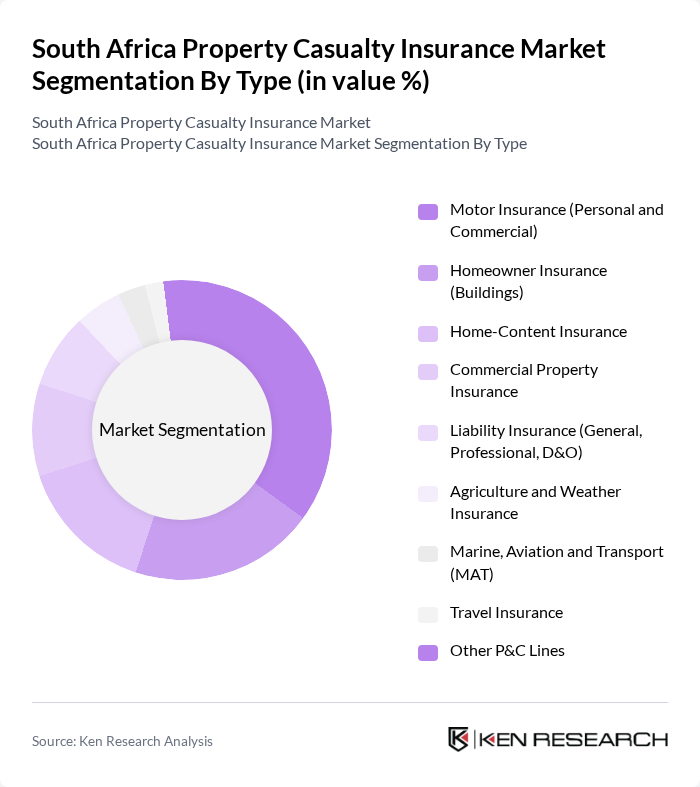
The segmentation by type includes various subsegments such as Motor Insurance (Personal and Commercial), Homeowner Insurance (Buildings), Home-Content Insurance, Commercial Property Insurance, Liability Insurance (General, Professional, D&O), Agriculture and Weather Insurance, Marine, Aviation and Transport (MAT), Travel Insurance, and Other P&C Lines. Among these, Motor Insurance is the leading subsegment, driven by high vehicle parc and the necessity for coverage against accidents, theft, and third-party liability. Motor-claims inflation and technology-enabled pricing (e.g., telematics) are active dynamics reinforcing motor’s share within South Africa’s non-life portfolio .
By End-User:
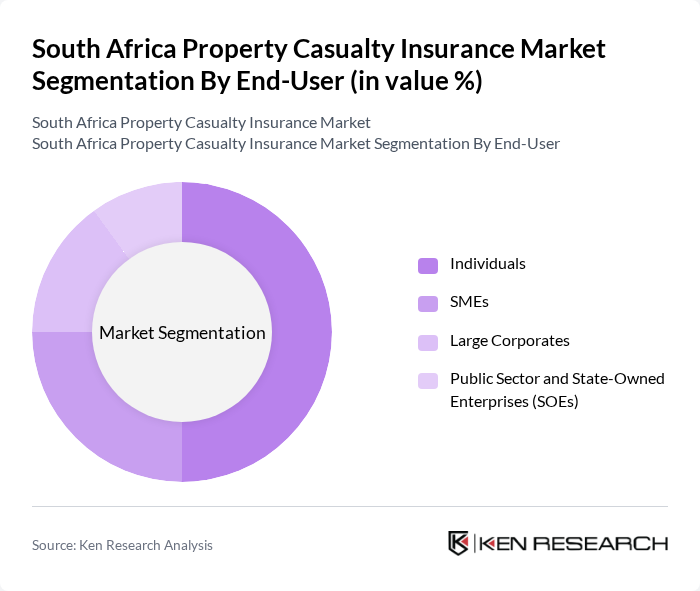
This segmentation includes Individuals, SMEs, Large Corporates, and Public Sector and State-Owned Enterprises (SOEs). The Individuals segment is the most significant, supported by widespread motor and household insurance uptake, while SMEs and corporates drive commercial property and liability demand, including supply-chain and business interruption covers. Increased use of embedded and digital distribution has broadened access for retail customers .
South Africa Property Casualty Insurance Market Competitive Landscape
The South Africa Property Casualty Insurance Market is characterized by a dynamic mix of regional and international players. Leading participants such as Santam Ltd., Old Mutual Insure Ltd., Discovery Insure Ltd., Hollard Insurance Company Ltd., Bryte Insurance Company Ltd. (A Fairfax Company), OUTsurance Insurance Company Ltd., Momentum Insure (Momentum Metropolitan Holdings), Absa Insurance Company Ltd. (Absa Group), First for Women Insurance (Telesure Investment Holdings), Auto & General Insurance Co. Ltd. (Telesure Investment Holdings), MiWay Insurance Ltd. (Sanlam Group), King Price Insurance Ltd., Renasa Insurance Company Ltd., Constantia Insurance Company Ltd., Sasria SOC Ltd., Hollard Partner Solutions (Cell Captive, incl. Guardrisk peers), Guardrisk Insurance Company Ltd. (MMI Holdings), AIG South Africa Ltd., Chubb Insurance South Africa Ltd., iTOO Special Risks (Hollard Group) contribute to innovation, geographic expansion, and service delivery in this space .
South Africa Property Casualty Insurance Market Industry Analysis
Growth Drivers
- Increasing Urbanization:South Africa's urban population is projected to reach 39 million in the future, up from 34 million in 2020, according to World Bank data. This rapid urbanization drives demand for property casualty insurance as more individuals and businesses seek coverage for their assets. Urban areas typically experience higher risks, prompting residents to invest in insurance products that protect against theft, fire, and natural disasters, thereby expanding the market significantly.
- Rising Middle-Class Population:The middle-class population in South Africa is expected to grow to 17 million in the future, increasing from 14 million in 2020, as reported by the African Development Bank. This demographic shift leads to higher disposable incomes, enabling more individuals to purchase property and, consequently, property casualty insurance. As the middle class expands, so does the demand for comprehensive insurance solutions that cater to their evolving needs and lifestyle changes.
- Enhanced Regulatory Framework:The South African government has implemented stricter regulations to ensure consumer protection and market stability, with the Financial Sector Conduct Authority overseeing compliance. In the future, the insurance sector is expected to see a 12% increase in compliance costs, which will encourage insurers to innovate and improve their offerings. This regulatory environment fosters trust among consumers, leading to increased uptake of property casualty insurance products as individuals seek reliable coverage.
Market Challenges
- Economic Instability:South Africa's GDP growth is projected to be only 1.5% in the future, according to the IMF, reflecting ongoing economic challenges. This sluggish growth impacts consumer spending and investment in insurance products. Economic instability often leads to higher unemployment rates, which can reduce the number of individuals able to afford property casualty insurance, thereby constraining market growth and increasing the risk of policy lapses.
- High Competition:The South African property casualty insurance market is characterized by intense competition, with over 32 registered insurers vying for market share. This competitive landscape results in price wars and reduced profit margins, making it challenging for companies to maintain sustainable growth. In the future, the average premium growth is expected to be limited to 4%, as insurers struggle to differentiate their offerings in a crowded market, impacting overall profitability.
South Africa Property Casualty Insurance Market Future Outlook
The South African property casualty insurance market is poised for transformation, driven by technological advancements and changing consumer preferences. The shift towards digital platforms is expected to enhance customer engagement and streamline operations, while the adoption of AI and big data analytics will enable insurers to offer personalized products. Additionally, the focus on sustainable practices will likely shape future offerings, aligning with global trends and consumer expectations for responsible insurance solutions.
Market Opportunities
- Growth in Digital Insurance Solutions:The digital insurance segment is anticipated to grow significantly, with online policy sales projected to increase by 30% in the future. This growth presents an opportunity for insurers to enhance customer experience through user-friendly platforms, making it easier for consumers to access and manage their policies, ultimately driving market penetration and customer loyalty.
- Expansion of Microinsurance Products:The microinsurance market is expected to reach 6 million policyholders in the future, addressing the needs of low-income consumers. This expansion offers insurers a chance to tap into an underserved market segment, providing affordable coverage options that can protect vulnerable populations against unforeseen risks, thereby fostering financial inclusion and market growth.
Scope of the Report
| Segment | Sub-Segments |
|---|---|
| By Type | Motor Insurance (Personal and Commercial) Homeowner Insurance (Buildings) Home-Content Insurance Commercial Property Insurance Liability Insurance (General, Professional, D&O) Agriculture and Weather Insurance Marine, Aviation and Transport (MAT) Travel Insurance Other P&C Lines |
| By End-User | Individuals SMEs Large Corporates Public Sector and State-Owned Enterprises (SOEs) |
| By Distribution Channel | Brokers Agents Banks (Bancassurance) Direct-to-Consumer (Insurer Direct) Digital Aggregators and InsurTech Platforms |
| By Coverage Type | Comprehensive (All-Risk) Coverage Third-Party/Specified Perils Coverage |
| By Policy Duration | Short-Term Policies (Monthly/Annual) Multi-Year/Long-Term Policies |
| By Premium Range | Low Premium Medium Premium High Premium |
| By Claims Process | Standard Claims Fast-Track/Digital Claims Complex/Large Loss Claims |
| By Region | Gauteng Western Cape KwaZulu-Natal Eastern Cape Rest of South Africa |
Key Target Audience
Investors and Venture Capitalist Firms
Government and Regulatory Bodies (e.g., Financial Sector Conduct Authority, Prudential Authority)
Insurance Brokers and Agents
Property Developers and Real Estate Firms
Underwriters and Reinsurers
Claims Management Companies
Risk Management Consultants
Insurance Technology (InsurTech) Startups
Players Mentioned in the Report:
Santam Ltd.
Old Mutual Insure Ltd.
Discovery Insure Ltd.
Hollard Insurance Company Ltd.
Bryte Insurance Company Ltd. (A Fairfax Company)
OUTsurance Insurance Company Ltd.
Momentum Insure (Momentum Metropolitan Holdings)
Absa Insurance Company Ltd. (Absa Group)
First for Women Insurance (Telesure Investment Holdings)
Auto & General Insurance Co. Ltd. (Telesure Investment Holdings)
MiWay Insurance Ltd. (Sanlam Group)
King Price Insurance Ltd.
Renasa Insurance Company Ltd.
Constantia Insurance Company Ltd.
Sasria SOC Ltd.
Hollard Partner Solutions (Cell Captive, incl. Guardrisk peers)
Guardrisk Insurance Company Ltd. (MMI Holdings)
AIG South Africa Ltd.
Chubb Insurance South Africa Ltd.
iTOO Special Risks (Hollard Group)
Table of Contents
Market Assessment Phase
1. Executive Summary and Approach
2. South Africa Property Casualty Insurance Market Overview
2.1 Key Insights and Strategic Recommendations
2.2 South Africa Property Casualty Insurance Market Overview
2.3 Definition and Scope
2.4 Evolution of Market Ecosystem
2.5 Timeline of Key Regulatory Milestones
2.6 Value Chain & Stakeholder Mapping
2.7 Business Cycle Analysis
2.8 Policy & Incentive Landscape
3. South Africa Property Casualty Insurance Market Analysis
3.1 Growth Drivers
3.1.1 Increasing Urbanization
3.1.2 Rising Middle-Class Population
3.1.3 Enhanced Regulatory Framework
3.1.4 Technological Advancements in Insurance
3.2 Market Challenges
3.2.1 Economic Instability
3.2.2 High Competition
3.2.3 Fraudulent Claims
3.2.4 Limited Consumer Awareness
3.3 Market Opportunities
3.3.1 Growth in Digital Insurance Solutions
3.3.2 Expansion of Microinsurance Products
3.3.3 Partnerships with Fintech Companies
3.3.4 Increasing Demand for Customized Policies
3.4 Market Trends
3.4.1 Shift Towards Online Insurance Platforms
3.4.2 Adoption of AI and Big Data Analytics
3.4.3 Focus on Sustainable Insurance Practices
3.4.4 Growth of Usage-Based Insurance Models
3.5 Government Regulation
3.5.1 Insurance Act Compliance
3.5.2 Consumer Protection Regulations
3.5.3 Financial Sector Conduct Authority Guidelines
3.5.4 Solvency Assessment and Management Regulations
4. SWOT Analysis
5. Stakeholder Analysis
6. Porter's Five Forces Analysis
7. South Africa Property Casualty Insurance Market Market Size, 2019-2024
7.1 By Value
7.2 By Volume
7.3 By Average Selling Price
8. South Africa Property Casualty Insurance Market Segmentation
8.1 By Type
8.1.1 Motor Insurance (Personal and Commercial)
8.1.2 Homeowner Insurance (Buildings)
8.1.3 Home-Content Insurance
8.1.4 Commercial Property Insurance
8.1.5 Liability Insurance (General, Professional, D&O)
8.1.6 Agriculture and Weather Insurance
8.1.7 Marine, Aviation and Transport (MAT)
8.1.8 Travel Insurance
8.1.9 Other P&C Lines
8.2 By End-User
8.2.1 Individuals
8.2.2 SMEs
8.2.3 Large Corporates
8.2.4 Public Sector and State-Owned Enterprises (SOEs)
8.3 By Distribution Channel
8.3.1 Brokers
8.3.2 Agents
8.3.3 Banks (Bancassurance)
8.3.4 Direct-to-Consumer (Insurer Direct)
8.3.5 Digital Aggregators and InsurTech Platforms
8.4 By Coverage Type
8.4.1 Comprehensive (All-Risk) Coverage
8.4.2 Third-Party/Specified Perils Coverage
8.5 By Policy Duration
8.5.1 Short-Term Policies (Monthly/Annual)
8.5.2 Multi-Year/Long-Term Policies
8.6 By Premium Range
8.6.1 Low Premium
8.6.2 Medium Premium
8.6.3 High Premium
8.7 By Claims Process
8.7.1 Standard Claims
8.7.2 Fast-Track/Digital Claims
8.7.3 Complex/Large Loss Claims
8.8 By Region
8.8.1 Gauteng
8.8.2 Western Cape
8.8.3 KwaZulu-Natal
8.8.4 Eastern Cape
8.8.5 Rest of South Africa
9. South Africa Property Casualty Insurance Market Competitive Analysis
9.1 Market Share of Key Players
9.2 Cross Comparison of Key Players
9.2.1 Company Name
9.2.2 Group Size (Large, Medium, or Small as per SA short-term industry)
9.2.3 Gross Written Premium (GWP) – P&C (ZAR)
9.2.4 Claims Ratio (Loss Ratio, %)
9.2.5 Claims Settlement Turnaround Time (Median days)
9.2.6 Solvency Coverage Ratio (SCR, %)
9.2.7 Combined Ratio (%)
9.2.8 Policyholder Retention/Churn Rate (%)
9.2.9 Distribution Mix (% via brokers/agents/bancassurance/digital)
9.2.10 Product Mix (% Motor, Property, Liability, MAT, Agriculture)
9.2.11 Geographic Mix (Gauteng/Western Cape/KZN/Rest, %)
9.2.12 Digital Adoption KPIs (online quotes/binds, app MAUs)
9.2.13 Net Promoter Score (NPS) / Customer Satisfaction
9.2.14 Revenue Growth Rate (YoY, %)
9.2.15 Reinsurance Dependence (% ceded premium)
9.2.16 Catastrophe Exposure and Risk Capital (modeled PML)
9.3 SWOT Analysis of Top Players
9.4 Pricing Analysis
9.5 Detailed Profile of Major Companies
9.5.1 Santam Ltd.
9.5.2 Old Mutual Insure Ltd.
9.5.3 Discovery Insure Ltd.
9.5.4 Hollard Insurance Company Ltd.
9.5.5 Bryte Insurance Company Ltd. (A Fairfax Company)
9.5.6 OUTsurance Insurance Company Ltd.
9.5.7 Momentum Insure (Momentum Metropolitan Holdings)
9.5.8 Absa Insurance Company Ltd. (Absa Group)
9.5.9 First for Women Insurance (Telesure Investment Holdings)
9.5.10 Auto & General Insurance Co. Ltd. (Telesure Investment Holdings)
9.5.11 MiWay Insurance Ltd. (Sanlam Group)
9.5.12 King Price Insurance Ltd.
9.5.13 Renasa Insurance Company Ltd.
9.5.14 Constantia Insurance Company Ltd.
9.5.15 Sasria SOC Ltd.
9.5.16 Hollard Partner Solutions (Cell Captive, incl. Guardrisk peers)
9.5.17 Guardrisk Insurance Company Ltd. (MMI Holdings)
9.5.18 AIG South Africa Ltd.
9.5.19 Chubb Insurance South Africa Ltd.
9.5.20 iTOO Special Risks (Hollard Group)
10. South Africa Property Casualty Insurance Market End-User Analysis
10.1 Procurement Behavior of Key Ministries
10.1.1 Insurance Policy Selection Criteria
10.1.2 Budget Allocation for Insurance
10.1.3 Risk Assessment Practices
10.2 Corporate Spend on Infrastructure & Energy
10.2.1 Insurance Coverage for Infrastructure Projects
10.2.2 Investment in Risk Management Solutions
10.3 Pain Point Analysis by End-User Category
10.3.1 Claims Processing Delays
10.3.2 Lack of Customization in Policies
10.4 User Readiness for Adoption
10.4.1 Awareness of Insurance Products
10.4.2 Digital Literacy Levels
10.5 Post-Deployment ROI and Use Case Expansion
10.5.1 Evaluation of Insurance Effectiveness
10.5.2 Expansion of Coverage Options
11. South Africa Property Casualty Insurance Market Future Size, 2025-2030
11.1 By Value
11.2 By Volume
11.3 By Average Selling Price
Go-To-Market Strategy Phase
1. Whitespace Analysis + Business Model Canvas
1.1 Market Gaps Identification
1.2 Value Proposition Development
1.3 Revenue Model Structuring
1.4 Key Partnerships Identification
1.5 Customer Segmentation Analysis
1.6 Cost Structure Analysis
1.7 Competitive Advantage Assessment
2. Marketing and Positioning Recommendations
2.1 Branding Strategies
2.2 Product USPs
3. Distribution Plan
3.1 Urban Retail vs Rural NGO Tie-ups
4. Channel & Pricing Gaps
4.1 Underserved Routes
4.2 Pricing Bands
5. Unmet Demand & Latent Needs
5.1 Category Gaps
5.2 Consumer Segments
6. Customer Relationship
6.1 Loyalty Programs
6.2 After-sales Service
7. Value Proposition
7.1 Sustainability
7.2 Integrated Supply Chains
8. Key Activities
8.1 Regulatory Compliance
8.2 Branding
8.3 Distribution Setup
9. Entry Strategy Evaluation
9.1 Domestic Market Entry Strategy
9.1.1 Product Mix
9.1.2 Pricing Band
9.1.3 Packaging
9.2 Export Entry Strategy
9.2.1 Target Countries
9.2.2 Compliance Roadmap
10. Entry Mode Assessment
10.1 JV
10.2 Greenfield
10.3 M&A
10.4 Distributor Model
11. Capital and Timeline Estimation
11.1 Capital Requirements
11.2 Timelines
12. Control vs Risk Trade-Off
12.1 Ownership vs Partnerships
13. Profitability Outlook
13.1 Breakeven Analysis
13.2 Long-term Sustainability
14. Potential Partner List
14.1 Distributors
14.2 JVs
14.3 Acquisition Targets
15. Execution Roadmap
15.1 Phased Plan for Market Entry
15.1.1 Market Setup
15.1.2 Market Entry
15.1.3 Growth Acceleration
15.1.4 Scale & Stabilize
15.2 Key Activities and Milestones
15.2.1 Activity Planning
15.2.2 Milestone Tracking
Research Methodology
Phase 1: Approach1
Desk Research
- Analysis of industry reports from the Association of South African Insurers (ASISA)
- Review of financial statements and annual reports from major property casualty insurance companies
- Examination of regulatory frameworks and guidelines from the Financial Sector Conduct Authority (FSCA)
Primary Research
- Interviews with senior executives from leading property casualty insurance firms
- Surveys targeting underwriters and claims adjusters to gather insights on market trends
- Focus groups with insurance brokers to understand customer needs and preferences
Validation & Triangulation
- Cross-validation of findings through multiple data sources including market reports and expert opinions
- Triangulation of qualitative insights from interviews with quantitative data from surveys
- Sanity checks conducted through expert panel reviews to ensure data accuracy
Phase 2: Market Size Estimation1
Top-down Assessment
- Estimation of total market size based on national insurance premium data
- Segmentation of the market by product lines such as property, liability, and motor insurance
- Incorporation of macroeconomic indicators such as GDP growth and housing market trends
Bottom-up Modeling
- Collection of data on policy counts and average premiums from major insurers
- Estimation of claims ratios and loss ratios to assess profitability
- Volume x premium basis for calculating total market revenue
Forecasting & Scenario Analysis
- Multi-factor regression analysis incorporating economic growth, regulatory changes, and consumer behavior
- Scenario modeling based on potential market disruptions such as natural disasters and economic downturns
- Baseline, optimistic, and pessimistic forecasts through 2030 to account for market volatility
Phase 3: CATI Sample Composition1
| Scope Item/Segment | Sample Size | Target Respondent Profiles |
|---|---|---|
| Residential Property Insurance | 140 | Homeowners, Insurance Agents |
| Commercial Property Insurance | 100 | Business Owners, Risk Managers |
| Motor Vehicle Insurance | 120 | Car Owners, Insurance Brokers |
| Liability Insurance | 80 | Corporate Executives, Compliance Officers |
| Claims Processing Insights | 90 | Claims Adjusters, Underwriters |
Frequently Asked Questions
What is the current value of the South Africa Property Casualty Insurance Market?
The South Africa Property Casualty Insurance Market is valued at approximately USD 5.3 billion, reflecting the scale of short-term insurance activity in the country. This valuation is based on a five-year historical analysis of non-life insurance premiums.
What are the main growth drivers for the South Africa Property Casualty Insurance Market?
Which cities dominate the South Africa Property Casualty Insurance Market?
What types of insurance are included in the South Africa Property Casualty Insurance Market?
Other Regional/Country Reports
Why Buy From Us?

What makes us stand out is that our consultants follow Robust, Refine and Result (RRR) methodology. Robust for clear definitions, approaches and sanity checking, Refine for differentiating respondents' facts and opinions, and Result for presenting data with story.

We have set a benchmark in the industry by offering our clients with syndicated and customized market research reports featuring coverage of entire market as well as meticulous research and analyst insights.

While we don't replace traditional research, we flip the method upside down. Our dual approach of Top Bottom & Bottom Top ensures quality deliverable by not just verifying company fundamentals but also looking at the sector and macroeconomic factors.

With one step in the future, our research team constantly tries to show you the bigger picture. We help with some of the tough questions you may encounter along the way: How is the industry positioned? Best marketing channel? KPI's of competitors? By aligning every element, we help maximize success.

Our report gives you instant access to the answers and sources that other companies might choose to hide. We elaborate each steps of research methodology we have used and showcase you the sample size to earn your trust.

If you need any support, we are here! We pride ourselves on universe strength, data quality, and quick, friendly, and professional service.