Ken Research Logo

Kuwait barcode printers market size, share, growth drivers, trends, opportunities & forecast 2025–2030

The Kuwait barcode printers market, valued at USD 8 million, is growing due to e-commerce surge, inventory management needs, and sectors like retail and logistics.

Region:Middle East

Author(s):Shubham

Product Code:KRAA8750

Pages:95

Published On:November 2025

About the Report

Base Year 2024

Kuwait Barcode Printers Market Overview

  • The Kuwait Barcode Printers Market is valued at USD 8 million, based on a five-year historical analysis and normalization from regional printer market data. This growth is primarily driven by the increasing demand for efficient inventory management and tracking solutions across sectors such as retail, healthcare, and logistics. The surge in e-commerce activities, adoption of automation in supply chain processes, and the integration of advanced printing technologies are further propelling market expansion. Notably, the shift toward mobile and industrial barcode printers is enhancing operational efficiency and productivity in these industries .
  • Kuwait City remains the dominant hub for the barcode printers market, attributed to its role as the capital and largest city in Kuwait. The high concentration of retail and logistics companies, coupled with substantial investments in technology and infrastructure, underpins its market leadership. Other notable regions such as Hawalli and Al Ahmadi also host a diverse range of businesses requiring barcode printing solutions, reflecting the broader regional demand for advanced inventory and asset management systems .
  • The Ministerial Resolution No. 2023/210 issued by the Ministry of Commerce and Industry mandates the implementation of barcode systems in retail and logistics sectors. This regulation requires businesses to adopt standardized barcode labeling for inventory control, compliance reporting, and operational transparency. The directive covers all retail outlets and logistics providers, stipulating minimum technical standards for barcode printers and periodic compliance audits to ensure accuracy and efficiency in inventory management .
Kuwait Barcode Printers Market Size

Kuwait Barcode Printers Market Segmentation

By Type:The market is segmented into Thermal Transfer Printers, Direct Thermal Printers, Inkjet Printers, Laser Printers, Mobile Printers, Industrial Printers, and Desktop Printers. Each type serves distinct applications and industries, addressing specific requirements such as durability, print quality, speed, and portability. Thermal Transfer Printers are preferred for producing robust, long-lasting labels, while Direct Thermal Printers are favored for high-volume, cost-effective printing in retail and logistics. Inkjet and Laser Printers are utilized for color and high-resolution applications, and Mobile Printers support on-the-go labeling needs in warehousing and field operations. Industrial Printers are designed for continuous, high-capacity use in manufacturing, and Desktop Printers cater to small-scale, office-based tasks .
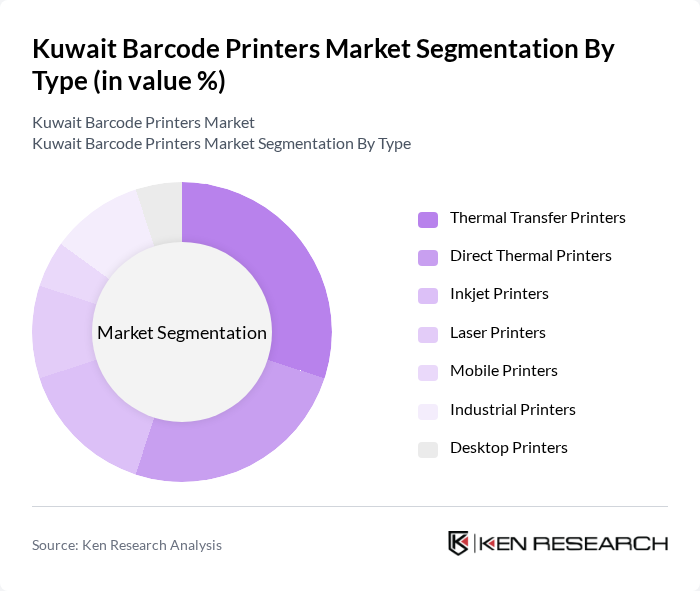
Kuwait Barcode Printers Market segmentation by Type.

The Thermal Transfer Printers segment currently dominates the market due to its capability to produce high-quality, durable labels that withstand challenging environmental conditions. This type is especially favored in manufacturing and logistics, where asset tracking and inventory management require labels with extended longevity. The ongoing trend toward automation and operational efficiency in these sectors continues to drive demand for thermal transfer technology, reinforcing its position as the leading choice among end-users .

By End-User:The market is segmented by end-user industries, including Retail and E-commerce, Healthcare, Logistics and Transportation, Manufacturing, Government and Public Sector, and Warehousing and Distribution. Each sector has unique barcode printing requirements, influencing the selection of printer types and technologies. Retail and E-commerce prioritize speed and accuracy for inventory and point-of-sale operations; Healthcare focuses on patient safety and traceability; Logistics and Transportation require robust solutions for shipment tracking; Manufacturing demands high-volume, durable labeling; Government and Public Sector utilize barcode systems for asset management and compliance; Warehousing and Distribution emphasize mobility and efficiency in inventory handling .

Kuwait Barcode Printers Market segmentation by End-User.

The Retail and E-commerce sector is the leading end-user of barcode printers, supported by the rapid expansion of online shopping and the imperative for efficient inventory management. Retailers rely on advanced barcode solutions to streamline operations, elevate customer experience, and maintain accurate stock levels. The growing adoption of automated systems and omnichannel retail strategies further consolidates this segment's dominance in the market .

Kuwait Barcode Printers Market Competitive Landscape

The Kuwait Barcode Printers Market is characterized by a dynamic mix of regional and international players. Leading participants such as Zebra Technologies Corporation, Honeywell International Inc., SATO Holdings Corporation, TSC Auto ID Technology Co., Ltd., Brother Industries, Ltd., Datalogic S.p.A., Printronix, LLC, Intermec Technologies Corporation, Avery Dennison Corporation, Seiko Epson Corporation, Bixolon Co., Ltd., Novexx Solutions GmbH, Toshiba TEC Corporation, Wasp Barcode Technologies, Dymo Corporation contribute to innovation, geographic expansion, and service delivery in this space.

Zebra Technologies Corporation

1969

Lincolnshire, Illinois, USA

Honeywell International Inc.

1906

Charlotte, North Carolina, USA

SATO Holdings Corporation

1940

Tokyo, Japan

TSC Auto ID Technology Co., Ltd.

1991

Taipei, Taiwan

Brother Industries, Ltd.

1908

Nagoya, Japan

Company

Establishment Year

Headquarters

Company Size Classification (Enterprise, Mid-Market, SME)

Year-over-Year Revenue Growth Rate (%)

Market Penetration Rate in Kuwait (%)

Customer Retention Rate (%)

Pricing Strategy (Premium, Mid-Range, Budget)

Product Portfolio Breadth (Number of SKUs)

Kuwait Barcode Printers Market Industry Analysis

Growth Drivers

  • Increasing Demand for Inventory Management Solutions:The demand for efficient inventory management solutions in Kuwait is projected to rise significantly, driven by the retail sector's growth, which is expected to reach USD 12 billion in future. This growth is fueled by the increasing need for businesses to optimize stock levels and reduce operational costs. As companies seek to enhance their inventory tracking capabilities, the adoption of barcode printers is anticipated to increase, supporting better inventory accuracy and management efficiency.
  • Growth in Retail and E-commerce Sectors:The retail and e-commerce sectors in Kuwait are experiencing rapid expansion, with e-commerce sales projected to reach USD 3.5 billion in future. This growth is driving the need for barcode printing solutions to streamline operations, improve customer experience, and enhance supply chain efficiency. As more retailers adopt technology to manage their operations, the demand for barcode printers is expected to rise, facilitating better product tracking and inventory management.
  • Technological Advancements in Printing Technology:The barcode printing technology landscape is evolving, with advancements such as thermal printing and mobile printing solutions gaining traction. In future, the global thermal printer market is expected to reach USD 5 billion, indicating a shift towards more efficient and cost-effective printing solutions. These innovations are driving the adoption of barcode printers in Kuwait, as businesses seek to leverage new technologies to enhance productivity and reduce operational costs.

Market Challenges

  • High Initial Investment Costs:One of the significant challenges facing the barcode printer market in Kuwait is the high initial investment required for advanced printing solutions. Many businesses, particularly small and medium-sized enterprises (SMEs), may find it difficult to allocate budgets for these technologies. With an average cost of USD 1,500 for a quality barcode printer, the financial barrier can hinder adoption, limiting market growth and innovation in the sector.
  • Limited Awareness Among Small Businesses:A considerable challenge in the Kuwait barcode printers market is the limited awareness of the benefits of barcode technology among small businesses. Many SMEs lack knowledge about how barcode systems can enhance operational efficiency and reduce errors. This gap in understanding can lead to underutilization of available technologies, stifling market growth. Educational initiatives and targeted marketing strategies are essential to address this challenge and promote adoption.

Kuwait Barcode Printers Market Future Outlook

The future of the Kuwait barcode printers market appears promising, driven by technological advancements and increasing demand for efficient inventory management solutions. As businesses continue to embrace automation and digital transformation, the integration of IoT and cloud-based printing solutions is expected to gain momentum. Additionally, the rise of smart retail technologies will further enhance the need for innovative barcode printing solutions, positioning the market for significant growth in the coming years.

Market Opportunities

  • Expansion of Smart Retail Technologies:The growing trend of smart retail technologies presents a significant opportunity for barcode printer manufacturers. With the retail sector in Kuwait projected to invest heavily in automation and smart solutions, the demand for advanced barcode printing systems is likely to increase, enabling retailers to enhance customer experiences and streamline operations.
  • Potential for Eco-Friendly Printing Solutions:As environmental concerns rise, there is a growing opportunity for eco-friendly barcode printing solutions in Kuwait. Businesses are increasingly seeking sustainable practices, and manufacturers that offer biodegradable or recyclable printing materials can tap into this market demand, positioning themselves as leaders in environmentally responsible technology.

Scope of the Report

SegmentSub-Segments
By Type

Thermal Transfer Printers

Direct Thermal Printers

Inkjet Printers

Laser Printers

Mobile Printers

Industrial Printers

Desktop Printers

By End-User

Retail and E-commerce

Healthcare

Logistics and Transportation

Manufacturing

Government and Public Sector

Warehousing and Distribution

By Application

Inventory Management

Shipping and Receiving

Product Labeling

Asset Tracking

Supply Chain Optimization

By Distribution Channel

Online Retail

Offline Retail

Direct Sales

Authorized Distributors

System Integrators

By Region

Capital Governorate

Hawalli Governorate

Al Ahmadi Governorate

Farwaniya Governorate

Mubarak Al-Kabeer Governorate

By Technology

RFID Technology

D Barcode Technology

D Barcode Technology

Cloud-Based Integration

By Pricing Model

One-time Purchase

Subscription-based

Lease

Managed Services

Key Target Audience

Investors and Venture Capitalist Firms

Government and Regulatory Bodies (e.g., Ministry of Commerce and Industry, Public Authority for Industry)

Manufacturers and Producers

Distributors and Retailers

Logistics and Supply Chain Companies

Healthcare Providers and Institutions

Retail Chains and Supermarkets

Technology Providers

Players Mentioned in the Report:

Zebra Technologies Corporation

Honeywell International Inc.

SATO Holdings Corporation

TSC Auto ID Technology Co., Ltd.

Brother Industries, Ltd.

Datalogic S.p.A.

Printronix, LLC

Intermec Technologies Corporation

Avery Dennison Corporation

Seiko Epson Corporation

Bixolon Co., Ltd.

Novexx Solutions GmbH

Toshiba TEC Corporation

Wasp Barcode Technologies

Dymo Corporation

Table of Contents

Market Assessment Phase

1. Executive Summary and Approach


2. Kuwait Barcode Printers Market Overview

2.1 Key Insights and Strategic Recommendations

2.2 Kuwait Barcode Printers Market Overview

2.3 Definition and Scope

2.4 Evolution of Market Ecosystem

2.5 Timeline of Key Regulatory Milestones

2.6 Value Chain & Stakeholder Mapping

2.7 Business Cycle Analysis

2.8 Policy & Incentive Landscape


3. Kuwait Barcode Printers Market Analysis

3.1 Growth Drivers

3.1.1 Increasing demand for inventory management solutions
3.1.2 Growth in retail and e-commerce sectors
3.1.3 Technological advancements in printing technology
3.1.4 Rising adoption of automation in various industries

3.2 Market Challenges

3.2.1 High initial investment costs
3.2.2 Limited awareness among small businesses
3.2.3 Competition from low-cost alternatives
3.2.4 Regulatory compliance issues

3.3 Market Opportunities

3.3.1 Expansion of smart retail technologies
3.3.2 Increasing focus on supply chain efficiency
3.3.3 Growth in healthcare and logistics sectors
3.3.4 Potential for eco-friendly printing solutions

3.4 Market Trends

3.4.1 Shift towards mobile and cloud-based printing solutions
3.4.2 Integration of IoT in barcode printing
3.4.3 Customization and personalization in printing
3.4.4 Rise of subscription-based models for printers

3.5 Government Regulation

3.5.1 Standards for barcode labeling
3.5.2 Environmental regulations on printer emissions
3.5.3 Compliance with data protection laws
3.5.4 Incentives for adopting green technologies

4. SWOT Analysis


5. Stakeholder Analysis


6. Porter's Five Forces Analysis


7. Kuwait Barcode Printers Market Size, 2019-2024

7.1 By Value

7.2 By Volume

7.3 By Average Selling Price


8. Kuwait Barcode Printers Market Segmentation

8.1 By Type

8.1.1 Thermal Transfer Printers
8.1.2 Direct Thermal Printers
8.1.3 Inkjet Printers
8.1.4 Laser Printers
8.1.5 Mobile Printers
8.1.6 Industrial Printers
8.1.7 Desktop Printers

8.2 By End-User

8.2.1 Retail and E-commerce
8.2.2 Healthcare
8.2.3 Logistics and Transportation
8.2.4 Manufacturing
8.2.5 Government and Public Sector
8.2.6 Warehousing and Distribution

8.3 By Application

8.3.1 Inventory Management
8.3.2 Shipping and Receiving
8.3.3 Product Labeling
8.3.4 Asset Tracking
8.3.5 Supply Chain Optimization

8.4 By Distribution Channel

8.4.1 Online Retail
8.4.2 Offline Retail
8.4.3 Direct Sales
8.4.4 Authorized Distributors
8.4.5 System Integrators

8.5 By Region

8.5.1 Capital Governorate
8.5.2 Hawalli Governorate
8.5.3 Al Ahmadi Governorate
8.5.4 Farwaniya Governorate
8.5.5 Mubarak Al-Kabeer Governorate

8.6 By Technology

8.6.1 RFID Technology
8.6.2 2D Barcode Technology
8.6.3 1D Barcode Technology
8.6.4 Cloud-Based Integration

8.7 By Pricing Model

8.7.1 One-time Purchase
8.7.2 Subscription-based
8.7.3 Lease
8.7.4 Managed Services

9. Kuwait Barcode Printers Market Competitive Analysis

9.1 Market Share of Key Players

9.2 Cross Comparison of Key Players

9.2.1 Company Name
9.2.2 Company Size Classification (Enterprise, Mid-Market, SME)
9.2.3 Year-over-Year Revenue Growth Rate (%)
9.2.4 Market Penetration Rate in Kuwait (%)
9.2.5 Customer Retention Rate (%)
9.2.6 Pricing Strategy (Premium, Mid-Range, Budget)
9.2.7 Product Portfolio Breadth (Number of SKUs)
9.2.8 Gross Margin / Operational Efficiency Ratio (%)
9.2.9 Brand Awareness Score (Market Recognition %)
9.2.10 Net Promoter Score (NPS) / Customer Satisfaction Index

9.3 SWOT Analysis of Top Players

9.4 Pricing Analysis

9.5 Detailed Profile of Major Companies

9.5.1 Zebra Technologies Corporation
9.5.2 Honeywell International Inc.
9.5.3 SATO Holdings Corporation
9.5.4 TSC Auto ID Technology Co., Ltd.
9.5.5 Brother Industries, Ltd.
9.5.6 Datalogic S.p.A.
9.5.7 Printronix, LLC
9.5.8 Intermec Technologies Corporation
9.5.9 Avery Dennison Corporation
9.5.10 Seiko Epson Corporation
9.5.11 Bixolon Co., Ltd.
9.5.12 Novexx Solutions GmbH
9.5.13 Toshiba TEC Corporation
9.5.14 Wasp Barcode Technologies
9.5.15 Dymo Corporation

10. Kuwait Barcode Printers Market End-User Analysis

10.1 Procurement Behavior of Key Ministries

10.1.1 Budget Allocation Trends
10.1.2 Preferred Suppliers
10.1.3 Procurement Processes
10.1.4 Contract Duration Preferences

10.2 Corporate Spend on Infrastructure & Technology

10.2.1 Investment Trends
10.2.2 Key Projects
10.2.3 Budget Priorities
10.2.4 Spending Forecasts

10.3 Pain Point Analysis by End-User Category

10.3.1 Common Challenges Faced
10.3.2 Technology Gaps
10.3.3 Service Expectations
10.3.4 Support Needs

10.4 User Readiness for Adoption

10.4.1 Training Requirements
10.4.2 Technology Familiarity
10.4.3 Change Management Strategies
10.4.4 Adoption Barriers

10.5 Post-Deployment ROI and Use Case Expansion

10.5.1 ROI Measurement Techniques
10.5.2 Use Case Success Stories
10.5.3 Expansion Opportunities
10.5.4 Long-term Value Assessment

11. Kuwait Barcode Printers Market Future Size, 2025-2030

11.1 By Value

11.2 By Volume

11.3 By Average Selling Price


Go-To-Market Strategy Phase

1. Whitespace Analysis + Business Model Canvas

1.1 Market Gaps Identification

1.2 Value Proposition Development

1.3 Revenue Streams Analysis

1.4 Key Partnerships Exploration

1.5 Cost Structure Evaluation

1.6 Customer Segmentation

1.7 Channels Strategy


2. Marketing and Positioning Recommendations

2.1 Branding Strategies

2.2 Product USPs

2.3 Target Audience Identification

2.4 Communication Strategy

2.5 Digital Marketing Tactics

2.6 Offline Marketing Strategies

2.7 Performance Metrics


3. Distribution Plan

3.1 Urban Retail Strategies

3.2 B2B Channel Development

3.3 E-commerce Integration

3.4 Direct Sales Approach

3.5 Distribution Partnerships

3.6 Logistics Management

3.7 Inventory Management


4. Channel & Pricing Gaps

4.1 Underserved Routes

4.2 Pricing Bands Analysis

4.3 Competitor Pricing Comparison

4.4 Customer Willingness to Pay

4.5 Discount Strategies

4.6 Bundling Opportunities

4.7 Pricing Strategy Recommendations


5. Unmet Demand & Latent Needs

5.1 Category Gaps

5.2 Consumer Segments Analysis

5.3 Emerging Trends Identification

5.4 Customer Feedback Analysis

5.5 Future Needs Forecasting5.6 Product Development Opportunities5.7 Market Entry Opportunities6. Customer Relationship6.1 Loyalty Programs6.2 After-sales Service6.3 Customer Engagement Strategies6.4 Feedback Mechanisms6.5 Relationship Management Tools6.6 Customer Retention Strategies6.7 Community Building Initiatives7. Value Proposition7.1 Sustainability Initiatives7.2 Integrated Supply Chains7.3 Cost Savings Analysis7.4 Quality Assurance Measures7.5 Customer-Centric Innovations7.6 Competitive Advantages7.7 Long-term Value Creation8.


Research Methodology

ApproachModellingSample

Phase 1: Approach1

Desk Research

  • Industry reports from local trade associations and market research firms
  • Government publications on manufacturing and import/export statistics related to barcode printers
  • Academic journals and white papers focusing on technology adoption in the Kuwaiti market

Primary Research

  • Interviews with key stakeholders in the printing and labeling industry, including manufacturers and distributors
  • Surveys targeting end-users in retail, logistics, and healthcare sectors to understand their barcode printing needs
  • Field visits to businesses utilizing barcode printers to gather qualitative insights on usage and preferences

Validation & Triangulation

  • Cross-validation of findings through multiple data sources, including trade publications and expert opinions
  • Triangulation of market size estimates using both top-down and bottom-up approaches
  • Sanity checks through feedback from industry experts and stakeholders

Phase 2: Market Size Estimation1

Top-down Assessment

  • Analysis of the overall printing market in Kuwait to estimate the share attributed to barcode printers
  • Segmentation of the market by end-user industries such as retail, logistics, and healthcare
  • Incorporation of growth trends in e-commerce and retail sectors influencing barcode printer demand

Bottom-up Modeling

  • Estimation of sales volume based on historical data from major suppliers and distributors in Kuwait
  • Cost analysis of barcode printers, including hardware, software, and maintenance expenses
  • Calculation of market size based on projected sales volume and average selling price

Forecasting & Scenario Analysis

  • Development of forecasting models considering technological advancements and market trends
  • Scenario analysis based on potential regulatory changes and economic conditions affecting the market
  • Projections for market growth through 2030, including best-case and worst-case scenarios

Phase 3: CATI Sample Composition1

Scope Item/SegmentSample SizeTarget Respondent Profiles
Retail Barcode Printing Needs100Store Managers, Inventory Control Specialists
Logistics and Supply Chain Applications80Logistics Coordinators, Warehouse Managers
Healthcare Sector Usage70Pharmacy Managers, Hospital Supply Chain Managers
Manufacturing Sector Requirements60Production Managers, Quality Control Supervisors
Government and Public Sector Applications50Procurement Officers, IT Managers

Frequently Asked Questions

What is the current value of the Kuwait Barcode Printers Market?

The Kuwait Barcode Printers Market is valued at approximately USD 8 million, driven by the increasing demand for efficient inventory management and tracking solutions across various sectors, including retail, healthcare, and logistics.

What factors are driving the growth of the barcode printers market in Kuwait?

Which regions in Kuwait are significant for the barcode printers market?

What types of barcode printers are available in the Kuwait market?

Other Regional/Country Reports

Indonesia Barcode Printers Market Size, Share, Growth Drivers, Trends, Opportunities & Forecast 2025–2030

Malaysia Barcode Printers Market Size, Share, Growth Drivers, Trends, Opportunities & Forecast 2025–2030

KSA Barcode Printers Market Size, Share, Growth Drivers, Trends, Opportunities & Forecast 2025–2030

APAC Barcode Printers Market Size, Share, Growth Drivers, Trends, Opportunities & Forecast 2025–2030

SEA Barcode Printers Market Size, Share, Growth Drivers, Trends, Opportunities & Forecast 2025–2030

Vietnam Barcode Printers Market Size, Share, Growth Drivers, Trends, Opportunities & Forecast 2025–2030

Why Buy From Us?

Refine Robust Result (RRR) Framework

What makes us stand out is that our consultants follow Robust, Refine and Result (RRR) methodology. Robust for clear definitions, approaches and sanity checking, Refine for differentiating respondents' facts and opinions, and Result for presenting data with story.

Our Reach Is Unmatched

We have set a benchmark in the industry by offering our clients with syndicated and customized market research reports featuring coverage of entire market as well as meticulous research and analyst insights.

Shifting the Research Paradigm

While we don't replace traditional research, we flip the method upside down. Our dual approach of Top Bottom & Bottom Top ensures quality deliverable by not just verifying company fundamentals but also looking at the sector and macroeconomic factors.

More Insights-Better Decisions

With one step in the future, our research team constantly tries to show you the bigger picture. We help with some of the tough questions you may encounter along the way: How is the industry positioned? Best marketing channel? KPI's of competitors? By aligning every element, we help maximize success.

Transparency and Trust

Our report gives you instant access to the answers and sources that other companies might choose to hide. We elaborate each steps of research methodology we have used and showcase you the sample size to earn your trust.

Round the Clock Support

If you need any support, we are here! We pride ourselves on universe strength, data quality, and quick, friendly, and professional service.

Why Clients Choose Us?

400000+
Reports in repository
150+
Consulting projects a year
100+
Analysts
8000+
Client Queries in 2022








