About the Report
Base Year 2024Kuwait Coding Bootcamp Market Overview
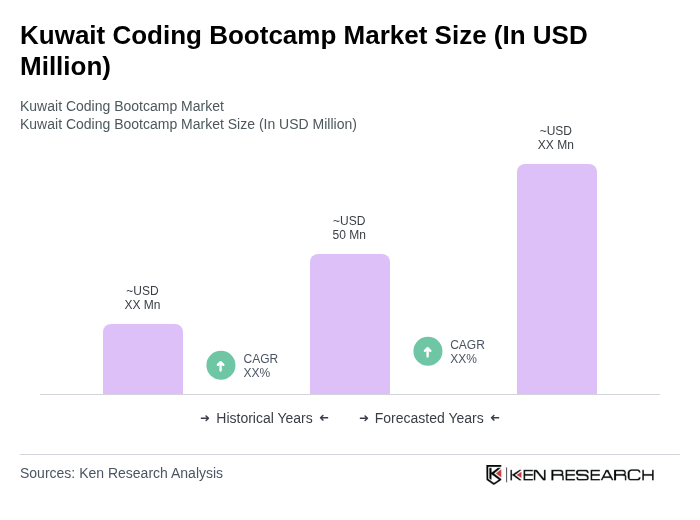
- The Kuwait Coding Bootcamp Market is valued at USD 50 million, based on a five-year historical analysis. This growth is primarily driven by the increasing demand for skilled tech professionals, as Kuwait's economy diversifies and invests in digital transformation initiatives. The rise in technology adoption across various sectors has led to a surge in interest for coding bootcamps, which provide accelerated training for individuals seeking to enter the tech workforce.
- Kuwait City is the dominant hub for coding bootcamps, primarily due to its status as the capital and largest city, where most educational institutions and tech companies are located. The concentration of resources, including access to technology and a growing startup ecosystem, fosters an environment conducive to the growth of coding bootcamps. Additionally, the presence of expatriates seeking skill enhancement further drives demand in this region.
- In 2023, the Kuwaiti government implemented a new regulation aimed at enhancing the quality of vocational training programs, including coding bootcamps. This regulation mandates that all bootcamp providers must obtain accreditation from the Ministry of Education, ensuring that they meet specific educational standards and provide recognized certifications. This initiative is designed to improve the overall quality of training and increase the employability of graduates.
Kuwait Coding Bootcamp Market Segmentation
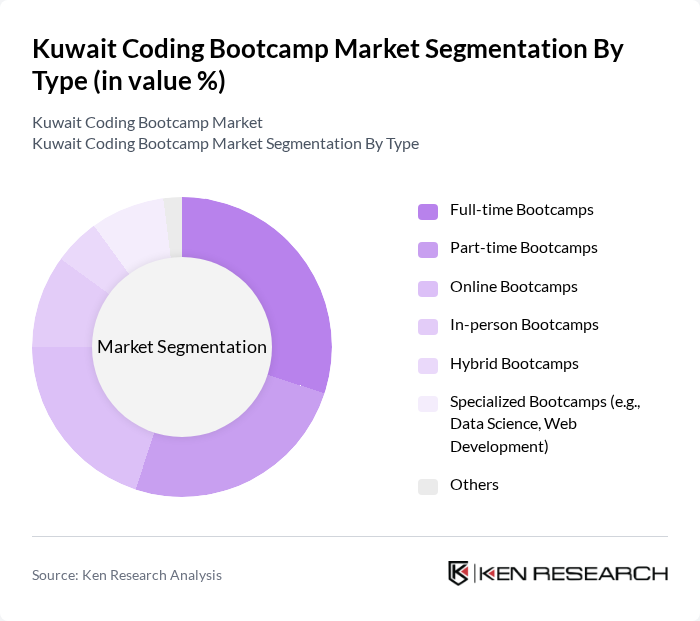
By Type:The coding bootcamp market can be segmented into various types, including Full-time Bootcamps, Part-time Bootcamps, Online Bootcamps, In-person Bootcamps, Hybrid Bootcamps, Specialized Bootcamps (e.g., Data Science, Web Development), and Others. Each type caters to different learning preferences and schedules, allowing a diverse range of participants to engage in coding education.
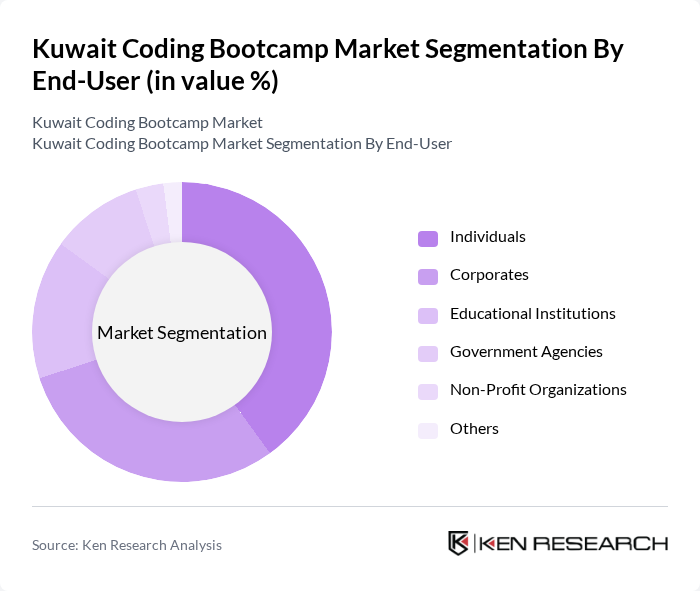
By End-User:The end-user segmentation includes Individuals, Corporates, Educational Institutions, Government Agencies, Non-Profit Organizations, and Others. This segmentation highlights the diverse clientele that coding bootcamps serve, from individuals seeking career changes to organizations looking to upskill their workforce.
Kuwait Coding Bootcamp Market Competitive Landscape
The Kuwait Coding Bootcamp Market is characterized by a dynamic mix of regional and international players. Leading participants such as Code Academy, Le Wagon, General Assembly, Ironhack, Thinkful, Flatiron School, Springboard, Coding Dojo, Nucamp, CareerFoundry, KodeKloud, Tech Elevator, Bloc, App Academy, Udacity contribute to innovation, geographic expansion, and service delivery in this space.
Kuwait Coding Bootcamp Market Industry Analysis
Growth Drivers
- Increasing Demand for Tech Skills:The demand for tech skills in Kuwait is surging, with the World Bank reporting a 30% increase in job postings for tech-related roles from 2022 to 2023. This trend is driven by the digital transformation across various sectors, including finance and healthcare, which are projected to require over 16,000 new tech professionals in the future. As businesses seek to innovate, coding bootcamps are positioned to fill this skills gap effectively.
- Government Initiatives Promoting Digital Education:The Kuwaiti government has allocated approximately $55 million for digital education initiatives in the future, aiming to enhance the tech workforce. This funding supports coding bootcamps and other educational programs, fostering a culture of innovation. Additionally, the Ministry of Education is integrating coding into school curricula, which is expected to increase enrollment in bootcamps by 25% over the next year, further driving market growth.
- Rise of the Startup Ecosystem in Kuwait:Kuwait's startup ecosystem is thriving, with over 220 startups launched in 2023 alone, according to the Kuwait National Fund for Small and Medium Enterprises. This growth is creating a robust demand for skilled tech workers, as startups often require agile and adaptable talent. Coding bootcamps are increasingly collaborating with these startups to provide tailored training, enhancing job placement rates and attracting more students to enroll.
Market Challenges
- Limited Awareness of Coding Bootcamps:Despite the growing demand for tech skills, awareness of coding bootcamps remains low in Kuwait. A recent survey indicated that only 30% of potential students are familiar with bootcamp offerings. This lack of awareness hinders enrollment, as many individuals still prefer traditional educational pathways. Increasing marketing efforts and outreach programs are essential to bridge this knowledge gap and attract more participants.
- Competition from Traditional Educational Institutions:Traditional universities in Kuwait are expanding their technology programs, posing significant competition to coding bootcamps. In 2023, universities reported a 20% increase in enrollment in computer science degrees. This trend may deter prospective students from considering bootcamps, which are often perceived as less credible. To remain competitive, bootcamps must emphasize their unique advantages, such as shorter duration and practical training.
Kuwait Coding Bootcamp Market Future Outlook
The future of the Kuwait coding bootcamp market appears promising, driven by increasing government support and a burgeoning tech ecosystem. As digital transformation accelerates, bootcamps are likely to adapt their curricula to meet evolving industry needs, focusing on emerging technologies. Furthermore, partnerships with local businesses will enhance job placement opportunities, making bootcamps an attractive option for aspiring tech professionals. The emphasis on practical skills and rapid training will continue to resonate with students seeking immediate employment in the tech sector.
Market Opportunities
- Expansion of Online Coding Bootcamp Offerings:The shift towards online education presents a significant opportunity for coding bootcamps in Kuwait. With internet penetration reaching 100% in the future, bootcamps can expand their reach and attract students from diverse backgrounds. This flexibility allows for tailored learning experiences, catering to the needs of working professionals and those in remote areas, potentially increasing enrollment by 35%.
- Collaboration with International Tech Companies:Collaborating with international tech firms can enhance the credibility and appeal of coding bootcamps. Such partnerships can provide access to global resources, mentorship, and internship opportunities, which are crucial for student success. By aligning with established companies, bootcamps can attract more students and improve job placement rates, fostering a stronger tech workforce in Kuwait.
Scope of the Report
| Segment | Sub-Segments |
|---|---|
| By Type | Full-time Bootcamps Part-time Bootcamps Online Bootcamps In-person Bootcamps Hybrid Bootcamps Specialized Bootcamps (e.g., Data Science, Web Development) Others |
| By End-User | Individuals Corporates Educational Institutions Government Agencies Non-Profit Organizations Others |
| By Demographics | Age Group (18-24, 25-34, 35+) Gender Educational Background Employment Status Others |
| By Duration | Short-term (less than 3 months) Medium-term (3-6 months) Long-term (6 months and above) Others |
| By Learning Format | Live Online Classes Recorded Sessions Blended Learning Others |
| By Certification Type | Industry-recognized Certifications In-house Certifications No Certification Others |
| By Payment Model | Upfront Payment Installment Plans Income Share Agreements Others |
Key Target Audience
Investors and Venture Capitalist Firms
Government and Regulatory Bodies (e.g., Ministry of Education, Public Authority for Applied Education and Training)
Corporate Training Departments
Tech Startups and Entrepreneurs
Non-Profit Organizations focused on Education and Workforce Development
Local and International Tech Companies
Industry Associations and Professional Networks
Financial Institutions and Banks
Players Mentioned in the Report:
Code Academy
Le Wagon
General Assembly
Ironhack
Thinkful
Flatiron School
Springboard
Coding Dojo
Nucamp
CareerFoundry
KodeKloud
Tech Elevator
Bloc
App Academy
Udacity
Table of Contents
Market Assessment Phase
1. Executive Summary and Approach
2. Kuwait Coding Bootcamp Market Overview
2.1 Key Insights and Strategic Recommendations
2.2 Kuwait Coding Bootcamp Market Overview
2.3 Definition and Scope
2.4 Evolution of Market Ecosystem
2.5 Timeline of Key Regulatory Milestones
2.6 Value Chain & Stakeholder Mapping
2.7 Business Cycle Analysis
2.8 Policy & Incentive Landscape
3. Kuwait Coding Bootcamp Market Analysis
3.1 Growth Drivers
3.1.1 Increasing demand for tech skills
3.1.2 Government initiatives promoting digital education
3.1.3 Rise of the startup ecosystem in Kuwait
3.1.4 Partnerships with local businesses for job placements
3.2 Market Challenges
3.2.1 Limited awareness of coding bootcamps
3.2.2 Competition from traditional educational institutions
3.2.3 High dropout rates among students
3.2.4 Economic fluctuations affecting enrollment
3.3 Market Opportunities
3.3.1 Expansion of online coding bootcamp offerings
3.3.2 Collaboration with international tech companies
3.3.3 Development of specialized coding programs for industries
3.3.4 Increasing interest in remote work and freelancing
3.4 Market Trends
3.4.1 Growth of hybrid learning models
3.4.2 Emphasis on soft skills alongside technical training
3.4.3 Use of AI and machine learning in curriculum
3.4.4 Focus on diversity and inclusion in tech education
3.5 Government Regulation
3.5.1 Licensing requirements for educational institutions
3.5.2 Accreditation standards for coding programs
3.5.3 Funding opportunities for tech education initiatives
3.5.4 Policies promoting STEM education in schools
4. SWOT Analysis
5. Stakeholder Analysis
6. Porter's Five Forces Analysis
7. Kuwait Coding Bootcamp Market Market Size, 2019-2024
7.1 By Value
7.2 By Volume
7.3 By Average Selling Price
8. Kuwait Coding Bootcamp Market Segmentation
8.1 By Type
8.1.1 Full-time Bootcamps
8.1.2 Part-time Bootcamps
8.1.3 Online Bootcamps
8.1.4 In-person Bootcamps
8.1.5 Hybrid Bootcamps
8.1.6 Specialized Bootcamps (e.g., Data Science, Web Development)
8.1.7 Others
8.2 By End-User
8.2.1 Individuals
8.2.2 Corporates
8.2.3 Educational Institutions
8.2.4 Government Agencies
8.2.5 Non-Profit Organizations
8.2.6 Others
8.3 By Demographics
8.3.1 Age Group (18-24, 25-34, 35+)
8.3.2 Gender
8.3.3 Educational Background
8.3.4 Employment Status
8.3.5 Others
8.4 By Duration
8.4.1 Short-term (less than 3 months)
8.4.2 Medium-term (3-6 months)
8.4.3 Long-term (6 months and above)
8.4.4 Others
8.5 By Learning Format
8.5.1 Live Online Classes
8.5.2 Recorded Sessions
8.5.3 Blended Learning
8.5.4 Others
8.6 By Certification Type
8.6.1 Industry-recognized Certifications
8.6.2 In-house Certifications
8.6.3 No Certification
8.6.4 Others
8.7 By Payment Model
8.7.1 Upfront Payment
8.7.2 Installment Plans
8.7.3 Income Share Agreements
8.7.4 Others
9. Kuwait Coding Bootcamp Market Competitive Analysis
9.1 Market Share of Key Players
9.2 Cross Comparison of Key Players
9.2.1 Company Name
9.2.2 Group Size (Large, Medium, or Small as per industry convention)
9.2.3 Enrollment Growth Rate
9.2.4 Customer Satisfaction Score
9.2.5 Job Placement Rate
9.2.6 Course Completion Rate
9.2.7 Pricing Strategy
9.2.8 Revenue per Student
9.2.9 Market Penetration Rate
9.2.10 Brand Recognition Score
9.3 SWOT Analysis of Top Players
9.4 Pricing Analysis
9.5 Detailed Profile of Major Companies
9.5.1 Code Academy
9.5.2 Le Wagon
9.5.3 General Assembly
9.5.4 Ironhack
9.5.5 Thinkful
9.5.6 Flatiron School
9.5.7 Springboard
9.5.8 Coding Dojo
9.5.9 Nucamp
9.5.10 CareerFoundry
9.5.11 KodeKloud
9.5.12 Tech Elevator
9.5.13 Bloc
9.5.14 App Academy
9.5.15 Udacity
10. Kuwait Coding Bootcamp Market End-User Analysis
10.1 Procurement Behavior of Key Ministries
10.1.1 Budget Allocation for Tech Education
10.1.2 Decision-Making Process
10.1.3 Preferred Training Providers
10.1.4 Evaluation Criteria for Bootcamps
10.2 Corporate Spend on Infrastructure & Energy
10.2.1 Investment in Employee Training
10.2.2 Partnerships with Bootcamps
10.2.3 Budget for Technology Adoption
10.2.4 Others
10.3 Pain Point Analysis by End-User Category
10.3.1 Skill Gaps in the Workforce
10.3.2 High Turnover Rates
10.3.3 Need for Continuous Learning
10.3.4 Others
10.4 User Readiness for Adoption
10.4.1 Awareness of Coding Bootcamps
10.4.2 Willingness to Invest in Training
10.4.3 Perceived Value of Coding Skills
10.4.4 Others
10.5 Post-Deployment ROI and Use Case Expansion
10.5.1 Measurement of Training Effectiveness
10.5.2 Long-term Career Benefits
10.5.3 Opportunities for Upskilling
10.5.4 Others
11. Kuwait Coding Bootcamp Market Future Size, 2025-2030
11.1 By Value
11.2 By Volume
11.3 By Average Selling Price
Go-To-Market Strategy Phase
1. Whitespace Analysis + Business Model Canvas
1.1 Market Gaps Identification
1.2 Value Proposition Development
1.3 Revenue Streams
1.4 Cost Structure
1.5 Key Partners
1.6 Key Activities
1.7 Customer Segments
2. Marketing and Positioning Recommendations
2.1 Branding Strategies
2.2 Product USPs
3. Distribution Plan
3.1 Urban Retail vs Rural NGO Tie-ups
4. Channel & Pricing Gaps
4.1 Underserved Routes
4.2 Pricing Bands
5. Unmet Demand & Latent Needs
5.1 Category Gaps
5.2 Consumer Segments
6. Customer Relationship
6.1 Loyalty Programs
6.2 After-sales Service
7. Value Proposition
7.1 Sustainability
7.2 Integrated Supply Chains
8. Key Activities
8.1 Regulatory Compliance
8.2 Branding
8.3 Distribution Setup
9. Entry Strategy Evaluation
9.1 Domestic Market Entry Strategy
9.1.1 Product Mix
9.1.2 Pricing Band
9.1.3 Packaging
9.2 Export Entry Strategy
9.2.1 Target Countries
9.2.2 Compliance Roadmap
10. Entry Mode Assessment
10.1 JV
10.2 Greenfield
10.3 M&A
10.4 Distributor Model
11. Capital and Timeline Estimation
11.1 Capital Requirements
11.2 Timelines
12. Control vs Risk Trade-Off
12.1 Ownership vs Partnerships
13. Profitability Outlook
13.1 Breakeven Analysis
13.2 Long-term Sustainability
14. Potential Partner List
14.1 Distributors
14.2 JVs
14.3 Acquisition Targets
15. Execution Roadmap
15.1 Phased Plan for Market Entry
15.1.1 Market Setup
15.1.2 Market Entry
15.1.3 Growth Acceleration
15.1.4 Scale & Stabilize
15.2 Key Activities and Milestones
15.2.1 Milestone Planning
15.2.2 Activity Tracking
Research Methodology
Phase 1: Approach1
Desk Research
- Analysis of government reports on digital education initiatives in Kuwait
- Review of existing literature on coding bootcamps and their impact on job markets
- Examination of online platforms and forums discussing coding education trends in the region
Primary Research
- Interviews with founders and instructors of local coding bootcamps
- Surveys targeting recent graduates of coding bootcamps to assess employment outcomes
- Focus groups with potential students to understand motivations and barriers to enrollment
Validation & Triangulation
- Cross-validation of findings with industry reports and educational statistics
- Triangulation of data from interviews, surveys, and secondary research sources
- Sanity checks through expert reviews from educational consultants and industry leaders
Phase 2: Market Size Estimation1
Top-down Assessment
- Estimation of the total addressable market based on national education spending
- Segmentation of the market by demographics, including age and employment status
- Incorporation of trends in technology adoption and workforce development initiatives
Bottom-up Modeling
- Analysis of enrollment numbers from existing coding bootcamps in Kuwait
- Operational cost assessments based on tuition fees and program duration
- Revenue projections based on average student enrollment and course offerings
Forecasting & Scenario Analysis
- Multi-factor regression analysis incorporating economic growth and tech industry expansion
- Scenario modeling based on potential changes in government policy and funding
- Baseline, optimistic, and pessimistic projections for bootcamp growth through 2030
Phase 3: CATI Sample Composition1
| Scope Item/Segment | Sample Size | Target Respondent Profiles |
|---|---|---|
| Current Coding Bootcamp Students | 100 | Students enrolled in various coding bootcamps |
| Recent Bootcamp Graduates | 80 | Graduates who completed bootcamps within the last year |
| Industry Employers | 60 | HR managers and hiring executives in tech companies |
| Educational Institutions | 50 | Administrators from universities and colleges offering tech programs |
| Potential Bootcamp Students | 90 | Individuals interested in pursuing coding education |
Frequently Asked Questions
What is the current value of the Kuwait Coding Bootcamp Market?
The Kuwait Coding Bootcamp Market is valued at approximately USD 50 million, reflecting a growing demand for skilled tech professionals as the economy diversifies and invests in digital transformation initiatives.
Where are the main coding bootcamps located in Kuwait?
What types of coding bootcamps are available in Kuwait?
How has the Kuwaiti government supported coding bootcamps?
Other Regional/Country Reports
Other Adjacent Reports
Egypt EdTech Market
Vietnam Online Education MarketEgypt Vocational Training Market
Belgium IT Certification Market
China Corporate Training Market Size, Share & Forecast, By Service Type, Delivery Model & End-Use Industry, 2026-2031Global Software Development Market Size, Share & Forecast, By Service Type, Delivery Model & End-Use Industry, 2026-2031Mexico Data Science Market
Kuwait Web Development Market
Indonesia Digital Transformation Market Size, Share & Forecast, By Solution Type, Deployment Model & End-Use Industry, 2026-2031Indonesia Startup Incubation Market
Why Buy From Us?

What makes us stand out is that our consultants follow Robust, Refine and Result (RRR) methodology. Robust for clear definitions, approaches and sanity checking, Refine for differentiating respondents' facts and opinions, and Result for presenting data with story.

We have set a benchmark in the industry by offering our clients with syndicated and customized market research reports featuring coverage of entire market as well as meticulous research and analyst insights.

While we don't replace traditional research, we flip the method upside down. Our dual approach of Top Bottom & Bottom Top ensures quality deliverable by not just verifying company fundamentals but also looking at the sector and macroeconomic factors.

With one step in the future, our research team constantly tries to show you the bigger picture. We help with some of the tough questions you may encounter along the way: How is the industry positioned? Best marketing channel? KPI's of competitors? By aligning every element, we help maximize success.

Our report gives you instant access to the answers and sources that other companies might choose to hide. We elaborate each steps of research methodology we have used and showcase you the sample size to earn your trust.

If you need any support, we are here! We pride ourselves on universe strength, data quality, and quick, friendly, and professional service.