About the Report
Base Year 2024Kuwait Confectionery Market Overview
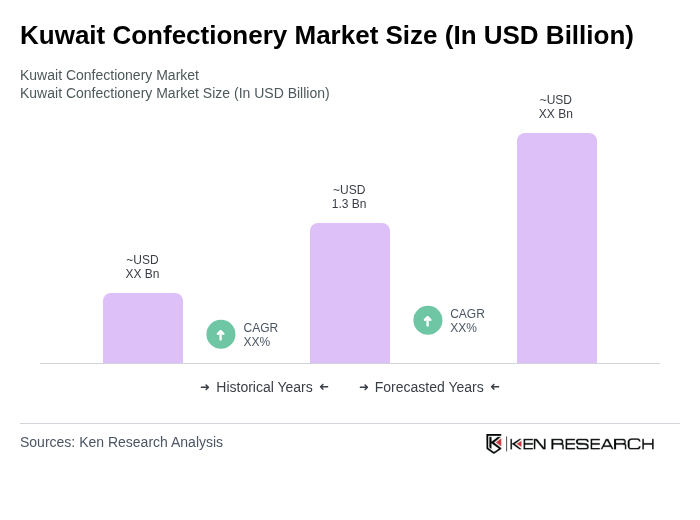
- The Kuwait Confectionery Market is valued at USD 1.3 billion, based on a five-year historical analysis of the broader confectionery and snacks category and Kuwait’s strong per capita spending on sweets and snack foods. This growth is primarily driven by increasing disposable incomes, a growing population, rising modern retail penetration, and an expanding culture of gifting during festivals such as Ramadan, Eid, and other special occasions. The demand for a variety of confectionery products, including chocolates, sugar confectionery, and novelty sweets, has surged as consumers seek indulgent treats, premium imported brands, and artisanal offerings, supported by expanding online and quick-commerce channels.
- Kuwait City is the dominant hub in the market, benefiting from its status as the capital and largest city, which attracts both local and international brands and hosts the highest concentration of modern retail formats. The concentration of retail outlets, supermarkets, hypermarkets, convenience stores, and shopping malls in urban areas facilitates easy access to a wide range of confectionery products, making it a key player in the market landscape and the primary launchpad for new product introductions.
- In 2023, the Kuwaiti government implemented regulations to enhance food safety standards in the confectionery sector. This includes mandatory labeling requirements for ingredients and nutritional information, aimed at promoting transparency and consumer awareness. The initiative is aligned with the Gulf Technical Regulation GSO 9/2013 on Labelling of Prepackaged Foodstuffs, as adopted and enforced in Kuwait by the Public Authority for Industry, which requires clear ingredient lists, allergen declaration, production and expiry dates, and nutrition labeling for prepackaged foods, including confectionery, thereby ensuring that products meet health and safety standards and fostering trust in local and imported products.
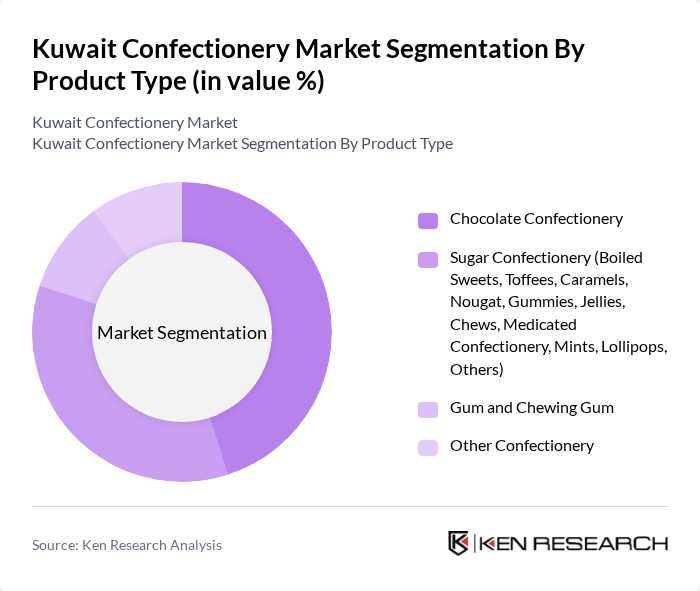
Kuwait Confectionery Market Segmentation
By Product Type:The product type segmentation includes various categories such as chocolate confectionery, sugar confectionery, gum and chewing gum, and other confectionery items. Chocolate confectionery is the leading segment within packaged sweets in Kuwait, supported by strong consumer affinity for international brands and significant representation in the overall snacks basket. The increasing demand for premium, filled, and gift-box chocolates, as well as artisanal and origin-specific products, has further fueled growth in this category. Sugar confectionery, which includes a wide range of boiled sweets, gummies, jellies, toffees, caramels, mints, lollipops, and medicated confectionery, also holds a significant share, appealing particularly to children and families and benefiting from impulse purchases in convenience and grocery channels. Gum and chewing gum, while smaller in comparison, remains a staple for young adults and teens, particularly for functional and sugar-free variants positioned around freshness and oral care. Other confectionery items, including seasonal, novelty, and ethnic sweets, contribute to the market's diversity, especially during festive periods and special occasions.
By Consumer Type:The consumer type segmentation encompasses children and teens, young adults, families, health-conscious and sugar-restricted consumers, and tourists and gifting buyers. Children and teens represent a significant portion of the market, driven by their preference for colorful, fun, and novelty confectionery products, especially gummies, lollipops, and chocolate bars. Young adults are increasingly drawn to premium, innovative, and on-the-go offerings, including filled chocolates, portion-controlled packs, and products marketed through digital and social media channels. Families often purchase in bulk for gatherings, celebrations, and everyday snacking, supporting multipack and family-size formats across both chocolate and sugar confectionery. Health-conscious consumers are shifting towards sugar-reduced, sugar-free, and organic options, as well as products featuring functional claims, reflecting a growing trend towards healthier eating within the broader snacks category. Tourists and gifting buyers contribute to seasonal spikes in demand, particularly during holidays and festivals, supporting sales of boxed chocolates, premium assortments, and specialty local confectionery in duty-free and modern retail outlets.

Kuwait Confectionery Market Competitive Landscape
The Kuwait Confectionery Market is characterized by a dynamic mix of regional and international players. Leading participants such as Mars, Incorporated (Mars Kuwait), Mondelez International, Nestlé S.A. (Nestlé Kuwait), Ferrero Group, The Hershey Company, Lindt & Sprüngli AG, Kuwait Danish Dairy Company (KDD), Kuwait Indo Trading Co. WLL, IFFCO Group, United Beverage Company K.S.C.C (UNIBEV), Local Premium Chocolatiers and Artisanal Brands (e.g., Fadaella Foods, Haven Chocolates), Leading Supermarket and Hypermarket Private Labels, Regional Importers and Distributors of International Confectionery Brands, Online-First and D2C Confectionery Brands Active in Kuwait, Other Notable Local Confectionery Manufacturers and Retailers contribute to innovation, geographic expansion, and service delivery in this space.
Kuwait Confectionery Market Industry Analysis
Growth Drivers
- Increasing Disposable Income:The average disposable income in Kuwait is projected to reach approximately $38,000 per capita in future, reflecting a 5% increase from previous estimates. This rise in income enables consumers to spend more on non-essential items, including confectionery products. As disposable income grows, the demand for premium and luxury confectionery items is expected to increase, driving market growth significantly. This trend is supported by the overall economic stability and growth in the region.
- Rising Demand for Premium Confectionery Products:The premium confectionery segment in Kuwait is anticipated to grow, with sales expected to reach $160 million in future. This growth is driven by changing consumer preferences towards high-quality, artisanal products. The increasing willingness to pay for premium offerings is evident as consumers seek unique flavors and high-quality ingredients, reflecting a broader trend towards indulgence and personalization in food choices, particularly among younger demographics.
- Growth of the Retail Sector:The retail sector in Kuwait is projected to expand by 6% in future, with the total retail sales expected to exceed $22 billion. This growth is bolstered by the increasing number of shopping malls and supermarkets, which provide greater access to confectionery products. Enhanced retail experiences and the introduction of specialized confectionery stores are also contributing to the market's expansion, making it easier for consumers to purchase a variety of confectionery items.
Market Challenges
- Intense Competition Among Local and International Brands:The Kuwaiti confectionery market is characterized by fierce competition, with over 250 brands vying for market share. This saturation leads to price wars and aggressive marketing strategies, which can erode profit margins. Local brands often struggle to compete with established international players who have greater resources and brand recognition, making it challenging for new entrants to gain a foothold in the market.
- Fluctuating Raw Material Prices:The confectionery industry in Kuwait faces challenges due to the volatility of raw material prices, particularly sugar and cocoa. In future, sugar prices are expected to fluctuate between $0.32 and $0.38 per pound, influenced by global supply chain disruptions and climatic conditions. These fluctuations can significantly impact production costs, forcing manufacturers to either absorb costs or pass them on to consumers, which may affect demand.
Kuwait Confectionery Market Future Outlook
The future of the Kuwait confectionery market appears promising, driven by evolving consumer preferences and technological advancements. The increasing focus on health and wellness is likely to spur innovation in product offerings, with manufacturers exploring healthier alternatives. Additionally, the rise of e-commerce platforms will facilitate greater accessibility to a diverse range of confectionery products, enhancing consumer convenience. As the market adapts to these trends, it is expected to witness sustained growth and diversification in product lines.
Market Opportunities
- Expansion of E-commerce Platforms:The e-commerce sector in Kuwait is projected to grow by 18% in future, providing a significant opportunity for confectionery brands to reach a broader audience. Online shopping offers convenience and access to a wider variety of products, enabling brands to cater to niche markets and enhance customer engagement through targeted marketing strategies.
- Introduction of Healthier Product Alternatives:With health consciousness on the rise, the demand for healthier confectionery options is increasing. The market for sugar-free and organic confectionery products is expected to grow, with sales projected to reach $60 million in future. This trend presents an opportunity for manufacturers to innovate and capture health-focused consumers, aligning with global dietary trends.
Scope of the Report
| Segment | Sub-Segments |
|---|---|
| By Product Type | Chocolate Confectionery Sugar Confectionery (Boiled Sweets, Toffees, Caramels, Nougat, Gummies, Jellies, Chews, Medicated Confectionery, Mints, Lollipops, Others) Gum and Chewing Gum Other Confectionery |
| By Consumer Type | Children and Teens Young Adults Families Health-Conscious and Sugar-Restricted Consumers Tourists and Gifting Buyers |
| By Distribution Channel | Supermarkets and Hypermarkets Convenience Stores Specialty Confectionery and Chocolate Boutiques Online Retail and E-commerce Platforms HoReCa and Institutional Channels |
| By Packaging Type | Single-Serve and On-the-Go Packs Family and Value Packs Gift Boxes and Premium Packaging Bulk and Institutional Packs |
| By Price Segment | Mass Mid-Priced Premium and Super-Premium |
| By Claim and Product Positioning | Sugar-Free and Reduced-Sugar Organic and Natural Ingredients Halal-Certified and Clean Label Functional and Fortified Confectionery Indulgent and Gifting-Focused |
| By Occasion and Consumption Moment | Everyday Snacking Festivals and Religious Occasions Weddings and Family Celebrations Corporate Gifting and Events Tourism, Travel Retail, and Duty-Free Purchases |
Key Target Audience
Investors and Venture Capitalist Firms
Government and Regulatory Bodies (e.g., Kuwait Municipality, Ministry of Health)
Manufacturers and Producers
Distributors and Retailers
Food Safety Authorities
Industry Associations (e.g., Kuwait Food and Beverage Association)
Importers and Exporters
Packaging Suppliers
Players Mentioned in the Report:
Mars, Incorporated (Mars Kuwait)
Mondelez International
Nestle S.A. (Nestle Kuwait)
Ferrero Group
The Hershey Company
Lindt & Sprungli AG
Kuwait Danish Dairy Company (KDD)
Kuwait Indo Trading Co. WLL
IFFCO Group
United Beverage Company K.S.C.C (UNIBEV)
Local Premium Chocolatiers and Artisanal Brands (e.g., Fadaella Foods, Haven Chocolates)
Leading Supermarket and Hypermarket Private Labels
Regional Importers and Distributors of International Confectionery Brands
Online-First and D2C Confectionery Brands Active in Kuwait
Other Notable Local Confectionery Manufacturers and Retailers
Table of Contents
Market Assessment Phase
1. Executive Summary and Approach
2. Kuwait Confectionery Market Overview
2.1 Key Insights and Strategic Recommendations
2.2 Kuwait Confectionery Market Overview
2.3 Definition and Scope
2.4 Evolution of Market Ecosystem
2.5 Timeline of Key Regulatory Milestones
2.6 Value Chain & Stakeholder Mapping
2.7 Business Cycle Analysis
2.8 Policy & Incentive Landscape
3. Kuwait Confectionery Market Analysis
3.1 Growth Drivers
3.1.1 Increasing disposable income
3.1.2 Rising demand for premium confectionery products
3.1.3 Growth of the retail sector
3.1.4 Cultural significance of sweets during festivals
3.2 Market Challenges
3.2.1 Intense competition among local and international brands
3.2.2 Fluctuating raw material prices
3.2.3 Health concerns regarding sugar consumption
3.2.4 Regulatory compliance and labeling requirements
3.3 Market Opportunities
3.3.1 Expansion of e-commerce platforms
3.3.2 Introduction of healthier product alternatives
3.3.3 Collaborations with local retailers
3.3.4 Growing interest in organic and natural ingredients
3.4 Market Trends
3.4.1 Increasing popularity of artisanal and handmade confectionery
3.4.2 Shift towards sustainable packaging solutions
3.4.3 Rise of online shopping for confectionery products
3.4.4 Innovative flavor combinations and product offerings
3.5 Government Regulation
3.5.1 Food safety standards and regulations
3.5.2 Labeling requirements for nutritional information
3.5.3 Import regulations for confectionery ingredients
3.5.4 Taxation policies affecting confectionery products
4. SWOT Analysis
5. Stakeholder Analysis
6. Porter's Five Forces Analysis
7. Kuwait Confectionery Market Market Size, 2019-2024
7.1 By Value
7.2 By Volume
7.3 By Average Selling Price
8. Kuwait Confectionery Market Segmentation
8.1 By Product Type
8.1.1 Chocolate Confectionery
8.1.2 Sugar Confectionery (Boiled Sweets, Toffees, Caramels, Nougat, Gummies, Jellies, Chews, Medicated Confectionery, Mints, Lollipops, Others)
8.1.3 Gum and Chewing Gum
8.1.4 Other Confectionery
8.2 By Consumer Type
8.2.1 Children and Teens
8.2.2 Young Adults
8.2.3 Families
8.2.4 Health-Conscious and Sugar-Restricted Consumers
8.2.5 Tourists and Gifting Buyers
8.3 By Distribution Channel
8.3.1 Supermarkets and Hypermarkets
8.3.2 Convenience Stores
8.3.3 Specialty Confectionery and Chocolate Boutiques
8.3.4 Online Retail and E-commerce Platforms
8.3.5 HoReCa and Institutional Channels
8.4 By Packaging Type
8.4.1 Single-Serve and On-the-Go Packs
8.4.2 Family and Value Packs
8.4.3 Gift Boxes and Premium Packaging
8.4.4 Bulk and Institutional Packs
8.5 By Price Segment
8.5.1 Mass
8.5.2 Mid-Priced
8.5.3 Premium and Super-Premium
8.6 By Claim and Product Positioning
8.6.1 Sugar-Free and Reduced-Sugar
8.6.2 Organic and Natural Ingredients
8.6.3 Halal-Certified and Clean Label
8.6.4 Functional and Fortified Confectionery
8.6.5 Indulgent and Gifting-Focused
8.7 By Occasion and Consumption Moment
8.7.1 Everyday Snacking
8.7.2 Festivals and Religious Occasions
8.7.3 Weddings and Family Celebrations
8.7.4 Corporate Gifting and Events
8.7.5 Tourism, Travel Retail, and Duty-Free Purchases
9. Kuwait Confectionery Market Competitive Analysis
9.1 Market Share of Key Players
9.2 Cross Comparison of Key Players
9.2.1 Company Name
9.2.2 Kuwait Confectionery Revenue (USD Million)
9.2.3 3-Year Revenue CAGR in Kuwait (%)
9.2.4 Kuwait Market Share (%)
9.2.5 Number of SKUs and Categories in Kuwait Portfolio
9.2.6 Average Realized Price per kg (USD/kg)
9.2.7 Gross Margin (%) on Kuwait Confectionery Sales
9.2.8 EBITDA Margin (%) – Kuwait Operations
9.2.9 Number of Retail Outlets Covered in Kuwait
9.2.10 Share of Modern Trade vs Traditional Trade (% of Sales)
9.2.11 E-commerce Share of Total Kuwait Sales (%)
9.2.12 Marketing and Trade Spend as % of Sales
9.2.13 Brand Awareness and Preference Index (Survey-Based)
9.2.14 New Product Launches in Last 24 Months (Count)
9.2.15 Share of Health-Oriented and Sugar-Reduced SKUs (%)
9.3 SWOT Analysis of Top Players
9.4 Pricing Analysis
9.5 Detailed Profile of Major Companies
9.5.1 Mars, Incorporated (Mars Kuwait)
9.5.2 Mondelez International
9.5.3 Nestlé S.A. (Nestlé Kuwait)
9.5.4 Ferrero Group
9.5.5 The Hershey Company
9.5.6 Lindt & Sprüngli AG
9.5.7 Kuwait Danish Dairy Company (KDD)
9.5.8 Kuwait Indo Trading Co. WLL
9.5.9 IFFCO Group
9.5.10 United Beverage Company K.S.C.C (UNIBEV)
9.5.11 Local Premium Chocolatiers and Artisanal Brands (e.g., Fadaella Foods, Haven Chocolates)
9.5.12 Leading Supermarket and Hypermarket Private Labels
9.5.13 Regional Importers and Distributors of International Confectionery Brands
9.5.14 Online-First and D2C Confectionery Brands Active in Kuwait
9.5.15 Other Notable Local Confectionery Manufacturers and Retailers
10. Kuwait Confectionery Market End-User Analysis
10.1 Procurement Behavior of Key Ministries
10.1.1 Budget Allocation for Confectionery Products
10.1.2 Preferred Suppliers
10.1.3 Procurement Processes
10.1.4 Seasonal Demand Variations
10.2 Corporate Spend on Infrastructure & Energy
10.2.1 Investment in Confectionery Production Facilities
10.2.2 Spending on Marketing and Promotions
10.2.3 Budget for Research and Development
10.2.4 Others
10.3 Pain Point Analysis by End-User Category
10.3.1 Quality Concerns
10.3.2 Price Sensitivity
10.3.3 Availability of Products
10.3.4 Others
10.4 User Readiness for Adoption
10.4.1 Awareness of New Products
10.4.2 Willingness to Try New Flavors
10.4.3 Feedback Mechanisms
10.4.4 Others
10.5 Post-Deployment ROI and Use Case Expansion
10.5.1 Measurement of Sales Growth
10.5.2 Customer Satisfaction Metrics
10.5.3 Market Share Analysis
10.5.4 Others
11. Kuwait Confectionery Market Future Size, 2025-2030
11.1 By Value
11.2 By Volume
11.3 By Average Selling Price
Go-To-Market Strategy Phase
1. Whitespace Analysis + Business Model Canvas
1.1 Market Gaps Identification
1.2 Business Model Development
2. Marketing and Positioning Recommendations
2.1 Branding Strategies
2.2 Product USPs
3. Distribution Plan
3.1 Urban Retail vs Rural NGO Tie-ups
4. Channel & Pricing Gaps
4.1 Underserved Routes
4.2 Pricing Bands
5. Unmet Demand & Latent Needs
5.1 Category Gaps
5.2 Consumer Segments
6. Customer Relationship
6.1 Loyalty Programs
6.2 After-sales Service
7. Value Proposition
7.1 Sustainability
7.2 Integrated Supply Chains
8. Key Activities
8.1 Regulatory Compliance
8.2 Branding
8.3 Distribution Setup
9. Entry Strategy Evaluation
9.1 Domestic Market Entry Strategy
9.1.1 Product Mix
9.1.2 Pricing Band
9.1.3 Packaging
9.2 Export Entry Strategy
9.2.1 Target Countries
9.2.2 Compliance Roadmap
10. Entry Mode Assessment
10.1 JV
10.2 Greenfield
10.3 M&A
10.4 Distributor Model
11. Capital and Timeline Estimation
11.1 Capital Requirements
11.2 Timelines
12. Control vs Risk Trade-Off
12.1 Ownership vs Partnerships
13. Profitability Outlook
13.1 Breakeven Analysis
13.2 Long-term Sustainability
14. Potential Partner List
14.1 Distributors
14.2 JVs
14.3 Acquisition Targets
15. Execution Roadmap
15.1 Phased Plan for Market Entry
15.1.1 Market Setup
15.1.2 Market Entry
15.1.3 Growth Acceleration
15.1.4 Scale & Stabilize
15.2 Key Activities and Milestones
15.2.1 Milestone Planning
Research Methodology
Phase 1: Approach1
Desk Research
- Analysis of market reports from local trade associations and government publications
- Review of consumer behavior studies and confectionery consumption trends in Kuwait
- Examination of import/export data and pricing trends from customs and trade databases
Primary Research
- Interviews with key stakeholders in the confectionery supply chain, including manufacturers and distributors
- Surveys targeting retail managers and shop owners to gather insights on consumer preferences
- Focus group discussions with consumers to understand taste preferences and purchasing behavior
Validation & Triangulation
- Cross-validation of findings through multiple data sources, including sales data and market surveys
- Triangulation of qualitative insights from interviews with quantitative data from surveys
- Sanity checks conducted through expert panel reviews comprising industry veterans
Phase 2: Market Size Estimation1
Top-down Assessment
- Estimation of total confectionery market size based on national consumption statistics
- Segmentation of the market by product type, including chocolates, candies, and baked goods
- Incorporation of demographic data to assess potential market growth among different age groups
Bottom-up Modeling
- Collection of sales data from leading confectionery retailers and manufacturers
- Estimation of average price points for various confectionery products
- Calculation of market size based on volume sold and average pricing across segments
Forecasting & Scenario Analysis
- Utilization of historical growth rates to project future market trends through 2030
- Scenario analysis based on economic conditions, consumer spending, and health trends
- Development of baseline, optimistic, and pessimistic forecasts to account for market volatility
Phase 3: CATI Sample Composition1
| Scope Item/Segment | Sample Size | Target Respondent Profiles |
|---|---|---|
| Retail Confectionery Sales | 120 | Store Managers, Retail Buyers |
| Consumer Preferences in Confectionery | 140 | General Consumers, Age 18-45 |
| Distribution Channel Insights | 90 | Distributors, Wholesalers |
| Health-Conscious Product Trends | 80 | Nutritionists, Health Food Retailers |
| Market Entry Strategies for New Brands | 70 | Marketing Managers, Brand Strategists |
Frequently Asked Questions
What is the current value of the Kuwait Confectionery Market?
The Kuwait Confectionery Market is valued at approximately USD 1.3 billion, driven by factors such as increasing disposable incomes, a growing population, and a rising culture of gifting during festivals like Ramadan and Eid.
What are the main drivers of growth in the Kuwait Confectionery Market?
Which product types dominate the Kuwait Confectionery Market?
How does consumer type segmentation look in the Kuwait Confectionery Market?
Other Regional/Country Reports
Other Adjacent Reports
Japan Snack Foods Market
India Bakery Products Market Size, Share & Forecast, By Product Type, Distribution Channel & Price Tier, 2026-2031Global Ice Cream Market Size, Share & Forecast, By Product Type, Price Tier & Distribution Channel, 2026-2031India Non-Alcoholic Beverages Market Size, Share & Forecast, By Product Type, Packaging Format & Distribution Channel, 2026-2031Indonesia Health Foods Market
Organic Foods MarketKSA food packaging market size, share, growth drivers, trends, opportunities & forecast 2025–2030Vietnam Gourmet Foods Market
Mexico Festive Gifting Market
Mexico Retail Channels Market
Why Buy From Us?

What makes us stand out is that our consultants follow Robust, Refine and Result (RRR) methodology. Robust for clear definitions, approaches and sanity checking, Refine for differentiating respondents' facts and opinions, and Result for presenting data with story.

We have set a benchmark in the industry by offering our clients with syndicated and customized market research reports featuring coverage of entire market as well as meticulous research and analyst insights.

While we don't replace traditional research, we flip the method upside down. Our dual approach of Top Bottom & Bottom Top ensures quality deliverable by not just verifying company fundamentals but also looking at the sector and macroeconomic factors.

With one step in the future, our research team constantly tries to show you the bigger picture. We help with some of the tough questions you may encounter along the way: How is the industry positioned? Best marketing channel? KPI's of competitors? By aligning every element, we help maximize success.

Our report gives you instant access to the answers and sources that other companies might choose to hide. We elaborate each steps of research methodology we have used and showcase you the sample size to earn your trust.

If you need any support, we are here! We pride ourselves on universe strength, data quality, and quick, friendly, and professional service.