Kuwait Mobile Stroke Unit Market Size Share Growth Drivers Trends Opportunities & Forecast 2025–2030

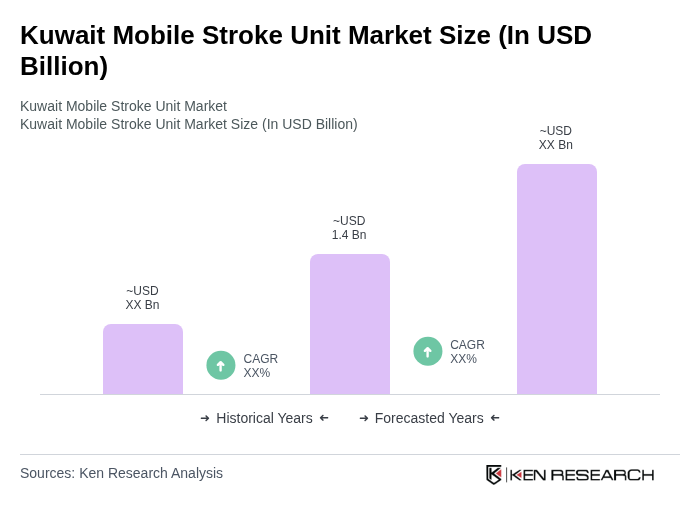
Kuwait mobile stroke unit market grows with EMS and telemedicine advancements, valued at $1.4 Bn.

Region:Middle East

Author(s):Shubham

Product Code:KRAD0887

Pages:90

Published On:December 2025
About the Report

Base Year 2024

Kuwait Mobile Stroke Unit Market Overview

  • The Kuwait Mobile Stroke Unit Market is part of the broader mobile stroke unit vehicle sector, which is valued at approximately USD 1.4 billion, based on a five-year analysis of the global mobile stroke unit vehicle market and related pre?hospital stroke care investments. Growth is driven by expanding emergency medical services infrastructure, rising stroke incidence, increasing government healthcare expenditure, and greater adoption of telemedicine and pre-hospital imaging capabilities, supported by broader stroke and neurovascular care investments in Kuwait.
  • Key players in this market include Siemens Healthineers, GE HealthCare Technologies, Philips Healthcare, and Medtronic, which supply key components such as CT scanners, imaging platforms, monitoring systems, and neuro-interventional solutions used in mobile stroke unit configurations. These companies play a significant role in driving growth and maintaining high standards in healthcare vehicle deployment and advanced stroke imaging across the Middle East region, including Kuwait, through partnerships with hospitals and emergency medical service providers.
  • Kuwait's healthcare modernization policies, such as Ministry of Health initiatives to expand and upgrade the ambulance fleet with advanced life-support systems, telemedicine connectivity, and GPS-based dispatch, reflect broader efforts to strengthen emergency medical vehicle capabilities. These measures enhance the infrastructure supporting related sectors like mobile stroke units and indicate governmental commitment to emergency healthcare development, aligned with the Health Insurance Law No. 114 of 2014 and subsequent Ministry of Health regulations that mandate improved emergency response capacity, quality standards in ambulance services, and integration of advanced diagnostic equipment in pre-hospital care.
Kuwait Mobile Stroke Unit Market Size

Kuwait Mobile Stroke Unit Market Segmentation

By Type:The market is segmented into various types of mobile stroke units, including Ground Mobile Stroke Units, Air Mobile Stroke Units, Hybrid Mobile Stroke Units, and Others, in line with global practice where purpose-built stroke ambulances and air-supported stroke response platforms are used for pre-hospital diagnosis and thrombolysis. Ground Mobile Stroke Units are expected to account for the largest share, as road-based units are the most widely deployed configuration in urban and peri-urban settings where rapid response times are critical for stroke patients. Air Mobile Stroke Units are gaining traction in regions with dispersed populations or difficult access, where air medical services are increasingly used for time-sensitive neurological emergencies, while Hybrid Units offer flexibility by combining multi-modality use and integration with hospital stroke networks. The Others category includes specialized or pilot units that cater to unique healthcare needs, such as tele-stroke-enabled rapid response vehicles and compact mobile imaging platforms.
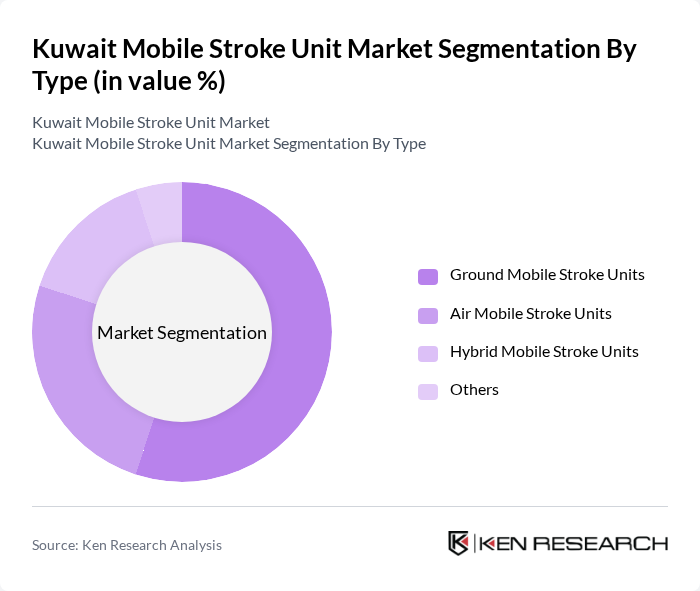
Kuwait Mobile Stroke Unit Market segmentation by Type.

By End-User:The end-user segmentation includes Hospitals, Emergency Medical Services, Private Clinics, and Others. Hospitals are the primary users of mobile stroke units, consistent with their central role in organized stroke systems of care and in operating comprehensive and primary stroke centers that coordinate pre-hospital thrombolysis and neuro-interventional services. Emergency Medical Services are also significant users, as EMS providers typically host or operate the vehicles and are responsible for rapid dispatch, triage, and transport within integrated stroke care pathways. Private Clinics and private hospital groups are emerging as users due to increasing demand for specialized neurological and neurovascular care, especially in urban centers with higher private sector participation, while the Others category includes academic medical centers, university health systems, and charitable or association-led stroke programs that participate in pilot deployments and research-focused mobile stroke initiatives.
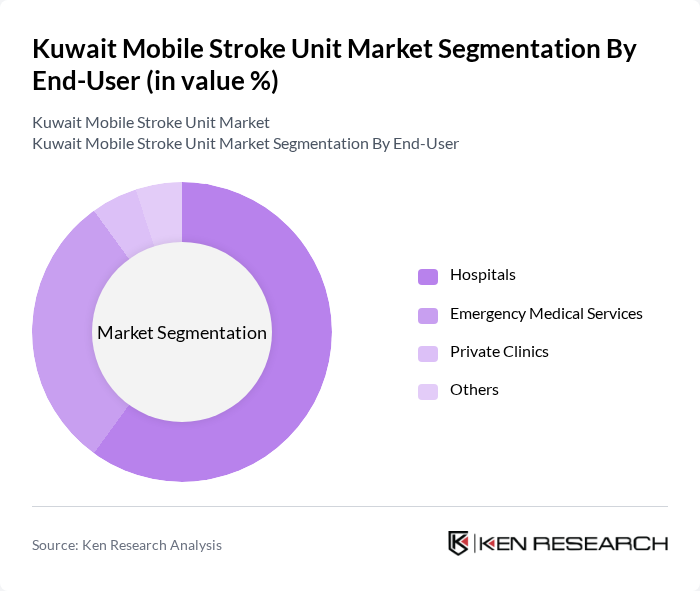
Kuwait Mobile Stroke Unit Market segmentation by End-User.

Kuwait Mobile Stroke Unit Market Competitive Landscape

The Kuwait Mobile Stroke Unit Market is characterized by a dynamic mix of regional and international players. Leading participants such as Al Sabah Medical Group, Kuwait Medical Services, Gulf Healthcare International, Al-Diwan Medical Company, Kuwait Stroke Association, Al-Mowasat Hospital, Dar Al Shifa Hospital, Royal Hayat Hospital, Al-Razi Hospital, Kuwait University Health Center, Al-Sabah Hospital, Ibn Sina Hospital, Jaber Al-Ahmad Hospital, Farwaniya Hospital, Adan Hospital contribute to innovation, geographic expansion, and service delivery in this space, leveraging broader investments in stroke diagnosis, neurovascular devices, and emergency medical services across Kuwait.

Al Sabah Medical Group

1995

Kuwait City, Kuwait

Kuwait Medical Services

2000

Kuwait City, Kuwait

Gulf Healthcare International

2005

Kuwait City, Kuwait

Al-Diwan Medical Company

1998

Kuwait City, Kuwait

Kuwait Stroke Association

2010

Kuwait City, Kuwait

Company

Establishment Year

Headquarters

Group Size (Large, Medium, or Small as per industry convention)

Revenue Growth Rate

Market Penetration Rate

Customer Satisfaction Score

Service Response Time

Pricing Strategy

Kuwait Mobile Stroke Unit Market Industry Analysis

Growth Drivers

  • Strong Fiscal & GDP Base:Kuwait’s GDP is estimated at USD 176.6 billion, with a GDP per capita of approximately USD 38,120. This robust economic foundation allows for significant investments in healthcare infrastructure, including mobile stroke units. The government’s ability to allocate funds for advanced medical technologies is crucial for enhancing emergency healthcare services. This financial strength supports the growth of specialized healthcare services, including mobile stroke units, across the nation.
  • High Healthcare Budget & Import Capability:Kuwait's annual budget revenues are projected at KWD 18.23 billion, with healthcare imports reaching USD 61.5 billion. This financial capacity enables the country to invest in advanced medical technologies necessary for mobile stroke units. The strong public financing reflects a commitment to improving healthcare services, ensuring that mobile units are equipped with the latest diagnostic and treatment technologies to effectively manage stroke cases.
  • Excellent Digital & Telecom Infrastructure:With a mobile subscription density of approximately 166 mobile cellular subscriptions per 100 people and approximately 4.5 million internet users, Kuwait ranks highly in the ICT Development Index. This advanced digital infrastructure is essential for mobile stroke units, facilitating real-time data transmission and telemedicine capabilities. The integration of technology in healthcare delivery enhances the efficiency and effectiveness of emergency response services, particularly in stroke management.

Market Challenges

  • Import Reliance & Supply Chain Vulnerability:Kuwait's total imports of goods and services represent a substantial share of GDP, reflecting a high dependence on external suppliers for many sectors, including healthcare. This heavy reliance on imports creates vulnerabilities in the supply chain for high-tech medical equipment, including mobile stroke units. Delays and logistical challenges can hinder the timely deployment of these critical services, impacting patient outcomes and overall healthcare efficiency.
  • Workforce Capacity Constraints:With a population exceeding approximately 4.3 million people, the demand for specialized healthcare services is high. However, the limited availability of trained medical personnel poses a significant challenge in operating mobile stroke units effectively. The shortage of specialists can lead to delays in service delivery, ultimately affecting the quality of care provided to stroke patients in urgent situations.

Kuwait Mobile Stroke Unit Market Future Outlook

The future of the Kuwait mobile stroke unit market appears promising, driven by advancements in digital health and artificial intelligence integration. The increasing focus on public-private partnerships and the expansion of healthcare services under Kuwait Vision 2035 will likely enhance the deployment of mobile stroke units. As the healthcare landscape evolves, the emphasis on rapid response services and preventive care will further solidify the role of mobile units in improving stroke management and patient outcomes across the nation.

Market Opportunities

  • Integration into PPP & Expatriate Health Services:The establishment of public-private partnership hospitals, each with approximately 500 beds, and a budget allocation of KWD 608 million for new constructions presents a significant opportunity. Mobile stroke units can effectively complement these facilities, addressing the healthcare needs of the growing expatriate population in Kuwait.
  • Leveraging Digital Infrastructure for Tele-Emergency:With mobile subscriptions at approximately 166 per 100 people, Kuwait's advanced digital infrastructure enables rapid remote consultations and diagnostics. This capability enhances the effectiveness of mobile stroke units, allowing for timely interventions and improved patient care in emergency situations, ultimately leading to better health outcomes.

Scope of the Report

SegmentSub-Segments
By Type

Ground Mobile Stroke Units

Air Mobile Stroke Units

Hybrid Mobile Stroke Units

Others

By End-User

Hospitals

Emergency Medical Services

Private Clinics

Others

By Service Type

Pre-Hospital Care

In-Hospital Care

Rehabilitation Services

Others

By Technology

Imaging Technology

Communication Technology

Monitoring Technology

Others

By Geographic Coverage

Urban Areas

Rural Areas

Suburban Areas

Others

By Funding Source

Government Funding

Private Investment

Public-Private Partnerships

Others

By Policy Support

Subsidies for Mobile Units

Tax Incentives

Grants for Research and Development

Others

Key Target Audience

Investors and Venture Capitalist Firms

Government and Regulatory Bodies (e.g., Ministry of Health, Kuwait Fire Service Directorate)

Healthcare Providers and Hospitals

Emergency Medical Services (EMS) Organizations

Medical Equipment Manufacturers

Health Insurance Companies

Pharmaceutical Companies

Public Health Organizations

Players Mentioned in the Report:

Al Sabah Medical Group

Kuwait Medical Services

Gulf Healthcare International

Al-Diwan Medical Company

Kuwait Stroke Association

Al-Mowasat Hospital

Dar Al Shifa Hospital

Royal Hayat Hospital

Al-Razi Hospital

Kuwait University Health Center

Al-Sabah Hospital

Ibn Sina Hospital

Jaber Al-Ahmad Hospital

Farwaniya Hospital

Adan Hospital

Table of Contents

Market Assessment Phase

1. Executive Summary and Approach


2. Kuwait Mobile Stroke Unit Market Overview

2.1 Key Insights and Strategic Recommendations

2.2 Kuwait Mobile Stroke Unit Market Overview

2.3 Definition and Scope

2.4 Evolution of Market Ecosystem

2.5 Timeline of Key Regulatory Milestones

2.6 Value Chain & Stakeholder Mapping

2.7 Business Cycle Analysis

2.8 Policy & Incentive Landscape


3. Kuwait Mobile Stroke Unit Market Analysis

3.1 Growth Drivers

3.1.1 Increasing prevalence of stroke cases
3.1.2 Advancements in telemedicine technology
3.1.3 Government initiatives for emergency healthcare
3.1.4 Rising awareness about stroke management

3.2 Market Challenges

3.2.1 High operational costs of mobile units
3.2.2 Limited infrastructure in rural areas
3.2.3 Regulatory hurdles in healthcare services
3.2.4 Shortage of trained medical personnel

3.3 Market Opportunities

3.3.1 Expansion of healthcare funding
3.3.2 Partnerships with private healthcare providers
3.3.3 Development of mobile health applications
3.3.4 Increasing demand for rapid response services

3.4 Market Trends

3.4.1 Integration of AI in stroke diagnosis
3.4.2 Growth of public-private partnerships
3.4.3 Focus on preventive healthcare measures
3.4.4 Adoption of patient-centered care models

3.5 Government Regulation

3.5.1 Licensing requirements for mobile units
3.5.2 Compliance with health and safety standards
3.5.3 Funding programs for emergency services
3.5.4 Regulations on telemedicine practices

4. SWOT Analysis


5. Stakeholder Analysis


6. Porter's Five Forces Analysis


7. Kuwait Mobile Stroke Unit Market Market Size, 2019-2024

7.1 By Value

7.2 By Volume

7.3 By Average Selling Price


8. Kuwait Mobile Stroke Unit Market Segmentation

8.1 By Type

8.1.1 Ground Mobile Stroke Units
8.1.2 Air Mobile Stroke Units
8.1.3 Hybrid Mobile Stroke Units
8.1.4 Others

8.2 By End-User

8.2.1 Hospitals
8.2.2 Emergency Medical Services
8.2.3 Private Clinics
8.2.4 Others

8.3 By Service Type

8.3.1 Pre-Hospital Care
8.3.2 In-Hospital Care
8.3.3 Rehabilitation Services
8.3.4 Others

8.4 By Technology

8.4.1 Imaging Technology
8.4.2 Communication Technology
8.4.3 Monitoring Technology
8.4.4 Others

8.5 By Geographic Coverage

8.5.1 Urban Areas
8.5.2 Rural Areas
8.5.3 Suburban Areas
8.5.4 Others

8.6 By Funding Source

8.6.1 Government Funding
8.6.2 Private Investment
8.6.3 Public-Private Partnerships
8.6.4 Others

8.7 By Policy Support

8.7.1 Subsidies for Mobile Units
8.7.2 Tax Incentives
8.7.3 Grants for Research and Development
8.7.4 Others

9. Kuwait Mobile Stroke Unit Market Competitive Analysis

9.1 Market Share of Key Players

9.2 Cross Comparison of Key Players

9.2.1 Company Name
9.2.2 Group Size (Large, Medium, or Small as per industry convention)
9.2.3 Revenue Growth Rate
9.2.4 Market Penetration Rate
9.2.5 Customer Satisfaction Score
9.2.6 Service Response Time
9.2.7 Pricing Strategy
9.2.8 Technology Adoption Rate
9.2.9 Operational Efficiency Ratio
9.2.10 Brand Recognition Index

9.3 SWOT Analysis of Top Players

9.4 Pricing Analysis

9.5 Detailed Profile of Major Companies

9.5.1 Al Sabah Medical Group
9.5.2 Kuwait Medical Services
9.5.3 Gulf Healthcare International
9.5.4 Al-Diwan Medical Company
9.5.5 Kuwait Stroke Association
9.5.6 Al-Mowasat Hospital
9.5.7 Dar Al Shifa Hospital
9.5.8 Royal Hayat Hospital
9.5.9 Al-Razi Hospital
9.5.10 Kuwait University Health Center
9.5.11 Al-Sabah Hospital
9.5.12 Ibn Sina Hospital
9.5.13 Jaber Al-Ahmad Hospital
9.5.14 Farwaniya Hospital
9.5.15 Adan Hospital

10. Kuwait Mobile Stroke Unit Market End-User Analysis

10.1 Procurement Behavior of Key Ministries

10.1.1 Ministry of Health
10.1.2 Ministry of Interior
10.1.3 Ministry of Finance
10.1.4 Others

10.2 Corporate Spend on Infrastructure & Energy

10.2.1 Healthcare Infrastructure Investments
10.2.2 Emergency Services Budget Allocation
10.2.3 Technology Upgrades in Healthcare
10.2.4 Others

10.3 Pain Point Analysis by End-User Category

10.3.1 Hospitals
10.3.2 Emergency Medical Services
10.3.3 Private Clinics
10.3.4 Others

10.4 User Readiness for Adoption

10.4.1 Training and Education Needs
10.4.2 Infrastructure Readiness
10.4.3 Technology Acceptance
10.4.4 Others

10.5 Post-Deployment ROI and Use Case Expansion

10.5.1 Cost Savings Analysis
10.5.2 Patient Outcome Improvements
10.5.3 Service Expansion Opportunities
10.5.4 Others

11. Kuwait Mobile Stroke Unit Market Future Size, 2025-2030

11.1 By Value

11.2 By Volume

11.3 By Average Selling Price


Go-To-Market Strategy Phase

1. Whitespace Analysis + Business Model Canvas

1.1 Market Gaps Identification

1.2 Value Proposition Development

1.3 Revenue Streams Analysis

1.4 Key Partnerships Exploration

1.5 Cost Structure Assessment

1.6 Customer Segmentation

1.7 Channels and Customer Relationships


2. Marketing and Positioning Recommendations

2.1 Branding Strategies

2.2 Product USPs


3. Distribution Plan

3.1 Urban Retail vs Rural NGO Tie-ups


4. Channel & Pricing Gaps

4.1 Underserved Routes

4.2 Pricing Bands


5. Unmet Demand & Latent Needs

5.1 Category Gaps

5.2 Consumer Segments


6. Customer Relationship

6.1 Loyalty Programs

6.2 After-sales Service


7. Value Proposition

7.1 Sustainability

7.2 Integrated Supply Chains


8. Key Activities

8.1 Regulatory Compliance

8.2 Branding

8.3 Distribution Setup


9. Entry Strategy Evaluation

9.1 Domestic Market Entry Strategy

9.1.1 Product Mix
9.1.2 Pricing Band
9.1.3 Packaging

9.2 Export Entry Strategy

9.2.1 Target Countries
9.2.2 Compliance Roadmap

10. Entry Mode Assessment

10.1 JV

10.2 Greenfield

10.3 M&A

10.4 Distributor Model


11. Capital and Timeline Estimation

11.1 Capital Requirements

11.2 Timelines


12. Control vs Risk Trade-Off

12.1 Ownership vs Partnerships


13. Profitability Outlook

13.1 Breakeven Analysis

13.2 Long-term Sustainability


14. Potential Partner List

14.1 Distributors

14.2 JVs

14.3 Acquisition Targets


15. Execution Roadmap

15.1 Phased Plan for Market Entry

15.1.1 Market Setup
15.1.2 Market Entry
15.1.3 Growth Acceleration
15.1.4 Scale & Stabilize

15.2 Key Activities and Milestones

15.2.1 Milestone Planning
15.2.2 Activity Tracking

Research Methodology

ApproachModellingSample

Phase 1: Approach1

Desk Research

  • Analysis of healthcare expenditure reports from the Ministry of Health, Kuwait
  • Review of existing literature on mobile stroke units and their impact on patient outcomes
  • Examination of demographic and epidemiological data related to stroke incidence in Kuwait

Primary Research

  • Interviews with healthcare professionals involved in stroke care and emergency services
  • Surveys targeting hospital administrators regarding mobile stroke unit implementation
  • Focus groups with patients and caregivers to understand perceptions of mobile stroke units

Validation & Triangulation

  • Cross-validation of findings with regional healthcare studies and reports
  • Triangulation of data from interviews, surveys, and secondary sources
  • Sanity checks through expert panel discussions with neurologists and emergency care specialists

Phase 2: Market Size Estimation1

Top-down Assessment

  • Estimation of the total addressable market based on national healthcare budgets
  • Segmentation of market size by urban vs. rural healthcare access
  • Incorporation of government health initiatives promoting mobile healthcare solutions

Bottom-up Modeling

  • Analysis of operational costs associated with mobile stroke unit deployment
  • Volume estimates based on projected stroke cases and response times
  • Cost per intervention calculated from equipment, staffing, and operational expenses

Forecasting & Scenario Analysis

  • Multi-factor regression analysis incorporating population growth and aging demographics
  • Scenario modeling based on potential healthcare policy changes and funding availability
  • Baseline, optimistic, and pessimistic forecasts through 2030 based on market trends

Phase 3: CATI Sample Composition1

Scope Item/SegmentSample SizeTarget Respondent Profiles
Emergency Medical Services (EMS) Providers60EMS Directors, Paramedics
Neurology Departments in Hospitals50Neurologists, Stroke Coordinators
Healthcare Policy Makers40Health Ministry Officials, Policy Analysts
Patient Advocacy Groups40Advocacy Leaders, Community Health Workers
Healthcare Equipment Suppliers50Sales Managers, Product Specialists

Frequently Asked Questions

What is the current value of the Kuwait Mobile Stroke Unit Market?

The Kuwait Mobile Stroke Unit Market is valued at approximately USD 1.4 billion, reflecting significant investments in pre-hospital stroke care and emergency medical services infrastructure within the country.

What factors are driving the growth of the Kuwait Mobile Stroke Unit Market?

Who are the key players in the Kuwait Mobile Stroke Unit Market?

What types of mobile stroke units are available in Kuwait?

Other Regional/Country Reports

Indonesia Mobile Stroke Unit Market

Malaysia Mobile Stroke Unit Market

KSA Mobile Stroke Unit Market

APAC Mobile Stroke Unit Market

SEA Mobile Stroke Unit Market

Vietnam Mobile Stroke Unit Market

Why Buy From Us?

Refine Robust Result (RRR) Framework

What makes us stand out is that our consultants follow Robust, Refine and Result (RRR) methodology. Robust for clear definitions, approaches and sanity checking, Refine for differentiating respondents' facts and opinions, and Result for presenting data with story.

Our Reach Is Unmatched

We have set a benchmark in the industry by offering our clients with syndicated and customized market research reports featuring coverage of entire market as well as meticulous research and analyst insights.

Shifting the Research Paradigm

While we don't replace traditional research, we flip the method upside down. Our dual approach of Top Bottom & Bottom Top ensures quality deliverable by not just verifying company fundamentals but also looking at the sector and macroeconomic factors.

More Insights-Better Decisions

With one step in the future, our research team constantly tries to show you the bigger picture. We help with some of the tough questions you may encounter along the way: How is the industry positioned? Best marketing channel? KPI's of competitors? By aligning every element, we help maximize success.

Transparency and Trust

Our report gives you instant access to the answers and sources that other companies might choose to hide. We elaborate each steps of research methodology we have used and showcase you the sample size to earn your trust.

Round the Clock Support

If you need any support, we are here! We pride ourselves on universe strength, data quality, and quick, friendly, and professional service.

Why Clients Choose Us?

400000+
Reports in repository
150+
Consulting projects a year
100+
Analysts
8000+
Client Queries in 2022








