About the Report
Base Year 2024Listen to the audio summary
Latin America Logistics Real Estate Market Overview
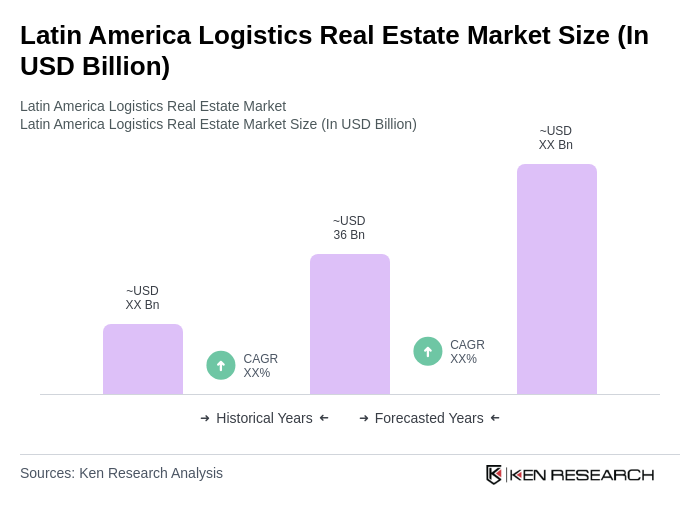
- The Latin America Logistics Real Estate Market is valued at approximately USD 36 billion, based on a five-year historical analysis of the industrial and logistics real estate sector. This growth is primarily driven by the rapid expansion of e-commerce, increased demand for modern warehousing and distribution facilities, and significant investments in infrastructure development across the region. The logistics sector has experienced a surge in activity as businesses adapt to evolving consumer behaviors, the need for faster delivery services, and the adoption of advanced supply chain technologies .
- Key players in this market include Brazil, Mexico, and Colombia, which dominate due to their strategic geographic locations, robust transportation and port networks, and growing urban populations. These countries have become primary hubs for logistics operations, attracting both domestic and foreign investments, and are enhancing their market presence and operational capabilities through public-private partnerships and infrastructure modernization .
- In 2023, Brazil's government introduced regulatory reforms aimed at improving logistics efficiency by reducing bureaucratic hurdles for logistics companies. These initiatives include tax incentives for companies investing in logistics infrastructure, streamlined customs processes, and digitalization of port and border operations, ultimately enhancing the competitiveness of the logistics sector in the region .
Latin America Logistics Real Estate Market Segmentation
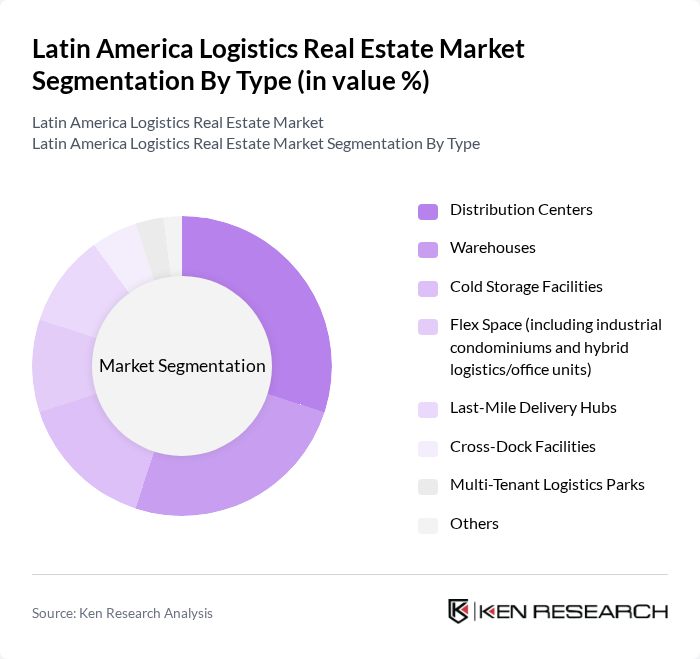
By Type:The logistics real estate market is segmented into Distribution Centers, Warehouses, Cold Storage Facilities, Flex Space (including industrial condominiums and hybrid logistics/office units), Last-Mile Delivery Hubs, Cross-Dock Facilities, Multi-Tenant Logistics Parks, and Others. Each segment addresses specific operational needs: Distribution Centers and Warehouses support bulk storage and regional distribution; Cold Storage Facilities cater to temperature-sensitive goods; Flex Space and Multi-Tenant Parks offer adaptable solutions for diverse tenants; Last-Mile Hubs and Cross-Dock Facilities enable rapid urban deliveries and efficient transshipment .
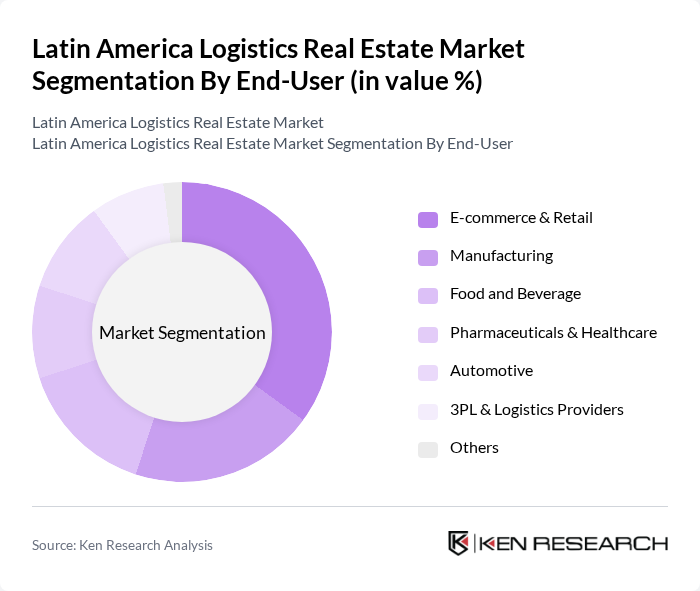
By End-User:The end-user segmentation includes E-commerce & Retail, Manufacturing, Food and Beverage, Pharmaceuticals & Healthcare, Automotive, 3PL & Logistics Providers, and Others. This segmentation reflects the diverse applications of logistics real estate: E-commerce & Retail drives demand for last-mile and fulfillment centers; Manufacturing and Automotive require large-scale distribution and storage; Food and Beverage and Pharmaceuticals need specialized cold storage; 3PL providers seek flexible, multi-client facilities .
Latin America Logistics Real Estate Market Competitive Landscape
The Latin America Logistics Real Estate Market is characterized by a dynamic mix of regional and international players. Leading participants such as Prologis, GLP, Goodman Group, LOG Commercial Properties (LOG CP), Vesta, Cyrela Commercial Properties (CCP), BR Properties, Tishman Speyer, CBRE, Colliers International, Cushman & Wakefield, JLL, Fibra Prologis, Fibra Macquarie, Grupo O’Donnell contribute to innovation, geographic expansion, and service delivery in this space.
Latin America Logistics Real Estate Market Industry Analysis
Growth Drivers
- Increasing E-commerce Demand:The Latin American e-commerce market is projected to reach $160 billion in future, driven by a 30% annual growth rate. This surge in online shopping is prompting logistics companies to expand their warehousing capabilities. In Brazil alone, e-commerce sales are expected to exceed $30 billion, necessitating enhanced logistics infrastructure to meet consumer expectations for faster delivery times and improved service quality.
- Infrastructure Development Initiatives:Governments across Latin America are investing heavily in infrastructure, with an estimated $200 billion allocated for transportation and logistics improvements in future. Projects include the expansion of highways and ports, which are crucial for efficient supply chain operations. For instance, the Brazilian government has committed $50 billion to enhance its road networks, facilitating better access to logistics hubs and reducing transit times for goods.
- Urbanization Trends:Urbanization in Latin America is accelerating, with over 80% of the population expected to live in urban areas in future. This trend is increasing demand for logistics real estate, particularly in metropolitan regions. Cities like Mexico City and São Paulo are experiencing significant growth in logistics facilities to support urban distribution needs, with an estimated 15 million square meters of new warehouse space required to accommodate this urban influx.
Market Challenges
- Regulatory Hurdles:The logistics sector in Latin America faces complex regulatory environments that can hinder growth. For example, Brazil's intricate tax system imposes an average tax burden of approximately 33% on logistics companies, complicating operations and reducing profitability. Additionally, varying regulations across countries create barriers for companies looking to expand regionally, leading to increased operational costs and delays in project implementation.
- Economic Instability:Economic fluctuations pose significant challenges for the logistics real estate market. In future, Latin America is projected to experience GDP growth of approximately 2%, with countries like Argentina facing inflation rates exceeding 50%. This economic uncertainty can lead to reduced investment in logistics infrastructure, as companies may hesitate to commit resources in a volatile market, impacting overall growth prospects in the sector.
Latin America Logistics Real Estate Market Future Outlook
The future of the Latin America logistics real estate market appears promising, driven by ongoing investments in infrastructure and the rapid growth of e-commerce. As urbanization continues, logistics providers will increasingly focus on optimizing last-mile delivery solutions to meet consumer demands. Additionally, technological advancements, such as automation and data analytics, are expected to enhance operational efficiency, enabling companies to adapt to changing market dynamics and consumer preferences effectively.
Market Opportunities
- Growth in Cold Storage Facilities:With the rise in demand for perishable goods, the cold storage segment is projected to grow significantly. The market for cold storage in Latin America is expected to reach $10 billion in future, driven by increased food exports and the need for temperature-controlled logistics solutions, particularly in Brazil and Chile.
- Expansion of Last-Mile Delivery Services:The last-mile delivery sector is set to expand rapidly, with investments expected to exceed $5 billion in future. Companies are focusing on enhancing delivery networks to meet the growing consumer demand for faster service. This trend is particularly evident in urban areas, where efficient last-mile solutions are critical for maintaining competitive advantage in the logistics market.
Scope of the Report
| Segment | Sub-Segments |
|---|---|
| By Type | Distribution Centers Warehouses Cold Storage Facilities Flex Space (including industrial condominiums and hybrid logistics/office units) Last-Mile Delivery Hubs Cross-Dock Facilities Multi-Tenant Logistics Parks Others |
| By End-User | E-commerce & Retail Manufacturing Food and Beverage Pharmaceuticals & Healthcare Automotive PL & Logistics Providers Others |
| By Investment Source | Domestic Institutional Investors Foreign Direct Investment (FDI) Public-Private Partnerships (PPP) Government Grants & Incentives Private Equity & Venture Capital Others |
| By Location | Major Urban Centers (e.g., São Paulo, Mexico City, Bogotá) Secondary Cities Near Ports Near Airports Industrial Corridors & Logistics Hubs Rural/Peripheral Areas Others |
| By Lease Type | Short-Term Leases Long-Term Leases Build-to-Suit Flexible Leases Others |
| By Facility Size | Small Facilities (Less than 10,000 sq ft) Medium Facilities (10,000 - 50,000 sq ft) Large Facilities (50,000 - 100,000 sq ft) Extra Large Facilities (Over 100,000 sq ft) Mega Distribution Centers (Over 500,000 sq ft) Others |
| By Service Type | Third-Party Logistics (3PL) Fourth-Party Logistics (4PL) Freight Forwarding Transportation Management Value-Added Logistics Services (e.g., packaging, labeling) Others |
Key Target Audience
Investors and Venture Capitalist Firms
Government and Regulatory Bodies (e.g., Ministry of Transport, National Institute of Logistics)
Real Estate Developers
Logistics and Supply Chain Companies
Construction Firms
Retail Chains and E-commerce Companies
Infrastructure Investment Funds
Local and Regional Economic Development Agencies
Players Mentioned in the Report:
Prologis
GLP
Goodman Group
LOG Commercial Properties (LOG CP)
Vesta
Cyrela Commercial Properties (CCP)
BR Properties
Tishman Speyer
CBRE
Colliers International
Cushman & Wakefield
JLL
Fibra Prologis
Fibra Macquarie
Grupo ODonnell
Table of Contents
Market Assessment Phase
1. Executive Summary and Approach
2. Latin America Logistics Real Estate Market Overview
2.1 Key Insights and Strategic Recommendations
2.2 Latin America Logistics Real Estate Market Overview
2.3 Definition and Scope
2.4 Evolution of Market Ecosystem
2.5 Timeline of Key Regulatory Milestones
2.6 Value Chain & Stakeholder Mapping
2.7 Business Cycle Analysis
2.8 Policy & Incentive Landscape
3. Latin America Logistics Real Estate Market Analysis
3.1 Growth Drivers
3.1.1 Increasing E-commerce Demand
3.1.2 Infrastructure Development Initiatives
3.1.3 Urbanization Trends
3.1.4 Foreign Direct Investment (FDI) Inflows
3.2 Market Challenges
3.2.1 Regulatory Hurdles
3.2.2 Economic Instability
3.2.3 Limited Access to Financing
3.2.4 Competition from Alternative Logistics Solutions
3.3 Market Opportunities
3.3.1 Growth in Cold Storage Facilities
3.3.2 Expansion of Last-Mile Delivery Services
3.3.3 Technological Advancements in Logistics
3.3.4 Sustainable Logistics Practices
3.4 Market Trends
3.4.1 Rise of Automation in Warehousing
3.4.2 Increased Focus on Sustainability
3.4.3 Shift Towards Multi-Modal Logistics
3.4.4 Growth of Shared Logistics Spaces
3.5 Government Regulation
3.5.1 Tax Incentives for Logistics Investments
3.5.2 Environmental Regulations
3.5.3 Land Use Policies
3.5.4 Trade Agreements Impacting Logistics
4. SWOT Analysis
5. Stakeholder Analysis
6. Porter's Five Forces Analysis
7. Latin America Logistics Real Estate Market Market Size, 2019-2024
7.1 By Value
7.2 By Volume
7.3 By Average Selling Price
8. Latin America Logistics Real Estate Market Segmentation
8.1 By Type
8.1.1 Distribution Centers
8.1.2 Warehouses
8.1.3 Cold Storage Facilities
8.1.4 Flex Space (including industrial condominiums and hybrid logistics/office units)
8.1.5 Last-Mile Delivery Hubs
8.1.6 Cross-Dock Facilities
8.1.7 Multi-Tenant Logistics Parks
8.1.8 Others
8.2 By End-User
8.2.1 E-commerce & Retail
8.2.2 Manufacturing
8.2.3 Food and Beverage
8.2.4 Pharmaceuticals & Healthcare
8.2.5 Automotive
8.2.6 3PL & Logistics Providers
8.2.7 Others
8.3 By Investment Source
8.3.1 Domestic Institutional Investors
8.3.2 Foreign Direct Investment (FDI)
8.3.3 Public-Private Partnerships (PPP)
8.3.4 Government Grants & Incentives
8.3.5 Private Equity & Venture Capital
8.3.6 Others
8.4 By Location
8.4.1 Major Urban Centers (e.g., São Paulo, Mexico City, Bogotá)
8.4.2 Secondary Cities
8.4.3 Near Ports
8.4.4 Near Airports
8.4.5 Industrial Corridors & Logistics Hubs
8.4.6 Rural/Peripheral Areas
8.4.7 Others
8.5 By Lease Type
8.5.1 Short-Term Leases
8.5.2 Long-Term Leases
8.5.3 Build-to-Suit
8.5.4 Flexible Leases
8.5.5 Others
8.6 By Facility Size
8.6.1 Small Facilities (Less than 10,000 sq ft)
8.6.2 Medium Facilities (10,000 - 50,000 sq ft)
8.6.3 Large Facilities (50,000 - 100,000 sq ft)
8.6.4 Extra Large Facilities (Over 100,000 sq ft)
8.6.5 Mega Distribution Centers (Over 500,000 sq ft)
8.6.6 Others
8.7 By Service Type
8.7.1 Third-Party Logistics (3PL)
8.7.2 Fourth-Party Logistics (4PL)
8.7.3 Freight Forwarding
8.7.4 Transportation Management
8.7.5 Value-Added Logistics Services (e.g., packaging, labeling)
8.7.6 Others
9. Latin America Logistics Real Estate Market Competitive Analysis
9.1 Market Share of Key Players
9.2 Cross Comparison of Key Players
9.2.1 Company Name
9.2.2 Portfolio Size (Total GLA in sq m/sq ft)
9.2.3 Geographic Coverage (Number of countries/markets served)
9.2.4 Occupancy Rate (%)
9.2.5 Revenue Growth Rate (%)
9.2.6 Average Lease Duration (years)
9.2.7 Customer Retention Rate (%)
9.2.8 Average Rental Yield (%)
9.2.9 Net Operating Income (NOI)
9.2.10 Return on Investment (ROI) (%)
9.2.11 Market Penetration Rate (%)
9.2.12 ESG/Sustainability Certifications (e.g., LEED, EDGE)
9.2.13 Development Pipeline (sq m/sq ft under construction or planned)
9.2.14 Tenant Mix (by sector or anchor clients)
9.2.15 Capital Structure (REIT, private, JV, etc.)
9.3 SWOT Analysis of Top Players
9.4 Pricing Analysis
9.5 Detailed Profile of Major Companies
9.5.1 Prologis
9.5.2 GLP
9.5.3 Goodman Group
9.5.4 LOG Commercial Properties (LOG CP)
9.5.5 Vesta
9.5.6 Cyrela Commercial Properties (CCP)
9.5.7 BR Properties
9.5.8 Tishman Speyer
9.5.9 CBRE
9.5.10 Colliers International
9.5.11 Cushman & Wakefield
9.5.12 JLL
9.5.13 Fibra Prologis
9.5.14 Fibra Macquarie
9.5.15 Grupo O’Donnell
10. Latin America Logistics Real Estate Market End-User Analysis
10.1 Procurement Behavior of Key Ministries
10.1.1 Government Procurement Policies
10.1.2 Budget Allocation for Infrastructure
10.1.3 Decision-Making Processes
10.1.4 Supplier Selection Criteria
10.2 Corporate Spend on Infrastructure & Energy
10.2.1 Investment Trends in Logistics Infrastructure
10.2.2 Budgeting for Energy Efficiency
10.2.3 Corporate Social Responsibility Initiatives
10.3 Pain Point Analysis by End-User Category
10.3.1 Supply Chain Disruptions
10.3.2 Rising Operational Costs
10.3.3 Compliance with Regulations
10.3.4 Technology Integration Challenges
10.4 User Readiness for Adoption
10.4.1 Awareness of New Technologies
10.4.2 Training and Skill Development Needs
10.4.3 Financial Readiness for Investment
10.5 Post-Deployment ROI and Use Case Expansion
10.5.1 Measurement of ROI Metrics
10.5.2 Case Studies of Successful Implementations
10.5.3 Future Use Case Opportunities
11. Latin America Logistics Real Estate Market Future Size, 2025-2030
11.1 By Value
11.2 By Volume
11.3 By Average Selling Price
Go-To-Market Strategy Phase
1. Whitespace Analysis + Business Model Canvas
1.1 Identification of Market Gaps
1.2 Value Proposition Development
1.3 Revenue Streams Analysis
1.4 Cost Structure Evaluation
1.5 Key Partnerships Identification
1.6 Customer Segments Analysis
1.7 Channels for Delivery
2. Marketing and Positioning Recommendations
2.1 Branding Strategies
2.2 Product USPs
2.3 Target Audience Identification
2.4 Communication Strategies
2.5 Digital Marketing Approaches
3. Distribution Plan
3.1 Urban Retail vs Rural NGO Tie-Ups
3.2 Logistics Network Optimization
3.3 Last-Mile Delivery Strategies
4. Channel & Pricing Gaps
4.1 Underserved Routes
4.2 Pricing Bands Analysis
4.3 Competitive Pricing Strategies
5. Unmet Demand & Latent Needs
5.1 Category Gaps
5.2 Consumer Segments Analysis
5.3 Emerging Trends Identification
6. Customer Relationship
6.1 Loyalty Programs
6.2 After-Sales Service
6.3 Customer Feedback Mechanisms
7. Value Proposition
7.1 Sustainability Initiatives
7.2 Integrated Supply Chains
7.3 Cost-Effectiveness
8. Key Activities
8.1 Regulatory Compliance
8.2 Branding Efforts
8.3 Distribution Setup
9. Entry Strategy Evaluation
9.1 Domestic Market Entry Strategy
9.1.1 Product Mix Considerations
9.1.2 Pricing Band Strategy
9.1.3 Packaging Approaches
9.2 Export Entry Strategy
9.2.1 Target Countries Identification
9.2.2 Compliance Roadmap Development
10. Entry Mode Assessment
10.1 Joint Ventures
10.2 Greenfield Investments
10.3 Mergers & Acquisitions
10.4 Distributor Model Evaluation
11. Capital and Timeline Estimation
11.1 Capital Requirements
11.2 Timelines for Implementation
12. Control vs Risk Trade-Off
12.1 Ownership vs Partnerships
12.2 Risk Management Strategies
13. Profitability Outlook
13.1 Breakeven Analysis
13.2 Long-Term Sustainability Strategies
14. Potential Partner List
14.1 Distributors
14.2 Joint Ventures
14.3 Acquisition Targets
15. Execution Roadmap
15.1 Phased Plan for Market Entry
15.1.1 Market Setup
15.1.2 Market Entry
15.1.3 Growth Acceleration
15.1.4 Scale & Stabilize
15.2 Key Activities and Milestones
15.2.1 Milestone Planning
15.2.2 Activity Tracking
Research Methodology
Phase 1: Approach1
Desk Research
- Analysis of logistics real estate trends from industry reports and market studies
- Review of government publications and economic indicators relevant to Latin American logistics
- Examination of real estate transaction data and investment reports from leading real estate firms
Primary Research
- Interviews with logistics real estate developers and property managers across key Latin American markets
- Surveys with logistics companies to understand their real estate needs and preferences
- Field interviews with local government officials regarding zoning laws and infrastructure developments
Validation & Triangulation
- Cross-validation of findings through multiple data sources including trade publications and expert opinions
- Triangulation of market size estimates using both qualitative insights and quantitative data
- Sanity checks through expert panel reviews to ensure data accuracy and relevance
Phase 2: Market Size Estimation1
Top-down Assessment
- Estimation of total logistics real estate market size based on national GDP and logistics spending ratios
- Segmentation of the market by type of logistics facilities (e.g., warehouses, distribution centers)
- Incorporation of macroeconomic factors such as trade agreements and foreign direct investment trends
Bottom-up Modeling
- Collection of data on existing logistics facilities and their occupancy rates across major cities
- Analysis of rental rates and operational costs associated with logistics real estate
- Volume and cost analysis based on logistics service providers' operational metrics
Forecasting & Scenario Analysis
- Multi-factor regression analysis incorporating e-commerce growth, urbanization rates, and infrastructure investments
- Scenario modeling based on potential regulatory changes and economic conditions in the region
- Development of baseline, optimistic, and pessimistic forecasts through 2030
Phase 3: CATI Sample Composition1
| Scope Item/Segment | Sample Size | Target Respondent Profiles |
|---|---|---|
| Warehouse Space Utilization | 100 | Facility Managers, Operations Directors |
| Distribution Center Development | 80 | Real Estate Developers, Logistics Executives |
| Cold Storage Facilities | 60 | Supply Chain Managers, Food Industry Executives |
| Last-Mile Delivery Solutions | 50 | Logistics Coordinators, Urban Planning Officials |
| Cross-Docking Operations | 40 | Warehouse Supervisors, Transportation Managers |
Frequently Asked Questions
What is the current value of the Latin America Logistics Real Estate Market?
The Latin America Logistics Real Estate Market is valued at approximately USD 36 billion, driven by the growth of e-commerce, demand for modern warehousing, and infrastructure investments across the region.
Which countries are the key players in the Latin America Logistics Real Estate Market?
What are the main segments of the Latin America Logistics Real Estate Market?
How is e-commerce influencing the logistics real estate market in Latin America?
Why Buy From Us?

What makes us stand out is that our consultants follow Robust, Refine and Result (RRR) methodology. Robust for clear definitions, approaches and sanity checking, Refine for differentiating respondents' facts and opinions, and Result for presenting data with story.

We have set a benchmark in the industry by offering our clients with syndicated and customized market research reports featuring coverage of entire market as well as meticulous research and analyst insights.

While we don't replace traditional research, we flip the method upside down. Our dual approach of Top Bottom & Bottom Top ensures quality deliverable by not just verifying company fundamentals but also looking at the sector and macroeconomic factors.

With one step in the future, our research team constantly tries to show you the bigger picture. We help with some of the tough questions you may encounter along the way: How is the industry positioned? Best marketing channel? KPI's of competitors? By aligning every element, we help maximize success.

Our report gives you instant access to the answers and sources that other companies might choose to hide. We elaborate each steps of research methodology we have used and showcase you the sample size to earn your trust.

If you need any support, we are here! We pride ourselves on universe strength, data quality, and quick, friendly, and professional service.