Mexico Freight Consulting Market

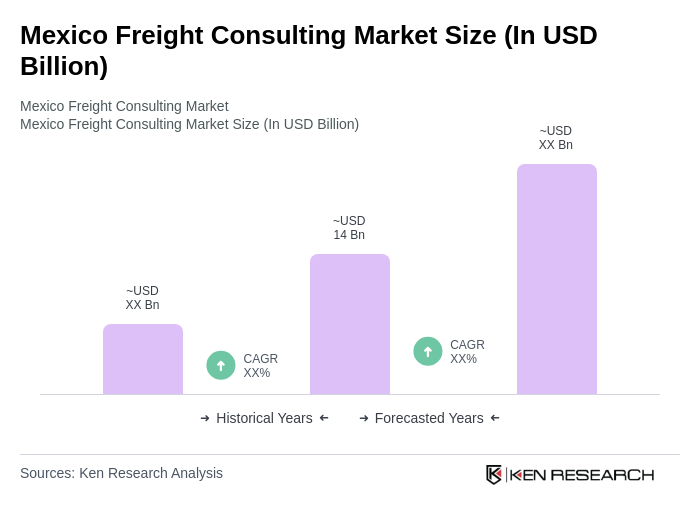
The Mexico Freight Consulting Market, worth USD 14 billion, is growing due to demand for efficient logistics, e-commerce surge, and government infrastructure reforms, focusing on supply chain optimization.

Region:Central and South America

Author(s):Geetanshi

Product Code:KRAA0206

Pages:81

Published On:August 2025
About the Report

Base Year 2024

Mexico Freight Consulting Market Overview

  • The Mexico Freight Consulting Market is valued at USD 14 billion, based on a five-year historical analysis of the broader freight forwarding and logistics consulting sector. This growth is primarily driven by the increasing demand for efficient logistics solutions, the expansion of e-commerce, and the need for supply chain optimization in various industries. The market has seen a significant rise in consulting services aimed at improving operational efficiency and reducing costs, with technology integration and digital transformation being key accelerators .
  • Key cities dominating the market include Mexico City, Guadalajara, and Monterrey. Mexico City serves as a major logistics hub due to its extensive transportation infrastructure and proximity to key trade routes. Guadalajara is recognized for its strong manufacturing base, particularly in electronics and automotive, while Monterrey is a center for commerce and industry, making these cities critical for freight consulting services .
  • The Mexican government has recently implemented infrastructure modernization and regulatory reforms aimed at enhancing the efficiency of freight transport across the country. These initiatives include investments in road, rail, and port infrastructure, technology upgrades, and streamlined customs processes, supporting the growth of the freight consulting market .
Mexico Freight Consulting Market Size

Mexico Freight Consulting Market Segmentation

By Type:The freight consulting market is segmented into various types, including Supply Chain Consulting, Freight Audit and Payment, Logistics Network Design, Transportation Management Consulting, Customs and Trade Compliance Consulting, Digital Transformation Consulting, and Others. Each of these segments plays a crucial role in addressing specific client needs and enhancing operational efficiencies. Supply Chain Consulting and Logistics Network Design are particularly prominent due to the complexity of cross-border trade and the need for network optimization in Mexico’s rapidly evolving logistics landscape .
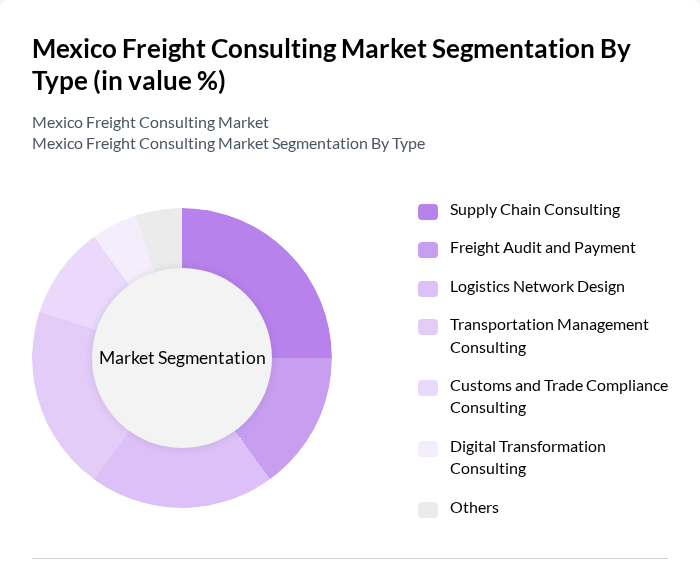
Mexico Freight Consulting Market segmentation by Type.

The Supply Chain Consulting segment is currently the dominant force in the market, driven by the increasing complexity of global supply chains and the need for businesses to optimize their logistics operations. Companies are increasingly seeking expert advice to enhance their supply chain efficiency, reduce costs, and improve service levels. The growing trend of digital transformation in logistics is also contributing to the rise of this segment, as businesses look to integrate advanced technologies into their supply chain processes .

By End-User:The market is also segmented by end-user industries, including Manufacturing, Automotive, Retail & E-commerce, Agriculture, Pharmaceuticals, Oil & Gas, Electronics, and Others. Each sector has unique logistics needs that drive demand for specialized consulting services. Manufacturing and Automotive remain leading end-users due to Mexico’s strong industrial base, while Retail & E-commerce is rapidly expanding, reflecting the surge in online shopping and demand for last-mile delivery solutions .
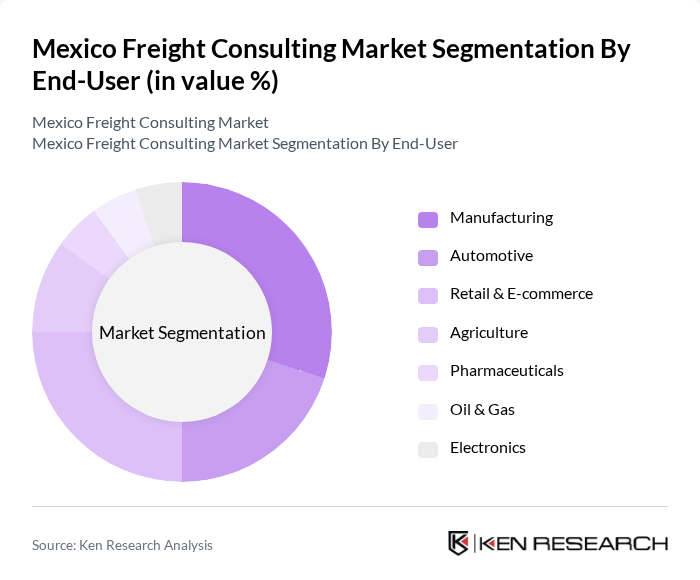
Mexico Freight Consulting Market segmentation by End-User.

The Manufacturing sector is the leading end-user in the freight consulting market, as it requires efficient logistics solutions to manage complex supply chains and production schedules. The automotive industry also plays a significant role, driven by the need for timely delivery of parts and finished vehicles. Retail and e-commerce are rapidly growing segments, reflecting the increasing demand for efficient distribution channels and last-mile delivery solutions .

Mexico Freight Consulting Market Competitive Landscape

The Mexico Freight Consulting Market is characterized by a dynamic mix of regional and international players. Leading participants such as Deloitte, PwC, KPMG, EY, Accenture, Boston Consulting Group (BCG), McKinsey & Company, Capgemini, A.T. Kearney, Roland Berger, Transplace (now part of Uber Freight), C.H. Robinson, DHL Consulting, Kuehne + Nagel Management Consulting, DB Schenker Consulting, FedEx Logistics Consulting, Grupo Traxión, Solistica, TIBA México, XPO Logistics contribute to innovation, geographic expansion, and service delivery in this space.

Company

Establishment Year

Headquarters

Group Size (Large, Medium, or Small as per industry convention)

Revenue Growth Rate (Mexico Freight Consulting Segment)

Client Retention Rate (Annual %)

Market Penetration Rate (Share of Top 100 Freight Clients in Mexico)

Average Project Value (USD)

Pricing Strategy (Fixed, Value-Based, Hourly, etc.)

Deloitte

1845

New York, USA

PwC

1998

London, UK

KPMG

1987

Amstelveen, Netherlands

EY

1989

London, UK

Accenture

1989

Dublin, Ireland

Mexico Freight Consulting Market Industry Analysis

Growth Drivers

  • Increasing Demand for Logistics Optimization:The logistics sector in Mexico is projected to grow significantly, driven by a demand for optimization. In future, the logistics industry is expected to reach a value of approximately $60 billion, with companies seeking to enhance efficiency and reduce costs. This demand is fueled by the need for streamlined operations, as businesses increasingly recognize that optimized logistics can lead to improved customer satisfaction and reduced operational expenses, ultimately enhancing competitiveness in the market.
  • Expansion of E-commerce and Online Retail:E-commerce in Mexico is experiencing rapid growth, with online sales projected to reach $30 billion in future, up from $25 billion in the previous year. This surge is driving demand for freight consulting services as businesses seek to navigate the complexities of logistics associated with online retail. The increase in online shopping is prompting companies to invest in efficient supply chain solutions, thereby creating opportunities for freight consultants to provide tailored strategies that address unique logistical challenges.
  • Government Investment in Infrastructure:The Mexican government is investing heavily in infrastructure, with a budget allocation of $8 billion for transportation projects in future. This investment aims to enhance road networks, ports, and rail systems, facilitating smoother freight movement. Improved infrastructure is expected to reduce transit times and costs, making logistics operations more efficient. Consequently, freight consulting firms can leverage these developments to offer strategic insights that align with the evolving infrastructure landscape, benefiting their clients.

Market Challenges

  • Regulatory Compliance Complexities:Navigating the regulatory landscape in Mexico poses significant challenges for freight consulting firms. In future, over 50 new regulations related to customs and transportation are expected to be implemented, complicating compliance efforts. Firms must stay abreast of these changes to avoid penalties and ensure smooth operations for their clients. The complexity of regulations can lead to increased operational costs and necessitate specialized knowledge, creating barriers for smaller consulting firms.
  • High Competition Among Consulting Firms:The freight consulting market in Mexico is characterized by intense competition, with over 200 firms vying for market share in future. This saturation leads to price wars and reduced profit margins, making it challenging for firms to differentiate their services. To remain competitive, consulting firms must innovate and offer unique value propositions, which can strain resources and require significant investment in marketing and technology to attract and retain clients.

Mexico Freight Consulting Market Future Outlook

The Mexico Freight Consulting Market is poised for transformative growth, driven by technological advancements and evolving consumer behaviors. As companies increasingly adopt digital freight solutions, the demand for consulting services will rise, particularly in areas like AI integration and real-time tracking. Additionally, the focus on sustainability will shape logistics strategies, prompting firms to develop eco-friendly practices. These trends indicate a dynamic market landscape where adaptability and innovation will be crucial for success in the coming years.

Market Opportunities

  • Adoption of Digital Freight Solutions:The shift towards digital freight solutions presents a significant opportunity for consulting firms. With an estimated 40% of logistics operations expected to be digitized in future, firms can capitalize on this trend by offering expertise in technology integration, helping clients streamline operations and enhance efficiency.
  • Growth in Cross-Border Trade:Cross-border trade between Mexico and the U.S. is projected to exceed $600 billion in future, creating opportunities for freight consultants to assist businesses in navigating the complexities of international logistics. This growth necessitates specialized consulting services to optimize supply chains and ensure compliance with trade regulations.

Scope of the Report

SegmentSub-Segments
By Type

Supply Chain Consulting

Freight Audit and Payment

Logistics Network Design

Transportation Management Consulting

Customs and Trade Compliance Consulting

Digital Transformation Consulting

Others

By End-User

Manufacturing

Automotive

Retail & E-commerce

Agriculture

Pharmaceuticals

Oil & Gas

Electronics

Others

By Service Model

Project-Based Consulting

Retainer-Based Consulting

On-Demand Consulting

Hybrid Consulting Models

Others

By Geographic Coverage

National Coverage

Regional Coverage (Northern, Central, Southern Mexico)

Cross-Border (US-Mexico)

Local Coverage

Others

By Industry Vertical

Consumer Goods

Electronics

Food and Beverage

Chemicals

Oil & Gas

Others

By Consulting Focus

Operational Efficiency

Cost Reduction

Risk Management

Sustainability & Green Logistics

Technology Integration

Others

By Technology Utilization

Data Analytics

Cloud Solutions

IoT Integration

Automation & Robotics

Others

Key Target Audience

Investors and Venture Capitalist Firms

Government and Regulatory Bodies (e.g., Secretaría de Comunicaciones y Transportes, Agencia Reguladora del Transporte Ferroviario)

Logistics and Supply Chain Managers

Freight Forwarders and Shipping Companies

Importers and Exporters

Customs Brokers

Infrastructure Development Agencies

Trade Associations and Chambers of Commerce

Players Mentioned in the Report:

Deloitte

PwC

KPMG

EY

Accenture

Boston Consulting Group (BCG)

McKinsey & Company

Capgemini

A.T. Kearney

Roland Berger

Transplace (now part of Uber Freight)

C.H. Robinson

DHL Consulting

Kuehne + Nagel Management Consulting

DB Schenker Consulting

FedEx Logistics Consulting

Grupo Traxion

Solistica

TIBA Mexico

XPO Logistics

Table of Contents

Market Assessment Phase

1. Executive Summary and Approach


2. Mexico Freight Consulting Market Overview

2.1 Key Insights and Strategic Recommendations

2.2 Mexico Freight Consulting Market Overview

2.3 Definition and Scope

2.4 Evolution of Market Ecosystem

2.5 Timeline of Key Regulatory Milestones

2.6 Value Chain & Stakeholder Mapping

2.7 Business Cycle Analysis

2.8 Policy & Incentive Landscape


3. Mexico Freight Consulting Market Analysis

3.1 Growth Drivers

3.1.1 Increasing demand for logistics optimization
3.1.2 Expansion of e-commerce and online retail
3.1.3 Government investment in infrastructure
3.1.4 Rising fuel prices driving cost efficiency needs

3.2 Market Challenges

3.2.1 Regulatory compliance complexities
3.2.2 High competition among consulting firms
3.2.3 Fluctuating economic conditions
3.2.4 Limited access to advanced technology

3.3 Market Opportunities

3.3.1 Adoption of digital freight solutions
3.3.2 Growth in cross-border trade
3.3.3 Increasing focus on sustainability
3.3.4 Development of smart logistics hubs

3.4 Market Trends

3.4.1 Integration of AI and machine learning in logistics
3.4.2 Shift towards multimodal transportation
3.4.3 Emphasis on real-time tracking and visibility
3.4.4 Rise of collaborative logistics platforms

3.5 Government Regulation

3.5.1 New customs regulations impacting freight
3.5.2 Environmental regulations for transportation
3.5.3 Labor laws affecting logistics operations
3.5.4 Safety standards for freight handling

4. SWOT Analysis


5. Stakeholder Analysis


6. Porter's Five Forces Analysis


7. Mexico Freight Consulting Market Market Size, 2019-2024

7.1 By Value

7.2 By Volume

7.3 By Average Selling Price


8. Mexico Freight Consulting Market Segmentation

8.1 By Type

8.1.1 Supply Chain Consulting
8.1.2 Freight Audit and Payment
8.1.3 Logistics Network Design
8.1.4 Transportation Management Consulting
8.1.5 Customs and Trade Compliance Consulting
8.1.6 Digital Transformation Consulting
8.1.7 Others

8.2 By End-User

8.2.1 Manufacturing
8.2.2 Automotive
8.2.3 Retail & E-commerce
8.2.4 Agriculture
8.2.5 Pharmaceuticals
8.2.6 Oil & Gas
8.2.7 Electronics
8.2.8 Others

8.3 By Service Model

8.3.1 Project-Based Consulting
8.3.2 Retainer-Based Consulting
8.3.3 On-Demand Consulting
8.3.4 Hybrid Consulting Models
8.3.5 Others

8.4 By Geographic Coverage

8.4.1 National Coverage
8.4.2 Regional Coverage (Northern, Central, Southern Mexico)
8.4.3 Cross-Border (US-Mexico)
8.4.4 Local Coverage
8.4.5 Others

8.5 By Industry Vertical

8.5.1 Consumer Goods
8.5.2 Electronics
8.5.3 Food and Beverage
8.5.4 Chemicals
8.5.5 Oil & Gas
8.5.6 Others

8.6 By Consulting Focus

8.6.1 Operational Efficiency
8.6.2 Cost Reduction
8.6.3 Risk Management
8.6.4 Sustainability & Green Logistics
8.6.5 Technology Integration
8.6.6 Others

8.7 By Technology Utilization

8.7.1 Data Analytics
8.7.2 Cloud Solutions
8.7.3 IoT Integration
8.7.4 Automation & Robotics
8.7.5 Others

9. Mexico Freight Consulting Market Competitive Analysis

9.1 Market Share of Key Players

9.2 Cross Comparison of Key Players

9.2.1 Company Name
9.2.2 Group Size (Large, Medium, or Small as per industry convention)
9.2.3 Revenue Growth Rate (Mexico Freight Consulting Segment)
9.2.4 Client Retention Rate (Annual %)
9.2.5 Market Penetration Rate (Share of Top 100 Freight Clients in Mexico)
9.2.6 Average Project Value (USD)
9.2.7 Pricing Strategy (Fixed, Value-Based, Hourly, etc.)
9.2.8 Net Promoter Score (NPS) / Customer Satisfaction Index
9.2.9 Service Diversification Index (Breadth of Freight Consulting Offerings)
9.2.10 Digital Adoption Rate (Share of Projects Involving Digital Solutions)
9.2.11 Operational Efficiency Ratio (Revenue per Consultant)
9.2.12 Cross-Border Project Share (%)

9.3 SWOT Analysis of Top Players

9.4 Pricing Analysis

9.5 Detailed Profile of Major Companies

9.5.1 Deloitte
9.5.2 PwC
9.5.3 KPMG
9.5.4 EY
9.5.5 Accenture
9.5.6 Boston Consulting Group (BCG)
9.5.7 McKinsey & Company
9.5.8 Capgemini
9.5.9 A.T. Kearney
9.5.10 Roland Berger
9.5.11 Transplace (now part of Uber Freight)
9.5.12 C.H. Robinson
9.5.13 DHL Consulting
9.5.14 Kuehne + Nagel Management Consulting
9.5.15 DB Schenker Consulting
9.5.16 FedEx Logistics Consulting
9.5.17 Grupo Traxión
9.5.18 Solistica
9.5.19 TIBA México
9.5.20 XPO Logistics

10. Mexico Freight Consulting Market End-User Analysis

10.1 Procurement Behavior of Key Ministries

10.1.1 Ministry of Transport
10.1.2 Ministry of Economy
10.1.3 Ministry of Finance
10.1.4 Others

10.2 Corporate Spend on Infrastructure & Energy

10.2.1 Budget Allocation Trends
10.2.2 Investment Priorities
10.2.3 Spending Patterns
10.2.4 Others

10.3 Pain Point Analysis by End-User Category

10.3.1 Retail Sector Challenges
10.3.2 Manufacturing Sector Challenges
10.3.3 Logistics Sector Challenges
10.3.4 Others

10.4 User Readiness for Adoption

10.4.1 Technology Adoption Rates
10.4.2 Training and Support Needs
10.4.3 Change Management Readiness
10.4.4 Others

10.5 Post-Deployment ROI and Use Case Expansion

10.5.1 ROI Measurement Techniques
10.5.2 Use Case Success Stories
10.5.3 Future Expansion Opportunities
10.5.4 Others

11. Mexico Freight Consulting Market Future Size, 2025-2030

11.1 By Value

11.2 By Volume

11.3 By Average Selling Price


Go-To-Market Strategy Phase

1. Whitespace Analysis + Business Model Canvas

1.1 Market Gaps Identification

1.2 Business Model Development


2. Marketing and Positioning Recommendations

2.1 Branding Strategies

2.2 Product USPs


3. Distribution Plan

3.1 Urban Retail Strategies

3.2 Rural NGO Tie-Ups


4. Channel & Pricing Gaps

4.1 Underserved Routes

4.2 Pricing Bands


5. Unmet Demand & Latent Needs

5.1 Category Gaps

5.2 Consumer Segments


6. Customer Relationship

6.1 Loyalty Programs

6.2 After-Sales Service


7. Value Proposition

7.1 Sustainability Initiatives

7.2 Integrated Supply Chains


8. Key Activities

8.1 Regulatory Compliance

8.2 Branding Efforts

8.3 Distribution Setup


9. Entry Strategy Evaluation

9.1 Domestic Market Entry Strategy

9.1.1 Product Mix
9.1.2 Pricing Band
9.1.3 Packaging

9.2 Export Entry Strategy

9.2.1 Target Countries
9.2.2 Compliance Roadmap

10. Entry Mode Assessment

10.1 JV

10.2 Greenfield

10.3 M&A

10.4 Distributor Model


11. Capital and Timeline Estimation

11.1 Capital Requirements

11.2 Timelines


12. Control vs Risk Trade-Off

12.1 Ownership vs Partnerships


13. Profitability Outlook

13.1 Breakeven Analysis

13.2 Long-Term Sustainability


14. Potential Partner List

14.1 Distributors

14.2 JVs

14.3 Acquisition Targets


15. Execution Roadmap

15.1 Phased Plan for Market Entry

15.1.1 Market Setup
15.1.2 Market Entry
15.1.3 Growth Acceleration
15.1.4 Scale & Stabilize

15.2 Key Activities and Milestones

15.2.1 Milestone Planning
15.2.2 Activity Tracking

Research Methodology

ApproachModellingSample

Phase 1: Approach1

Desk Research

  • Analysis of trade statistics from the Mexican Ministry of Transport and Communications
  • Review of logistics and freight reports published by industry associations
  • Examination of government policy documents related to freight and transportation infrastructure

Primary Research

  • Interviews with logistics executives from major freight companies operating in Mexico
  • Surveys targeting supply chain managers in key industries such as automotive and manufacturing
  • Field interviews with customs brokers and freight forwarders to understand operational challenges

Validation & Triangulation

  • Cross-validation of findings through multiple data sources including trade publications and expert insights
  • Triangulation of market trends using historical data and current market dynamics
  • Sanity checks conducted through expert panel reviews comprising industry veterans

Phase 2: Market Size Estimation1

Top-down Assessment

  • Estimation of total freight market size based on national logistics expenditure reports
  • Segmentation of the market by freight type (road, rail, air, and sea) and industry verticals
  • Incorporation of government initiatives aimed at improving freight efficiency and sustainability

Bottom-up Modeling

  • Collection of operational data from leading freight companies to establish volume benchmarks
  • Cost analysis based on service pricing models across different freight modes
  • Calculation of market size using volume and cost metrics for each freight segment

Forecasting & Scenario Analysis

  • Utilization of econometric models to project future market growth based on GDP and trade volume trends
  • Scenario analysis considering potential regulatory changes and technological advancements in logistics
  • Development of baseline, optimistic, and pessimistic forecasts through 2030

Phase 3: CATI Sample Composition1

Scope Item/SegmentSample SizeTarget Respondent Profiles
Road Freight Operations100Logistics Managers, Fleet Operations Directors
Rail Freight Services60Rail Operations Managers, Supply Chain Analysts
Air Cargo Logistics50Air Freight Managers, Customs Compliance Officers
Maritime Freight Solutions40Port Operations Managers, Shipping Coordinators
Freight Forwarding Services45Freight Forwarding Managers, Business Development Executives

Frequently Asked Questions

What is the current value of the Mexico Freight Consulting Market?

The Mexico Freight Consulting Market is valued at approximately USD 14 billion, reflecting a significant growth driven by the demand for efficient logistics solutions, e-commerce expansion, and supply chain optimization across various industries.

What are the key cities driving the Mexico Freight Consulting Market?

What factors are driving growth in the Mexico Freight Consulting Market?

What challenges do freight consulting firms face in Mexico?

Why Buy From Us?

Refine Robust Result (RRR) Framework

What makes us stand out is that our consultants follow Robust, Refine and Result (RRR) methodology. Robust for clear definitions, approaches and sanity checking, Refine for differentiating respondents' facts and opinions, and Result for presenting data with story.

Our Reach Is Unmatched

We have set a benchmark in the industry by offering our clients with syndicated and customized market research reports featuring coverage of entire market as well as meticulous research and analyst insights.

Shifting the Research Paradigm

While we don't replace traditional research, we flip the method upside down. Our dual approach of Top Bottom & Bottom Top ensures quality deliverable by not just verifying company fundamentals but also looking at the sector and macroeconomic factors.

More Insights-Better Decisions

With one step in the future, our research team constantly tries to show you the bigger picture. We help with some of the tough questions you may encounter along the way: How is the industry positioned? Best marketing channel? KPI's of competitors? By aligning every element, we help maximize success.

Transparency and Trust

Our report gives you instant access to the answers and sources that other companies might choose to hide. We elaborate each steps of research methodology we have used and showcase you the sample size to earn your trust.

Round the Clock Support

If you need any support, we are here! We pride ourselves on universe strength, data quality, and quick, friendly, and professional service.

Why Clients Choose Us?

400000+
Reports in repository
150+
Consulting projects a year
100+
Analysts
8000+
Client Queries in 2022








