Spain Freight Consulting Market

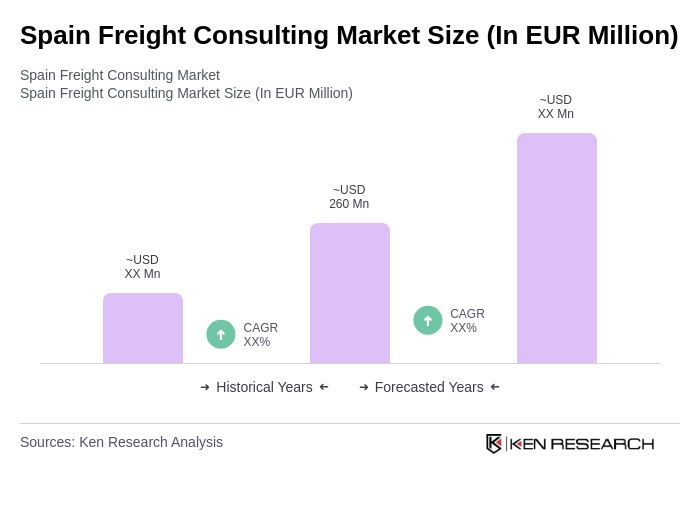
Spain Freight Consulting Market, worth EUR 260 million, grows due to e-commerce expansion, technological advancements, and sustainability focus, segmented by type and end-user.

Region:Europe

Author(s):Shubham

Product Code:KRAA0878

Pages:99

Published On:August 2025
About the Report

Base Year 2024

Spain Freight Consulting Market Overview

  • The Spain Freight Consulting Market is valued at EUR 260 million, based on a five-year historical analysis of the broader freight logistics sector and the consulting segment’s share within it. Growth is primarily driven by the increasing complexity of supply chains, the rapid expansion of e-commerce, and the need for efficient, technology-enabled logistics solutions. Companies are increasingly seeking expert advice to optimize their operations, reduce costs, and enhance service delivery in a highly competitive environment .
  • Key logistics hubs in this market include Madrid, Barcelona, and Valencia, which dominate due to their strategic locations, advanced infrastructure, and significant port activities. These cities serve as major logistics and intermodal transport hubs, facilitating trade and transportation across Europe and internationally, and thus attract a high concentration of consulting firms specializing in freight and logistics .
  • The Spanish government has implemented regulatory initiatives to enhance the efficiency of freight transport, including the "Logistics and Transport Strategy." This strategy focuses on infrastructure modernization, sustainable logistics practices, and digitalization of the sector. These measures aim to streamline operations, improve environmental performance, and foster growth in the freight consulting market .
Spain Freight Consulting Market Size

Spain Freight Consulting Market Segmentation

By Type:The market is segmented into Strategic Consulting, Operational Consulting, IT Consulting, Compliance Consulting, Financial Consulting, Risk Management Consulting, Sustainability & Green Logistics Consulting, Digital Transformation Consulting, and Others. Each segment addresses specific client needs, such as network design, process optimization, regulatory compliance, technology integration, financial planning, risk mitigation, sustainability strategies, and digital transformation. The growing emphasis on digitalization and sustainability is increasing demand for IT, digital transformation, and green logistics consulting services .
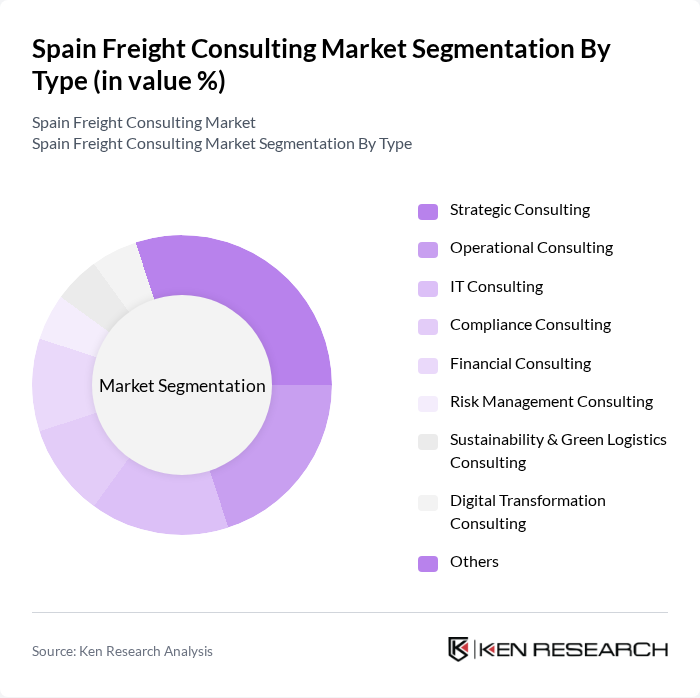
Spain Freight Consulting Market segmentation by Type.

By End-User:The end-user segmentation includes Retail & E-commerce, Manufacturing, Automotive, Pharmaceuticals & Healthcare, Food and Beverage, Agriculture, Construction & Infrastructure, Energy & Utilities, and Others. Each sector has unique logistics requirements, driving demand for specialized consulting services. The rapid growth of e-commerce and retail, ongoing expansion in manufacturing and automotive, and the need for temperature-controlled logistics in pharmaceuticals and food are key demand drivers. Construction, infrastructure, and energy sectors also require tailored freight solutions due to project complexity and regulatory requirements .
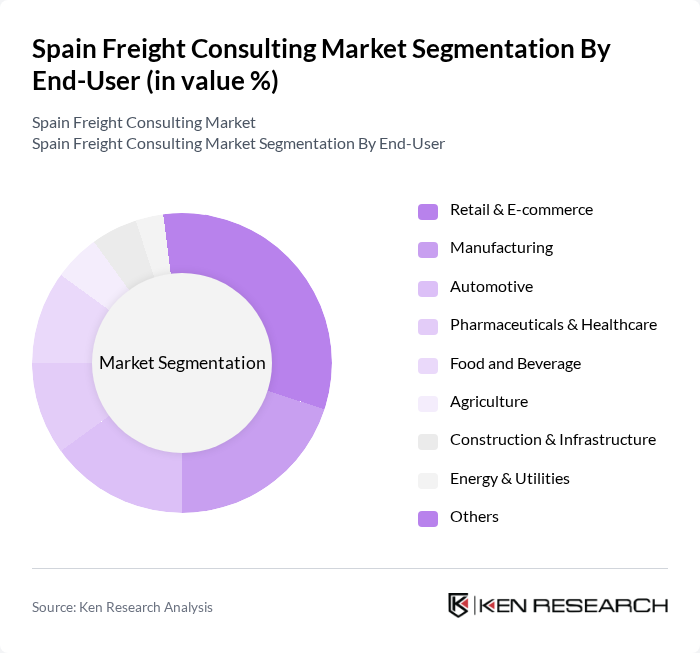
Spain Freight Consulting Market segmentation by End-User.

Spain Freight Consulting Market Competitive Landscape

The Spain Freight Consulting Market is characterized by a dynamic mix of regional and international players. Leading participants such as Accenture, Deloitte, PwC, KPMG, EY, Roland Berger, McKinsey & Company, Boston Consulting Group, Capgemini, A.T. Kearney, Oliver Wyman, Bain & Company, Transporeon, C.H. Robinson, XPO Logistics, DHL Consulting (DHL Supply Chain Spain), DB Schenker Consulting, Alfil Logistics, Grupo Sesé, Logista contribute to innovation, geographic expansion, and service delivery in this space.

Accenture

1989

Dublin, Ireland

Deloitte

1845

London, United Kingdom

PwC

1998

London, United Kingdom

KPMG

1987

Amstelveen, Netherlands

EY

1989

London, United Kingdom

Company

Establishment Year

Headquarters

Group Size (Large, Medium, or Small as per industry convention)

Revenue (Spain Freight Consulting Segment, EUR)

Revenue Growth Rate (YoY, %)

Number of Freight & Logistics Clients (Spain)

Market Penetration Rate (Share of Top 100 Freight Companies Served)

Service Portfolio Breadth (Number of Consulting Service Types Offered)

Spain Freight Consulting Market Industry Analysis

Growth Drivers

  • Increasing Demand for Efficient Supply Chain Solutions:The Spanish logistics sector is projected to reach €60 billion in future, driven by the need for optimized supply chain solutions. Companies are increasingly investing in consulting services to enhance operational efficiency, reduce costs, and improve delivery times. The World Bank reports that Spain's logistics performance index has improved, indicating a growing recognition of the importance of effective supply chain management in maintaining competitiveness in the global market.
  • Growth in E-commerce and Online Retail:E-commerce sales in Spain are expected to exceed €20 billion in future, reflecting a significant shift in consumer behavior. This surge in online retail is driving demand for freight consulting services to streamline logistics and distribution networks. According to the Spanish National Statistics Institute, e-commerce accounted for approximately 11% of total retail sales most recently available, highlighting the critical role of efficient freight solutions in meeting consumer expectations for fast and reliable delivery.
  • Technological Advancements in Logistics:The integration of advanced technologies such as AI and IoT in logistics is transforming the freight consulting landscape in Spain. In future, investments in logistics technology are projected to reach €5 billion, enhancing data analytics capabilities and operational efficiencies. The Spanish government’s push for digitalization in logistics, supported by EU funding, is fostering innovation and creating a competitive edge for consulting firms that leverage these technologies to optimize freight operations.

Market Challenges

  • Regulatory Compliance Complexity:The freight consulting market in Spain faces significant challenges due to complex regulatory frameworks. In future, compliance costs are expected to rise by 10% as firms navigate EU logistics regulations and local laws. This complexity can deter smaller consulting firms from entering the market, limiting competition and innovation. The need for specialized knowledge in regulatory compliance is critical for firms aiming to provide effective consulting services in this environment.
  • High Competition Among Consulting Firms:The Spanish freight consulting market is characterized by intense competition, with over 1,000 firms vying for market share in future. This saturation leads to price wars and reduced profit margins, making it challenging for firms to differentiate their services. According to industry reports, the top five consulting firms control only 30% of the market, indicating a fragmented landscape where smaller players struggle to establish a foothold amidst aggressive competition.

Spain Freight Consulting Market Future Outlook

The future of the Spain freight consulting market appears promising, driven by ongoing digital transformation and a heightened focus on sustainability. As companies increasingly adopt green logistics practices, the demand for consulting services that facilitate this transition will grow. Additionally, the integration of AI and data analytics is expected to enhance operational efficiencies, allowing firms to offer more tailored solutions. These trends will likely create a dynamic environment for consulting firms, fostering innovation and collaboration in the logistics sector.

Market Opportunities

  • Adoption of Green Logistics Practices:With Spain's commitment to reducing carbon emissions by 55% by 2030, there is a significant opportunity for consulting firms to assist businesses in implementing sustainable logistics solutions. This shift is expected to drive demand for expertise in eco-friendly practices, creating a lucrative niche for consultants who can guide firms through the transition to greener operations.
  • Integration of AI and Data Analytics:The increasing reliance on data-driven decision-making presents a substantial opportunity for freight consulting firms. By leveraging AI and advanced analytics, consultants can provide actionable insights that enhance supply chain efficiency. As companies seek to optimize their logistics operations, the demand for consulting services that incorporate these technologies is anticipated to rise, positioning firms for growth in this evolving landscape.

Scope of the Report

SegmentSub-Segments
By Type

Strategic Consulting

Operational Consulting

IT Consulting

Compliance Consulting

Financial Consulting

Risk Management Consulting

Sustainability & Green Logistics Consulting

Digital Transformation Consulting

Others

By End-User

Retail & E-commerce

Manufacturing

Automotive

Pharmaceuticals & Healthcare

Food and Beverage

Agriculture

Construction & Infrastructure

Energy & Utilities

Others

By Service Model

Project-Based Consulting

Retainer-Based Consulting

Hourly Consulting

Performance-Based Consulting

Hybrid/Custom Engagements

Others

By Geographic Focus

Domestic Market Focus (Spain)

International Market Focus (EU/Global)

Regional Market Focus (Catalonia, Madrid, Valencia, Andalusia, etc.)

Port-Centric Consulting (Barcelona, Valencia, Algeciras, Bilbao)

Others

By Client Size

Large Enterprises

Medium Enterprises

Small Enterprises

Startups

Public Sector/Institutions

Others

By Consulting Duration

Short-Term Consulting

Long-Term Consulting

Ongoing Support

Project-Based Duration

Others

By Industry Focus

Transportation and Logistics

Wholesale and Retail Trade

E-commerce Logistics

Cold Chain & Temperature-Controlled Logistics

Courier, Express, and Parcel (CEP)

Maritime & Port Logistics

Rail & Intermodal Logistics

Others

Key Target Audience

Investors and Venture Capitalist Firms

Government and Regulatory Bodies (e.g., Ministry of Transport, Mobility and Urban Agenda)

Logistics and Supply Chain Managers

Freight Forwarders and Shipping Companies

Port Authorities and Terminal Operators

Customs and Border Protection Agencies

Infrastructure Development Agencies

Trade and Export Promotion Organizations

Players Mentioned in the Report:

Accenture

Deloitte

PwC

KPMG

EY

Roland Berger

McKinsey & Company

Boston Consulting Group

Capgemini

A.T. Kearney

Oliver Wyman

Bain & Company

Transporeon

C.H. Robinson

XPO Logistics

DHL Consulting (DHL Supply Chain Spain)

DB Schenker Consulting

Alfil Logistics

Grupo Sese

Logista

Table of Contents

Market Assessment Phase

1. Executive Summary and Approach


2. Spain Freight Consulting Market Overview

2.1 Key Insights and Strategic Recommendations

2.2 Spain Freight Consulting Market Overview

2.3 Definition and Scope

2.4 Evolution of Market Ecosystem

2.5 Timeline of Key Regulatory Milestones

2.6 Value Chain & Stakeholder Mapping

2.7 Business Cycle Analysis

2.8 Policy & Incentive Landscape


3. Spain Freight Consulting Market Analysis

3.1 Growth Drivers

3.1.1 Increasing Demand for Efficient Supply Chain Solutions
3.1.2 Growth in E-commerce and Online Retail
3.1.3 Expansion of International Trade Agreements
3.1.4 Technological Advancements in Logistics

3.2 Market Challenges

3.2.1 Regulatory Compliance Complexity
3.2.2 High Competition Among Consulting Firms
3.2.3 Fluctuating Fuel Prices
3.2.4 Limited Awareness of Consulting Benefits

3.3 Market Opportunities

3.3.1 Adoption of Green Logistics Practices
3.3.2 Integration of AI and Data Analytics
3.3.3 Expansion into Emerging Markets
3.3.4 Development of Customized Consulting Services

3.4 Market Trends

3.4.1 Shift Towards Digital Transformation
3.4.2 Increasing Focus on Sustainability
3.4.3 Rise of Collaborative Logistics
3.4.4 Growth of Last-Mile Delivery Solutions

3.5 Government Regulation

3.5.1 Implementation of EU Logistics Regulations
3.5.2 Compliance with Environmental Standards
3.5.3 Labor Regulations Impacting Freight Operations
3.5.4 Tax Incentives for Sustainable Practices

4. SWOT Analysis


5. Stakeholder Analysis


6. Porter's Five Forces Analysis


7. Spain Freight Consulting Market Market Size, 2019-2024

7.1 By Value

7.2 By Volume

7.3 By Average Selling Price


8. Spain Freight Consulting Market Segmentation

8.1 By Type

8.1.1 Strategic Consulting
8.1.2 Operational Consulting
8.1.3 IT Consulting
8.1.4 Compliance Consulting
8.1.5 Financial Consulting
8.1.6 Risk Management Consulting
8.1.7 Sustainability & Green Logistics Consulting
8.1.8 Digital Transformation Consulting
8.1.9 Others

8.2 By End-User

8.2.1 Retail & E-commerce
8.2.2 Manufacturing
8.2.3 Automotive
8.2.4 Pharmaceuticals & Healthcare
8.2.5 Food and Beverage
8.2.6 Agriculture
8.2.7 Construction & Infrastructure
8.2.8 Energy & Utilities
8.2.9 Others

8.3 By Service Model

8.3.1 Project-Based Consulting
8.3.2 Retainer-Based Consulting
8.3.3 Hourly Consulting
8.3.4 Performance-Based Consulting
8.3.5 Hybrid/Custom Engagements
8.3.6 Others

8.4 By Geographic Focus

8.4.1 Domestic Market Focus (Spain)
8.4.2 International Market Focus (EU/Global)
8.4.3 Regional Market Focus (Catalonia, Madrid, Valencia, Andalusia, etc.)
8.4.4 Port-Centric Consulting (Barcelona, Valencia, Algeciras, Bilbao)
8.4.5 Others

8.5 By Client Size

8.5.1 Large Enterprises
8.5.2 Medium Enterprises
8.5.3 Small Enterprises
8.5.4 Startups
8.5.5 Public Sector/Institutions
8.5.6 Others

8.6 By Consulting Duration

8.6.1 Short-Term Consulting
8.6.2 Long-Term Consulting
8.6.3 Ongoing Support
8.6.4 Project-Based Duration
8.6.5 Others

8.7 By Industry Focus

8.7.1 Transportation and Logistics
8.7.2 Wholesale and Retail Trade
8.7.3 E-commerce Logistics
8.7.4 Cold Chain & Temperature-Controlled Logistics
8.7.5 Courier, Express, and Parcel (CEP)
8.7.6 Maritime & Port Logistics
8.7.7 Rail & Intermodal Logistics
8.7.8 Others

9. Spain Freight Consulting Market Competitive Analysis

9.1 Market Share of Key Players

9.2 Cross Comparison of Key Players

9.2.1 Company Name
9.2.2 Group Size (Large, Medium, or Small as per industry convention)
9.2.3 Revenue (Spain Freight Consulting Segment, EUR)
9.2.4 Revenue Growth Rate (YoY, %)
9.2.5 Number of Freight & Logistics Clients (Spain)
9.2.6 Market Penetration Rate (Share of Top 100 Freight Companies Served)
9.2.7 Service Portfolio Breadth (Number of Consulting Service Types Offered)
9.2.8 Client Retention Rate (%)
9.2.9 Average Project Value (EUR)
9.2.10 Customer Satisfaction Score (NPS or Equivalent)
9.2.11 Project Completion Rate (%)
9.2.12 Operational Efficiency Ratio (Revenue per Consultant)
9.2.13 Digitalization Index (Share of Projects Involving Digital/Tech Solutions)
9.2.14 Sustainability Advisory Share (Share of Projects Focused on Green Logistics)

9.3 SWOT Analysis of Top Players

9.4 Pricing Analysis

9.5 Detailed Profile of Major Companies

9.5.1 Accenture
9.5.2 Deloitte
9.5.3 PwC
9.5.4 KPMG
9.5.5 EY
9.5.6 Roland Berger
9.5.7 McKinsey & Company
9.5.8 Boston Consulting Group
9.5.9 Capgemini
9.5.10 A.T. Kearney
9.5.11 Oliver Wyman
9.5.12 Bain & Company
9.5.13 Transporeon
9.5.14 C.H. Robinson
9.5.15 XPO Logistics
9.5.16 DHL Consulting (DHL Supply Chain Spain)
9.5.17 DB Schenker Consulting
9.5.18 Alfil Logistics
9.5.19 Grupo Sesé
9.5.20 Logista

10. Spain Freight Consulting Market End-User Analysis

10.1 Procurement Behavior of Key Ministries

10.1.1 Ministry of Transport
10.1.2 Ministry of Industry
10.1.3 Ministry of Environment
10.1.4 Ministry of Economy

10.2 Corporate Spend on Infrastructure & Energy

10.2.1 Investment in Logistics Infrastructure
10.2.2 Spending on Technology Upgrades
10.2.3 Budget Allocation for Sustainability Initiatives

10.3 Pain Point Analysis by End-User Category

10.3.1 Delays in Freight Delivery
10.3.2 High Transportation Costs
10.3.3 Lack of Real-Time Tracking
10.3.4 Compliance with Regulations

10.4 User Readiness for Adoption

10.4.1 Awareness of Consulting Benefits
10.4.2 Willingness to Invest in Consulting Services
10.4.3 Readiness for Digital Transformation

10.5 Post-Deployment ROI and Use Case Expansion

10.5.1 Measurement of Cost Savings
10.5.2 Evaluation of Service Efficiency
10.5.3 Expansion of Consulting Services

11. Spain Freight Consulting Market Future Size, 2025-2030

11.1 By Value

11.2 By Volume

11.3 By Average Selling Price


Go-To-Market Strategy Phase

1. Whitespace Analysis + Business Model Canvas

1.1 Market Gaps Identification

1.2 Value Proposition Development

1.3 Revenue Model Structuring

1.4 Key Partnerships Identification

1.5 Customer Segmentation Analysis

1.6 Competitive Landscape Overview

1.7 Risk Assessment


2. Marketing and Positioning Recommendations

2.1 Branding Strategies

2.2 Product USPs

2.3 Target Audience Identification

2.4 Communication Strategy

2.5 Digital Marketing Tactics

2.6 Performance Metrics


3. Distribution Plan

3.1 Urban Retail Strategies

3.2 Rural NGO Tie-Ups

3.3 Online Distribution Channels

3.4 Partnership with Local Businesses

3.5 Logistics and Supply Chain Management


4. Channel & Pricing Gaps

4.1 Underserved Routes

4.2 Pricing Bands Analysis

4.3 Competitor Pricing Comparison

4.4 Customer Willingness to Pay

4.5 Value-Based Pricing Strategies


5. Unmet Demand & Latent Needs

5.1 Category Gaps Identification

5.2 Consumer Segments Analysis

5.3 Emerging Trends Exploration

5.4 Feedback Mechanisms


6. Customer Relationship

6.1 Loyalty Programs

6.2 After-Sales Service

6.3 Customer Engagement Strategies

6.4 Feedback and Improvement Processes


7. Value Proposition

7.1 Sustainability Initiatives

7.2 Integrated Supply Chains

7.3 Cost Efficiency

7.4 Customer-Centric Solutions


8. Key Activities

8.1 Regulatory Compliance

8.2 Branding Efforts

8.3 Distribution Setup

8.4 Training and Development


9. Entry Strategy Evaluation

9.1 Domestic Market Entry Strategy

9.1.1 Product Mix
9.1.2 Pricing Band
9.1.3 Packaging

9.2 Export Entry Strategy

9.2.1 Target Countries
9.2.2 Compliance Roadmap

10. Entry Mode Assessment

10.1 Joint Ventures

10.2 Greenfield Investments

10.3 Mergers & Acquisitions

10.4 Distributor Model


11. Capital and Timeline Estimation

11.1 Capital Requirements

11.2 Timelines


12. Control vs Risk Trade-Off

12.1 Ownership vs Partnerships


13. Profitability Outlook

13.1 Breakeven Analysis

13.2 Long-Term Sustainability


14. Potential Partner List

14.1 Distributors

14.2 Joint Ventures

14.3 Acquisition Targets


15. Execution Roadmap

15.1 Phased Plan for Market Entry

15.1.1 Market Setup
15.1.2 Market Entry
15.1.3 Growth Acceleration
15.1.4 Scale & Stabilize

15.2 Key Activities and Milestones

15.2.1 Activity Planning
15.2.2 Milestone Tracking

Research Methodology

ApproachModellingSample

Phase 1: Approach1

Desk Research

  • Analysis of freight transport statistics from the Spanish Ministry of Transport
  • Review of industry reports from logistics associations and trade bodies in Spain
  • Examination of market trends and forecasts published by economic research institutions

Primary Research

  • Interviews with logistics managers at major freight forwarding companies
  • Surveys conducted with shippers and manufacturers utilizing freight services
  • Field interviews with port authorities and customs officials to understand regulatory impacts

Validation & Triangulation

  • Cross-validation of findings through multiple data sources including government and private sector reports
  • Triangulation of qualitative insights from interviews with quantitative data from surveys
  • Sanity checks through expert panel reviews comprising industry veterans and analysts

Phase 2: Market Size Estimation1

Top-down Assessment

  • Estimation of total freight volume based on national GDP growth and trade statistics
  • Segmentation of freight services by mode (road, rail, air, sea) and end-user industries
  • Incorporation of government initiatives aimed at enhancing logistics efficiency

Bottom-up Modeling

  • Collection of operational data from leading freight companies to establish baseline metrics
  • Cost analysis based on service pricing models across different freight modes
  • Volume and cost calculations to derive revenue estimates for each segment

Forecasting & Scenario Analysis

  • Utilization of time series analysis to project future freight demand trends
  • Scenario modeling based on economic indicators and potential regulatory changes
  • Development of baseline, optimistic, and pessimistic forecasts through 2030

Phase 3: CATI Sample Composition1

Scope Item/SegmentSample SizeTarget Respondent Profiles
Road Freight Services100Logistics Coordinators, Fleet Managers
Maritime Freight Operations60Port Managers, Shipping Line Executives
Air Cargo Logistics50Air Freight Managers, Customs Brokers
Rail Freight Transportation40Rail Operations Managers, Supply Chain Analysts
Cold Chain Logistics40Quality Assurance Managers, Distribution Supervisors

Frequently Asked Questions

What is the current value of the Spain Freight Consulting Market?

The Spain Freight Consulting Market is valued at approximately EUR 260 million, reflecting the segment's share within the broader freight logistics sector. This valuation is based on a five-year historical analysis of market trends and growth drivers.

What factors are driving growth in the Spain Freight Consulting Market?

Which cities are key logistics hubs in Spain?

What regulatory initiatives has the Spanish government implemented for freight transport?

Why Buy From Us?

Refine Robust Result (RRR) Framework

What makes us stand out is that our consultants follow Robust, Refine and Result (RRR) methodology. Robust for clear definitions, approaches and sanity checking, Refine for differentiating respondents' facts and opinions, and Result for presenting data with story.

Our Reach Is Unmatched

We have set a benchmark in the industry by offering our clients with syndicated and customized market research reports featuring coverage of entire market as well as meticulous research and analyst insights.

Shifting the Research Paradigm

While we don't replace traditional research, we flip the method upside down. Our dual approach of Top Bottom & Bottom Top ensures quality deliverable by not just verifying company fundamentals but also looking at the sector and macroeconomic factors.

More Insights-Better Decisions

With one step in the future, our research team constantly tries to show you the bigger picture. We help with some of the tough questions you may encounter along the way: How is the industry positioned? Best marketing channel? KPI's of competitors? By aligning every element, we help maximize success.

Transparency and Trust

Our report gives you instant access to the answers and sources that other companies might choose to hide. We elaborate each steps of research methodology we have used and showcase you the sample size to earn your trust.

Round the Clock Support

If you need any support, we are here! We pride ourselves on universe strength, data quality, and quick, friendly, and professional service.

Why Clients Choose Us?

400000+
Reports in repository
150+
Consulting projects a year
100+
Analysts
8000+
Client Queries in 2022








