About the Report
Base Year 2024Middle East Candy Market Overview
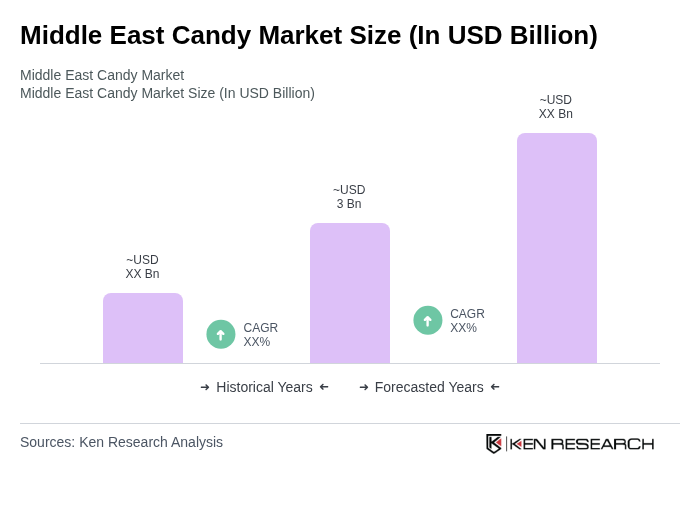
- The Middle East Candy Market is valued at USD 3 billion, based on a five-year historical analysis. This growth is primarily driven by rising middle-class incomes, urbanization, and evolving lifestyles across the region. The expansion of modern retail landscapes, such as supermarkets, hypermarkets, and e-commerce, enhances product accessibility, while innovation in healthier formats like sugar-free, organic, and premium-flavored candies appeals to increasingly health-conscious and discerning consumers.
- Key players in this market include Saudi Arabia and the UAE, which lead consumption due to their large youth populations, high disposable incomes, gifting customs, and modern retail infrastructure. Global confectionery companies such as Nestlé, Mars Inc., Mondelez International, and Ferrero are key contributors, alongside regional brands like Al Haramain, Al Rifai, and Laffah, which leverage local tastes and distribution networks to strengthen their position.
- In 2024, the government of the UAE announced new regulations aimed at reducing sugar consumption, including mandatory labeling of sugar content in candy products. This initiative is part of a broader public health strategy to combat rising obesity rates and promote healthier eating habits among consumers, thereby influencing manufacturers to reformulate their products.
Middle East Candy Market Segmentation
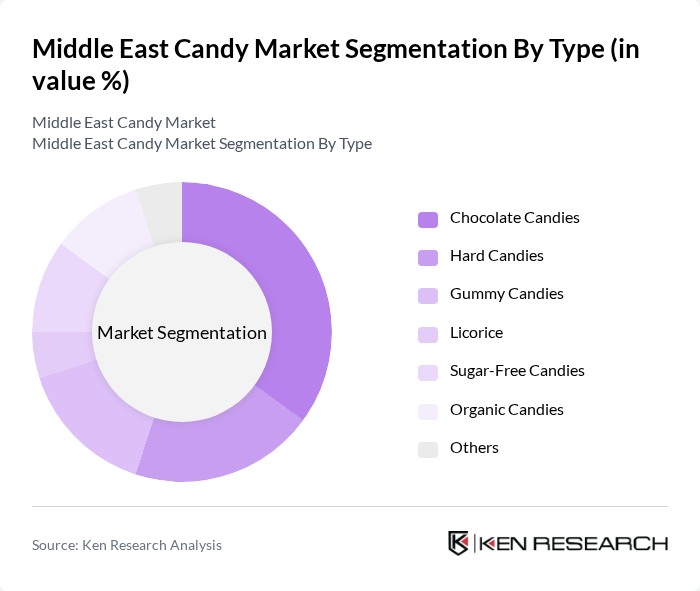
By Type:The candy market is segmented into various types, including chocolate candies, hard candies, gummy candies, licorice, sugar-free candies, organic candies, and others. Among these, chocolate candies dominate the market due to their widespread popularity and versatility in flavors and forms. The increasing demand for premium and artisanal chocolate options is also driving growth in this segment.
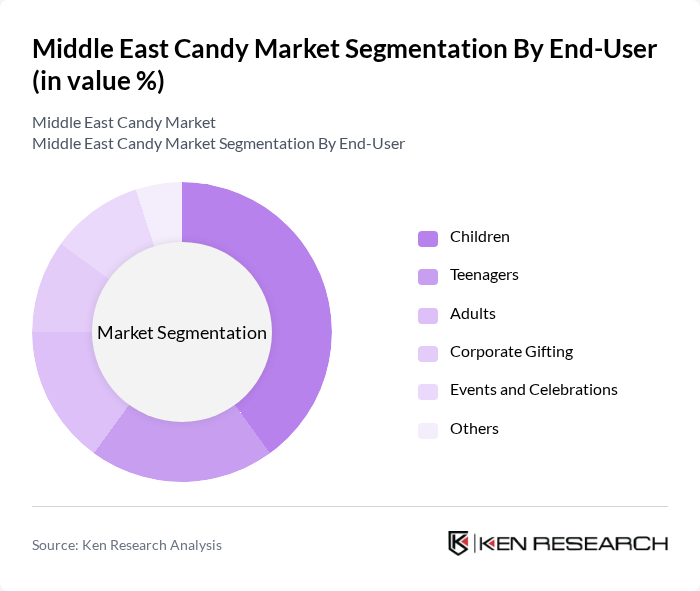
By End-User:The end-user segmentation includes children, teenagers, adults, corporate gifting, events and celebrations, and others. Children represent the largest consumer group, driven by marketing strategies targeting young audiences and the popularity of candies as treats. The trend of gifting candies during celebrations further boosts demand in this segment.
Middle East Candy Market Competitive Landscape
The Middle East Candy Market is characterized by a dynamic mix of regional and international players. Leading participants such as Mars, Incorporated, Mondelez International, Ferrero Group, Nestlé S.A., Haribo GmbH & Co. KG, Perfetti Van Melle, The Hershey Company, General Mills, Inc., Lindt & Sprüngli AG, Cémoi Chocolatier, Cloetta AB, Yildiz Holding, Tootsie Roll Industries, LLC, Jelly Belly Candy Company, R.M. Palmer Company contribute to innovation, geographic expansion, and service delivery in this space.
Middle East Candy Market Industry Analysis
Growth Drivers
- High Production Volume in Key Countries:The Middle East candy market is bolstered by a substantial production volume of 1,400,000 tons of candies, sweets, and non-chocolate confectionery in future. This robust output not only meets local demand but also positions the region as a significant player in the global candy market. The sustained growth in production supports supply strength and enhances market scale, making it a vital growth driver for the industry.
- Major Production by Leading Nations:In future, Turkey, Iran, and Saudi Arabia are the leading producers, contributing 510,000 tons, 280,000 tons, and 200,000 tons, respectively. This concentration of production capacity in these countries underpins regional value chains and facilitates economies of scale. The dominance of these nations in candy production not only strengthens their market positions but also enhances their ability to meet both domestic and international demand effectively.
- Substantial Import Demand in Growing Markets:The demand for imported candies remains significant, with Iraq importing 70,000 tons, Saudi Arabia 55,000 tons, and the UAE 45,000 tons in future. This high domestic demand for confectionery products drives import volumes, reinforcing market expansion. The growing consumer base in these countries indicates a strong appetite for diverse candy offerings, further stimulating market growth in the region.
Market Challenges
- Decline in Production Value:Despite an increase in production volume, the export-price production value for the candy market has decreased to $3,500,000,000 in future. This decline suggests potential price pressures or rising costs that could hinder profitability for manufacturers. The challenge of maintaining production value amidst increasing competition and fluctuating costs poses a significant hurdle for market players.
- Falling Imports Trend:The import of candies, sweets, and non-chocolate confectionery has declined by 1.5% to 280,000 tons in future, with the import value dropping to $1,000,000,000. This trend may indicate softening demand or increased competition from local producers, which could hinder market growth. The decline in imports highlights the need for manufacturers to adapt to changing market dynamics and consumer preferences.
Middle East Candy Market Future Outlook
The Middle East candy market is poised for a transformative phase, driven by evolving consumer preferences and economic conditions. With a strong GDP per capita, particularly in countries like Qatar and the UAE, there is potential for premiumization and health-oriented product offerings. However, the market may face value erosion risks due to price sensitivity and competition. Consolidation among leading producers could optimize supply chains, while innovation in flavors and sustainable practices will likely shape future growth trajectories.
Market Opportunities
- Export-led Growth Potential:The high production capacity of 1.4 million tons exceeding domestic demand presents significant opportunities for expanding exports to adjacent markets. This surplus indicates a potential for tapping into new markets, enhancing revenue streams, and diversifying market risks for producers in the region.
- Supply Chain Integration in High-Capacity Markets:Countries like Turkey, Iran, and Saudi Arabia could benefit from integrating their supply chains, particularly in packaging and branding. This vertical integration can help capture more value along the production chain, improve efficiency, and enhance competitiveness in both local and international markets.
Scope of the Report
| Segment | Sub-Segments |
|---|---|
| By Type | Chocolate Candies Hard Candies Gummy Candies Licorice Sugar-Free Candies Organic Candies Others |
| By End-User | Children Teenagers Adults Corporate Gifting Events and Celebrations Others |
| By Distribution Channel | Supermarkets/Hypermarkets Convenience Stores Online Retail Specialty Stores Vending Machines Others |
| By Packaging Type | Bags Boxes Bulk Packaging Individual Wrappers Others |
| By Flavor | Chocolate Fruit Mint Spicy Others |
| By Occasion | Festivals Birthdays Weddings Corporate Events Others |
| By Price Range | Premium Mid-Range Economy Others |
Key Target Audience
Investors and Venture Capitalist Firms
Government and Regulatory Bodies (e.g., Ministry of Economy, Food and Drug Administration)
Manufacturers and Producers
Distributors and Retailers
Importers and Exporters
Food Safety and Quality Assurance Organizations
Marketing and Advertising Agencies
Logistics and Supply Chain Companies
Players Mentioned in the Report:
Mars, Incorporated
Mondelez International
Ferrero Group
Nestle S.A.
Haribo GmbH & Co. KG
Perfetti Van Melle
The Hershey Company
General Mills, Inc.
Lindt & Sprungli AG
Cemoi Chocolatier
Cloetta AB
Yildiz Holding
Tootsie Roll Industries, LLC
Jelly Belly Candy Company
R.M. Palmer Company
Table of Contents
Market Assessment Phase
1. Executive Summary and Approach
2. Middle East Candy Market Overview
2.1 Key Insights and Strategic Recommendations
2.2 Middle East Candy Market Overview
2.3 Definition and Scope
2.4 Evolution of Market Ecosystem
2.5 Timeline of Key Regulatory Milestones
2.6 Value Chain & Stakeholder Mapping
2.7 Business Cycle Analysis
2.8 Policy & Incentive Landscape
3. Middle East Candy Market Analysis
3.1 Growth Drivers
3.1.1 Increasing disposable income
3.1.2 Rising demand for premium and artisanal candies
3.1.3 Expansion of retail channels
3.1.4 Growing popularity of gifting and celebrations
3.2 Market Challenges
3.2.1 Intense competition among local and international brands
3.2.2 Fluctuating raw material prices
3.2.3 Regulatory compliance and food safety standards
3.2.4 Changing consumer preferences towards healthier options
3.3 Market Opportunities
3.3.1 Expansion into e-commerce platforms
3.3.2 Development of sugar-free and organic candy options
3.3.3 Collaborations with local artisans and brands
3.3.4 Increasing focus on sustainable packaging solutions
3.4 Market Trends
3.4.1 Growth of online candy subscription services
3.4.2 Rising interest in exotic flavors and ingredients
3.4.3 Increased marketing through social media platforms
3.4.4 Focus on experiential marketing and brand storytelling
3.5 Government Regulation
3.5.1 Food safety regulations and labeling requirements
3.5.2 Import/export regulations for confectionery products
3.5.3 Taxation policies affecting sugary products
3.5.4 Regulations on advertising to children
4. SWOT Analysis
5. Stakeholder Analysis
6. Porter's Five Forces Analysis
7. Middle East Candy Market Market Size, 2019-2024
7.1 By Value
7.2 By Volume
7.3 By Average Selling Price
8. Middle East Candy Market Segmentation
8.1 By Type
8.1.1 Chocolate Candies
8.1.2 Hard Candies
8.1.3 Gummy Candies
8.1.4 Licorice
8.1.5 Sugar-Free Candies
8.1.6 Organic Candies
8.1.7 Others
8.2 By End-User
8.2.1 Children
8.2.2 Teenagers
8.2.3 Adults
8.2.4 Corporate Gifting
8.2.5 Events and Celebrations
8.2.6 Others
8.3 By Distribution Channel
8.3.1 Supermarkets/Hypermarkets
8.3.2 Convenience Stores
8.3.3 Online Retail
8.3.4 Specialty Stores
8.3.5 Vending Machines
8.3.6 Others
8.4 By Packaging Type
8.4.1 Bags
8.4.2 Boxes
8.4.3 Bulk Packaging
8.4.4 Individual Wrappers
8.4.5 Others
8.5 By Flavor
8.5.1 Chocolate
8.5.2 Fruit
8.5.3 Mint
8.5.4 Spicy
8.5.5 Others
8.6 By Occasion
8.6.1 Festivals
8.6.2 Birthdays
8.6.3 Weddings
8.6.4 Corporate Events
8.6.5 Others
8.7 By Price Range
8.7.1 Premium
8.7.2 Mid-Range
8.7.3 Economy
8.7.4 Others
9. Middle East Candy Market Competitive Analysis
9.1 Market Share of Key Players
9.2 Cross Comparison of Key Players
9.2.1 Company Name
9.2.2 Group Size (Large, Medium, or Small as per industry convention)
9.2.3 Revenue Growth Rate
9.2.4 Market Penetration Rate
9.2.5 Customer Retention Rate
9.2.6 Product Diversification Index
9.2.7 Pricing Strategy
9.2.8 Brand Recognition Score
9.2.9 Distribution Network Efficiency
9.2.10 Innovation Rate
9.3 SWOT Analysis of Top Players
9.4 Pricing Analysis
9.5 Detailed Profile of Major Companies
9.5.1 Mars, Incorporated
9.5.2 Mondelez International
9.5.3 Ferrero Group
9.5.4 Nestlé S.A.
9.5.5 Haribo GmbH & Co. KG
9.5.6 Perfetti Van Melle
9.5.7 The Hershey Company
9.5.8 General Mills, Inc.
9.5.9 Lindt & Sprüngli AG
9.5.10 Cémoi Chocolatier
9.5.11 Cloetta AB
9.5.12 Yildiz Holding
9.5.13 Tootsie Roll Industries, LLC
9.5.14 Jelly Belly Candy Company
9.5.15 R.M. Palmer Company
10. Middle East Candy Market End-User Analysis
10.1 Procurement Behavior of Key Ministries
10.1.1 Budget Allocation for Confectionery Products
10.1.2 Preferred Suppliers and Brands
10.1.3 Procurement Processes and Regulations
10.1.4 Seasonal Demand Fluctuations
10.2 Corporate Spend on Infrastructure & Energy
10.2.1 Investment in Candy Production Facilities
10.2.2 Expenditure on Marketing and Promotions
10.2.3 Budget for Research and Development
10.2.4 Spending on Sustainability Initiatives
10.3 Pain Point Analysis by End-User Category
10.3.1 Quality Concerns
10.3.2 Price Sensitivity
10.3.3 Availability of Varieties
10.3.4 Health Considerations
10.4 User Readiness for Adoption
10.4.1 Awareness of New Products
10.4.2 Willingness to Try New Flavors
10.4.3 Acceptance of Online Purchasing
10.4.4 Feedback Mechanisms
10.5 Post-Deployment ROI and Use Case Expansion
10.5.1 Sales Growth Post-Implementation
10.5.2 Customer Satisfaction Metrics
10.5.3 Market Share Increase
10.5.4 Brand Loyalty Development
11. Middle East Candy Market Future Size, 2025-2030
11.1 By Value
11.2 By Volume
11.3 By Average Selling Price
Go-To-Market Strategy Phase
1. Whitespace Analysis + Business Model Canvas
1.1 Market Gaps Identification
1.2 Value Proposition Development
1.3 Revenue Streams Analysis
1.4 Customer Segmentation
1.5 Key Partnerships
1.6 Cost Structure Evaluation
1.7 Channels of Distribution
2. Marketing and Positioning Recommendations
2.1 Branding Strategies
2.2 Product USPs
3. Distribution Plan
3.1 Urban Retail vs Rural NGO Tie-ups
4. Channel & Pricing Gaps
4.1 Underserved Routes
4.2 Pricing Bands
5. Unmet Demand & Latent Needs
5.1 Category Gaps
5.2 Consumer Segments
6. Customer Relationship
6.1 Loyalty Programs
6.2 After-Sales Service
7. Value Proposition
7.1 Sustainability
7.2 Integrated Supply Chains
8. Key Activities
8.1 Regulatory Compliance
8.2 Branding
8.3 Distribution Setup
9. Entry Strategy Evaluation
9.1 Domestic Market Entry Strategy
9.1.1 Product Mix
9.1.2 Pricing Band
9.1.3 Packaging
9.2 Export Entry Strategy
9.2.1 Target Countries
9.2.2 Compliance Roadmap
10. Entry Mode Assessment
10.1 JV
10.2 Greenfield
10.3 M&A
10.4 Distributor Model
11. Capital and Timeline Estimation
11.1 Capital Requirements
11.2 Timelines
12. Control vs Risk Trade-Off
12.1 Ownership vs Partnerships
13. Profitability Outlook
13.1 Breakeven Analysis
13.2 Long-Term Sustainability
14. Potential Partner List
14.1 Distributors
14.2 JVs
14.3 Acquisition Targets
15. Execution Roadmap
15.1 Phased Plan for Market Entry
15.1.1 Market Setup
15.1.2 Market Entry
15.1.3 Growth Acceleration
15.1.4 Scale & Stabilize
15.2 Key Activities and Milestones
15.2.1 Milestone Planning
15.2.2 Activity Scheduling
Research Methodology
Phase 1: Approach1
Desk Research
- Analysis of market reports from industry associations and trade publications
- Review of demographic and economic data from government statistical agencies
- Examination of consumer behavior studies and trends in confectionery consumption
Primary Research
- Interviews with key stakeholders in the candy manufacturing sector
- Surveys targeting retailers and distributors in the Middle East candy market
- Focus groups with consumers to understand preferences and purchasing habits
Validation & Triangulation
- Cross-validation of findings with multiple data sources, including sales data and market trends
- Triangulation of insights from interviews, surveys, and secondary data
- Sanity checks through expert reviews and feedback from industry analysts
Phase 2: Market Size Estimation1
Top-down Assessment
- Estimation of total market size based on regional confectionery sales data
- Segmentation of the market by product type, including chocolate, gummies, and hard candies
- Incorporation of growth rates from historical data and market forecasts
Bottom-up Modeling
- Collection of sales volume data from leading candy manufacturers in the region
- Estimation of average selling prices across different candy categories
- Calculation of market size based on volume and price data aggregated from various sources
Forecasting & Scenario Analysis
- Development of forecasting models using historical sales data and market trends
- Scenario analysis based on economic conditions, consumer trends, and regulatory impacts
- Projections for market growth under different economic scenarios through 2030
Phase 3: CATI Sample Composition1
| Scope Item/Segment | Sample Size | Target Respondent Profiles |
|---|---|---|
| Retail Candy Sales | 150 | Store Managers, Retail Buyers |
| Wholesale Distribution Channels | 100 | Wholesale Distributors, Supply Chain Managers |
| Consumer Preferences in Candy | 200 | General Consumers, Candy Enthusiasts |
| Market Trends in Health-Conscious Candy | 80 | Health Food Retailers, Nutritionists |
| Impact of E-commerce on Candy Sales | 120 | E-commerce Managers, Digital Marketing Specialists |
Frequently Asked Questions
What is the current value of the Middle East Candy Market?
The Middle East Candy Market is valued at approximately USD 3 billion, reflecting a five-year historical analysis. This growth is attributed to rising middle-class incomes, urbanization, and changing consumer lifestyles across the region.
Which countries are the largest consumers of candy in the Middle East?
What types of candies dominate the Middle East Candy Market?
How is the Middle East Candy Market expected to grow in the future?
Other Regional/Country Reports
Indonesia Candy Market
Malaysia Candy Market
APAC Candy Market
Other Adjacent Reports
Indonesia Sugar-Free Products Market
Kuwait E-commerce Retail Market
Mexico Supermarket Retail Market
KSA food packaging market size, share, growth drivers, trends, opportunities & forecast 2025–2030Vietnam Gifting Market
Asia Pacific Health and Wellness Market Size, Share & Forecast, By Wellness Category, Distribution Channel & Geography, 2026-2031Vietnam Food and Beverage MarketWhy Buy From Us?

What makes us stand out is that our consultants follow Robust, Refine and Result (RRR) methodology. Robust for clear definitions, approaches and sanity checking, Refine for differentiating respondents' facts and opinions, and Result for presenting data with story.

We have set a benchmark in the industry by offering our clients with syndicated and customized market research reports featuring coverage of entire market as well as meticulous research and analyst insights.

While we don't replace traditional research, we flip the method upside down. Our dual approach of Top Bottom & Bottom Top ensures quality deliverable by not just verifying company fundamentals but also looking at the sector and macroeconomic factors.

With one step in the future, our research team constantly tries to show you the bigger picture. We help with some of the tough questions you may encounter along the way: How is the industry positioned? Best marketing channel? KPI's of competitors? By aligning every element, we help maximize success.

Our report gives you instant access to the answers and sources that other companies might choose to hide. We elaborate each steps of research methodology we have used and showcase you the sample size to earn your trust.

If you need any support, we are here! We pride ourselves on universe strength, data quality, and quick, friendly, and professional service.