About the Report
Base Year 2024Middle East Chocolate Market Overview
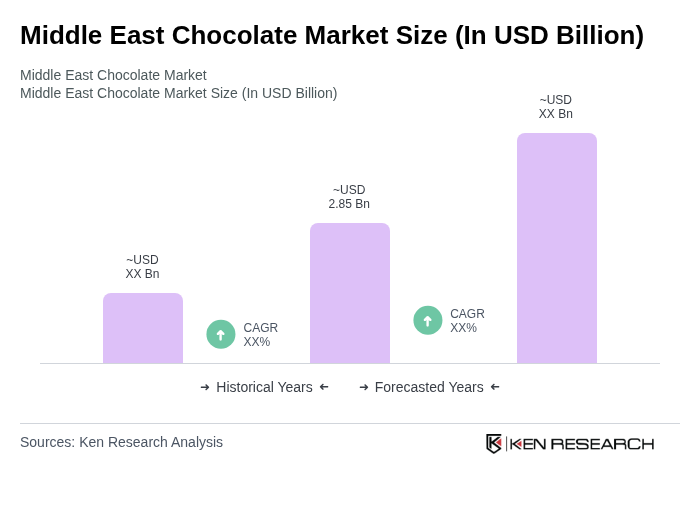
- The Middle East Chocolate Market is valued at USD 2.85 billion, based on recent analysis. Growth is driven by rising demand for premium and artisanal chocolates, the expansion of gifting cultures around festivals and celebrations, and evolving consumer preferences favoring novel flavors and health-oriented products, all supported by a shift toward quick-commerce and online retail channels.
- Key markets include Saudi Arabia and the United Arab Emirates, where strategic local investments and premium consumer demand influence dynamics. These countries dominate the market due to their affluent populations, increasing disposable incomes, and a strong culture of gifting, particularly during festive seasons, which significantly boosts chocolate consumption.
- In 2024, the Saudi Arabian government announced a strategic initiative to enhance local chocolate production capabilities, including investments exceeding USD 10 billion in food sector development and incentives for halal-certified production. This initiative aims to strengthen the chocolate industry’s supply chain resilience and manufacturing capabilities.
Middle East Chocolate Market Segmentation
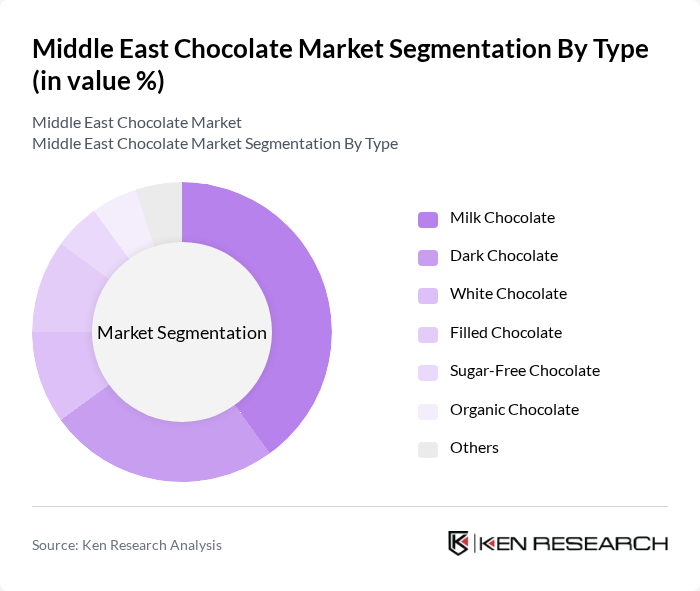
By Type:The chocolate market in the Middle East is segmented into various types, including milk chocolate, dark chocolate, white chocolate, filled chocolate, sugar-free chocolate, organic chocolate, and others. Among these, milk chocolate remains the most popular due to its creamy texture and widespread appeal across different age groups. Dark chocolate is gaining traction as health-conscious consumers seek products with higher cocoa content and lower sugar levels. The demand for organic and sugar-free options is also on the rise, reflecting a shift towards healthier eating habits.
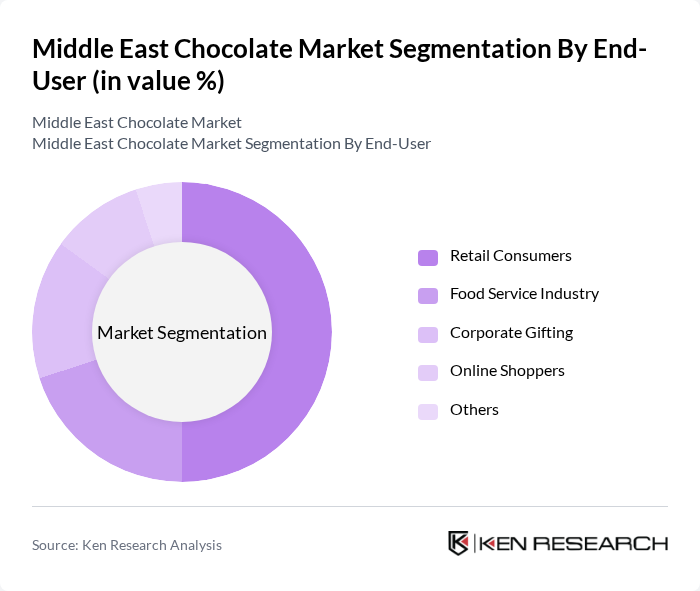
By End-User:The end-user segmentation of the chocolate market includes retail consumers, the food service industry, corporate gifting, online shoppers, and others. Retail consumers dominate the market, driven by the increasing availability of chocolate products in supermarkets and convenience stores. The food service industry is also a significant contributor, as restaurants and cafes incorporate chocolate into their dessert offerings. Corporate gifting is gaining popularity, especially during festive seasons, as companies seek to strengthen client relationships through premium chocolate gifts.
Middle East Chocolate Market Competitive Landscape
The Middle East Chocolate Market is characterized by a dynamic mix of regional and international players. Leading participants such as Mars, Incorporated, Mondelez International, Nestlé S.A., Ferrero Group, Barry Callebaut AG, Lindt & Sprüngli AG, Al Nassma Chocolate, Patchi, Godiva Chocolatier, Cacao Barry, Chocolatier, Bateel International, Chocodate, Al-Rifai, Fawaz Al-Hokair Group contribute to innovation, geographic expansion, and service delivery in this space.
Middle East Chocolate Market Industry Analysis
Growth Drivers
- High GDP per Capita in Key GCC Countries:In future, Qatar's GDP per capita is projected at USD 73,000, while the UAE and Saudi Arabia are at USD 50,000 and USD 34,000, respectively. These elevated income levels enhance consumer purchasing power, particularly for discretionary items like chocolate. As disposable incomes rise, consumers are more inclined to indulge in premium chocolate products, driving market growth significantly across the region.
- Strong UAE Economic Expansion Fuels Demand:The UAE's real GDP growth is anticipated to reach approximately USD 4.5% in future, with the non-oil sector contributing over 70% to the GDP. This robust economic performance, driven by sectors such as tourism and construction, stimulates domestic consumption, including confectionery products. Increased economic activity translates into higher demand for chocolate, particularly in urban areas where consumer spending is concentrated.
- Population Urbanization – Large Metro Concentrations:The Dubai–Sharjah–Ajman metropolitan area is home to around 6.1 million residents as of 2023, with an urbanization rate of approximately 88% in future. This high urbanization fosters a concentrated consumer base with easy access to retail channels, including supermarkets and specialty stores. The convenience of purchasing chocolate products in urban settings significantly boosts overall market demand.
Market Challenges
- Volatility in Export Prices and Regional Value Decline:The chocolate market value in the Middle East is projected to decline to USD 8.5 billion in future, reflecting pressures on export prices. This decline indicates vulnerability in pricing and revenue, which can adversely affect margins for producers and importers. Such fluctuations create uncertainty in the market, complicating strategic planning for businesses involved in chocolate production and distribution.
- Supply Chain Disruption – Pistachio Shortage:The price of pistachio kernels has surged from USD 7.80 to USD 10.50 per pound due to increased demand driven by trends like the viral “Dubai chocolate.” This ingredient scarcity disrupts supply chains, leading to higher input costs for chocolate manufacturers. Such disruptions can hinder production capabilities and affect the availability of certain chocolate products in the market.
Middle East Chocolate Market Future Outlook
The Middle East chocolate market is poised for dynamic growth, driven by increasing consumer interest in premium and specialty products. The rise of digital marketing and social media trends, particularly through platforms like TikTok, is expected to influence product launches and consumer engagement significantly. Additionally, local manufacturing initiatives, supported by government incentives, will likely enhance production capabilities and reduce import dependencies, fostering a more resilient market landscape.
Market Opportunities
- Local Production via Investment Incentives:Nestlé's USD 75 million investment in a new facility in Jeddah, set to begin operations in future with a capacity of 16,000 tonnes per year, exemplifies the shift towards local production. This initiative aims to reduce reliance on imports while benefiting from government support for diversification, ultimately expanding the manufacturing base in the region.
- Export Opportunities Centered on Turkey:Turkey is projected to account for 78% of the regional chocolate export volume and 72% of the export value in future. This strong export infrastructure presents significant opportunities for scaling cross-border trade, particularly for neighboring markets. Leveraging Turkey's established logistics can enhance market access for chocolate producers in the region.
Scope of the Report
| Segment | Sub-Segments |
|---|---|
| By Type | Milk Chocolate Dark Chocolate White Chocolate Filled Chocolate Sugar-Free Chocolate Organic Chocolate Others |
| By End-User | Retail Consumers Food Service Industry Corporate Gifting Online Shoppers Others |
| By Distribution Channel | Supermarkets/Hypermarkets Specialty Stores Online Retail Convenience Stores Others |
| By Packaging Type | Boxes Pouches Bars Bulk Packaging Others |
| By Occasion | Festivals Birthdays Weddings Corporate Events Others |
| By Price Range | Premium Mid-Range Economy Others |
| By Flavor | Classic Flavors Exotic Flavors Seasonal Flavors Others |
Key Target Audience
Investors and Venture Capitalist Firms
Government and Regulatory Bodies (e.g., Ministry of Economy, Food Safety Authority)
Manufacturers and Producers
Distributors and Retailers
Importers and Exporters
Food and Beverage Industry Associations
Packaging Suppliers
Financial Institutions
Players Mentioned in the Report:
Mars, Incorporated
Mondelez International
Nestle S.A.
Ferrero Group
Barry Callebaut AG
Lindt & Sprungli AG
Al Nassma Chocolate
Patchi
Godiva Chocolatier
Cacao Barry
Chocolatier
Bateel International
Chocodate
Al-Rifai
Fawaz Al-Hokair Group
Table of Contents
Market Assessment Phase
1. Executive Summary and Approach
2. Middle East Chocolate Market Overview
2.1 Key Insights and Strategic Recommendations
2.2 Middle East Chocolate Market Overview
2.3 Definition and Scope
2.4 Evolution of Market Ecosystem
2.5 Timeline of Key Regulatory Milestones
2.6 Value Chain & Stakeholder Mapping
2.7 Business Cycle Analysis
2.8 Policy & Incentive Landscape
3. Middle East Chocolate Market Analysis
3.1 Growth Drivers
3.1.1 Increasing Demand for Premium Chocolates
3.1.2 Rising Health Consciousness and Demand for Dark Chocolate
3.1.3 Expansion of Retail Channels
3.1.4 Growing Gifting Culture During Festivals
3.2 Market Challenges
3.2.1 Fluctuating Cocoa Prices
3.2.2 Stringent Food Safety Regulations
3.2.3 Competition from Local and International Brands
3.2.4 Supply Chain Disruptions
3.3 Market Opportunities
3.3.1 Introduction of Innovative Flavors and Formats
3.3.2 E-commerce Growth for Chocolate Sales
3.3.3 Collaborations with Local Artisans
3.3.4 Expansion into Untapped Markets
3.4 Market Trends
3.4.1 Increasing Popularity of Organic and Fair-Trade Chocolates
3.4.2 Rise of Vegan Chocolate Options
3.4.3 Customization and Personalization in Chocolate Products
3.4.4 Sustainable Packaging Initiatives
3.5 Government Regulation
3.5.1 Food Safety Standards Compliance
3.5.2 Import Tariffs on Cocoa Products
3.5.3 Labeling Requirements for Chocolate Products
3.5.4 Regulations on Health Claims
4. SWOT Analysis
5. Stakeholder Analysis
6. Porter's Five Forces Analysis
7. Middle East Chocolate Market Market Size, 2019-2024
7.1 By Value
7.2 By Volume
7.3 By Average Selling Price
8. Middle East Chocolate Market Segmentation
8.1 By Type
8.1.1 Milk Chocolate
8.1.2 Dark Chocolate
8.1.3 White Chocolate
8.1.4 Filled Chocolate
8.1.5 Sugar-Free Chocolate
8.1.6 Organic Chocolate
8.1.7 Others
8.2 By End-User
8.2.1 Retail Consumers
8.2.2 Food Service Industry
8.2.3 Corporate Gifting
8.2.4 Online Shoppers
8.2.5 Others
8.3 By Distribution Channel
8.3.1 Supermarkets/Hypermarkets
8.3.2 Specialty Stores
8.3.3 Online Retail
8.3.4 Convenience Stores
8.3.5 Others
8.4 By Packaging Type
8.4.1 Boxes
8.4.2 Pouches
8.4.3 Bars
8.4.4 Bulk Packaging
8.4.5 Others
8.5 By Occasion
8.5.1 Festivals
8.5.2 Birthdays
8.5.3 Weddings
8.5.4 Corporate Events
8.5.5 Others
8.6 By Price Range
8.6.1 Premium
8.6.2 Mid-Range
8.6.3 Economy
8.6.4 Others
8.7 By Flavor
8.7.1 Classic Flavors
8.7.2 Exotic Flavors
8.7.3 Seasonal Flavors
8.7.4 Others
9. Middle East Chocolate Market Competitive Analysis
9.1 Market Share of Key Players
9.2 Cross Comparison of Key Players
9.2.1 Company Name
9.2.2 Group Size (Large, Medium, or Small as per industry convention)
9.2.3 Revenue Growth Rate
9.2.4 Market Penetration Rate
9.2.5 Customer Retention Rate
9.2.6 Pricing Strategy
9.2.7 Product Diversification Index
9.2.8 Brand Recognition Score
9.2.9 Distribution Efficiency
9.2.10 Innovation Rate
9.3 SWOT Analysis of Top Players
9.4 Pricing Analysis
9.5 Detailed Profile of Major Companies
9.5.1 Mars, Incorporated
9.5.2 Mondelez International
9.5.3 Nestlé S.A.
9.5.4 Ferrero Group
9.5.5 Barry Callebaut AG
9.5.6 Lindt & Sprüngli AG
9.5.7 Al Nassma Chocolate
9.5.8 Patchi
9.5.9 Godiva Chocolatier
9.5.10 Cacao Barry
9.5.11 Chocolatier
9.5.12 Bateel International
9.5.13 Chocodate
9.5.14 Al-Rifai
9.5.15 Fawaz Al-Hokair Group
10. Middle East Chocolate Market End-User Analysis
10.1 Procurement Behavior of Key Ministries
10.1.1 Ministry of Health
10.1.2 Ministry of Education
10.1.3 Ministry of Commerce
10.1.4 Ministry of Culture
10.2 Corporate Spend on Infrastructure & Energy
10.2.1 Corporate Gifting Trends
10.2.2 Event Sponsorships
10.2.3 Marketing Campaigns
10.2.4 Product Launches
10.3 Pain Point Analysis by End-User Category
10.3.1 Retail Consumers
10.3.2 Food Service Providers
10.3.3 Corporate Buyers
10.3.4 Online Shoppers
10.4 User Readiness for Adoption
10.4.1 Awareness of Chocolate Varieties
10.4.2 Willingness to Pay for Premium Products
10.4.3 Interest in Sustainable Options
10.4.4 Online Shopping Preferences
10.5 Post-Deployment ROI and Use Case Expansion
10.5.1 Customer Feedback Mechanisms
10.5.2 Repeat Purchase Rates
10.5.3 Brand Loyalty Metrics
10.5.4 Market Expansion Opportunities
11. Middle East Chocolate Market Future Size, 2025-2030
11.1 By Value
11.2 By Volume
11.3 By Average Selling Price
Go-To-Market Strategy Phase
1. Whitespace Analysis + Business Model Canvas
1.1 Market Gaps Identification
1.2 Business Model Framework
2. Marketing and Positioning Recommendations
2.1 Branding Strategies
2.2 Product USPs
3. Distribution Plan
3.1 Urban Retail vs Rural NGO Tie-ups
4. Channel & Pricing Gaps
4.1 Underserved Routes
4.2 Pricing Bands
5. Unmet Demand & Latent Needs
5.1 Category Gaps
5.2 Consumer Segments
6. Customer Relationship
6.1 Loyalty Programs
6.2 After-sales Service
7. Value Proposition
7.1 Sustainability
7.2 Integrated Supply Chains
8. Key Activities
8.1 Regulatory Compliance
8.2 Branding
8.3 Distribution Setup
9. Entry Strategy Evaluation
9.1 Domestic Market Entry Strategy
9.1.1 Product Mix
9.1.2 Pricing Band
9.1.3 Packaging
9.2 Export Entry Strategy
9.2.1 Target Countries
9.2.2 Compliance Roadmap
10. Entry Mode Assessment
10.1 JV
10.2 Greenfield
10.3 M&A
10.4 Distributor Model
11. Capital and Timeline Estimation
11.1 Capital Requirements
11.2 Timelines
12. Control vs Risk Trade-Off
12.1 Ownership vs Partnerships
13. Profitability Outlook
13.1 Breakeven Analysis
13.2 Long-term Sustainability
14. Potential Partner List
14.1 Distributors
14.2 JVs
14.3 Acquisition Targets
15. Execution Roadmap
15.1 Phased Plan for Market Entry
15.1.1 Market Setup
15.1.2 Market Entry
15.1.3 Growth Acceleration
15.1.4 Scale & Stabilize
15.2 Key Activities and Milestones
15.2.1 Milestone Planning
15.2.2 Activity Tracking
Research Methodology
Phase 1: Approach1
Desk Research
- Market reports from industry associations and trade publications focused on the Middle East chocolate sector
- Analysis of import/export data from government trade statistics and customs databases
- Review of consumer behavior studies and market trends published by regional research firms
Primary Research
- Interviews with key stakeholders in the chocolate supply chain, including manufacturers and distributors
- Surveys targeting retail managers and buyers in supermarkets and specialty stores
- Focus groups with consumers to understand preferences and purchasing behavior regarding chocolate products
Validation & Triangulation
- Cross-validation of findings through comparison with historical sales data and market growth rates
- Triangulation of insights from primary interviews with secondary data sources to ensure consistency
- Sanity checks conducted through expert panel reviews involving industry veterans and market analysts
Phase 2: Market Size Estimation1
Top-down Assessment
- Estimation of total market size based on regional GDP growth and chocolate consumption trends
- Segmentation of the market by product type (e.g., dark, milk, and white chocolate) and distribution channel
- Incorporation of demographic factors influencing chocolate consumption, such as age and income levels
Bottom-up Modeling
- Collection of sales data from leading chocolate manufacturers and retailers in the region
- Estimation of average selling prices and volume sold across different chocolate categories
- Calculation of market size based on unit sales multiplied by average prices for each segment
Forecasting & Scenario Analysis
- Development of forecasting models using historical growth rates and market drivers such as health trends and premiumization
- Scenario analysis based on potential economic shifts, regulatory changes, and consumer preferences
- Creation of baseline, optimistic, and pessimistic forecasts for the chocolate market through 2030
Phase 3: CATI Sample Composition1
| Scope Item/Segment | Sample Size | Target Respondent Profiles |
|---|---|---|
| Retail Chocolate Sales | 150 | Store Managers, Category Buyers |
| Consumer Preferences | 200 | Chocolate Consumers, Age 18-45 |
| Manufacturing Insights | 100 | Production Managers, Quality Control Officers |
| Distribution Channel Analysis | 80 | Logistics Coordinators, Supply Chain Managers |
| Market Trends and Innovations | 70 | Product Development Managers, Marketing Executives |
Frequently Asked Questions
What is the current value of the Middle East Chocolate Market?
The Middle East Chocolate Market is currently valued at approximately USD 2.85 billion. This valuation reflects the growing demand for premium and artisanal chocolates, alongside the expansion of gifting cultures during festivals and celebrations.
Which countries are the key markets in the Middle East Chocolate Market?
What are the main drivers of growth in the Middle East Chocolate Market?
What challenges does the Middle East Chocolate Market face?
Other Regional/Country Reports
Other Adjacent Reports
Indonesia Premium Food Market
KSA Gourmet Food Market
Europe Food Service Market Size, Share & Forecast, By Service Type, Customer Type, Delivery Model & Geography, 2026-2032Vietnam Retail Food Market
Vietnam E-commerce Food Market
Global Halal Food Market Size, Share & Forecast, By Product Type, Distribution Channel & Customer Type, 2026-2031Vietnam Organic Food Market Outlook to 2030South Africa Gift Market
Italy Luxury Goods Market Size, Share & Forecast, By Product Category, Price Tier & Distribution Channel, 2026–2032Why Buy From Us?

What makes us stand out is that our consultants follow Robust, Refine and Result (RRR) methodology. Robust for clear definitions, approaches and sanity checking, Refine for differentiating respondents' facts and opinions, and Result for presenting data with story.

We have set a benchmark in the industry by offering our clients with syndicated and customized market research reports featuring coverage of entire market as well as meticulous research and analyst insights.

While we don't replace traditional research, we flip the method upside down. Our dual approach of Top Bottom & Bottom Top ensures quality deliverable by not just verifying company fundamentals but also looking at the sector and macroeconomic factors.

With one step in the future, our research team constantly tries to show you the bigger picture. We help with some of the tough questions you may encounter along the way: How is the industry positioned? Best marketing channel? KPI's of competitors? By aligning every element, we help maximize success.

Our report gives you instant access to the answers and sources that other companies might choose to hide. We elaborate each steps of research methodology we have used and showcase you the sample size to earn your trust.

If you need any support, we are here! We pride ourselves on universe strength, data quality, and quick, friendly, and professional service.