About the Report
Base Year 2024Middle East Coffee Machine Market Overview
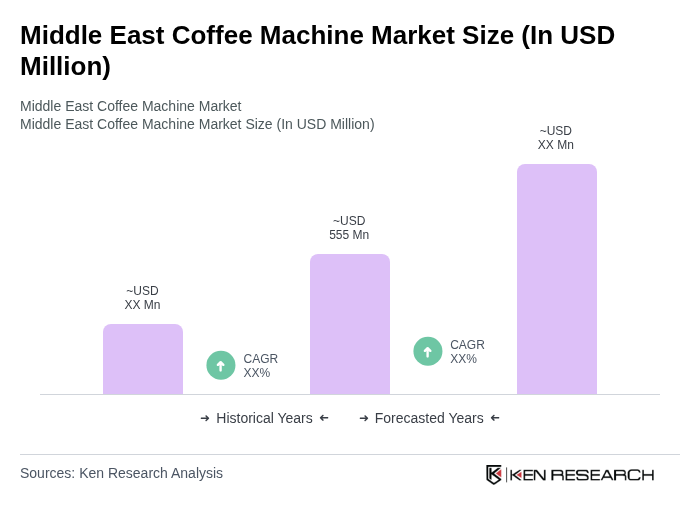
- The Middle East Coffee Machine Market is valued at USD 555 million, based on a five-year historical analysis. This growth is primarily driven by the increasing coffee consumption culture, urbanization, and the rise of specialty coffee shops across the region, supported by a rapidly expanding coffee market in Middle East and Africa. The growing trend of home brewing, rising demand for premium and specialty coffee, and increased adoption of automatic and single-serve machines have also significantly contributed to the market's expansion.
- Key players in this market include Saudi Arabia, the United Arab Emirates, and Qatar, alongside other high-income Gulf countries. These countries dominate the market due to their affluent consumer base, high disposable incomes, strong coffee culture, and rapidly growing consumption of roasted coffee and specialty beverages. The presence of numerous cafés and international coffee chains, expanding independent specialty coffee shops, and a rising trend of at-home coffee consumption supported by premium machines further solidifies their position in the market.
- In 2022, the Saudi Arabian government launched the Saudi Coffee Company, backed by an announced investment of around USD 320 million by the Public Investment Fund, to develop the national coffee industry across the value chain, including farming, processing, roasting, and marketing. This strategic initiative aims to expand local coffee production, build processing and roasting capabilities, and support Saudi coffee farmers, which in turn stimulates demand for commercial and domestic coffee machines through the strengthening of specialty coffee culture and local brands.
Middle East Coffee Machine Market Segmentation
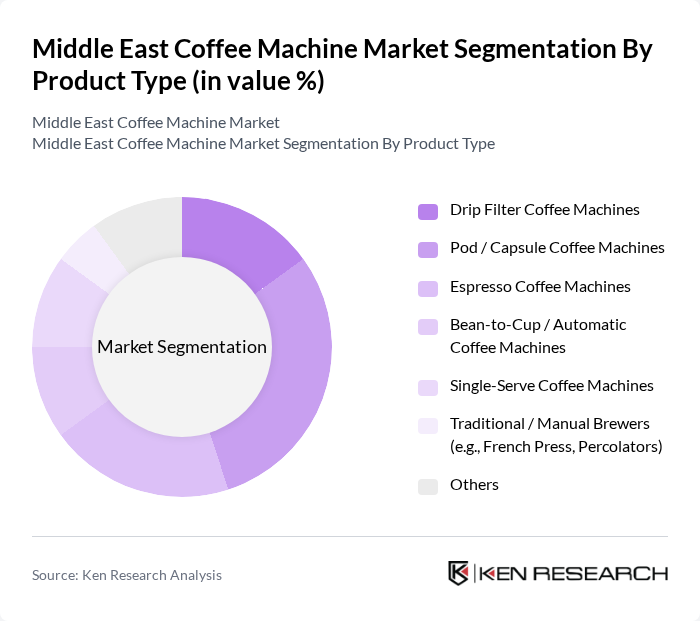
By Product Type:The product type segmentation includes various coffee machine categories that cater to different consumer preferences and usage scenarios. The subsegments are Drip Filter Coffee Machines, Pod / Capsule Coffee Machines, Espresso Coffee Machines, Bean-to-Cup / Automatic Coffee Machines, Single-Serve Coffee Machines, Traditional / Manual Brewers (e.g., French Press, Percolators), and Others. In line with wider Middle East and Africa trends where drip filter has historically held the largest revenue share and pod / capsule systems have been the fastest growing product segment, both Drip Filter and Pod / Capsule Coffee Machines are gaining significant traction. Pod / Capsule Coffee Machines, in particular, continue to gain share due to their convenience, portion control, and ease of use, appealing to busy consumers and those seeking a quick and consistent coffee solution, while automatic and bean-to-cup machines are increasingly adopted by premium home users and commercial operators.
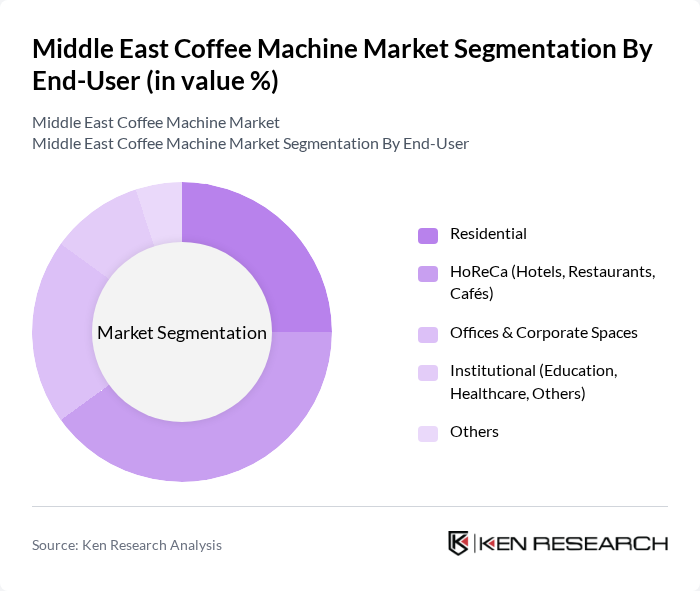
By End-User:The end-user segmentation encompasses various consumer categories, including Residential, HoReCa (Hotels, Restaurants, Cafés), Offices & Corporate Spaces, Institutional (Education, Healthcare, Others), and Others. The HoReCa segment is particularly dominant, driven by the increasing number of cafés, specialty coffee shops, and hotels in urban and tourism-focused areas, which are investing in high-quality espresso, bean-to-cup, and automatic coffee machines to meet consumer demand for premium coffee experiences. At the same time, rising home consumption supported by premium roasted coffee availability and growing installed base of domestic machines is reinforcing the residential end-user segment across the region.
Middle East Coffee Machine Market Competitive Landscape
The Middle East Coffee Machine Market is characterized by a dynamic mix of regional and international players. Leading participants such as Nestlé Nespresso, Breville Group, De'Longhi Group, Koninklijke Philips N.V., Krups (Groupe SEB), BSH Hausgeräte GmbH (Bosch), Saeco, Luigi Lavazza S.p.A., Cuisinart, Hamilton Beach Brands, Gaggia Milano, Smeg S.p.A., Rancilio Group, Jura Elektroapparate AG, Miele & Cie. KG contribute to innovation, geographic expansion, connected and automatic machine offerings, and enhanced after-sales service delivery in this space.
Middle East Coffee Machine Market Industry Analysis
Growth Drivers
- Increasing Coffee Consumption:The Middle East has witnessed a significant rise in coffee consumption, with the market reaching approximately 1.5 million tons in future. This trend is driven by a growing coffee culture, particularly among younger demographics. According to the International Coffee Organization, coffee consumption in the region is projected to increase by 4% annually, reflecting a shift towards premium coffee experiences and specialty brews, which further fuels demand for advanced coffee machines.
- Rise in Specialty Coffee Shops:The number of specialty coffee shops in the Middle East has surged, with over 1,200 new establishments opening in future alone. This growth is attributed to changing consumer preferences for high-quality coffee and unique brewing methods. As these shops invest in high-end coffee machines to meet customer expectations, the demand for sophisticated brewing equipment is expected to rise, creating a lucrative market for coffee machine manufacturers.
- Technological Advancements in Coffee Machines:The coffee machine industry is experiencing rapid technological advancements, with innovations such as smart brewing systems and IoT integration. In future, the market for smart coffee machines in the Middle East was valued at approximately $150 million. These machines offer enhanced user experiences and convenience, driving consumer interest and adoption. As technology continues to evolve, it is expected to significantly influence purchasing decisions in the coffee machine market.
Market Challenges
- High Initial Investment Costs:The high initial investment required for quality coffee machines poses a significant barrier to entry for many potential buyers. Premium coffee machines can range from $1,000 to $10,000, making them inaccessible for smaller businesses and individual consumers. This financial hurdle limits market growth, particularly in regions where disposable income is lower, affecting overall sales and market penetration.
- Limited Availability of Spare Parts:The availability of spare parts for coffee machines is often limited in the Middle East, which can lead to prolonged downtimes for businesses. According to industry reports, over 30% of coffee machine owners have faced challenges in sourcing replacement parts. This issue not only affects operational efficiency but also discourages potential buyers from investing in high-end machines, impacting overall market growth.
Middle East Coffee Machine Market Future Outlook
The Middle East coffee machine market is poised for significant growth, driven by evolving consumer preferences and technological advancements. As coffee culture continues to flourish, the demand for high-quality, innovative coffee machines will likely increase. Additionally, the rise of e-commerce platforms will facilitate easier access to a variety of coffee machines, enhancing market reach. Sustainability trends will also shape product offerings, as consumers increasingly seek eco-friendly options, further influencing market dynamics in the coming years.
Market Opportunities
- Expansion of E-commerce Platforms:The growth of e-commerce in the Middle East presents a significant opportunity for coffee machine manufacturers. With online sales projected to reach $30 billion in future, companies can leverage digital platforms to reach a broader audience, enhancing visibility and sales potential. This shift allows for targeted marketing strategies and improved customer engagement, driving market growth.
- Increasing Demand for Smart Coffee Machines:The demand for smart coffee machines is on the rise, with sales expected to increase by 20% annually. Consumers are increasingly interested in machines that offer connectivity and customization features. This trend presents an opportunity for manufacturers to innovate and develop products that cater to tech-savvy consumers, enhancing user experience and driving sales in the competitive market.
Scope of the Report
| Segment | Sub-Segments |
|---|---|
| By Product Type | Drip Filter Coffee Machines Pod / Capsule Coffee Machines Espresso Coffee Machines Bean-to-Cup / Automatic Coffee Machines Single-Serve Coffee Machines Traditional / Manual Brewers (e.g., French Press, Percolators) Others |
| By End-User | Residential HoReCa (Hotels, Restaurants, Cafés) Offices & Corporate Spaces Institutional (Education, Healthcare, Others) Others |
| By Country | Saudi Arabia United Arab Emirates Qatar Kuwait Oman Bahrain Rest of Middle East |
| By Technology | Manual Coffee Machines Semi-Automatic Coffee Machines Fully Automatic Coffee Machines Smart / Connected Coffee Machines Others |
| By Application | Home Use Office Use Cafés and Restaurants Hotels and Hospitality Others |
| By Distribution Channel | Specialty Stores Supermarkets & Hypermarkets Online Retail / E-commerce Direct Sales / B2B Others |
| By Price Range | Economy Mid-Range Premium Luxury / Professional |
Key Target Audience
Investors and Venture Capitalist Firms
Government and Regulatory Bodies (e.g., Ministry of Economy, Ministry of Trade)
Manufacturers and Producers
Distributors and Retailers
Hospitality Industry Stakeholders (e.g., Hotel Chains, Cafés)
Technology Providers
Industry Associations (e.g., Specialty Coffee Association)
Financial Institutions
Players Mentioned in the Report:
Nestle Nespresso
Breville Group
De'Longhi Group
Koninklijke Philips N.V.
Krups (Groupe SEB)
BSH Hausgerate GmbH (Bosch)
Saeco
Luigi Lavazza S.p.A.
Cuisinart
Hamilton Beach Brands
Gaggia Milano
Smeg S.p.A.
Rancilio Group
Jura Elektroapparate AG
Miele & Cie. KG
Table of Contents
Market Assessment Phase
1. Executive Summary and Approach
2. Middle East Coffee Machine Market Overview
2.1 Key Insights and Strategic Recommendations
2.2 Middle East Coffee Machine Market Overview
2.3 Definition and Scope
2.4 Evolution of Market Ecosystem
2.5 Timeline of Key Regulatory Milestones
2.6 Value Chain & Stakeholder Mapping
2.7 Business Cycle Analysis
2.8 Policy & Incentive Landscape
3. Middle East Coffee Machine Market Analysis
3.1 Growth Drivers
3.1.1 Increasing Coffee Consumption
3.1.2 Rise in Specialty Coffee Shops
3.1.3 Technological Advancements in Coffee Machines
3.1.4 Growing Awareness of Coffee Quality
3.2 Market Challenges
3.2.1 High Initial Investment Costs
3.2.2 Limited Availability of Spare Parts
3.2.3 Competition from Instant Coffee Products
3.2.4 Regulatory Compliance Issues
3.3 Market Opportunities
3.3.1 Expansion of E-commerce Platforms
3.3.2 Increasing Demand for Smart Coffee Machines
3.3.3 Growth in Home Brewing Trends
3.3.4 Collaborations with Coffee Roasters
3.4 Market Trends
3.4.1 Shift Towards Sustainable Coffee Machines
3.4.2 Customization and Personalization of Coffee Machines
3.4.3 Integration of IoT in Coffee Machines
3.4.4 Rise of Subscription Services for Coffee Supplies
3.5 Government Regulation
3.5.1 Standards for Energy Efficiency
3.5.2 Import Tariffs on Coffee Machines
3.5.3 Health and Safety Regulations
3.5.4 Environmental Regulations on Waste Disposal
4. SWOT Analysis
5. Stakeholder Analysis
6. Porter's Five Forces Analysis
7. Middle East Coffee Machine Market Market Size, 2019-2024
7.1 By Value
7.2 By Volume
7.3 By Average Selling Price
8. Middle East Coffee Machine Market Segmentation
8.1 By Product Type
8.1.1 Drip Filter Coffee Machines
8.1.2 Pod / Capsule Coffee Machines
8.1.3 Espresso Coffee Machines
8.1.4 Bean-to-Cup / Automatic Coffee Machines
8.1.5 Single-Serve Coffee Machines
8.1.6 Traditional / Manual Brewers (e.g., French Press, Percolators)
8.1.7 Others
8.2 By End-User
8.2.1 Residential
8.2.2 HoReCa (Hotels, Restaurants, Cafés)
8.2.3 Offices & Corporate Spaces
8.2.4 Institutional (Education, Healthcare, Others)
8.2.5 Others
8.3 By Country
8.3.1 Saudi Arabia
8.3.2 United Arab Emirates
8.3.3 Qatar
8.3.4 Kuwait
8.3.5 Oman
8.3.6 Bahrain
8.3.7 Rest of Middle East
8.4 By Technology
8.4.1 Manual Coffee Machines
8.4.2 Semi-Automatic Coffee Machines
8.4.3 Fully Automatic Coffee Machines
8.4.4 Smart / Connected Coffee Machines
8.4.5 Others
8.5 By Application
8.5.1 Home Use
8.5.2 Office Use
8.5.3 Cafés and Restaurants
8.5.4 Hotels and Hospitality
8.5.5 Others
8.6 By Distribution Channel
8.6.1 Specialty Stores
8.6.2 Supermarkets & Hypermarkets
8.6.3 Online Retail / E-commerce
8.6.4 Direct Sales / B2B
8.6.5 Others
8.7 By Price Range
8.7.1 Economy
8.7.2 Mid-Range
8.7.3 Premium
8.7.4 Luxury / Professional
9. Middle East Coffee Machine Market Competitive Analysis
9.1 Market Share of Key Players
9.2 Cross Comparison of Key Players
9.2.1 Company Name
9.2.2 Regional Revenue (USD Mn)
9.2.3 Installed Base (Units in Operation)
9.2.4 Volume Sales (Annual Units)
9.2.5 Market Share (%)
9.2.6 Revenue Growth Rate (YoY %)
9.2.7 EBITDA Margin (%)
9.2.8 Average Selling Price (USD / Unit)
9.2.9 Channel Mix (Retail vs B2B %)
9.2.10 R&D / Innovation Spend (% of Revenue)
9.2.11 New Product Launches (Last 3 Years)
9.2.12 Average Contract Length – HoReCa / B2B (Years)
9.2.13 Service & Maintenance Revenue (% of Total)
9.2.14 Brand Awareness / Preference Score
9.3 SWOT Analysis of Top Players
9.4 Pricing Analysis
9.5 Detailed Profile of Major Companies
9.5.1 Nestlé Nespresso
9.5.2 Breville Group
9.5.3 De'Longhi Group
9.5.4 Koninklijke Philips N.V.
9.5.5 Krups (Groupe SEB)
9.5.6 BSH Hausgeräte GmbH (Bosch)
9.5.7 Saeco
9.5.8 Luigi Lavazza S.p.A.
9.5.9 Cuisinart
9.5.10 Hamilton Beach Brands
9.5.11 Gaggia Milano
9.5.12 Smeg S.p.A.
9.5.13 Rancilio Group
9.5.14 Jura Elektroapparate AG
9.5.15 Miele & Cie. KG
10. Middle East Coffee Machine Market End-User Analysis
10.1 Procurement Behavior of Key Ministries
10.1.1 Budget Allocation for Coffee Machines
10.1.2 Decision-Making Process
10.1.3 Supplier Selection Criteria
10.1.4 Contract Management Practices
10.2 Corporate Spend on Infrastructure & Energy
10.2.1 Investment in Coffee Equipment
10.2.2 Maintenance and Operational Costs
10.2.3 Energy Consumption Analysis
10.2.4 Budgeting for Upgrades
10.3 Pain Point Analysis by End-User Category
10.3.1 Quality Consistency Issues
10.3.2 Equipment Downtime
10.3.3 Training and Support Needs
10.3.4 Cost Management Challenges
10.4 User Readiness for Adoption
10.4.1 Awareness of New Technologies
10.4.2 Willingness to Invest
10.4.3 Training Requirements
10.4.4 Feedback Mechanisms
10.5 Post-Deployment ROI and Use Case Expansion
10.5.1 Measurement of ROI
10.5.2 Expansion into New Use Cases
10.5.3 Customer Satisfaction Metrics
10.5.4 Long-term Value Assessment
11. Middle East Coffee Machine Market Future Size, 2025-2030
11.1 By Value
11.2 By Volume
11.3 By Average Selling Price
Go-To-Market Strategy Phase
1. Whitespace Analysis + Business Model Canvas
1.1 Market Gaps Identification
1.2 Business Model Development
2. Marketing and Positioning Recommendations
2.1 Branding Strategies
2.2 Product USPs
3. Distribution Plan
3.1 Urban Retail vs Rural NGO Tie-ups
4. Channel & Pricing Gaps
4.1 Underserved Routes
4.2 Pricing Bands
5. Unmet Demand & Latent Needs
5.1 Category Gaps
5.2 Consumer Segments
6. Customer Relationship
6.1 Loyalty Programs
6.2 After-sales Service
7. Value Proposition
7.1 Sustainability
7.2 Integrated Supply Chains
8. Key Activities
8.1 Regulatory Compliance
8.2 Branding
8.3 Distribution Setup
9. Entry Strategy Evaluation
9.1 Domestic Market Entry Strategy
9.1.1 Product Mix
9.1.2 Pricing Band
9.1.3 Packaging
9.2 Export Entry Strategy
9.2.1 Target Countries
9.2.2 Compliance Roadmap
10. Entry Mode Assessment
10.1 JV
10.2 Greenfield
10.3 M&A
10.4 Distributor Model
11. Capital and Timeline Estimation
11.1 Capital Requirements
11.2 Timelines
12. Control vs Risk Trade-Off
12.1 Ownership vs Partnerships
13. Profitability Outlook
13.1 Breakeven Analysis
13.2 Long-term Sustainability
14. Potential Partner List
14.1 Distributors
14.2 JVs
14.3 Acquisition Targets
15. Execution Roadmap
15.1 Phased Plan for Market Entry
15.1.1 Market Setup
15.1.2 Market Entry
15.1.3 Growth Acceleration
15.1.4 Scale & Stabilize
15.2 Key Activities and Milestones
15.2.1 Activity Planning
15.2.2 Milestone Tracking
Research Methodology
Phase 1: Approach1
Desk Research
- Market reports from industry associations and trade publications specific to the coffee machine sector in the Middle East
- Government publications and trade statistics related to coffee imports and consumption trends
- Analysis of consumer behavior studies and market surveys conducted by local research firms
Primary Research
- Interviews with key stakeholders including manufacturers, distributors, and retailers in the coffee machine market
- Surveys targeting coffee shop owners and baristas to understand preferences and purchasing behavior
- Focus group discussions with consumers to gauge brand perception and product features of interest
Validation & Triangulation
- Cross-validation of findings through multiple data sources including sales data and consumer feedback
- Triangulation of insights from primary interviews with secondary data trends
- Sanity checks conducted through expert panel reviews comprising industry veterans and market analysts
Phase 2: Market Size Estimation1
Top-down Assessment
- Estimation of market size based on overall coffee consumption statistics in the Middle East
- Segmentation of the market by product type, including espresso machines, drip coffee makers, and single-serve machines
- Incorporation of growth rates from related sectors such as coffee retail and café establishments
Bottom-up Modeling
- Collection of sales data from leading coffee machine manufacturers operating in the region
- Estimation of average selling prices and volume sold across different distribution channels
- Analysis of market penetration rates among various consumer segments, including households and commercial establishments
Forecasting & Scenario Analysis
- Multi-factor regression analysis incorporating economic indicators, coffee consumption trends, and demographic shifts
- Scenario planning based on potential impacts of market disruptions, such as supply chain issues or changes in consumer preferences
- Development of baseline, optimistic, and pessimistic forecasts through 2030, considering market dynamics and external factors
Phase 3: CATI Sample Composition1
| Scope Item/Segment | Sample Size | Target Respondent Profiles |
|---|---|---|
| Household Coffee Machine Users | 140 | Homeowners, Coffee Enthusiasts |
| Café and Restaurant Owners | 100 | Business Owners, Operations Managers |
| Retail Distributors of Coffee Machines | 80 | Sales Managers, Product Buyers |
| Baristas and Coffee Shop Staff | 70 | Baristas, Shift Supervisors |
| Market Analysts and Industry Experts | 40 | Market Researchers, Industry Consultants |
Frequently Asked Questions
What is the current value of the Middle East Coffee Machine Market?
The Middle East Coffee Machine Market is valued at approximately USD 555 million, reflecting a significant growth trend driven by increasing coffee consumption, urbanization, and the rise of specialty coffee shops in the region.
What factors are driving the growth of the coffee machine market in the Middle East?
Which countries are the leading players in the Middle East Coffee Machine Market?
What types of coffee machines are popular in the Middle East?
Other Regional/Country Reports
Other Adjacent Reports
Belgium Specialty Coffee Market
Japan Coffee Capsule Market
Germany Coffee Grinder Market
South Africa Kitchen Appliance Market
Brazil Beverage Dispenser Market
Oman Vending Machine Market Report Size Share Growth Drivers Trends Opportunities & Forecast 2025–2030South Africa Smart Home Appliance Market
Vietnam Foodservice Equipment Market
India Hot Beverage Market Outlook to 2030Why Buy From Us?

What makes us stand out is that our consultants follow Robust, Refine and Result (RRR) methodology. Robust for clear definitions, approaches and sanity checking, Refine for differentiating respondents' facts and opinions, and Result for presenting data with story.

We have set a benchmark in the industry by offering our clients with syndicated and customized market research reports featuring coverage of entire market as well as meticulous research and analyst insights.

While we don't replace traditional research, we flip the method upside down. Our dual approach of Top Bottom & Bottom Top ensures quality deliverable by not just verifying company fundamentals but also looking at the sector and macroeconomic factors.

With one step in the future, our research team constantly tries to show you the bigger picture. We help with some of the tough questions you may encounter along the way: How is the industry positioned? Best marketing channel? KPI's of competitors? By aligning every element, we help maximize success.

Our report gives you instant access to the answers and sources that other companies might choose to hide. We elaborate each steps of research methodology we have used and showcase you the sample size to earn your trust.

If you need any support, we are here! We pride ourselves on universe strength, data quality, and quick, friendly, and professional service.