About the Report
Base Year 2024Indonesia Coffee Machine Market Overview
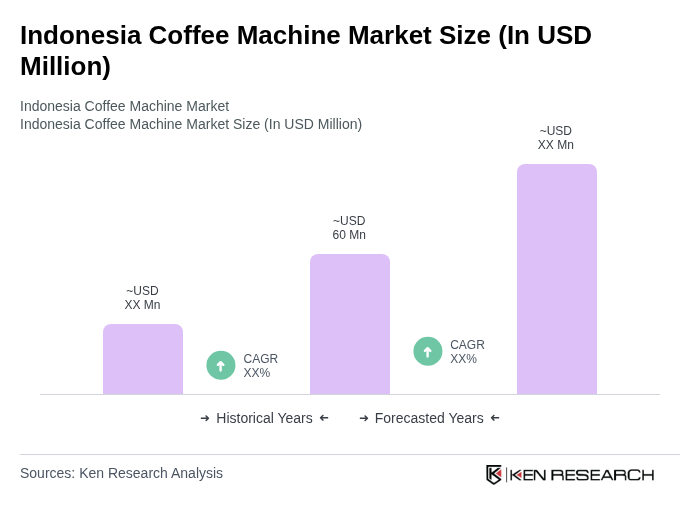
- The Indonesia Coffee Machine Market is valued at USD 60 million, based on a five-year historical analysis of household coffee machine revenues. This growth is primarily driven by the increasing coffee consumption culture, urbanization, and the rise of specialty and grab?and?go coffee shops, supported by Indonesia’s rapid rise in domestic coffee consumption to one of the world’s largest consumer markets. The growing trend of home brewing and the demand for high-quality coffee experiences have also significantly contributed to the market's expansion, as residential demand for coffee makers continues to increase alongside disposable incomes and exposure to café-style beverages.
- Key cities such as Jakarta, Bandung, and Surabaya dominate the market due to their high population density and vibrant coffee culture. Jakarta, being the capital, serves as a hub for coffee enthusiasts and businesses, while Bandung is known for its café culture and co-working cafés that attract both locals and tourists. Surabaya's growing middle class and the expansion of modern retail and “coffee-to-go” concepts further fuel the demand for coffee machines in both residential and commercial segments.
- In 2023, the Indonesian government implemented regulations to promote the local coffee industry, including incentives for coffee-related equipment and machinery producers through national industry development and downstreaming policies. Key measures are framed under instruments such as the National Industrial Development Master Plan (Rencana Induk Pembangunan Industri Nasional/RIPIN) issued by the Ministry of Industry and the Job Creation Law (Undang-Undang Cipta Kerja) and its implementing Government Regulations, which encourage value addition, local sourcing, investment incentives, and import-duty facilities for machinery used in agro?processing and beverage industries, thereby supporting coffee machine manufacturers that localize components and source materials domestically.
Indonesia Coffee Machine Market Segmentation
By Machine Type:The coffee machine market can be segmented into various types, including Drip Coffee Makers, Espresso Machines (Semi & Fully Automatic), Capsule/Pod Coffee Machines, Bean-to-Cup Machines, Filter/Manual Machines (including French Press and Pour-over), and Others. Each type caters to different consumer preferences and usage scenarios, influencing market dynamics, with espresso and capsule systems increasingly preferred in urban households and commercial outlets due to convenience and consistency.
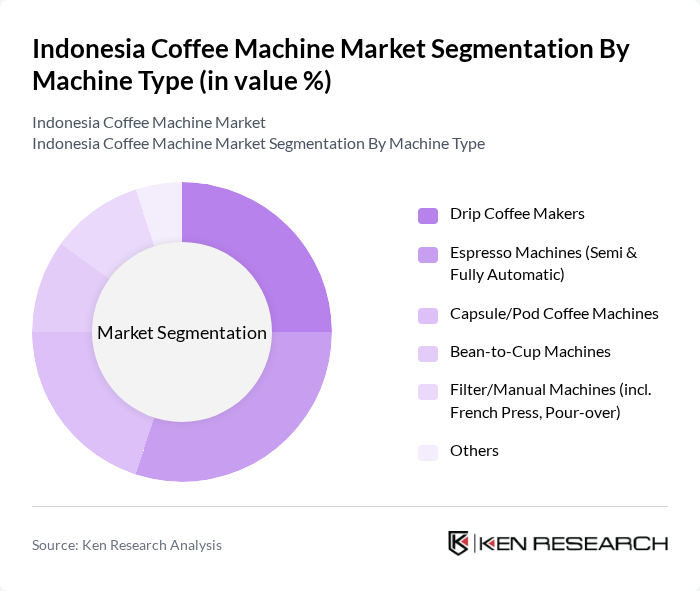
The Espresso Machines segment is currently dominating the market due to the increasing popularity of espresso-based beverages among consumers and the rapid proliferation of specialty coffee chains and local brands offering espresso drinks. This trend is driven by the growing café culture and the desire for high-quality coffee experiences at home. Consumers are increasingly investing in semi and fully automatic machines that offer convenience and quality, and in some cases integrated grinders, leading to a significant rise in sales within this sub-segment, particularly in middle- to upper-income urban households.
By End-User:The market can be segmented based on end-users, including Residential, Cafés and Coffee Shops, Restaurants & HoReCa, Offices & Corporate, and Others (such as Hotels and Co-working spaces). Each segment reflects different consumer needs and purchasing behaviors, impacting the overall market landscape, with commercial users focusing on durability and throughput and residential buyers emphasizing ease of use and price–performance.
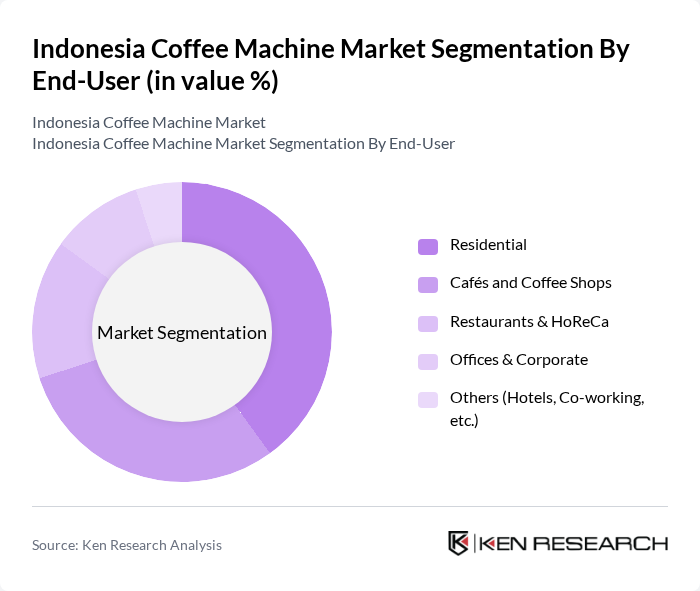
The Residential segment leads the market, driven by the increasing trend of home brewing and the growing coffee culture among Indonesian consumers, as domestic coffee consumption continues to rise strongly. As more people seek to replicate café-quality coffee at home, the demand for coffee machines in residential settings has surged. This shift in consumer behavior is further supported by the availability of various affordable and high-quality coffee machines through e?commerce platforms, modern retail, and electronics chains, making both entry-level drip makers and compact espresso or capsule systems more accessible across key cities.
Indonesia Coffee Machine Market Competitive Landscape
The Indonesia Coffee Machine Market is characterized by a dynamic mix of regional and international players. Leading participants such as Philips Indonesia, Breville, De'Longhi, Nespresso, Krups, Tefal, Smeg, Caffitaly, Gaggia, Rancilio, Hario, Bialetti (Moka Pot Systems), Cuisinart, Hamilton Beach, Local & Regional Brands (e.g., Oxone, Kris, Maspion) contribute to innovation, geographic expansion, and service delivery in this space.
Indonesia Coffee Machine Market Industry Analysis
Growth Drivers
- Increasing Coffee Consumption:Indonesia's coffee consumption reached approximately 3.3 million 60-kilogram bags in future, reflecting a steady annual growth rate of 5%. This surge is driven by a cultural shift towards coffee appreciation, particularly among younger consumers. The World Bank projects that the country's GDP will grow by 5.2% in future, further boosting disposable income and enabling more consumers to invest in coffee machines for home brewing.
- Rise of Specialty Coffee Shops:The number of specialty coffee shops in Indonesia has increased by 15% annually, with over 5,750 establishments reported in future. This trend is fostering a greater demand for high-quality coffee machines, as these shops seek to enhance their offerings. The growing urban population, projected to reach 57% in future, is expected to further drive this trend, as urban dwellers increasingly favor premium coffee experiences.
- Technological Advancements in Coffee Machines:The coffee machine sector is witnessing rapid technological innovations, with smart coffee machines sales increasing by 22% in future. Features such as app connectivity and automated brewing processes are appealing to tech-savvy consumers. As the Indonesian market embraces digital solutions, the demand for advanced coffee machines is expected to rise, supported by a projected increase in internet penetration to 78% in future.
Market Challenges
- High Import Tariffs on Coffee Machines:Indonesia imposes import tariffs of up to 20% on coffee machines, significantly impacting pricing and accessibility. This barrier limits the entry of international brands and raises costs for consumers. The government’s focus on local manufacturing may alleviate some pressure, but current tariffs hinder market growth, especially as the demand for premium machines continues to rise.
- Limited Local Manufacturing:Local production of coffee machines in Indonesia is minimal, with only 12% of the market being locally manufactured. This reliance on imports not only increases costs but also affects supply chain stability. The lack of investment in local manufacturing capabilities restricts the market's ability to meet growing consumer demand, particularly for innovative and high-quality coffee machines.
Indonesia Coffee Machine Market Future Outlook
The Indonesia coffee machine market is poised for significant growth, driven by increasing consumer interest in home brewing and specialty coffee experiences. As urbanization continues, more consumers are likely to invest in coffee machines that offer convenience and quality. Additionally, the rise of e-commerce platforms will facilitate easier access to a variety of coffee machines, enhancing market penetration. Innovations in eco-friendly designs will also attract environmentally conscious consumers, further shaping the market landscape.
Market Opportunities
- Expansion of E-commerce Platforms:The growth of e-commerce in Indonesia, projected to reach USD 55 billion in future, presents a significant opportunity for coffee machine sales. Online platforms enable consumers to access a wider range of products, enhancing market reach and convenience. This shift is expected to drive sales, particularly among younger, tech-savvy consumers who prefer online shopping.
- Increasing Demand for Home Brewing Solutions:With a growing trend towards home brewing, the demand for compact and user-friendly coffee machines is on the rise. In future, sales of home brewing machines increased by 32%, indicating a shift in consumer preferences. This trend is expected to continue, as more individuals seek quality coffee experiences at home, creating a lucrative market segment for manufacturers.
Scope of the Report
| Segment | Sub-Segments |
|---|---|
| By Machine Type | Drip Coffee Makers Espresso Machines (Semi & Fully Automatic) Capsule/Pod Coffee Machines Bean-to-Cup Machines Filter/Manual Machines (incl. French Press, Pour-over) Others |
| By End-User | Residential Cafés and Coffee Shops Restaurants & HoReCa Offices & Corporate Others (Hotels, Co-working, etc.) |
| By Region | Greater Jakarta (Jabodetabek) Java (excl. Jabodetabek) Sumatra Bali & Nusa Tenggara Kalimantan, Sulawesi & Other Regions |
| By Application | Home Use Office & Institutional Use HoReCa (Cafés, Restaurants, Hotels) Self-service / Vending Others |
| By Price Range | Economy (< IDR 2 million) Mid-Range (IDR 2–7 million) Premium (IDR 7–15 million) Luxury (> IDR 15 million) Others |
| By Brand Origin | Local/Regional Brands Global Brands Emerging / Niche Brands Private Label & Store Brands |
| By Distribution Channel | Offline Retail (Modern Trade, Electronics Chains) Traditional Retail & Specialist Stores Online Marketplaces & E-commerce Direct & Institutional Sales |
Key Target Audience
Investors and Venture Capitalist Firms
Government and Regulatory Bodies (e.g., Ministry of Trade, Ministry of Agriculture)
Manufacturers and Producers
Distributors and Retailers
Hospitality Industry Stakeholders (e.g., Hotels, Cafés, Restaurants)
Technology Providers
Industry Associations (e.g., Indonesian Coffee Exporters Association)
Financial Institutions
Players Mentioned in the Report:
Philips Indonesia
Breville
De'Longhi
Nespresso
Krups
Tefal
Smeg
Caffitaly
Gaggia
Rancilio
Hario
Bialetti (Moka Pot Systems)
Cuisinart
Hamilton Beach
Local & Regional Brands (e.g., Oxone, Kris, Maspion)
Table of Contents
Market Assessment Phase
1. Executive Summary and Approach
2. Indonesia Coffee Machine Market Overview
2.1 Key Insights and Strategic Recommendations
2.2 Indonesia Coffee Machine Market Overview
2.3 Definition and Scope
2.4 Evolution of Market Ecosystem
2.5 Timeline of Key Regulatory Milestones
2.6 Value Chain & Stakeholder Mapping
2.7 Business Cycle Analysis
2.8 Policy & Incentive Landscape
3. Indonesia Coffee Machine Market Analysis
3.1 Growth Drivers
3.1.1 Increasing Coffee Consumption
3.1.2 Rise of Specialty Coffee Shops
3.1.3 Technological Advancements in Coffee Machines
3.1.4 Growing Middle-Class Population
3.2 Market Challenges
3.2.1 High Import Tariffs on Coffee Machines
3.2.2 Limited Local Manufacturing
3.2.3 Competition from Traditional Brewing Methods
3.2.4 Fluctuating Coffee Bean Prices
3.3 Market Opportunities
3.3.1 Expansion of E-commerce Platforms
3.3.2 Increasing Demand for Home Brewing Solutions
3.3.3 Collaborations with Coffee Producers
3.3.4 Eco-friendly Coffee Machine Innovations
3.4 Market Trends
3.4.1 Growth of Smart Coffee Machines
3.4.2 Rise in Subscription Services for Coffee
3.4.3 Focus on Sustainability and Ethical Sourcing
3.4.4 Customization and Personalization in Coffee Machines
3.5 Government Regulation
3.5.1 Standards for Electrical Appliances
3.5.2 Import Regulations for Coffee Machines
3.5.3 Environmental Regulations on Manufacturing
3.5.4 Consumer Protection Laws
4. SWOT Analysis
5. Stakeholder Analysis
6. Porter's Five Forces Analysis
7. Indonesia Coffee Machine Market Market Size, 2019-2024
7.1 By Value
7.2 By Volume
7.3 By Average Selling Price
8. Indonesia Coffee Machine Market Segmentation
8.1 By Machine Type
8.1.1 Drip Coffee Makers
8.1.2 Espresso Machines (Semi & Fully Automatic)
8.1.3 Capsule/Pod Coffee Machines
8.1.4 Bean-to-Cup Machines
8.1.5 Filter/Manual Machines (incl. French Press, Pour-over)
8.1.6 Others
8.2 By End-User
8.2.1 Residential
8.2.2 Cafés and Coffee Shops
8.2.3 Restaurants & HoReCa
8.2.4 Offices & Corporate
8.2.5 Others (Hotels, Co-working, etc.)
8.3 By Region
8.3.1 Greater Jakarta (Jabodetabek)
8.3.2 Java (excl. Jabodetabek)
8.3.3 Sumatra
8.3.4 Bali & Nusa Tenggara
8.3.5 Kalimantan, Sulawesi & Other Regions
8.4 By Application
8.4.1 Home Use
8.4.2 Office & Institutional Use
8.4.3 HoReCa (Cafés, Restaurants, Hotels)
8.4.4 Self-service / Vending
8.4.5 Others
8.5 By Price Range
8.5.1 Economy (< IDR 2 million)
8.5.2 Mid-Range (IDR 2–7 million)
8.5.3 Premium (IDR 7–15 million)
8.5.4 Luxury (> IDR 15 million)
8.5.5 Others
8.6 By Brand Origin
8.6.1 Local/Regional Brands
8.6.2 Global Brands
8.6.3 Emerging / Niche Brands
8.6.4 Private Label & Store Brands
8.7 By Distribution Channel
8.7.1 Offline Retail (Modern Trade, Electronics Chains)
8.7.2 Traditional Retail & Specialist Stores
8.7.3 Online Marketplaces & E-commerce
8.7.4 Direct & Institutional Sales
9. Indonesia Coffee Machine Market Competitive Analysis
9.1 Market Share of Key Players
9.2 Cross Comparison of Key Players
9.2.1 Company Name
9.2.2 Group Size (Large, Medium, or Small as per industry convention)
9.2.3 Indonesia Coffee Machine Revenue (Latest FY)
9.2.4 3-Year Revenue CAGR in Indonesia
9.2.5 Installed Base / Units in Operation
9.2.6 Market Penetration in Key Cities (Outlet / Store Reach)
9.2.7 Average Selling Price Band Positioning
9.2.8 Product Portfolio Breadth (Models / Formats)
9.2.9 R&D and New Product Introduction Frequency
9.2.10 Share of Sales via Online Channels
9.2.11 Service Network Coverage (Cities / Service Points)
9.2.12 Brand Awareness / Preference Index
9.3 SWOT Analysis of Top Players
9.4 Pricing Analysis
9.5 Detailed Profile of Major Companies
9.5.1 Philips Indonesia
9.5.2 Breville
9.5.3 De'Longhi
9.5.4 Nespresso
9.5.5 Krups
9.5.6 Tefal
9.5.7 Smeg
9.5.8 Caffitaly
9.5.9 Gaggia
9.5.10 Rancilio
9.5.11 Hario
9.5.12 Bialetti (Moka Pot Systems)
9.5.13 Cuisinart
9.5.14 Hamilton Beach
9.5.15 Local & Regional Brands (e.g., Oxone, Kris, Maspion)
10. Indonesia Coffee Machine Market End-User Analysis
10.1 Procurement Behavior of Key Ministries
10.1.1 Budget Allocation for Coffee Machines
10.1.2 Decision-Making Process
10.1.3 Supplier Selection Criteria
10.1.4 Contracting Procedures
10.2 Corporate Spend on Infrastructure & Energy
10.2.1 Investment in Coffee Equipment
10.2.2 Budgeting for Maintenance
10.2.3 Energy Efficiency Considerations
10.2.4 Long-term Contracts with Suppliers
10.3 Pain Point Analysis by End-User Category
10.3.1 Quality Consistency
10.3.2 Equipment Reliability
10.3.3 Service and Support Availability
10.3.4 Cost of Ownership
10.4 User Readiness for Adoption
10.4.1 Awareness of New Technologies
10.4.2 Training and Support Needs
10.4.3 Financial Readiness
10.4.4 Cultural Acceptance of Coffee Machines
10.5 Post-Deployment ROI and Use Case Expansion
10.5.1 Measurement of ROI
10.5.2 Use Case Scenarios
10.5.3 Customer Feedback Mechanisms
10.5.4 Future Expansion Plans
11. Indonesia Coffee Machine Market Future Size, 2025-2030
11.1 By Value
11.2 By Volume
11.3 By Average Selling Price
Go-To-Market Strategy Phase
1. Whitespace Analysis + Business Model Canvas
1.1 Market Gaps Identification
1.2 Business Model Development
2. Marketing and Positioning Recommendations
2.1 Branding Strategies
2.2 Product USPs
3. Distribution Plan
3.1 Urban Retail vs Rural NGO Tie-ups
4. Channel & Pricing Gaps
4.1 Underserved Routes
4.2 Pricing Bands
5. Unmet Demand & Latent Needs
5.1 Category Gaps
5.2 Consumer Segments
6. Customer Relationship
6.1 Loyalty Programs
6.2 After-sales Service
7. Value Proposition
7.1 Sustainability
7.2 Integrated Supply Chains
8. Key Activities
8.1 Regulatory Compliance
8.2 Branding
8.3 Distribution Setup
9. Entry Strategy Evaluation
9.1 Domestic Market Entry Strategy
9.1.1 Product Mix
9.1.2 Pricing Band
9.1.3 Packaging
9.2 Export Entry Strategy
9.2.1 Target Countries
9.2.2 Compliance Roadmap
10. Entry Mode Assessment
10.1 JV
10.2 Greenfield
10.3 M&A
10.4 Distributor Model
11. Capital and Timeline Estimation
11.1 Capital Requirements
11.2 Timelines
12. Control vs Risk Trade-Off
12.1 Ownership vs Partnerships
13. Profitability Outlook
13.1 Breakeven Analysis
13.2 Long-term Sustainability
14. Potential Partner List
14.1 Distributors
14.2 JVs
14.3 Acquisition Targets
15. Execution Roadmap
15.1 Phased Plan for Market Entry
15.1.1 Market Setup
15.1.2 Market Entry
15.1.3 Growth Acceleration
15.1.4 Scale & Stabilize
15.2 Key Activities and Milestones
15.2.1 Milestone Planning
15.2.2 Activity Tracking
Research Methodology
Phase 1: Approach1
Desk Research
- Analysis of industry reports from Indonesian coffee associations and trade bodies
- Review of market trends and consumer behavior studies published by local research firms
- Examination of government publications on coffee production and export statistics
Primary Research
- Interviews with key stakeholders in the coffee machine supply chain, including manufacturers and distributors
- Surveys conducted with coffee shop owners and baristas to understand usage patterns and preferences
- Field visits to coffee machine retailers to gather insights on customer interactions and sales strategies
Validation & Triangulation
- Cross-validation of findings through comparison with international coffee machine market data
- Triangulation of insights from primary interviews with secondary data sources
- Sanity checks through expert panel discussions with industry veterans and market analysts
Phase 2: Market Size Estimation1
Top-down Assessment
- Estimation of market size based on national coffee consumption statistics and growth rates
- Segmentation of the market by coffee machine types, including espresso machines, drip coffee makers, and grinders
- Incorporation of trends in coffee culture and café proliferation across urban areas
Bottom-up Modeling
- Collection of sales data from leading coffee machine retailers and distributors in Indonesia
- Estimation of average selling prices and volume sold across different machine categories
- Analysis of import/export data to assess the impact of international brands on local market dynamics
Forecasting & Scenario Analysis
- Multi-factor regression analysis incorporating economic indicators, consumer spending, and coffee trends
- Scenario modeling based on potential shifts in consumer preferences and market disruptions
- Development of baseline, optimistic, and pessimistic forecasts through 2030
Phase 3: CATI Sample Composition1
| Scope Item/Segment | Sample Size | Target Respondent Profiles |
|---|---|---|
| Commercial Coffee Machine Users | 120 | Café Owners, Restaurant Managers |
| Home Coffee Machine Consumers | 100 | Home Baristas, Coffee Enthusiasts |
| Retail Coffee Machine Sellers | 80 | Store Managers, Sales Representatives |
| Importers of Coffee Machines | 60 | Import Managers, Procurement Officers |
| Industry Experts and Analysts | 40 | Market Analysts, Coffee Industry Consultants |
Frequently Asked Questions
What is the current value of the Indonesia Coffee Machine Market?
The Indonesia Coffee Machine Market is valued at approximately USD 60 million, driven by increasing coffee consumption, urbanization, and the rise of specialty coffee shops, reflecting a growing coffee culture in the country.
What factors are driving the growth of coffee machine sales in Indonesia?
Which cities are the main markets for coffee machines in Indonesia?
What types of coffee machines are popular in Indonesia?
Other Regional/Country Reports
Other Adjacent Reports
Thailand Coffee Bean Market
Japan Specialty Coffee Market
Global Small Kitchen Appliances Market Report Size Share Growth Drivers Trends Opportunities & Forecast 2025–2030South Korea Commercial Kitchen Equipment Market
Mexico Beverage Dispensing Equipment Market
Thailand Coffee Capsule Market
Thailand Coffee Grinder Market
Germany Major Home Appliance MarketAsia Pacific Food Processing Machinery Market Outlook to 2030: Size, Share, Growth and TrendsIndia Hot Beverage Market Outlook to 2030Why Buy From Us?

What makes us stand out is that our consultants follow Robust, Refine and Result (RRR) methodology. Robust for clear definitions, approaches and sanity checking, Refine for differentiating respondents' facts and opinions, and Result for presenting data with story.

We have set a benchmark in the industry by offering our clients with syndicated and customized market research reports featuring coverage of entire market as well as meticulous research and analyst insights.

While we don't replace traditional research, we flip the method upside down. Our dual approach of Top Bottom & Bottom Top ensures quality deliverable by not just verifying company fundamentals but also looking at the sector and macroeconomic factors.

With one step in the future, our research team constantly tries to show you the bigger picture. We help with some of the tough questions you may encounter along the way: How is the industry positioned? Best marketing channel? KPI's of competitors? By aligning every element, we help maximize success.

Our report gives you instant access to the answers and sources that other companies might choose to hide. We elaborate each steps of research methodology we have used and showcase you the sample size to earn your trust.

If you need any support, we are here! We pride ourselves on universe strength, data quality, and quick, friendly, and professional service.