About the Report
Base Year 2024Listen to the audio summary
Middle East Entertainment Furniture Market Overview
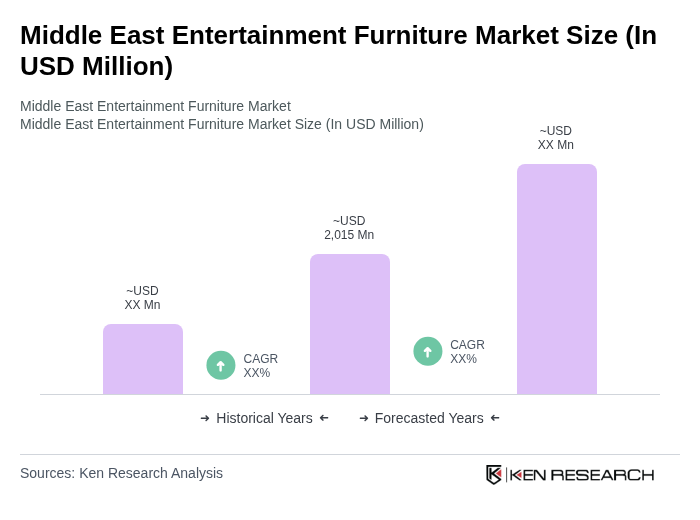
- The Middle East Entertainment Furniture Market is valued at USD 2,015 million, based on a five-year historical analysis. This growth is primarily driven by rising demand for leisure and home theatre setups, expanding hospitality and residential fit-outs, and increasing consumer preference for dedicated entertainment pieces amid enhanced digital lifestyles.
- Key players in this market include the UAE and Saudi Arabia, where rapid development of luxury residences and hospitality venues fuels uptake. Regional furniture manufacturers, contract fit-out specialists, and large-scale retail chains play key roles. Global brands such as Inter IKEA and Ashley Furniture are influential through strong distribution networks, while local fit-out suppliers support bespoke entertainment furniture demand.
- In 2024, the UAE's government announced a strategic initiative to promote sustainable practices in the furniture industry. This initiative includes incentives for manufacturers to adopt eco-friendly materials and processes, aligning with the country's broader sustainability goals and enhancing the market for entertainment furniture.
Middle East Entertainment Furniture Market Segmentation
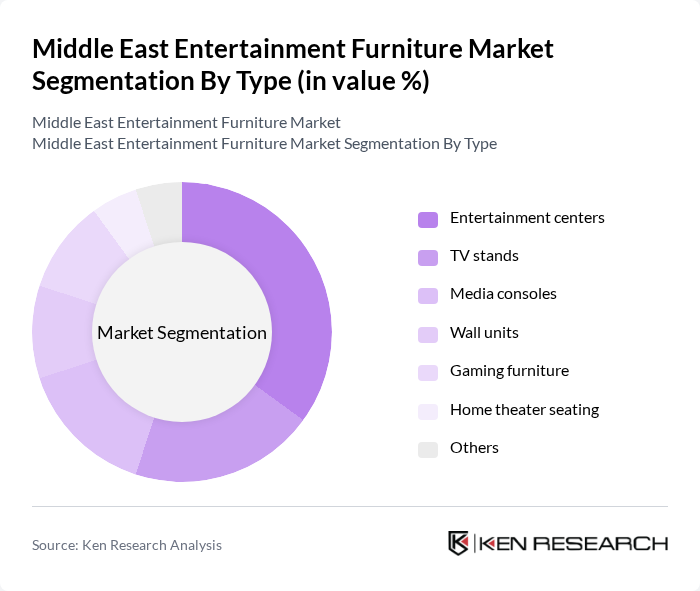
By Type:The entertainment furniture market is segmented into various types, including entertainment centers, TV stands, media consoles, wall units, gaming furniture, home theater seating, and others. Among these, entertainment centers are currently the most dominant segment, driven by the increasing trend of home entertainment systems and the desire for stylish, multifunctional furniture that enhances living spaces. Consumers are increasingly investing in comprehensive setups that combine aesthetics with functionality, leading to a surge in demand for entertainment centers.
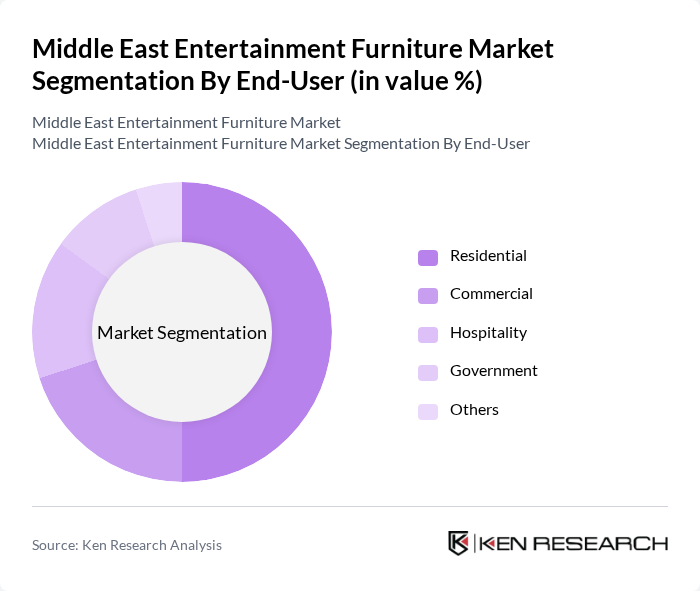
By End-User:The market is also segmented by end-user categories, including residential, commercial, hospitality, government, and others. The residential segment is the leading category, as more consumers are investing in home entertainment solutions due to the rise in remote work and home-based leisure activities. This trend has been further accelerated by the pandemic, leading to increased spending on home furnishings that enhance comfort and entertainment.
Middle East Entertainment Furniture Market Competitive Landscape
The Middle East Entertainment Furniture Market is characterized by a dynamic mix of regional and international players. Leading participants such as IKEA, Home Centre, Pan Emirates, The One, Danube Home, Landmark Group, Al-Futtaim Group, Royal Furniture, Muji, Habitat, Home Box, Aati Furniture, Mamas & Papas, KARE Design, Axiom Furniture contribute to innovation, geographic expansion, and service delivery in this space.
Middle East Entertainment Furniture Market Industry Analysis
Growth Drivers
- Strong Furniture Market Revenue in Middle East & Africa:The revenue for the Middle East and Africa furniture market reached USD 8,000 million in future. This substantial figure indicates a robust demand foundation across the region, with the Middle East contributing significantly. The growth is driven by increasing consumer spending and a shift towards home entertainment solutions, reflecting a broader trend in lifestyle changes and preferences. Source: Grand View Research.
- MEA Minimalist Furniture Segment – Beds Leading:The minimalist furniture market generated USD 4 billion in future, with beds being a leading product type. This reflects a significant consumer shift towards minimalist and functional designs, driven by urbanization and smaller living spaces. The demand for space-saving and aesthetically pleasing furniture is expected to continue growing, aligning with modern lifestyle trends. Source: Grand View Research.
- UAE Market Size and Real Estate-Driven Demand:The UAE furniture market was valued at USD 3.8 billion in future, supported by the construction of over 25,000 new homes. This real estate expansion directly fuels demand for entertainment and home furnishings, as new homeowners seek to furnish their living spaces. The ongoing development in the UAE's housing sector is a critical driver for the entertainment furniture market. Source: UAE furniture market overview.
Market Challenges
- High Import Dependency & Supply Chain Disruptions:Over 65% of furniture sold in the UAE and Saudi Arabia in 2023 was imported, making the market vulnerable to external trade disruptions. This dependency can lead to increased costs and shipping delays, particularly affecting supply chains through critical routes like the Red Sea. Such challenges can hinder market growth and affect pricing strategies. Source: Oxford Business Group.
- Economic Volatility and Reduced Consumer Spending:Inflation in Egypt exceeded 32% in 2023, significantly impacting consumer purchasing power. In oil-dependent or inflation-prone economies, reduced discretionary spending on furniture is a major challenge. Economic instability can lead to decreased demand for entertainment furniture, as consumers prioritize essential expenditures over luxury items. Source: IMF data.
Middle East Entertainment Furniture Market Future Outlook
The Middle East entertainment furniture market is expected to undergo significant transformation driven by trends such as the adoption of smart furniture and a growing emphasis on sustainability. With over 45% of new residential developments in the UAE incorporating eco-friendly materials, the demand for sustainable furniture solutions is likely to rise. Additionally, mega-projects in hospitality and entertainment sectors will create opportunities for customized furniture, further shaping the market landscape in the coming years.
Market Opportunities
- Smart & Sustainable Furniture Solutions:With over 45% of new residential developments in the UAE featuring sustainability elements, there is a growing market for eco-friendly and tech-infused furniture. This aligns with consumer preferences for low-emission and recycled content materials, presenting a significant opportunity for manufacturers to innovate and capture market share. Source: UAE Ministry of Climate Change and Environment.
- Commercial and Hospitality Interior Fit-Out Demand:Saudi Arabia's plan to open over 250 new luxury hotels by 2030 presents a massive opportunity for customized entertainment and hospitality furniture. This demand for high-quality, tailored solutions in large-scale infrastructure projects can significantly boost the market for entertainment furniture in the region. Source: Saudi Commission for Hotels and Restaurants.
Scope of the Report
| Segment | Sub-Segments |
|---|---|
| By Type | Entertainment centers TV stands Media consoles Wall units Gaming furniture Home theater seating Others |
| By End-User | Residential Commercial Hospitality Government Others |
| By Material | Wood Metal Glass Upholstered Others |
| By Distribution Channel | Online retail Offline retail Direct sales Others |
| By Price Range | Budget Mid-range Premium Others |
| By Design Style | Modern Traditional Contemporary Rustic Others |
| By Functionality | Fixed furniture Modular furniture Multi-functional furniture Others |
Key Target Audience
Investors and Venture Capitalist Firms
Government and Regulatory Bodies (e.g., Ministry of Culture and Knowledge Development, Saudi Arabian General Investment Authority)
Manufacturers and Producers
Distributors and Retailers
Event Organizers and Venue Operators
Interior Designers and Architects
Hospitality Industry Stakeholders
Real Estate Developers
Players Mentioned in the Report:
IKEA
Home Centre
Pan Emirates
The One
Danube Home
Landmark Group
Al-Futtaim Group
Royal Furniture
Muji
Habitat
Home Box
Aati Furniture
Mamas & Papas
KARE Design
Axiom Furniture
Table of Contents
Market Assessment Phase
1. Executive Summary and Approach
2. Middle East Entertainment Furniture Market Overview
2.1 Key Insights and Strategic Recommendations
2.2 Middle East Entertainment Furniture Market Overview
2.3 Definition and Scope
2.4 Evolution of Market Ecosystem
2.5 Timeline of Key Regulatory Milestones
2.6 Value Chain & Stakeholder Mapping
2.7 Business Cycle Analysis
2.8 Policy & Incentive Landscape
3. Middle East Entertainment Furniture Market Analysis
3.1 Growth Drivers
3.1.1 Increasing disposable income
3.1.2 Rising demand for home entertainment solutions
3.1.3 Growth in the real estate sector
3.1.4 Technological advancements in furniture design
3.2 Market Challenges
3.2.1 High competition among local and international brands
3.2.2 Fluctuating raw material prices
3.2.3 Changing consumer preferences
3.2.4 Economic instability in certain regions
3.3 Market Opportunities
3.3.1 Expansion of e-commerce platforms
3.3.2 Increasing popularity of smart furniture
3.3.3 Collaborations with interior designers
3.3.4 Growth in tourism and hospitality sectors
3.4 Market Trends
3.4.1 Sustainable and eco-friendly furniture options
3.4.2 Customization and personalization of products
3.4.3 Integration of technology in furniture
3.4.4 Rise of multi-functional furniture
3.5 Government Regulation
3.5.1 Standards for safety and quality
3.5.2 Import tariffs and trade regulations
3.5.3 Environmental regulations on materials
3.5.4 Incentives for local manufacturing
4. SWOT Analysis
5. Stakeholder Analysis
6. Porter's Five Forces Analysis
7. Middle East Entertainment Furniture Market Market Size, 2019-2024
7.1 By Value
7.2 By Volume
7.3 By Average Selling Price
8. Middle East Entertainment Furniture Market Segmentation
8.1 By Type
8.1.1 Entertainment centers
8.1.2 TV stands
8.1.3 Media consoles
8.1.4 Wall units
8.1.5 Gaming furniture
8.1.6 Home theater seating
8.1.7 Others
8.2 By End-User
8.2.1 Residential
8.2.2 Commercial
8.2.3 Hospitality
8.2.4 Government
8.2.5 Others
8.3 By Material
8.3.1 Wood
8.3.2 Metal
8.3.3 Glass
8.3.4 Upholstered
8.3.5 Others
8.4 By Distribution Channel
8.4.1 Online retail
8.4.2 Offline retail
8.4.3 Direct sales
8.4.4 Others
8.5 By Price Range
8.5.1 Budget
8.5.2 Mid-range
8.5.3 Premium
8.5.4 Others
8.6 By Design Style
8.6.1 Modern
8.6.2 Traditional
8.6.3 Contemporary
8.6.4 Rustic
8.6.5 Others
8.7 By Functionality
8.7.1 Fixed furniture
8.7.2 Modular furniture
8.7.3 Multi-functional furniture
8.7.4 Others
9. Middle East Entertainment Furniture Market Competitive Analysis
9.1 Market Share of Key Players
9.2 Cross Comparison of Key Players
9.2.1 Company Name
9.2.2 Group Size (Large, Medium, or Small as per industry convention)
9.2.3 Revenue Growth Rate
9.2.4 Market Penetration Rate
9.2.5 Customer Retention Rate
9.2.6 Pricing Strategy
9.2.7 Product Innovation Rate
9.2.8 Distribution Efficiency
9.2.9 Brand Recognition Score
9.2.10 Customer Satisfaction Index
9.3 SWOT Analysis of Top Players
9.4 Pricing Analysis
9.5 Detailed Profile of Major Companies
9.5.1 IKEA
9.5.2 Home Centre
9.5.3 Pan Emirates
9.5.4 The One
9.5.5 Danube Home
9.5.6 Landmark Group
9.5.7 Al-Futtaim Group
9.5.8 Royal Furniture
9.5.9 Muji
9.5.10 Habitat
9.5.11 Home Box
9.5.12 Aati Furniture
9.5.13 Mamas & Papas
9.5.14 KARE Design
9.5.15 Axiom Furniture
10. Middle East Entertainment Furniture Market End-User Analysis
10.1 Procurement Behavior of Key Ministries
10.1.1 Budget allocation trends
10.1.2 Preferred suppliers
10.1.3 Procurement cycles
10.1.4 Compliance requirements
10.2 Corporate Spend on Infrastructure & Energy
10.2.1 Investment trends
10.2.2 Key projects
10.2.3 Budget priorities
10.2.4 Spending forecasts
10.3 Pain Point Analysis by End-User Category
10.3.1 Residential challenges
10.3.2 Commercial challenges
10.3.3 Hospitality challenges
10.3.4 Government challenges
10.4 User Readiness for Adoption
10.4.1 Awareness levels
10.4.2 Adoption barriers
10.4.3 Training needs
10.4.4 Support requirements
10.5 Post-Deployment ROI and Use Case Expansion
10.5.1 ROI measurement methods
10.5.2 Use case success stories
10.5.3 Future expansion plans
10.5.4 Feedback mechanisms
11. Middle East Entertainment Furniture Market Future Size, 2025-2030
11.1 By Value
11.2 By Volume
11.3 By Average Selling Price
Go-To-Market Strategy Phase
1. Whitespace Analysis + Business Model Canvas
1.1 Market gaps identification
1.2 Business model components
2. Marketing and Positioning Recommendations
2.1 Branding strategies
2.2 Product USPs
3. Distribution Plan
3.1 Urban retail vs rural NGO tie-ups
4. Channel & Pricing Gaps
4.1 Underserved routes
4.2 Pricing bands
5. Unmet Demand & Latent Needs
5.1 Category gaps
5.2 Consumer segments
6. Customer Relationship
6.1 Loyalty programs
6.2 After-sales service
7. Value Proposition
7.1 Sustainability
7.2 Integrated supply chains
8. Key Activities
8.1 Regulatory compliance
8.2 Branding
8.3 Distribution setup
9. Entry Strategy Evaluation
9.1 Domestic Market Entry Strategy
9.1.1 Product mix
9.1.2 Pricing band
9.1.3 Packaging
9.2 Export Entry Strategy
9.2.1 Target countries
9.2.2 Compliance roadmap
10. Entry Mode Assessment
10.1 JV
10.2 Greenfield
10.3 M&A
10.4 Distributor Model
11. Capital and Timeline Estimation
11.1 Capital requirements
11.2 Timelines
12. Control vs Risk Trade-Off
12.1 Ownership vs Partnerships
13. Profitability Outlook
13.1 Breakeven analysis
13.2 Long-term sustainability
14. Potential Partner List
14.1 Distributors
14.2 JVs
14.3 Acquisition targets
15. Execution Roadmap
15.1 Phased Plan for Market Entry
15.1.1 Market Setup
15.1.2 Market Entry
15.1.3 Growth Acceleration
15.1.4 Scale & Stabilize
15.2 Key Activities and Milestones
15.2.1 Milestone tracking
15.2.2 Activity scheduling
Research Methodology
Phase 1: Approach1
Desk Research
- Market reports from industry associations and trade publications focused on the Middle East furniture sector
- Analysis of consumer behavior trends through online surveys and social media sentiment analysis
- Government publications and economic reports detailing the growth of the entertainment sector in the region
Primary Research
- Interviews with key stakeholders including furniture manufacturers and retailers specializing in entertainment furniture
- Focus group discussions with consumers to understand preferences and purchasing behavior
- Surveys targeting interior designers and architects to gauge trends in entertainment furniture design
Validation & Triangulation
- Cross-validation of findings through multiple data sources including sales data and consumer feedback
- Triangulation of insights from primary interviews with secondary data trends
- Sanity checks conducted through expert panel reviews comprising industry veterans and market analysts
Phase 2: Market Size Estimation1
Top-down Assessment
- Estimation of market size based on overall furniture market growth rates and segment-specific trends
- Analysis of demographic data to identify target consumer segments for entertainment furniture
- Incorporation of regional economic indicators and consumer spending patterns on home entertainment
Bottom-up Modeling
- Collection of sales data from leading entertainment furniture retailers across the Middle East
- Estimation of average selling prices and volume sold for various product categories
- Analysis of distribution channels and their impact on market penetration and growth
Forecasting & Scenario Analysis
- Multi-factor regression analysis incorporating variables such as population growth, urbanization, and disposable income
- Scenario modeling based on potential economic shifts and consumer trends in home entertainment
- Development of baseline, optimistic, and pessimistic forecasts through 2030
Phase 3: CATI Sample Composition1
| Scope Item/Segment | Sample Size | Target Respondent Profiles |
|---|---|---|
| Residential Entertainment Furniture Purchases | 150 | Homeowners, Interior Designers |
| Commercial Entertainment Furniture Solutions | 100 | Business Owners, Facility Managers |
| Consumer Preferences in Furniture Design | 80 | Design Enthusiasts, Trend Analysts |
| Market Trends in Online Furniture Sales | 120 | E-commerce Managers, Digital Marketing Specialists |
| Impact of COVID-19 on Furniture Buying Behavior | 90 | Consumers, Market Researchers |
Frequently Asked Questions
What is the current value of the Middle East Entertainment Furniture Market?
The Middle East Entertainment Furniture Market is valued at approximately USD 2,015 million, reflecting a significant growth driven by increasing demand for leisure and home theatre setups, as well as consumer preferences for dedicated entertainment furniture.
Which countries are the key players in the Middle East Entertainment Furniture Market?
What types of entertainment furniture are most popular in the Middle East?
How is the Middle East Entertainment Furniture Market segmented by end-user?
Other Regional/Country Reports
Indonesia Entertainment Furniture Market
Malaysia Entertainment Furniture Market
KSA Entertainment Furniture Market
APAC Entertainment Furniture Market
SEA Entertainment Furniture Market
Vietnam Entertainment Furniture Market
Other Adjacent Reports
Singapore Hospitality Furniture Market
Malaysia Commercial Furniture Market
Vietnam Sustainable Furniture Market
Vietnam smart furniture market report Size, Share, Growth Drivers, Trends, Opportunities & Forecast 2025–2030KSA Gaming Furniture Market
Global luxury furniture market Size, Share, Growth Drivers, Trends, Opportunities & Forecast 2025–2030Middle East Contract Furniture Market Report Size Share Growth Drivers Trends Opportunities & Forecast 2025–2030UAE Interior Fit-Out Market Size, Share & Forecast, By Service Type, End-Use Industry & Delivery Model, 2026–2031KSA minimalist furniture market report size, share, growth drivers, trends, opportunities & forecast 2025–2030Why Buy From Us?

What makes us stand out is that our consultants follow Robust, Refine and Result (RRR) methodology. Robust for clear definitions, approaches and sanity checking, Refine for differentiating respondents' facts and opinions, and Result for presenting data with story.

We have set a benchmark in the industry by offering our clients with syndicated and customized market research reports featuring coverage of entire market as well as meticulous research and analyst insights.

While we don't replace traditional research, we flip the method upside down. Our dual approach of Top Bottom & Bottom Top ensures quality deliverable by not just verifying company fundamentals but also looking at the sector and macroeconomic factors.

With one step in the future, our research team constantly tries to show you the bigger picture. We help with some of the tough questions you may encounter along the way: How is the industry positioned? Best marketing channel? KPI's of competitors? By aligning every element, we help maximize success.

Our report gives you instant access to the answers and sources that other companies might choose to hide. We elaborate each steps of research methodology we have used and showcase you the sample size to earn your trust.

If you need any support, we are here! We pride ourselves on universe strength, data quality, and quick, friendly, and professional service.