Region:Middle East
Author(s):Shubham
Product Code:KRAD1871
Pages:86
Published On:December 2025
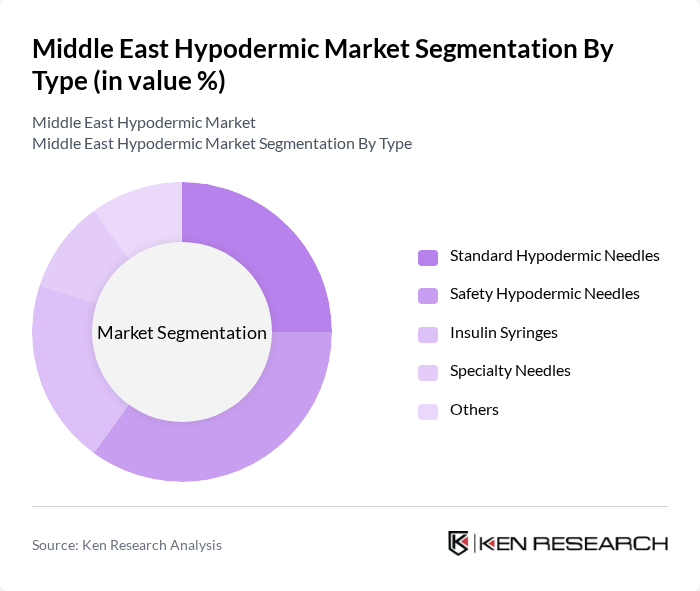
By Type:The hypodermic market is segmented into various types, including Standard Hypodermic Needles, Safety Hypodermic Needles, Insulin Syringes, Specialty Needles, and Others. Among these, Safety Hypodermic Needles are gaining traction due to their ability to reduce needlestick injuries, which is a significant concern in healthcare settings. The increasing focus on patient safety and regulatory requirements is driving the demand for safety-engineered products, making them the leading subsegment in the market.
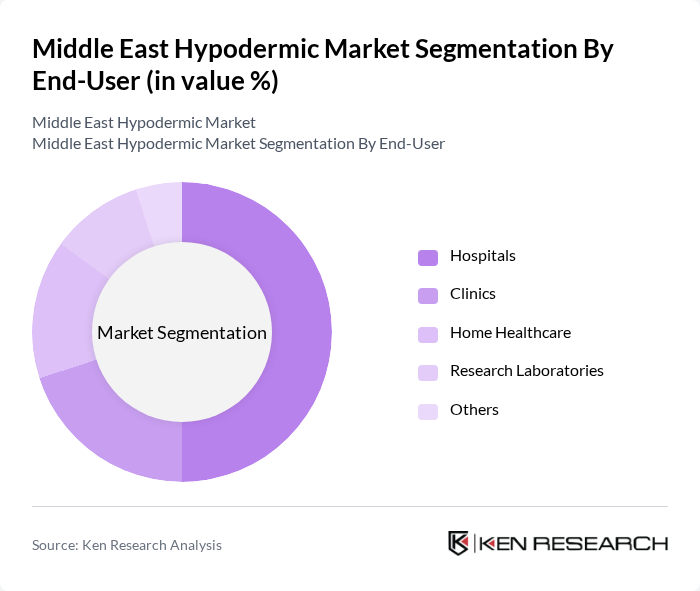
By End-User:The end-user segmentation includes Hospitals, Clinics, Home Healthcare, Research Laboratories, and Others. Hospitals are the dominant end-user segment, driven by the high volume of procedures requiring injections and the increasing number of patients with chronic diseases. The demand for efficient and safe injection practices in hospitals is propelling the growth of this segment, making it the largest contributor to the market.
The Middle East Hypodermic Market is characterized by a dynamic mix of regional and international players. Leading participants such as Becton, Dickinson and Company, Terumo Corporation, Smiths Medical, Nipro Corporation, Medtronic, Covidien (Medtronic), Fresenius Kabi, Abbott Laboratories, Gerresheimer AG, HMD (Hindustan Syringes and Medical Devices), Amsino International, Unilife Corporation, B. Braun Melsungen AG, Medline Industries, Inc., Halyard Health contribute to innovation, geographic expansion, and service delivery in this space.
The Middle East hypodermic market is poised for significant growth, driven by the increasing adoption of prefilled syringes, projected to rise fromUSD 165.2 milliontoUSD 353.7 million. Additionally, the overall MENA syringes and cannula market is expected to expand fromUSD 1.72 billiontoUSD 3.17 billion, indicating a robust long-term growth trajectory supported by healthcare modernization and rising demand for disposable products.
| Segment | Sub-Segments |
|---|---|
| By Type | Standard Hypodermic Needles Safety Hypodermic Needles Insulin Syringes Specialty Needles Others |
| By End-User | Hospitals Clinics Home Healthcare Research Laboratories Others |
| By Application | Vaccination Drug Delivery Blood Sampling Others |
| By Material | Stainless Steel Plastic Glass Others |
| By Distribution Channel | Direct Sales Online Retail Distributors Others |
| By Region | GCC Countries Levant Region North Africa Others |
| By Product Lifecycle Stage | Introduction Stage Growth Stage Maturity Stage Decline Stage Others |
| Scope Item/Segment | Sample Size | Target Respondent Profiles |
|---|---|---|
| Hospital Procurement Departments | 100 | Procurement Managers, Supply Chain Coordinators |
| Clinics and Outpatient Facilities | 80 | Clinic Managers, Nursing Supervisors |
| Pharmaceutical Distributors | 70 | Sales Representatives, Distribution Managers |
| Manufacturers of Hypodermic Products | 60 | Product Development Managers, Quality Assurance Officers |
| Regulatory Bodies and Health Authorities | 50 | Regulatory Affairs Specialists, Policy Makers |
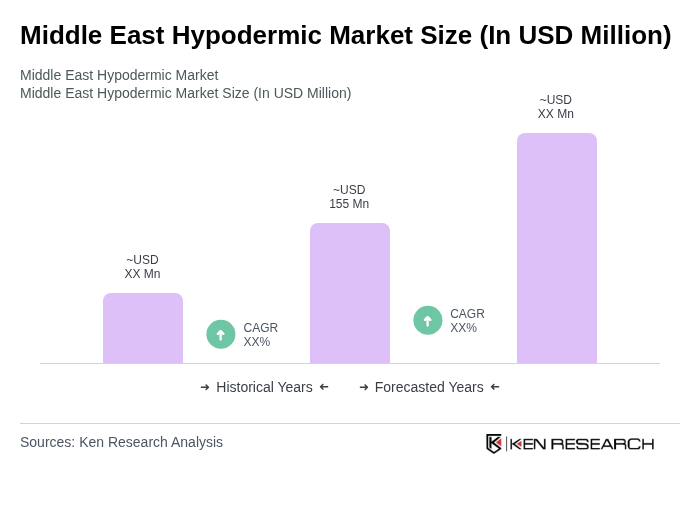
The Middle East Hypodermic Market is valued at approximately USD 155 million, driven by the rising prevalence of chronic diseases and the demand for safe, user-friendly injectable devices, alongside advancements in healthcare infrastructure.

What makes us stand out is that our consultants follow Robust, Refine and Result (RRR) methodology. Robust for clear definitions, approaches and sanity checking, Refine for differentiating respondents' facts and opinions, and Result for presenting data with story.

We have set a benchmark in the industry by offering our clients with syndicated and customized market research reports featuring coverage of entire market as well as meticulous research and analyst insights.

While we don't replace traditional research, we flip the method upside down. Our dual approach of Top Bottom & Bottom Top ensures quality deliverable by not just verifying company fundamentals but also looking at the sector and macroeconomic factors.

With one step in the future, our research team constantly tries to show you the bigger picture. We help with some of the tough questions you may encounter along the way: How is the industry positioned? Best marketing channel? KPI's of competitors? By aligning every element, we help maximize success.

Our report gives you instant access to the answers and sources that other companies might choose to hide. We elaborate each steps of research methodology we have used and showcase you the sample size to earn your trust.

If you need any support, we are here! We pride ourselves on universe strength, data quality, and quick, friendly, and professional service.













