Middle East Intent Based Networking Market Report Size Share Growth Drivers Trends Opportunities & Forecast 2025–2030

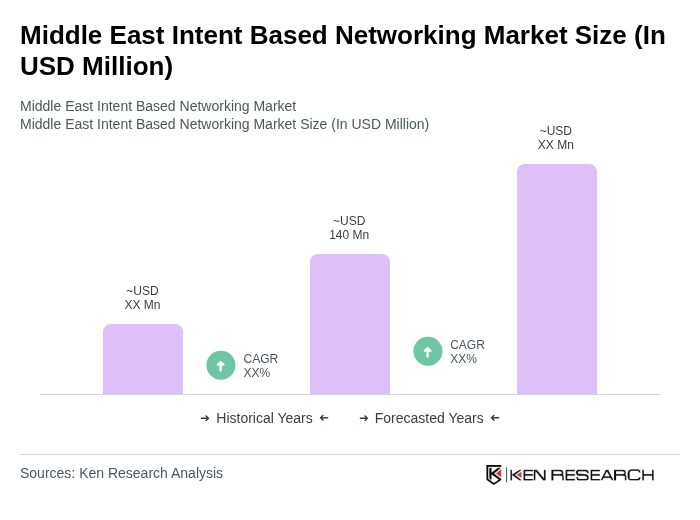
The Middle East Intent Based Networking Market, valued at USD 140 million, is growing due to demand for automated, secure networks amid smart city initiatives and 5G adoption.

Region:Middle East

Author(s):Geetanshi

Product Code:KRAA4125

Pages:95

Published On:January 2026
About the Report

Base Year 2024

Middle East Intent Based Networking Market Overview

  • The Middle East Intent Based Networking Market is valued at USD 140 million, based on a five-year historical analysis. This growth is primarily driven by the increasing demand for network automation, enhanced security measures, and the need for efficient network management solutions across various industries, including telecom, BFSI, government, and large enterprises. The rise in digital transformation initiatives and the adoption of cloud-based services, supported by strong regional investments in digital infrastructure and smart city programs, have further fueled the market's expansion.
  • Key players in this market include Saudi Arabia, the United Arab Emirates, and Qatar. These countries dominate the market due to their robust investments in technology infrastructure, large-scale digital transformation and smart city initiatives such as NEOM in Saudi Arabia and various smart city programs in the UAE, and government strategies promoting digitalization and cloud adoption across public and private sectors. A growing number of enterprises in these countries are seeking advanced networking solutions such as software-defined networking and intent-based networking to improve operational efficiency, strengthen cybersecurity, and support multi-cloud and 5G deployments.
  • In 2023, the UAE government strengthened its cybersecurity and network governance framework through instruments such as the Federal Decree-Law No. 34 of 2021 on Combatting Rumors and Cybercrimes issued by the UAE Federal Government, and sectoral ICT regulations from the Telecommunications and Digital Government Regulatory Authority (TDRA), which require public entities and operators to implement advanced security controls, continuous monitoring, and policy-based network management. These regulatory requirements, together with national digital government strategies, are driving public sector organizations to adopt more automated, policy-driven, and intent-oriented networking solutions to protect sensitive data, ensure network resilience, and enhance service delivery.
Middle East Intent Based Networking Market Size

Middle East Intent Based Networking Market Segmentation

By Component:The components of the market include hardware, software, and services. Hardware encompasses the physical devices required for networking, such as routers, switches, wireless access infrastructure, and security appliances that support programmable and software-defined capabilities. Software includes the applications, controllers, analytics engines, and orchestration platforms that translate business intent into network policies and manage network operations across multi-domain and multi-cloud environments. Services refer to consulting, integration, training, and managed services provided by vendors and system integrators to design, deploy, and optimize intent-based networking solutions and ensure their ongoing performance and compliance.
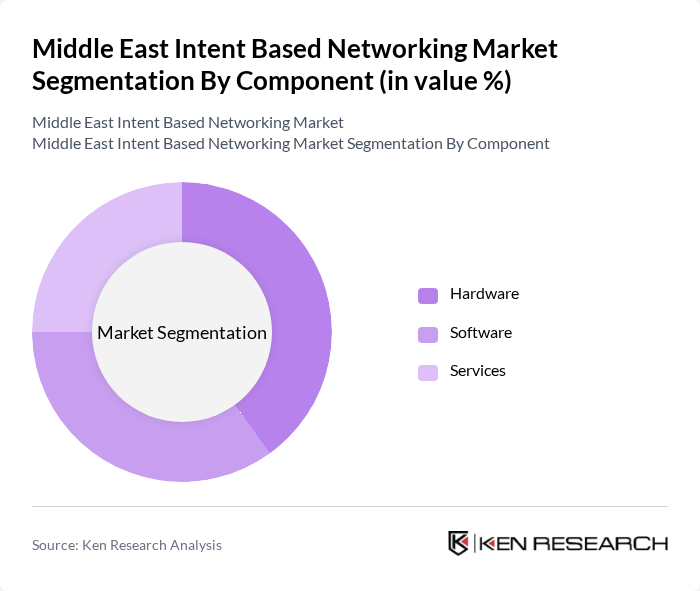
Middle East Intent Based Networking Market segmentation by Component.

By Deployment Model:The deployment models in the market include on-premises, cloud, and hybrid solutions. On-premises solutions are preferred by organizations seeking complete control over their networking infrastructure and data, especially in sectors with strict data residency and security requirements, aligning with the global trend where on-premises intent-based networking has held a leading share due to security and compliance considerations. Cloud solutions offer flexibility and scalability, enabling rapid deployment, centralized policy management, and integration with public cloud and SaaS environments, which is increasingly attractive for digitally mature enterprises in the region. Hybrid models combine both approaches, allowing organizations to leverage the benefits of on-premises control and cloud agility, supporting distributed workplaces, edge locations, and multi-cloud connectivity.
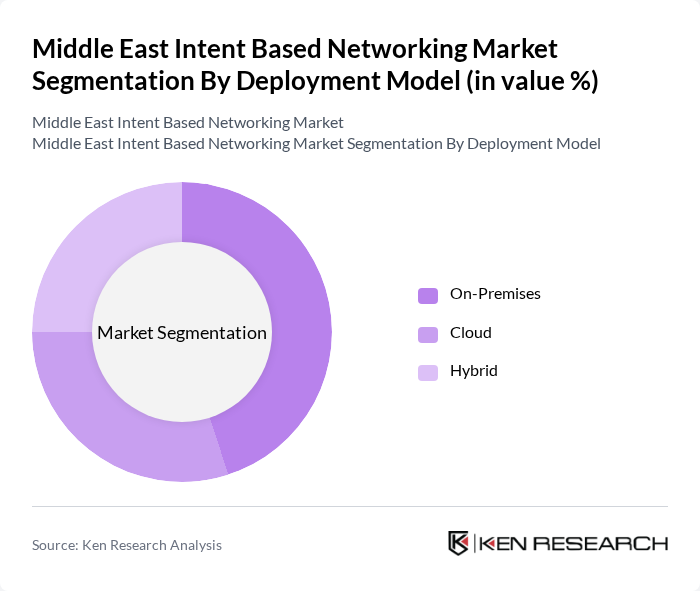
Middle East Intent Based Networking Market segmentation by Deployment Model.

Middle East Intent Based Networking Market Competitive Landscape

The Middle East Intent Based Networking Market is characterized by a dynamic mix of regional and international players. Leading participants such as Cisco Systems, Inc., Juniper Networks, Inc., Arista Networks, Inc., VMware, Inc., Hewlett Packard Enterprise (HPE), International Business Machines Corporation (IBM), Extreme Networks, Inc., Nokia Corporation, Huawei Technologies Co., Ltd., Fortinet, Inc., Palo Alto Networks, Inc., Cato Networks Ltd., Netgear, Inc., NVIDIA Corporation (Mellanox Technologies), Riverbed Technology, Inc. contribute to innovation in network automation and analytics, geographic expansion across key Gulf markets, and differentiated service delivery models including managed and cloud-delivered networking in this space.

Cisco Systems, Inc.

1984

San Jose, California, USA

Juniper Networks, Inc.

1996

Sunnyvale, California, USA

Arista Networks, Inc.

2004

Santa Clara, California, USA

VMware, Inc.

1998

Palo Alto, California, USA

Hewlett Packard Enterprise (HPE)

2015

Spring, Texas, USA

Company

Establishment Year

Headquarters

Regional Revenue (Middle East, latest FY)

3?Year Revenue CAGR (Global / Regional)

EBITDA Margin

R&D Spend as % of Revenue

Middle East Market Share (%)

Average Deal Size (USD, Middle East)

Middle East Intent Based Networking Market Industry Analysis

Growth Drivers

  • Increasing Demand for Network Automation:The Middle East is witnessing a surge in demand for network automation, driven by the need for operational efficiency. In future, the region's IT spending is projected to reach $40 billion, with automation solutions accounting for approximately $8 billion. This shift is largely influenced by businesses aiming to reduce operational costs and enhance service delivery, as automated networks can decrease downtime by up to 30%, significantly improving productivity.
  • Rise in Cybersecurity Threats:Cybersecurity threats in the Middle East have escalated, with reported incidents increasing by 50% in the last year alone. In future, the cybersecurity market is expected to exceed $3.5 billion, prompting organizations to adopt intent-based networking solutions that enhance security protocols. This growing concern for data protection is driving investments in advanced networking technologies, as companies seek to safeguard sensitive information against evolving threats.
  • Expansion of Cloud-Based Services:The cloud services market in the Middle East is projected to grow to $10 billion in future, fueled by the increasing adoption of cloud computing across various sectors. This expansion necessitates robust networking solutions that can support scalable and flexible cloud infrastructures. As organizations migrate to the cloud, the demand for intent-based networking solutions that optimize performance and ensure seamless connectivity is expected to rise significantly.

Market Challenges

  • High Implementation Costs:The initial costs associated with implementing intent-based networking solutions can be prohibitive for many organizations in the Middle East. In future, the average expenditure for deploying these advanced systems is estimated to be around $1.5 million per enterprise. This financial barrier can deter smaller businesses from adopting necessary technologies, limiting overall market growth and innovation in the region.
  • Lack of Skilled Workforce:The Middle East faces a significant skills gap in the IT sector, particularly in advanced networking technologies. In future, it is estimated that there will be a shortage of over 100,000 skilled IT professionals in the region. This lack of expertise hampers the effective implementation and management of intent-based networking solutions, posing a challenge for organizations aiming to leverage these technologies for competitive advantage.

Middle East Intent Based Networking Market Future Outlook

The future of the Middle East Intent Based Networking Market appears promising, driven by technological advancements and increasing digital transformation initiatives. As organizations prioritize automation and cybersecurity, the adoption of AI-driven networking solutions is expected to accelerate. Additionally, the rise of smart cities and 5G networks will further enhance connectivity and data management capabilities, creating a conducive environment for innovation and growth in the networking sector.

Market Opportunities

  • Development of 5G Networks:The rollout of 5G networks in the Middle East presents a significant opportunity for intent-based networking solutions. With investments projected to reach $5 billion in future, businesses can leverage enhanced connectivity to optimize network performance and support a growing number of IoT devices, driving demand for advanced networking technologies.
  • Increased Investment in Smart Cities:The Middle East is investing heavily in smart city initiatives, with over $20 billion allocated for development in future. This investment creates opportunities for intent-based networking solutions that can facilitate efficient urban management, improve public services, and enhance connectivity, positioning companies to capitalize on the growing demand for smart infrastructure.

Scope of the Report

SegmentSub-Segments
By Component

Hardware

Software

Services

By Deployment Model

On-Premises

Cloud

Hybrid

By Application

Network Automation & Orchestration

Policy Enforcement & Security

Dynamic Network Optimization

Network Monitoring & Analytics

Network Policy Compliance & Governance

By End-User Industry

IT & Telecom

BFSI

Government & Public Sector

Healthcare

Manufacturing

Retail & E?commerce

Energy & Utilities

Others

By Organization Size

Large Enterprises

Small & Medium-sized Enterprises (SMEs)

By Network Type

LAN

WAN

WLAN

Data Center Networks

Campus Networks

By Country

Saudi Arabia

United Arab Emirates

Qatar

Kuwait

Oman

Bahrain

Rest of Middle East

Key Target Audience

Investors and Venture Capitalist Firms

Government and Regulatory Bodies (e.g., Telecommunications Regulatory Authority, Ministry of Communications and Information Technology)

Network Equipment Manufacturers

Telecommunications Service Providers

Cloud Service Providers

Cybersecurity Firms

Data Center Operators

Industry Associations (e.g., Middle East Telecommunications Association)

Players Mentioned in the Report:

Cisco Systems, Inc.

Juniper Networks, Inc.

Arista Networks, Inc.

VMware, Inc.

Hewlett Packard Enterprise (HPE)

International Business Machines Corporation (IBM)

Extreme Networks, Inc.

Nokia Corporation

Huawei Technologies Co., Ltd.

Fortinet, Inc.

Palo Alto Networks, Inc.

Cato Networks Ltd.

Netgear, Inc.

NVIDIA Corporation (Mellanox Technologies)

Riverbed Technology, Inc.

Table of Contents

Market Assessment Phase

1. Executive Summary and Approach


2. Middle East Intent Based Networking Market Overview

2.1 Key Insights and Strategic Recommendations

2.2 Middle East Intent Based Networking Market Overview

2.3 Definition and Scope

2.4 Evolution of Market Ecosystem

2.5 Timeline of Key Regulatory Milestones

2.6 Value Chain & Stakeholder Mapping

2.7 Business Cycle Analysis

2.8 Policy & Incentive Landscape


3. Middle East Intent Based Networking Market Analysis

3.1 Growth Drivers

3.1.1 Increasing demand for network automation
3.1.2 Rise in cybersecurity threats
3.1.3 Expansion of cloud-based services
3.1.4 Growing adoption of IoT devices

3.2 Market Challenges

3.2.1 High implementation costs
3.2.2 Lack of skilled workforce
3.2.3 Integration with legacy systems
3.2.4 Regulatory compliance issues

3.3 Market Opportunities

3.3.1 Development of 5G networks
3.3.2 Increased investment in smart cities
3.3.3 Partnerships with technology providers
3.3.4 Expansion into emerging markets

3.4 Market Trends

3.4.1 Shift towards AI-driven networking solutions
3.4.2 Growing focus on sustainability in networking
3.4.3 Increased demand for real-time data analytics
3.4.4 Rise of subscription-based networking services

3.5 Government Regulation

3.5.1 Data protection regulations
3.5.2 Cybersecurity compliance mandates
3.5.3 Telecommunications licensing requirements
3.5.4 Incentives for technology adoption

4. SWOT Analysis


5. Stakeholder Analysis


6. Porter's Five Forces Analysis


7. Middle East Intent Based Networking Market Market Size, 2019-2024

7.1 By Value

7.2 By Volume

7.3 By Average Selling Price


8. Middle East Intent Based Networking Market Segmentation

8.1 By Component

8.1.1 Hardware
8.1.2 Software
8.1.3 Services

8.2 By Deployment Model

8.2.1 On-Premises
8.2.2 Cloud
8.2.3 Hybrid

8.3 By Application

8.3.1 Network Automation & Orchestration
8.3.2 Policy Enforcement & Security
8.3.3 Dynamic Network Optimization
8.3.4 Network Monitoring & Analytics
8.3.5 Network Policy Compliance & Governance

8.4 By End-User Industry

8.4.1 IT & Telecom
8.4.2 BFSI
8.4.3 Government & Public Sector
8.4.4 Healthcare
8.4.5 Manufacturing
8.4.6 Retail & E?commerce
8.4.7 Energy & Utilities
8.4.8 Others

8.5 By Organization Size

8.5.1 Large Enterprises
8.5.2 Small & Medium-sized Enterprises (SMEs)

8.6 By Network Type

8.6.1 LAN
8.6.2 WAN
8.6.3 WLAN
8.6.4 Data Center Networks
8.6.5 Campus Networks

8.7 By Country

8.7.1 Saudi Arabia
8.7.2 United Arab Emirates
8.7.3 Qatar
8.7.4 Kuwait
8.7.5 Oman
8.7.6 Bahrain
8.7.7 Rest of Middle East

9. Middle East Intent Based Networking Market Competitive Analysis

9.1 Market Share of Key Players

9.2 Cross Comparison of Key Players

9.2.1 Company Name
9.2.2 Regional Revenue (Middle East, latest FY)
9.2.3 3?Year Revenue CAGR (Global / Regional)
9.2.4 EBITDA Margin
9.2.5 R&D Spend as % of Revenue
9.2.6 Middle East Market Share (%)
9.2.7 Average Deal Size (USD, Middle East)
9.2.8 Number of Active Middle East Customers
9.2.9 Pipeline Coverage (x of Annual Target)
9.2.10 Customer Retention / Net Revenue Retention (%)
9.2.11 Cloud vs On?Premise Revenue Mix (%)
9.2.12 Recurring Revenue Share (%)

9.3 SWOT Analysis of Top Players

9.4 Pricing Analysis

9.5 Detailed Profile of Major Companies

9.5.1 Cisco Systems, Inc.
9.5.2 Juniper Networks, Inc.
9.5.3 Arista Networks, Inc.
9.5.4 VMware, Inc.
9.5.5 Hewlett Packard Enterprise (HPE)
9.5.6 International Business Machines Corporation (IBM)
9.5.7 Extreme Networks, Inc.
9.5.8 Nokia Corporation
9.5.9 Huawei Technologies Co., Ltd.
9.5.10 Fortinet, Inc.
9.5.11 Palo Alto Networks, Inc.
9.5.12 Cato Networks Ltd.
9.5.13 Netgear, Inc.
9.5.14 NVIDIA Corporation (Mellanox Technologies)
9.5.15 Riverbed Technology, Inc.

10. Middle East Intent Based Networking Market End-User Analysis

10.1 Procurement Behavior of Key Ministries

10.1.1 Ministry of Communications
10.1.2 Ministry of Interior
10.1.3 Ministry of Education
10.1.4 Ministry of Health

10.2 Corporate Spend on Infrastructure & Energy

10.2.1 IT Infrastructure Investments
10.2.2 Energy Efficiency Initiatives

10.3 Pain Point Analysis by End-User Category

10.3.1 Network Downtime
10.3.2 Security Vulnerabilities

10.4 User Readiness for Adoption

10.4.1 Training and Support Needs
10.4.2 Technology Familiarity

10.5 Post-Deployment ROI and Use Case Expansion

10.5.1 Performance Metrics
10.5.2 Scalability Options

11. Middle East Intent Based Networking Market Future Size, 2025-2030

11.1 By Value

11.2 By Volume

11.3 By Average Selling Price


Go-To-Market Strategy Phase

1. Whitespace Analysis + Business Model Canvas

1.1 Market Gaps Identification

1.2 Business Model Development


2. Marketing and Positioning Recommendations

2.1 Branding Strategies

2.2 Product USPs


3. Distribution Plan

3.1 Urban Retail Strategies

3.2 Rural NGO Tie-Ups


4. Channel & Pricing Gaps

4.1 Underserved Routes

4.2 Pricing Bands


5. Unmet Demand & Latent Needs

5.1 Category Gaps

5.2 Consumer Segments


6. Customer Relationship

6.1 Loyalty Programs

6.2 After-Sales Service


7. Value Proposition

7.1 Sustainability Initiatives

7.2 Integrated Supply Chains


8. Key Activities

8.1 Regulatory Compliance

8.2 Branding Efforts

8.3 Distribution Setup


9. Entry Strategy Evaluation

9.1 Domestic Market Entry Strategy

9.1.1 Product Mix
9.1.2 Pricing Band
9.1.3 Packaging

9.2 Export Entry Strategy

9.2.1 Target Countries
9.2.2 Compliance Roadmap

10. Entry Mode Assessment

10.1 Joint Ventures

10.2 Greenfield Investments

10.3 Mergers & Acquisitions

10.4 Distributor Model


11. Capital and Timeline Estimation

11.1 Capital Requirements

11.2 Timelines


12. Control vs Risk Trade-Off

12.1 Ownership vs Partnerships


13. Profitability Outlook

13.1 Breakeven Analysis

13.2 Long-Term Sustainability


14. Potential Partner List

14.1 Distributors

14.2 Joint Ventures

14.3 Acquisition Targets


15. Execution Roadmap

15.1 Phased Plan for Market Entry

15.1.1 Market Setup
15.1.2 Market Entry
15.1.3 Growth Acceleration
15.1.4 Scale & Stabilize

15.2 Key Activities and Milestones

15.2.1 Activity Planning
15.2.2 Milestone Tracking

Research Methodology

ApproachModellingSample

Phase 1: Approach1

Desk Research

  • Industry reports from telecommunications and networking associations in the Middle East
  • Market analysis publications focusing on intent-based networking technologies
  • Government publications and white papers on digital transformation initiatives in the region

Primary Research

  • Interviews with IT decision-makers in large enterprises across various sectors
  • Surveys targeting network engineers and system architects in telecommunications firms
  • Focus groups with technology consultants specializing in networking solutions

Validation & Triangulation

  • Cross-validation of findings through multiple industry reports and expert opinions
  • Triangulation of data from primary interviews and secondary research sources
  • Sanity checks conducted through expert panel discussions and feedback sessions

Phase 2: Market Size Estimation1

Top-down Assessment

  • Analysis of overall IT spending trends in the Middle East, focusing on networking solutions
  • Segmentation of the market by industry verticals such as healthcare, finance, and education
  • Incorporation of regional digital transformation initiatives and government investments

Bottom-up Modeling

  • Data collection from leading intent-based networking vendors regarding sales figures
  • Estimation of market penetration rates based on current adoption levels in various sectors
  • Cost analysis of intent-based networking solutions to derive average selling prices

Forecasting & Scenario Analysis

  • Multi-variable forecasting models incorporating growth drivers such as cloud adoption and IoT
  • Scenario analysis based on potential regulatory changes and technological advancements
  • Development of baseline, optimistic, and pessimistic market growth projections through 2030

Phase 3: CATI Sample Composition1

Scope Item/SegmentSample SizeTarget Respondent Profiles
Enterprise Networking Solutions120IT Managers, Network Administrators
Telecommunications Infrastructure110Network Engineers, Operations Directors
Cloud Networking Services90Cloud Architects, IT Consultants
Cybersecurity in Networking75Security Analysts, Compliance Officers
SME Networking Solutions65Small Business Owners, IT Support Staff

Frequently Asked Questions

What is the current value of the Middle East Intent Based Networking Market?

The Middle East Intent Based Networking Market is valued at approximately USD 140 million, driven by the increasing demand for network automation, enhanced security measures, and efficient network management solutions across various industries such as telecom, BFSI, and government.

What are the key drivers of growth in the Middle East Intent Based Networking Market?

Which countries dominate the Middle East Intent Based Networking Market?

What are the main components of Intent Based Networking solutions?

Why Buy From Us?

Refine Robust Result (RRR) Framework

What makes us stand out is that our consultants follow Robust, Refine and Result (RRR) methodology. Robust for clear definitions, approaches and sanity checking, Refine for differentiating respondents' facts and opinions, and Result for presenting data with story.

Our Reach Is Unmatched

We have set a benchmark in the industry by offering our clients with syndicated and customized market research reports featuring coverage of entire market as well as meticulous research and analyst insights.

Shifting the Research Paradigm

While we don't replace traditional research, we flip the method upside down. Our dual approach of Top Bottom & Bottom Top ensures quality deliverable by not just verifying company fundamentals but also looking at the sector and macroeconomic factors.

More Insights-Better Decisions

With one step in the future, our research team constantly tries to show you the bigger picture. We help with some of the tough questions you may encounter along the way: How is the industry positioned? Best marketing channel? KPI's of competitors? By aligning every element, we help maximize success.

Transparency and Trust

Our report gives you instant access to the answers and sources that other companies might choose to hide. We elaborate each steps of research methodology we have used and showcase you the sample size to earn your trust.

Round the Clock Support

If you need any support, we are here! We pride ourselves on universe strength, data quality, and quick, friendly, and professional service.

Why Clients Choose Us?

400000+
Reports in repository
150+
Consulting projects a year
100+
Analysts
8000+
Client Queries in 2022








