About the Report
Base Year 2024United Arab Emirates Leather Chemicals Market Overview
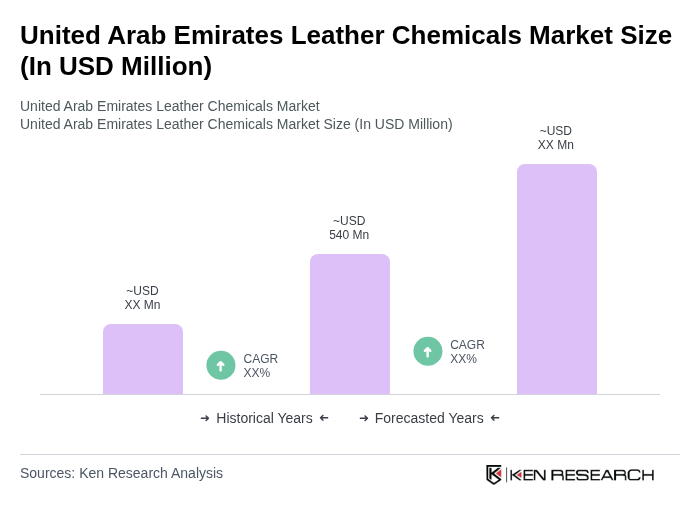
- The United Arab Emirates Leather Chemicals Market is valued at USD 540 million, based on a five-year historical analysis.This growth is primarily driven by the increasing demand for leather products in various sectors, including automotive interiors, fashion accessories, footwear, and furniture, alongside a growing focus on sustainable and high‑performance chemicals in leather production.
- Key cities such as Dubai and Abu Dhabi dominate the market due to their robust industrial and logistics infrastructure, strategic location for re‑export and regional trade, and a high concentration of luxury, fashion, and automotive brands that require premium leather products and components.The presence of established tanneries, regional distribution hubs of global chemical producers, and specialized chemical traders further enhances their market position.
- In 2023, the UAE government implemented regulations aimed at promoting sustainable practices in the chemical and manufacturing sectors that include leather processing activities, such as mandatory environmental permitting, hazardous substances control, and effluent management standards under federal and emirate‑level environmental laws.In particular, the Federal Law No. 24 of 1999 for the Protection and Development of the Environment, issued by the Ministry of Climate Change and Environment, and subsequent implementing regulations set binding requirements on industrial facilities to manage chemical use, emissions, and wastewater, driving increased adoption of eco‑friendly leather chemicals and compliance with global sustainability standards.
United Arab Emirates Leather Chemicals Market Segmentation
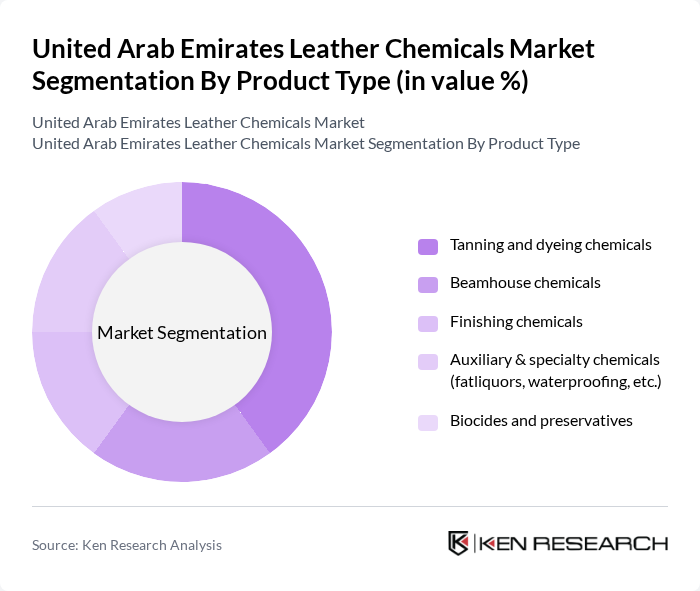
By Product Type:The product type segmentation includes various categories such as tanning and dyeing chemicals, beamhouse chemicals, finishing chemicals, auxiliary & specialty chemicals (fatliquors, waterproofing, etc.), and biocides and preservatives. This structure is consistent with global leather chemicals classifications, where beamhouse, tanning, dyeing, and finishing chemicals form the core of the value chain.Among these, tanning and dyeing chemicals are the most significant due to their essential role in converting raw hides into stable leather and imparting color and performance, catering to the high demand for quality leather goods across footwear, automotive, and luxury applications.
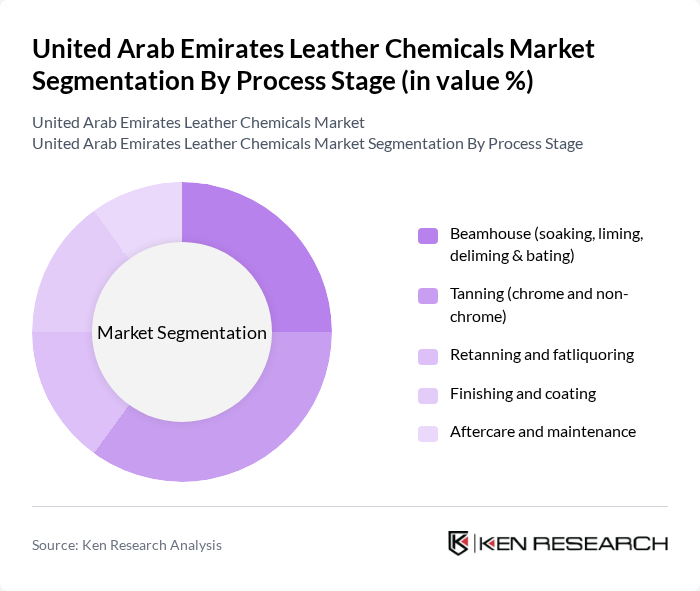
By Process Stage:The process stage segmentation encompasses beamhouse (soaking, liming, deliming & bating), tanning (chrome and non-chrome), retanning and fatliquoring, finishing and coating, and aftercare and maintenance, which aligns with standard leather manufacturing workflows used globally.The tanning process, particularly chrome tanning, continues to dominate this segment due to its processing efficiency, cost‑effectiveness, and ability to deliver consistent physical properties for automotive, footwear, and upholstery leathers, while non‑chrome and metal‑free systems are gaining share as brands push for more sustainable alternatives.
United Arab Emirates Leather Chemicals Market Competitive Landscape
The United Arab Emirates Leather Chemicals Market is characterized by a dynamic mix of regional and international players. Leading participants such as BASF SE, LANXESS AG, Huntsman Corporation, TFL Leather Technology GmbH, Stahl Holdings B.V., Clariant AG, Dow Chemical Company, Solvay S.A., Kraton Corporation, Eastman Chemical Company, Wacker Chemie AG, Archroma Management LLC, Zschimmer & Schwarz Group, Sisecam Chemicals, and local UAE-based leather chemical distributors contribute to innovation, geographic expansion, and service delivery in this space.
United Arab Emirates Leather Chemicals Market Industry Analysis
Growth Drivers
- Increasing Demand for Leather Goods:The United Arab Emirates has witnessed a significant rise in the demand for leather goods, with the market valued at approximately AED 1.5 billion. This growth is driven by a burgeoning middle class and a strong tourism sector, which collectively contribute to a projected increase in leather consumption by 10% annually. The luxury segment, particularly handbags and footwear, is expected to see the highest growth, reflecting changing consumer preferences towards high-quality products.
- Growth in the Automotive Leather Market:The automotive sector in the UAE is projected to grow, with an estimated 300,000 vehicles sold, leading to increased demand for automotive leather. The market for automotive leather is expected to reach AED 800 million, driven by rising disposable incomes and a preference for luxury vehicles. This trend is further supported by manufacturers focusing on premium interiors, enhancing the demand for high-quality leather chemicals used in production.
- Rising Awareness of Sustainable Leather Production:There is a growing consumer awareness regarding sustainable practices in leather production, with 65% of consumers in the UAE expressing a preference for eco-friendly products. This shift is prompting manufacturers to adopt sustainable leather chemicals, which are projected to account for 30% of the market. The UAE government’s initiatives to promote sustainability further bolster this trend, encouraging investments in green technologies and practices within the leather industry.
Market Challenges
- Fluctuating Raw Material Prices:The leather chemicals market faces challenges due to the volatility in raw material prices, particularly for chemicals derived from petroleum. Prices for key raw materials surged by 15%, impacting production costs significantly. This fluctuation creates uncertainty for manufacturers, who must navigate these changes while maintaining competitive pricing and profitability, ultimately affecting the overall market stability.
- Stringent Environmental Regulations:The UAE has implemented strict environmental regulations concerning chemical usage in leather production, with compliance costs rising by 20% in recent years. These regulations aim to reduce pollution and promote sustainable practices, but they also pose challenges for manufacturers who must invest in new technologies and processes. Non-compliance can lead to hefty fines, further straining the financial resources of smaller companies in the sector.
United Arab Emirates Leather Chemicals Market Future Outlook
The future of the UAE leather chemicals market appears promising, driven by increasing consumer demand for sustainable and high-quality leather products. As the automotive and fashion industries continue to expand, manufacturers are likely to invest in innovative technologies that enhance production efficiency and reduce environmental impact. Additionally, the growing trend of online retailing is expected to facilitate broader market access, allowing companies to reach a wider audience and adapt to changing consumer preferences more effectively.
Market Opportunities
- Adoption of Eco-Friendly Leather Chemicals:The shift towards eco-friendly leather chemicals presents a significant opportunity, with the market for these products expected to grow by AED 200 million. Companies that invest in sustainable practices can differentiate themselves and attract environmentally conscious consumers, enhancing their market position and profitability.
- Expansion into Emerging Markets:The UAE leather chemicals market can benefit from expanding into emerging markets in the Middle East and North Africa, where demand for leather products is increasing. With a projected market growth of AED 150 million in these regions, companies can leverage their expertise and establish a foothold in new markets, driving revenue growth and diversification.
Scope of the Report
| Segment | Sub-Segments |
|---|---|
| By Product Type | Tanning and dyeing chemicals Beamhouse chemicals Finishing chemicals Auxiliary & speciality chemicals (fatliquors, waterproofing, etc.) Biocides and preservatives |
| By Process Stage | Beamhouse (soaking, liming, deliming & bating) Tanning (chrome and non-chrome) Retanning and fatliquoring Finishing and coating Aftercare and maintenance |
| By End-Use Industry | Footwear and leather accessories Automotive leather Furniture and interior upholstery Garments and fashion Industrial and other technical leather |
| By Leather Type | Bovine leather Ovine and caprine leather Porcine leather Exotic leather Synthetic and coated leather |
| By Distribution Channel | Direct sales to tanneries Authorized distributors and agents OEM supply agreements Online and digital channels Others |
| By Technology | Conventional chemical-based solutions Enzyme-based and biotechnology solutions Water-based polyurethane and acrylic systems Solvent-based systems Hybrid and nano-enabled systems |
| By Sustainability Profile | Conventional leather chemicals Low-VOC and reduced-chrome systems Chrome-free and metal-free systems Bio-based and biodegradable chemicals Certified sustainable product lines (LWG/ZDHC compliant) |
Key Target Audience
Investors and Venture Capitalist Firms
Government and Regulatory Bodies (e.g., Ministry of Economy, Ministry of Climate Change and Environment)
Manufacturers and Producers of Leather Chemicals
Distributors and Retailers of Leather Products
Leather Industry Associations
Importers and Exporters of Leather Chemicals
Environmental Agencies (e.g., Emirates Authority for Standardization and Metrology)
Financial Institutions and Banks
Players Mentioned in the Report:
BASF SE
LANXESS AG
Huntsman Corporation
TFL Leather Technology GmbH
Stahl Holdings B.V.
Clariant AG
Dow Chemical Company
Solvay S.A.
Kraton Corporation
Eastman Chemical Company
Wacker Chemie AG
Archroma Management LLC
Zschimmer & Schwarz Group
Sisecam Chemicals
Local and regional UAE-based leather chemical distributors
Table of Contents
Market Assessment Phase
1. Executive Summary and Approach
2. United Arab Emirates Leather Chemicals Market Overview
2.1 Key Insights and Strategic Recommendations
2.2 United Arab Emirates Leather Chemicals Market Overview
2.3 Definition and Scope
2.4 Evolution of Market Ecosystem
2.5 Timeline of Key Regulatory Milestones
2.6 Value Chain & Stakeholder Mapping
2.7 Business Cycle Analysis
2.8 Policy & Incentive Landscape
3. United Arab Emirates Leather Chemicals Market Analysis
3.1 Growth Drivers
3.1.1 Increasing demand for leather goods
3.1.2 Growth in the automotive leather market
3.1.3 Rising awareness of sustainable leather production
3.1.4 Expansion of the fashion industry
3.2 Market Challenges
3.2.1 Fluctuating raw material prices
3.2.2 Stringent environmental regulations
3.2.3 Competition from synthetic alternatives
3.2.4 Limited skilled labor in the sector
3.3 Market Opportunities
3.3.1 Adoption of eco-friendly leather chemicals
3.3.2 Expansion into emerging markets
3.3.3 Technological advancements in leather processing
3.3.4 Collaborations with fashion brands for sustainable practices
3.4 Market Trends
3.4.1 Shift towards biodegradable leather chemicals
3.4.2 Increasing use of digital technologies in production
3.4.3 Growth of online retail for leather products
3.4.4 Rising consumer preference for luxury leather goods
3.5 Government Regulation
3.5.1 Regulations on chemical usage in leather production
3.5.2 Environmental protection laws
3.5.3 Import/export regulations for leather chemicals
3.5.4 Standards for leather quality and safety
4. SWOT Analysis
5. Stakeholder Analysis
6. Porter's Five Forces Analysis
7. United Arab Emirates Leather Chemicals Market Market Size, 2019-2024
7.1 By Value
7.2 By Volume
7.3 By Average Selling Price
8. United Arab Emirates Leather Chemicals Market Segmentation
8.1 By Product Type
8.1.1 Tanning and dyeing chemicals
8.1.2 Beamhouse chemicals
8.1.3 Finishing chemicals
8.1.4 Auxiliary & speciality chemicals (fatliquors, waterproofing, etc.)
8.1.5 Biocides and preservatives
8.2 By Process Stage
8.2.1 Beamhouse (soaking, liming, deliming & bating)
8.2.2 Tanning (chrome and non-chrome)
8.2.3 Retanning and fatliquoring
8.2.4 Finishing and coating
8.2.5 Aftercare and maintenance
8.3 By End-Use Industry
8.3.1 Footwear and leather accessories
8.3.2 Automotive leather
8.3.3 Furniture and interior upholstery
8.3.4 Garments and fashion
8.3.5 Industrial and other technical leather
8.4 By Leather Type
8.4.1 Bovine leather
8.4.2 Ovine and caprine leather
8.4.3 Porcine leather
8.4.4 Exotic leather
8.4.5 Synthetic and coated leather
8.5 By Distribution Channel
8.5.1 Direct sales to tanneries
8.5.2 Authorized distributors and agents
8.5.3 OEM supply agreements
8.5.4 Online and digital channels
8.5.5 Others
8.6 By Technology
8.6.1 Conventional chemical-based solutions
8.6.2 Enzyme-based and biotechnology solutions
8.6.3 Water-based polyurethane and acrylic systems
8.6.4 Solvent-based systems
8.6.5 Hybrid and nano-enabled systems
8.7 By Sustainability Profile
8.7.1 Conventional leather chemicals
8.7.2 Low-VOC and reduced-chrome systems
8.7.3 Chrome-free and metal-free systems
8.7.4 Bio-based and biodegradable chemicals
8.7.5 Certified sustainable product lines (LWG/ZDHC compliant)
9. United Arab Emirates Leather Chemicals Market Competitive Analysis
9.1 Market Share of Key Players
9.2 Cross Comparison of Key Players
9.2.1 Company name
9.2.2 Group size (revenue and employee band)
9.2.3 Revenue growth rate (CAGR, UAE and global)
9.2.4 UAE leather chemicals revenue and market share
9.2.5 EBITDA margin and operating margin
9.2.6 R&D intensity (% of revenue)
9.2.7 Capex intensity (% of revenue)
9.2.8 Product portfolio depth (leather chemicals SKUs, segments served)
9.2.9 Sustainability score (LWG/ZDHC compliance, emissions targets)
9.2.10 Customer concentration and key OEM/tannery relationships
9.2.11 Average selling price positioning and discounting level
9.2.12 Distribution coverage in UAE (emirates, channel partners)
9.2.13 Innovation pipeline (new launches, patents, pilot projects)
9.2.14 On-time delivery and service level performance
9.2.15 Credit profile and funding capacity
9.3 SWOT Analysis of Top Players
9.4 Pricing Analysis
9.5 Detailed Profile of Major Companies
9.5.1 BASF SE
9.5.2 LANXESS AG
9.5.3 Huntsman Corporation
9.5.4 TFL Leather Technology GmbH
9.5.5 Stahl Holdings B.V.
9.5.6 Clariant AG
9.5.7 Dow Chemical Company
9.5.8 Solvay S.A.
9.5.9 Kraton Corporation
9.5.10 Eastman Chemical Company
9.5.11 Wacker Chemie AG
9.5.12 Archroma Management LLC
9.5.13 Zschimmer & Schwarz Group
9.5.14 Sisecam Chemicals
9.5.15 Local and regional UAE-based leather chemical distributors
10. United Arab Emirates Leather Chemicals Market End-User Analysis
10.1 Procurement Behavior of Key Ministries
10.1.1 Government contracts and tenders
10.1.2 Budget allocation for leather products
10.1.3 Compliance with local sourcing regulations
10.1.4 Preference for sustainable products
10.2 Corporate Spend on Infrastructure & Energy
10.2.1 Investment in leather manufacturing facilities
10.2.2 Expenditure on energy-efficient technologies
10.2.3 Budget for R&D in leather chemicals
10.2.4 Spending on workforce training
10.3 Pain Point Analysis by End-User Category
10.3.1 Quality assurance issues
10.3.2 Supply chain disruptions
10.3.3 Cost management challenges
10.3.4 Regulatory compliance hurdles
10.4 User Readiness for Adoption
10.4.1 Awareness of sustainable practices
10.4.2 Training and skill development
10.4.3 Availability of eco-friendly products
10.4.4 Financial readiness for investment
10.5 Post-Deployment ROI and Use Case Expansion
10.5.1 Measurement of cost savings
10.5.2 Assessment of product performance
10.5.3 Expansion into new markets
10.5.4 Long-term sustainability benefits
11. United Arab Emirates Leather Chemicals Market Future Size, 2025-2030
11.1 By Value
11.2 By Volume
11.3 By Average Selling Price
Go-To-Market Strategy Phase
1. Whitespace Analysis + Business Model Canvas
1.1 Market gaps and opportunities
2. Marketing and Positioning Recommendations
2.1 Branding strategies
2.2 Product USPs
3. Distribution Plan
3.1 Urban retail vs rural NGO tie-ups
4. Channel & Pricing Gaps
4.1 Underserved routes
4.2 Pricing bands
5. Unmet Demand & Latent Needs
5.1 Category gaps
5.2 Consumer segments
6. Customer Relationship
6.1 Loyalty programs
6.2 After-sales service
7. Value Proposition
7.1 Sustainability
7.2 Integrated supply chains
8. Key Activities
8.1 Regulatory compliance
8.2 Branding
8.3 Distribution setup
9. Entry Strategy Evaluation
9.1 Domestic Market Entry Strategy
9.1.1 Product mix
9.1.2 Pricing band
9.1.3 Packaging
9.2 Export Entry Strategy
9.2.1 Target countries
9.2.2 Compliance roadmap
10. Entry Mode Assessment
10.1 JV, Greenfield, M&A, Distributor Model
11. Capital and Timeline Estimation
11.1 Capital requirements
11.2 Timelines
12. Control vs Risk Trade-Off
12.1 Ownership vs Partnerships
13. Profitability Outlook
13.1 Breakeven analysis
13.2 Long-term sustainability
14. Potential Partner List
14.1 Distributors
14.2 JVs
14.3 Acquisition targets
15. Execution Roadmap
15.1 Phased Plan for Market Entry
15.1.1 Market Setup
15.1.2 Market Entry
15.1.3 Growth Acceleration
15.1.4 Scale & Stabilize
15.2 Key Activities and Milestones
15.2.1 Milestone tracking
15.2.2 Activity scheduling
Research Methodology
Phase 1: Approach1
Desk Research
- Industry reports from the UAE Ministry of Economy and relevant trade associations
- Market analysis publications from global chemical industry analysts
- Statistical data from the UAE Federal Competitiveness and Statistics Authority
Primary Research
- Interviews with key stakeholders in the leather chemicals supply chain, including manufacturers and distributors
- Surveys targeting end-users in the leather industry, such as tanneries and leather goods producers
- Focus group discussions with industry experts and consultants specializing in chemical applications
Validation & Triangulation
- Cross-validation of findings through multiple data sources, including trade publications and market surveys
- Triangulation of qualitative insights from interviews with quantitative data from market reports
- Sanity checks conducted through expert panel reviews to ensure data accuracy and relevance
Phase 2: Market Size Estimation1
Top-down Assessment
- Analysis of the overall leather market size in the UAE and its growth trajectory
- Segmentation of the leather chemicals market by product type and application
- Incorporation of macroeconomic indicators and industry growth forecasts
Bottom-up Modeling
- Estimation of market size based on production volumes of leather goods and associated chemical usage
- Cost analysis of leather chemicals based on supplier pricing and market demand
- Volume x price calculations to derive revenue estimates for each segment
Forecasting & Scenario Analysis
- Utilization of time-series analysis to project future market trends based on historical data
- Scenario modeling based on potential regulatory changes and sustainability trends in the leather industry
- Development of baseline, optimistic, and pessimistic forecasts through 2030
Phase 3: CATI Sample Composition1
| Scope Item/Segment | Sample Size | Target Respondent Profiles |
|---|---|---|
| Leather Tanning Industry | 90 | Tannery Managers, Production Supervisors |
| Leather Goods Manufacturing | 70 | Product Managers, Quality Control Officers |
| Chemical Suppliers | 60 | Sales Managers, Technical Support Specialists |
| Regulatory Bodies | 50 | Policy Makers, Environmental Compliance Officers |
| Research Institutions | 40 | Research Analysts, Industry Consultants |
Frequently Asked Questions
What is the current value of the United Arab Emirates Leather Chemicals Market?
The United Arab Emirates Leather Chemicals Market is valued at approximately USD 540 million, reflecting a significant growth driven by the increasing demand for leather products across various sectors, including automotive, fashion, and furniture.
Which cities dominate the UAE Leather Chemicals Market?
What are the main drivers of growth in the UAE Leather Chemicals Market?
What challenges does the UAE Leather Chemicals Market face?
Other Regional/Country Reports
Other Adjacent Reports
Malaysia Automotive Interiors Market
India Footwear Market (2022- 2027)Kuwait fashion accessories market report size, share, growth drivers, trends, opportunities & forecast 2025–2030Belgium Furniture Upholstery Market
Global Textile Chemicals Market Outlook to 2030USA Specialty Chemicals Market Size Share Growth Drivers Trends Opportunities & Forecast 2025–2030India Dyes and Pigments Market Outlook to 2030Bahrain Polymer Coatings Market
UAE Sustainable Chemicals Market
Why Buy From Us?

What makes us stand out is that our consultants follow Robust, Refine and Result (RRR) methodology. Robust for clear definitions, approaches and sanity checking, Refine for differentiating respondents' facts and opinions, and Result for presenting data with story.

We have set a benchmark in the industry by offering our clients with syndicated and customized market research reports featuring coverage of entire market as well as meticulous research and analyst insights.

While we don't replace traditional research, we flip the method upside down. Our dual approach of Top Bottom & Bottom Top ensures quality deliverable by not just verifying company fundamentals but also looking at the sector and macroeconomic factors.

With one step in the future, our research team constantly tries to show you the bigger picture. We help with some of the tough questions you may encounter along the way: How is the industry positioned? Best marketing channel? KPI's of competitors? By aligning every element, we help maximize success.

Our report gives you instant access to the answers and sources that other companies might choose to hide. We elaborate each steps of research methodology we have used and showcase you the sample size to earn your trust.

If you need any support, we are here! We pride ourselves on universe strength, data quality, and quick, friendly, and professional service.