About the Report
Base Year 2024Middle East Lower Extremity Implants Market Overview
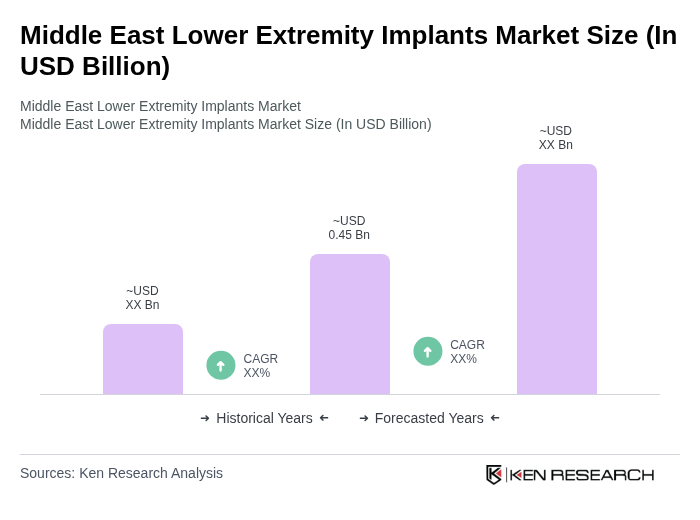
- The Middle East Lower Extremity Implants Market is valued at USD 0.45 billion, based on a five-year historical analysis and considering that lower extremity implants account for the largest share of the regional orthopedic implants segment. This growth is primarily driven by the increasing prevalence of orthopedic disorders such as osteoarthritis and trauma-related fractures, a rising geriatric population, and advancements in implant technologies including patient-specific and navigation-assisted systems. The demand for lower extremity implants, particularly knee and hip implants, has surged due to growing awareness of surgical options, medical tourism, and sustained investments in acute and specialized orthopedic care infrastructure across the region.
- Key players in this market include Saudi Arabia, the United Arab Emirates, and Qatar, which dominate due to their advanced healthcare systems, higher healthcare expenditure per capita, and increasing investments in medical technology and specialized orthopedic centers. These countries have established themselves as regional healthcare hubs, attracting international medical tourism and fostering innovation in orthopedic solutions through partnerships with global implant manufacturers and the deployment of advanced navigation and minimally invasive surgery platforms.
- In Saudi Arabia, medical devices including orthopedic and lower extremity implants supplied to public hospitals must comply with the Medical Devices Interim Regulation and implementing rules issued by the Saudi Food and Drug Authority (SFDA), as well as the Medical Devices Marketing Authorization (MDMA) requirements, which together mandate registration of manufacturers and products, conformity assessment, and use of certified devices in healthcare institutions. These frameworks aim to enhance patient safety and ensure the quality and performance of medical implants used in orthopedic surgeries through controls on importation, licensing, post-market surveillance, and vigilance reporting by healthcare providers.
Middle East Lower Extremity Implants Market Segmentation
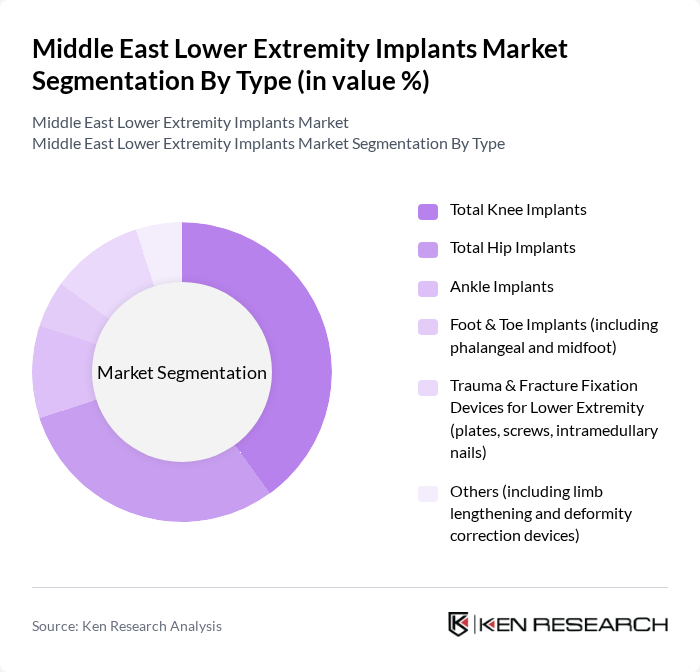
By Type:The market is segmented into various types of implants, including Total Knee Implants, Total Hip Implants, Ankle Implants, Foot & Toe Implants (including phalangeal and midfoot), Trauma & Fracture Fixation Devices for Lower Extremity (plates, screws, intramedullary nails), and Others (including limb lengthening and deformity correction devices). This structure aligns with the broader lower extremity implants taxonomy, which typically covers large joint arthroplasty (hip and knee), ankle and foot reconstruction, and trauma fixation systems. Among these, Total Knee Implants are the most dominant due to the high incidence and treatment rates of knee osteoarthritis, and the large volume of knee replacement surgeries performed annually in hospital settings. The growing elderly population, increasing obesity prevalence, and expansion of high-volume arthroplasty centers in Gulf Cooperation Council (GCC) countries contribute significantly to the demand for knee implants, making them a focal point in the market.
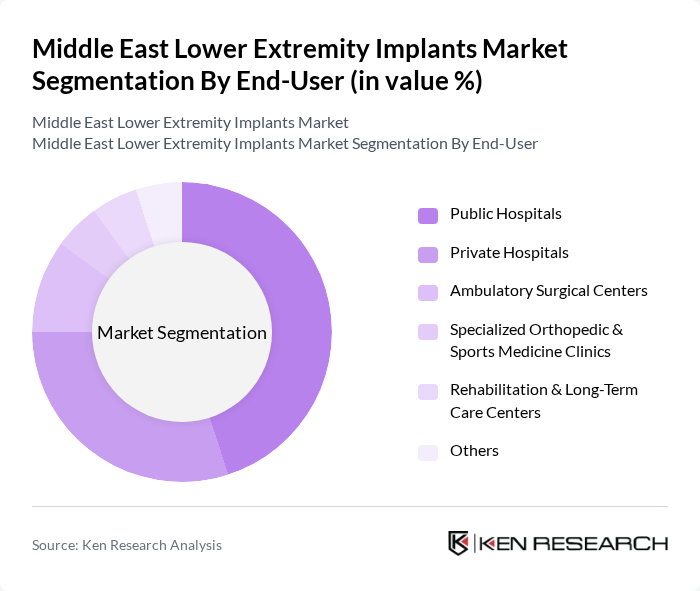
By End-User:The market is segmented by end-users, including Public Hospitals, Private Hospitals, Ambulatory Surgical Centers, Specialized Orthopedic & Sports Medicine Clinics, Rehabilitation & Long-Term Care Centers, and Others. This segmentation reflects the global pattern where hospitals and surgical centers account for most lower extremity implant procedures. Public Hospitals are the leading segment due to their extensive patient base, centralized trauma and joint replacement services, and government funding, which allows for the procurement of advanced lower extremity implants and navigation systems. The increasing number of joint replacement and trauma surgeries performed in public healthcare facilities, coupled with rising demand for orthopedic treatments and expanding insurance coverage in GCC markets, drives the growth of this segment.
Middle East Lower Extremity Implants Market Competitive Landscape
The Middle East Lower Extremity Implants Market is characterized by a dynamic mix of regional and international players. Leading participants such as Stryker Corporation, Zimmer Biomet Holdings, Inc., DePuy Synthes (Johnson & Johnson MedTech), Smith & Nephew plc, Medtronic plc, Arthrex, Inc., Globus Medical, Inc., Exactech, Inc., B. Braun Melsungen AG (Aesculap Division), Orthofix Medical Inc., Medacta International SA, Conformis, Inc., LimaCorporate S.p.A., United Orthopedic Corporation, Amico Group (Middle East Orthopedic Distributor & Manufacturer) contribute to innovation, geographic expansion, and service delivery in this space, with portfolios spanning knee and hip arthroplasty, ankle and foot reconstruction, and trauma fixation systems.
Middle East Lower Extremity Implants Market Industry Analysis
Growth Drivers
- Increasing Prevalence of Orthopedic Disorders:The Middle East is witnessing a significant rise in orthopedic disorders, with an estimated 1.6 million cases of osteoarthritis reported annually. This increase is largely attributed to lifestyle changes and a growing sedentary population. According to the World Health Organization, the prevalence of musculoskeletal disorders is projected to rise by 30% in future, driving demand for lower extremity implants as patients seek effective treatment options.
- Advancements in Implant Technology:Technological innovations in lower extremity implants, such as the development of bioresorbable materials and 3D printing, are enhancing surgical outcomes. In future, the global market for orthopedic implants is expected to reach $55 billion, with a significant portion attributed to the Middle East. These advancements not only improve patient recovery times but also reduce the risk of complications, thereby increasing the adoption of these implants in clinical settings.
- Rising Geriatric Population:The geriatric population in the Middle East is projected to reach 60 million in future, according to the United Nations. This demographic shift is leading to a higher incidence of age-related orthopedic conditions, necessitating the use of lower extremity implants. As older adults often require joint replacement surgeries, healthcare providers are increasingly focusing on this segment, further propelling market growth in the region.
Market Challenges
- High Cost of Implants:The cost of lower extremity implants remains a significant barrier to access in the Middle East, with prices ranging from $6,000 to $22,000 per procedure. This high cost limits the availability of these implants, particularly in lower-income regions. As healthcare budgets tighten, hospitals may prioritize cost-effective alternatives, which could hinder the growth of the implant market despite rising demand.
- Regulatory Hurdles:The regulatory landscape for medical devices in the Middle East is complex, with varying standards across countries. For instance, the approval process for new implants can take up to 20 months, delaying market entry. This regulatory uncertainty can deter manufacturers from investing in the region, limiting the availability of innovative products and stifling competition in the lower extremity implants market.
Middle East Lower Extremity Implants Market Future Outlook
The future of the Middle East lower extremity implants market appears promising, driven by technological advancements and demographic shifts. As healthcare systems evolve, there is a growing emphasis on personalized medicine and patient-centric care. Additionally, the integration of digital technologies, such as telemedicine and AI, is expected to enhance surgical planning and patient outcomes. These trends will likely foster a more robust market environment, encouraging innovation and improving access to care.
Market Opportunities
- Expansion of Healthcare Infrastructure:The Middle East is investing heavily in healthcare infrastructure, with over $120 billion allocated for development in future. This expansion will facilitate better access to advanced medical technologies, including lower extremity implants, thereby increasing patient treatment options and driving market growth.
- Increasing Demand for Minimally Invasive Surgeries:There is a growing preference for minimally invasive surgical techniques in the region, with a projected increase of 30% in such procedures in future. This trend is expected to boost the demand for lower extremity implants, as these surgeries often require specialized implant designs that cater to less invasive approaches, enhancing recovery times and patient satisfaction.
Scope of the Report
| Segment | Sub-Segments |
|---|---|
| By Type | Total Knee Implants Total Hip Implants Ankle Implants Foot & Toe Implants (including phalangeal and midfoot) Trauma & Fracture Fixation Devices for Lower Extremity (plates, screws, intramedullary nails) Others (including limb lengthening and deformity correction devices) |
| By End-User | Public Hospitals Private Hospitals Ambulatory Surgical Centers Specialized Orthopedic & Sports Medicine Clinics Rehabilitation & Long-Term Care Centers Others |
| By Material | Metal Implants (stainless steel, cobalt-chromium, titanium) Polymer Implants (UHMWPE and others) Ceramic Implants Composite & Bioabsorbable Implants Patient-Specific / 3D-Printed Implants Others |
| By Procedure Type | Primary Replacement Procedures Revision Replacement Procedures Trauma Reconstruction Procedures Minimally Invasive / Robotic-Assisted Procedures Others |
| By Distribution Channel | Direct Sales to Hospitals and Large Buying Groups Local & Regional Distributors / Agents Tender-Based Government Procurement Online / E-Procurement Platforms Others |
| By Region | GCC Countries (Saudi Arabia, UAE, Qatar, Kuwait, Oman, Bahrain) Levant Region (Jordan, Lebanon, Iraq, others) North Africa (Egypt and neighboring markets) Iran & Turkey Others |
| By Patient Demographics | Age Group (Pediatric, Adult, Geriatric) Gender (Male, Female) Activity Level (Elite / Athletic, Moderately Active, Sedentary) Obesity & Comorbidity Status Others |
Key Target Audience
Investors and Venture Capitalist Firms
Government and Regulatory Bodies (e.g., Ministry of Health, Food and Drug Administration of
Manufacturers and Producers
Distributors and Retailers
Healthcare Providers and Hospitals
Medical Device Regulatory Authorities (e.g., Saudi Food and Drug Authority)
Industry Associations (e.g., Middle East Orthopedic Association)
Financial Institutions and Investment Banks
Players Mentioned in the Report:
Stryker Corporation
Zimmer Biomet Holdings, Inc.
DePuy Synthes (Johnson & Johnson MedTech)
Smith & Nephew plc
Medtronic plc
Arthrex, Inc.
Globus Medical, Inc.
Exactech, Inc.
B. Braun Melsungen AG (Aesculap Division)
Orthofix Medical Inc.
Medacta International SA
Conformis, Inc.
LimaCorporate S.p.A.
United Orthopedic Corporation
Amico Group (Middle East Orthopedic Distributor & Manufacturer)
Table of Contents
Market Assessment Phase
1. Executive Summary and Approach
2. Middle East Lower Extremity Implants Market Overview
2.1 Key Insights and Strategic Recommendations
2.2 Middle East Lower Extremity Implants Market Overview
2.3 Definition and Scope
2.4 Evolution of Market Ecosystem
2.5 Timeline of Key Regulatory Milestones
2.6 Value Chain & Stakeholder Mapping
2.7 Business Cycle Analysis
2.8 Policy & Incentive Landscape
3. Middle East Lower Extremity Implants Market Analysis
3.1 Growth Drivers
3.1.1 Increasing prevalence of orthopedic disorders
3.1.2 Advancements in implant technology
3.1.3 Rising geriatric population
3.1.4 Growing healthcare expenditure
3.2 Market Challenges
3.2.1 High cost of implants
3.2.2 Regulatory hurdles
3.2.3 Limited awareness among patients
3.2.4 Competition from alternative treatments
3.3 Market Opportunities
3.3.1 Expansion of healthcare infrastructure
3.3.2 Increasing demand for minimally invasive surgeries
3.3.3 Growth in medical tourism
3.3.4 Development of innovative materials
3.4 Market Trends
3.4.1 Shift towards personalized medicine
3.4.2 Integration of digital technologies
3.4.3 Focus on patient-centric care
3.4.4 Rise in outpatient procedures
3.5 Government Regulation
3.5.1 Stricter quality control measures
3.5.2 Enhanced approval processes for new implants
3.5.3 Regulations on pricing and reimbursement
3.5.4 Guidelines for clinical trials and studies
4. SWOT Analysis
5. Stakeholder Analysis
6. Porter's Five Forces Analysis
7. Middle East Lower Extremity Implants Market Market Size, 2019-2024
7.1 By Value
7.2 By Volume
7.3 By Average Selling Price
8. Middle East Lower Extremity Implants Market Segmentation
8.1 By Type
8.1.1 Total Knee Implants
8.1.2 Total Hip Implants
8.1.3 Ankle Implants
8.1.4 Foot & Toe Implants (including phalangeal and midfoot)
8.1.5 Trauma & Fracture Fixation Devices for Lower Extremity (plates, screws, intramedullary nails)
8.1.6 Others (including limb lengthening and deformity correction devices)
8.2 By End-User
8.2.1 Public Hospitals
8.2.2 Private Hospitals
8.2.3 Ambulatory Surgical Centers
8.2.4 Specialized Orthopedic & Sports Medicine Clinics
8.2.5 Rehabilitation & Long-Term Care Centers
8.2.6 Others
8.3 By Material
8.3.1 Metal Implants (stainless steel, cobalt-chromium, titanium)
8.3.2 Polymer Implants (UHMWPE and others)
8.3.3 Ceramic Implants
8.3.4 Composite & Bioabsorbable Implants
8.3.5 Patient-Specific / 3D-Printed Implants
8.3.6 Others
8.4 By Procedure Type
8.4.1 Primary Replacement Procedures
8.4.2 Revision Replacement Procedures
8.4.3 Trauma Reconstruction Procedures
8.4.4 Minimally Invasive / Robotic-Assisted Procedures
8.4.5 Others
8.5 By Distribution Channel
8.5.1 Direct Sales to Hospitals and Large Buying Groups
8.5.2 Local & Regional Distributors / Agents
8.5.3 Tender-Based Government Procurement
8.5.4 Online / E-Procurement Platforms
8.5.5 Others
8.6 By Region
8.6.1 GCC Countries (Saudi Arabia, UAE, Qatar, Kuwait, Oman, Bahrain)
8.6.2 Levant Region (Jordan, Lebanon, Iraq, others)
8.6.3 North Africa (Egypt and neighboring markets)
8.6.4 Iran & Turkey
8.6.5 Others
8.7 By Patient Demographics
8.7.1 Age Group (Pediatric, Adult, Geriatric)
8.7.2 Gender (Male, Female)
8.7.3 Activity Level (Elite / Athletic, Moderately Active, Sedentary)
8.7.4 Obesity & Comorbidity Status
8.7.5 Others
9. Middle East Lower Extremity Implants Market Competitive Analysis
9.1 Market Share of Key Players
9.2 Cross Comparison of Key Players
9.2.1 Company Name
9.2.2 Group Size (global major, regional leader, or local player)
9.2.3 Middle East Revenue from Lower Extremity Implants
9.2.4 3–5 Year CAGR in Regional Implant Sales
9.2.5 Installed Base of Lower Extremity Systems in Middle East Hospitals
9.2.6 Market Share in Key Procedure Segments (knee, hip, ankle, trauma)
9.2.7 Average Selling Price Positioning (premium, mid-tier, value)
9.2.8 R&D Intensity (% of revenue invested in product development)
9.2.9 Portfolio Breadth (number of SKUs / indications covered)
9.2.10 Regulatory & Tender Coverage (number of country registrations / MOH tenders won)
9.2.11 Distribution Network Strength (number of active distributors and countries covered)
9.2.12 Surgeon Engagement & Training Programs (number of courses / participants per year)
9.2.13 Clinical Evidence Base (number of regional clinical studies / publications)
9.3 SWOT Analysis of Top Players
9.4 Pricing Analysis
9.5 Detailed Profile of Major Companies
9.5.1 Stryker Corporation
9.5.2 Zimmer Biomet Holdings, Inc.
9.5.3 DePuy Synthes (Johnson & Johnson MedTech)
9.5.4 Smith & Nephew plc
9.5.5 Medtronic plc
9.5.6 Arthrex, Inc.
9.5.7 Globus Medical, Inc.
9.5.8 Exactech, Inc.
9.5.9 B. Braun Melsungen AG (Aesculap Division)
9.5.10 Orthofix Medical Inc.
9.5.11 Medacta International SA
9.5.12 Conformis, Inc.
9.5.13 LimaCorporate S.p.A.
9.5.14 United Orthopedic Corporation
9.5.15 Amico Group (Middle East Orthopedic Distributor & Manufacturer)
10. Middle East Lower Extremity Implants Market End-User Analysis
10.1 Procurement Behavior of Key Ministries
10.1.1 Budget Allocation Trends
10.1.2 Decision-Making Processes
10.1.3 Supplier Selection Criteria
10.1.4 Contract Management Practices
10.2 Corporate Spend on Infrastructure & Energy
10.2.1 Investment Trends in Healthcare Facilities
10.2.2 Spending on Medical Equipment
10.2.3 Budgeting for Research and Development
10.2.4 Others
10.3 Pain Point Analysis by End-User Category
10.3.1 Challenges in Procurement
10.3.2 Issues with Supply Chain Management
10.3.3 Quality Assurance Concerns
10.3.4 Others
10.4 User Readiness for Adoption
10.4.1 Training and Education Needs
10.4.2 Technology Acceptance Levels
10.4.3 Infrastructure Readiness
10.4.4 Others
10.5 Post-Deployment ROI and Use Case Expansion
10.5.1 Measurement of Success Metrics
10.5.2 Feedback Mechanisms
10.5.3 Opportunities for Upselling
10.5.4 Others
11. Middle East Lower Extremity Implants Market Future Size, 2025-2030
11.1 By Value
11.2 By Volume
11.3 By Average Selling Price
Go-To-Market Strategy Phase
1. Whitespace Analysis + Business Model Canvas
1.1 Market Gaps Identification
1.2 Business Model Framework
2. Marketing and Positioning Recommendations
2.1 Branding Strategies
2.2 Product USPs
3. Distribution Plan
3.1 Urban Retail Strategies
3.2 Rural NGO Tie-Ups
4. Channel & Pricing Gaps
4.1 Underserved Routes
4.2 Pricing Bands
5. Unmet Demand & Latent Needs
5.1 Category Gaps
5.2 Consumer Segments
6. Customer Relationship
6.1 Loyalty Programs
6.2 After-Sales Service
7. Value Proposition
7.1 Sustainability Initiatives
7.2 Integrated Supply Chains
8. Key Activities
8.1 Regulatory Compliance
8.2 Branding Efforts
8.3 Distribution Setup
9. Entry Strategy Evaluation
9.1 Domestic Market Entry Strategy
9.1.1 Product Mix Considerations
9.1.2 Pricing Band Strategies
9.1.3 Packaging Approaches
9.2 Export Entry Strategy
9.2.1 Target Countries
9.2.2 Compliance Roadmap
10. Entry Mode Assessment
10.1 Joint Ventures
10.2 Greenfield Investments
10.3 Mergers & Acquisitions
10.4 Distributor Model
11. Capital and Timeline Estimation
11.1 Capital Requirements
11.2 Timelines for Implementation
12. Control vs Risk Trade-Off
12.1 Ownership Considerations
12.2 Partnerships Evaluation
13. Profitability Outlook
13.1 Breakeven Analysis
13.2 Long-Term Sustainability
14. Potential Partner List
14.1 Distributors
14.2 Joint Ventures
14.3 Acquisition Targets
15. Execution Roadmap
15.1 Phased Plan for Market Entry
15.1.1 Market Setup
15.1.2 Market Entry
15.1.3 Growth Acceleration
15.1.4 Scale & Stabilize
15.2 Key Activities and Milestones
15.2.1 Milestone Planning
15.2.2 Activity Tracking
Research Methodology
Phase 1: Approach1
Desk Research
- Industry reports from medical device associations and healthcare market research firms
- Published articles and white papers on lower extremity implants from academic journals
- Government health statistics and demographic data from regional health ministries
Primary Research
- Interviews with orthopedic surgeons specializing in lower extremity procedures
- Surveys with hospital procurement managers regarding implant purchasing trends
- Focus groups with patients who have undergone lower extremity surgeries
Validation & Triangulation
- Cross-validation of data from multiple healthcare institutions and clinics
- Triangulation of findings from primary interviews and secondary data sources
- Sanity checks through expert panels comprising orthopedic specialists and market analysts
Phase 2: Market Size Estimation1
Top-down Assessment
- Analysis of total healthcare expenditure in the Middle East and its allocation to orthopedic implants
- Segmentation of market size by country, focusing on key markets like UAE, Saudi Arabia, and Egypt
- Incorporation of trends in aging population and increasing incidence of orthopedic conditions
Bottom-up Modeling
- Volume estimates based on surgical procedure data from hospitals and clinics
- Cost analysis of lower extremity implants, including average selling prices across different regions
- Estimation of market share for various implant types (e.g., knee, hip, ankle) based on sales data
Forecasting & Scenario Analysis
- Multi-factor regression analysis incorporating factors such as population growth and healthcare access
- Scenario modeling based on potential regulatory changes and technological advancements in implants
- Development of baseline, optimistic, and pessimistic market forecasts through 2030
Phase 3: CATI Sample Composition1
| Scope Item/Segment | Sample Size | Target Respondent Profiles |
|---|---|---|
| Knee Implant Procedures | 120 | Orthopedic Surgeons, Hospital Administrators |
| Hip Replacement Market | 100 | Procurement Managers, Medical Device Distributors |
| Ankle Implant Usage | 80 | Surgeons, Rehabilitation Specialists |
| Patient Experience with Implants | 100 | Patients, Caregivers |
| Market Trends in Lower Extremity Implants | 90 | Healthcare Analysts, Market Researchers |
Frequently Asked Questions
What is the current value of the Middle East Lower Extremity Implants Market?
The Middle East Lower Extremity Implants Market is valued at approximately USD 0.45 billion. This valuation reflects a significant share within the regional orthopedic implants segment, driven by increasing orthopedic disorders and advancements in implant technologies.
What factors are driving the growth of the Lower Extremity Implants Market in the Middle East?
Which countries are leading in the Middle East Lower Extremity Implants Market?
What types of implants are included in the Middle East Lower Extremity Implants Market?
Other Regional/Country Reports
Indonesia Lower Extremity Implants Market
Malaysia Lower Extremity Implants Market
KSA Lower Extremity Implants Market
APAC Lower Extremity Implants Market
SEA Lower Extremity Implants Market
Vietnam Lower Extremity Implants Market
Other Adjacent Reports
KSA Trauma Fixation Devices Market
Saudi Arabia Biomaterials Market Report Size Share Growth Drivers Trends Opportunities & Forecast 2025–2030Philippines Surgical Navigation Systems Market Size, Share, Growth Drivers, Trends, Opportunities & Forecast 2025–2030Global minimally invasive surgery market report size, share, growth drivers, trends, opportunities & forecast 2025–2030Bahrain Medical Tourism Market Report Size, Share, Growth Drivers, Trends, Opportunities & Forecast 2025–2030Global Rehabilitation Equipment Market Outlook to 2030Philippines Orthobiologics Market
Qatar Healthcare Infrastructure Market
Why Buy From Us?

What makes us stand out is that our consultants follow Robust, Refine and Result (RRR) methodology. Robust for clear definitions, approaches and sanity checking, Refine for differentiating respondents' facts and opinions, and Result for presenting data with story.

We have set a benchmark in the industry by offering our clients with syndicated and customized market research reports featuring coverage of entire market as well as meticulous research and analyst insights.

While we don't replace traditional research, we flip the method upside down. Our dual approach of Top Bottom & Bottom Top ensures quality deliverable by not just verifying company fundamentals but also looking at the sector and macroeconomic factors.

With one step in the future, our research team constantly tries to show you the bigger picture. We help with some of the tough questions you may encounter along the way: How is the industry positioned? Best marketing channel? KPI's of competitors? By aligning every element, we help maximize success.

Our report gives you instant access to the answers and sources that other companies might choose to hide. We elaborate each steps of research methodology we have used and showcase you the sample size to earn your trust.

If you need any support, we are here! We pride ourselves on universe strength, data quality, and quick, friendly, and professional service.