About the Report
Base Year 2024Middle East Personal Loan Market Overview
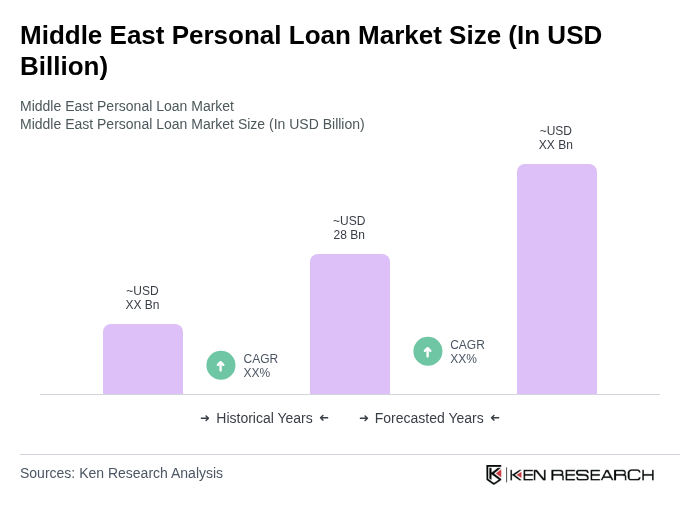
- The Middle East Personal Loan Market is valued at USD 28 billion, based on a five-year historical analysis. This growth is primarily driven by increasing consumer demand for credit, rising disposable incomes, a growing trend towards financial inclusion, rapid digitalisation in consumer lending, and the rise of fintech-driven credit assessment models. The market has seen a significant uptick in personal loan applications as individuals seek financing for various purposes, including home improvements, education, debt consolidation, medical expenses, and lifestyle-driven borrowing.
- Countries such as the United Arab Emirates, Saudi Arabia, and Qatar dominate the Middle East Personal Loan Market due to their robust banking infrastructure, high expatriate populations, and a strong consumer credit culture. The presence of numerous financial institutions and a competitive lending environment further enhance the accessibility of personal loans in these regions, making them key players in the market.
- The Consumer Protection Regulations, 2020 issued by the Central Bank of the UAE require licensed financial institutions to implement comprehensive credit assessments, including evaluation of debt burden ratios not exceeding 50% of monthly income, mandatory affordability checks, and transparent disclosure of all loan terms prior to approval. These regulations mandate lenders to maintain robust risk management frameworks, conduct periodic reviews of borrower financial capacity, and adhere to standardized grievance redressal mechanisms to safeguard consumer interests in the personal loan sector.
Middle East Personal Loan Market Segmentation
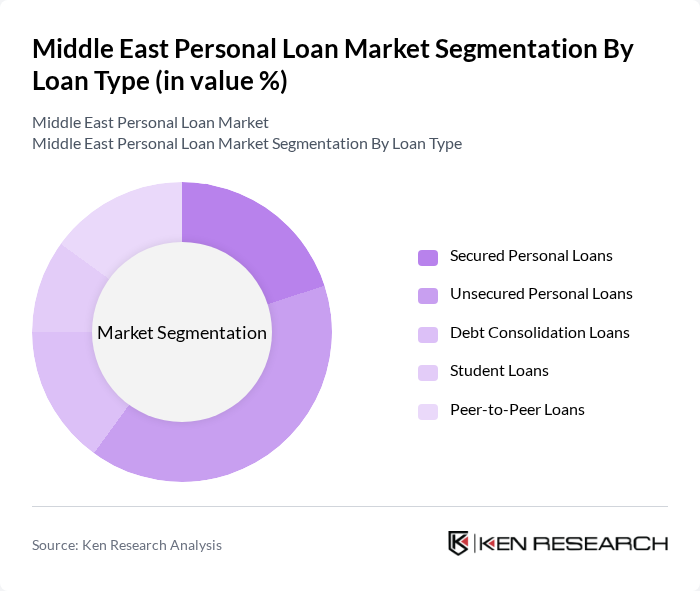
By Loan Type:The segmentation of personal loans by loan type includes various categories that cater to different consumer needs. The primary subsegments are secured personal loans, unsecured personal loans, debt consolidation loans, student loans, and peer-to-peer loans. Among these, unsecured personal loans are particularly popular due to their ease of access and minimal requirements, appealing to a broad range of borrowers.
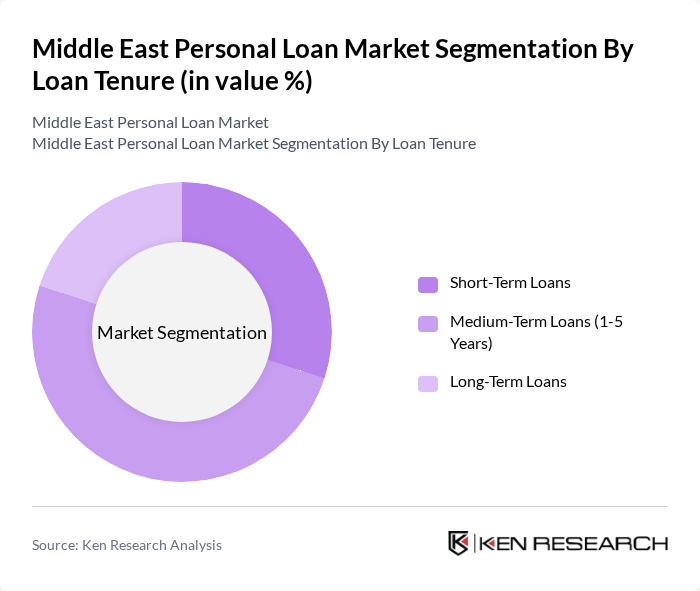
By Loan Tenure:The loan tenure segmentation includes short-term loans, medium-term loans (1-5 years), and long-term loans. Short-term loans are favored by consumers looking for quick financial solutions, while medium and long-term loans are preferred for larger expenses, such as home renovations or education. The flexibility in repayment options across these tenures caters to diverse borrower needs.
Middle East Personal Loan Market Competitive Landscape
The Middle East Personal Loan Market is characterized by a dynamic mix of regional and international players. Leading participants such as Emirates NBD, Qatar National Bank, Abu Dhabi Commercial Bank, National Bank of Kuwait, Al Rajhi Bank, Bank of Sharjah, Mashreq Bank, Saudi National Bank, Dubai Islamic Bank, First Abu Dhabi Bank, Arab Bank, Bank of Bahrain and Kuwait, Kuwait Finance House, Qatar Islamic Bank, Bahrain Islamic Bank contribute to innovation, geographic expansion, and service delivery in this space.
Middle East Personal Loan Market Industry Analysis
Growth Drivers
- Increasing Consumer Demand for Credit:The Middle East has witnessed a significant rise in consumer demand for personal loans, with the total outstanding personal loans reaching approximately $110 billion in future. This surge is driven by a growing middle class, which is projected to increase by 25% in future, leading to higher borrowing needs for education, home improvement, and consumer goods. The World Bank reports that consumer credit in the region has expanded by 12% annually, reflecting a robust appetite for financial products.
- Rising Disposable Income:The average disposable income in the Middle East is expected to rise to $32,000 per capita in future, up from $28,000 in future. This increase is primarily attributed to economic diversification efforts and job creation in non-oil sectors. As disposable income rises, consumers are more likely to seek personal loans for various purposes, including travel and home renovations, thereby driving market growth. The IMF projects a GDP growth rate of 4% for the region, further supporting this trend.
- Expansion of Digital Banking Services:The digital banking sector in the Middle East is rapidly evolving, with over 70% of the population now using online banking services. In future, it is estimated that digital banking penetration will reach 80%, driven by increased smartphone usage and internet accessibility. This shift facilitates easier access to personal loans, as consumers can apply online, leading to a projected increase in loan applications by 30% year-on-year. The rise of fintech companies is also enhancing service delivery and customer experience.
Market Challenges
- High Default Rates:The personal loan default rate in the Middle East is currently around 9%, significantly impacting lenders' profitability. Economic fluctuations and job market instability contribute to this challenge, as many borrowers struggle to meet repayment obligations. The Central Bank of the UAE has reported that defaults have increased by 3% over the past year, prompting lenders to tighten credit assessments and reconsider lending strategies, which may limit access to credit for some consumers.
- Regulatory Compliance Issues:The regulatory landscape for personal loans in the Middle East is complex, with varying requirements across countries. Compliance costs can reach up to $1.2 million annually for lenders, particularly smaller institutions. The introduction of stricter consumer protection laws and anti-money laundering regulations has increased operational burdens. As a result, many lenders face challenges in maintaining compliance while remaining competitive, which can hinder market growth and innovation in loan products.
Middle East Personal Loan Market Future Outlook
The Middle East personal loan market is poised for significant transformation, driven by technological advancements and changing consumer behaviors. As digital banking continues to expand, more consumers will prefer online loan applications, enhancing accessibility. Additionally, the integration of artificial intelligence in credit scoring will improve risk assessment, allowing lenders to offer personalized loan products. The market is expected to adapt to evolving consumer needs, with a focus on financial inclusion and innovative lending solutions that cater to diverse demographics.
Market Opportunities
- Growth of Fintech Solutions:The fintech sector is rapidly expanding, with investments in the Middle East reaching $2 billion in future. This growth presents opportunities for personal loan providers to collaborate with fintech companies, enhancing service delivery and customer engagement. By leveraging technology, lenders can streamline processes and reduce costs, ultimately improving access to credit for underserved populations.
- Increasing Penetration of Mobile Banking:With mobile banking users projected to reach 60 million in future, personal loan providers can tap into this growing market. The convenience of mobile platforms allows consumers to manage their finances and apply for loans seamlessly. This trend is expected to drive a 35% increase in mobile loan applications, providing lenders with a significant opportunity to expand their customer base and enhance service offerings.
Scope of the Report
| Segment | Sub-Segments |
|---|---|
| By Loan Type | Secured Personal Loans Unsecured Personal Loans Debt Consolidation Loans Student Loans Peer-to-Peer Loans |
| By Loan Tenure | Short-Term Loans Medium-Term Loans (1-5 Years) Long-Term Loans |
| By Loan Purpose | Individual Borrowers Debt Consolidation Home Improvement Medical Expenses Emergency Expenses |
| By Lender Type | Banks Credit Unions Online Lenders Peer-to-Peer Lenders |
| By Borrower Segment | First-Time Borrowers Repeat Borrowers High-Net-Worth Individuals Expatriate Populations |
Key Target Audience
Investors and Venture Capitalist Firms
Government and Regulatory Bodies (e.g., Central Bank of the UAE, Saudi Arabian Monetary Authority)
Microfinance Institutions
Non-Banking Financial Companies (NBFCs)
Credit Rating Agencies
Payment Processing Companies
Insurance Providers
Financial Technology (FinTech) Startups
Players Mentioned in the Report:
Emirates NBD
Qatar National Bank
Abu Dhabi Commercial Bank
National Bank of Kuwait
Al Rajhi Bank
Bank of Sharjah
Mashreq Bank
Saudi National Bank
Dubai Islamic Bank
First Abu Dhabi Bank
Arab Bank
Bank of Bahrain and Kuwait
Kuwait Finance House
Qatar Islamic Bank
Bahrain Islamic Bank
Table of Contents
Market Assessment Phase
1. Executive Summary and Approach
2. Middle East Personal Loan Market Overview
2.1 Key Insights and Strategic Recommendations
2.2 Middle East Personal Loan Market Overview
2.3 Definition and Scope
2.4 Evolution of Market Ecosystem
2.5 Timeline of Key Regulatory Milestones
2.6 Value Chain & Stakeholder Mapping
2.7 Business Cycle Analysis
2.8 Policy & Incentive Landscape
3. Middle East Personal Loan Market Analysis
3.1 Growth Drivers
3.1.1 Increasing Consumer Demand for Credit
3.1.2 Rising Disposable Income
3.1.3 Expansion of Digital Banking Services
3.1.4 Government Initiatives to Promote Financial Inclusion
3.2 Market Challenges
3.2.1 High Default Rates
3.2.2 Regulatory Compliance Issues
3.2.3 Limited Financial Literacy Among Consumers
3.2.4 Economic Instability in the Region
3.3 Market Opportunities
3.3.1 Growth of Fintech Solutions
3.3.2 Increasing Penetration of Mobile Banking
3.3.3 Expansion into Underserved Markets
3.3.4 Partnerships with E-commerce Platforms
3.4 Market Trends
3.4.1 Shift Towards Online Loan Applications
3.4.2 Personalization of Loan Products
3.4.3 Integration of AI in Credit Scoring
3.4.4 Rise of Peer-to-Peer Lending Platforms
3.5 Government Regulation
3.5.1 Consumer Protection Laws
3.5.2 Interest Rate Caps
3.5.3 Licensing Requirements for Lenders
3.5.4 Anti-Money Laundering Regulations
4. SWOT Analysis
5. Stakeholder Analysis
6. Porter's Five Forces Analysis
7. Middle East Personal Loan Market Market Size, 2019-2024
7.1 By Value
7.2 By Volume
7.3 By Average Selling Price
8. Middle East Personal Loan Market Segmentation
8.1 By Loan Type
8.1.1 Secured Personal Loans
8.1.2 Unsecured Personal Loans
8.1.3 Debt Consolidation Loans
8.1.4 Student Loans
8.1.5 Peer-to-Peer Loans
8.2 By Loan Tenure
8.2.1 Short-Term Loans
8.2.2 Medium-Term Loans (1-5 Years)
8.2.3 Long-Term Loans
8.3 By Loan Purpose
8.3.1 Individual Borrowers
8.3.2 Debt Consolidation
8.3.3 Home Improvement
8.3.4 Medical Expenses
8.3.5 Emergency Expenses
8.4 By Lender Type
8.4.1 Banks
8.4.2 Credit Unions
8.4.3 Online Lenders
8.4.4 Peer-to-Peer Lenders
8.5 By Borrower Segment
8.5.1 First-Time Borrowers
8.5.2 Repeat Borrowers
8.5.3 High-Net-Worth Individuals
8.5.4 Expatriate Populations
9. Middle East Personal Loan Market Competitive Analysis
9.1 Market Share of Key Players
9.2 Cross Comparison of Key Players
9.2.1 Company Name
9.2.2 Group Size (Large, Medium, or Small as per industry convention)
9.2.3 Loan Approval Rate (%)
9.2.4 Average Loan Amount Disbursed (USD)
9.2.5 Default Rate (%)
9.2.6 Customer Retention Rate (%)
9.2.7 Average Interest Rate (%)
9.2.8 Net Promoter Score (NPS)
9.2.9 Year-over-Year Revenue Growth Rate (%)
9.2.10 Digital Loan Origination Volume (Units)
9.3 SWOT Analysis of Top Players
9.4 Pricing Analysis
9.5 Detailed Profile of Major Companies
9.5.1 Emirates NBD
9.5.2 Qatar National Bank
9.5.3 Abu Dhabi Commercial Bank
9.5.4 National Bank of Kuwait
9.5.5 Al Rajhi Bank
9.5.6 Bank of Sharjah
9.5.7 Mashreq Bank
9.5.8 Saudi National Bank
9.5.9 Dubai Islamic Bank
9.5.10 First Abu Dhabi Bank
9.5.11 Arab Bank
9.5.12 Bank of Bahrain and Kuwait
9.5.13 Kuwait Finance House
9.5.14 Qatar Islamic Bank
9.5.15 Bahrain Islamic Bank
10. Middle East Personal Loan Market End-User Analysis
10.1 Procurement Behavior of Key Ministries
10.1.1 Loan Application Processes
10.1.2 Approval Timelines
10.1.3 Preferred Loan Types
10.1.4 Budget Allocations
10.2 Corporate Spend on Infrastructure & Energy
10.2.1 Investment Trends
10.2.2 Financing Sources
10.2.3 Loan Utilization
10.2.4 Future Projections
10.3 Pain Point Analysis by End-User Category
10.3.1 Access to Credit
10.3.2 Interest Rate Concerns
10.3.3 Loan Processing Delays
10.3.4 Customer Service Issues
10.4 User Readiness for Adoption
10.4.1 Awareness Levels
10.4.2 Technology Adoption
10.4.3 Financial Literacy
10.4.4 Trust in Financial Institutions
10.5 Post-Deployment ROI and Use Case Expansion
10.5.1 Performance Metrics
10.5.2 Customer Feedback
10.5.3 Future Investment Plans
10.5.4 Market Expansion Opportunities
11. Middle East Personal Loan Market Future Size, 2025-2030
11.1 By Value
11.2 By Volume
11.3 By Average Selling Price
Go-To-Market Strategy Phase
1. Whitespace Analysis + Business Model Canvas
1.1 Market Gaps Identification
1.2 Business Model Framework
2. Marketing and Positioning Recommendations
2.1 Branding Strategies
2.2 Product USPs
3. Distribution Plan
3.1 Urban Retail vs Rural NGO Tie-ups
4. Channel & Pricing Gaps
4.1 Underserved Routes
4.2 Pricing Bands
5. Unmet Demand & Latent Needs
5.1 Category Gaps
5.2 Consumer Segments
6. Customer Relationship
6.1 Loyalty Programs
6.2 After-sales Service
7. Value Proposition
7.1 Sustainability
7.2 Integrated Supply Chains
8. Key Activities
8.1 Regulatory Compliance
8.2 Branding
8.3 Distribution Setup
9. Entry Strategy Evaluation
9.1 Domestic Market Entry Strategy
9.1.1 Product Mix
9.1.2 Pricing Band
9.1.3 Packaging
9.2 Export Entry Strategy
9.2.1 Target Countries
9.2.2 Compliance Roadmap
10. Entry Mode Assessment
10.1 JV
10.2 Greenfield
10.3 M&A
10.4 Distributor Model
11. Capital and Timeline Estimation
11.1 Capital Requirements
11.2 Timelines
12. Control vs Risk Trade-Off
12.1 Ownership vs Partnerships
13. Profitability Outlook
13.1 Breakeven Analysis
13.2 Long-term Sustainability
14. Potential Partner List
14.1 Distributors
14.2 JVs
14.3 Acquisition Targets
15. Execution Roadmap
15.1 Phased Plan for Market Entry
15.1.1 Market Setup
15.1.2 Market Entry
15.1.3 Growth Acceleration
15.1.4 Scale & Stabilize
15.2 Key Activities and Milestones
15.2.1 Activity Timeline
15.2.2 Milestone Tracking
Research Methodology
Phase 1: Approach1
Desk Research
- Analysis of financial reports from leading banks and financial institutions in the Middle East
- Review of market studies and white papers published by regional financial analysts
- Examination of government publications and regulatory frameworks affecting personal loans
Primary Research
- Interviews with financial advisors and loan officers from major banks
- Surveys targeting consumers who have recently taken personal loans
- Focus groups with potential borrowers to understand their preferences and concerns
Validation & Triangulation
- Cross-validation of findings with data from multiple financial institutions
- Triangulation of consumer insights with macroeconomic indicators
- Sanity checks through expert panel discussions with industry veterans
Phase 2: Market Size Estimation1
Top-down Assessment
- Estimation of total personal loan market size based on GDP growth and consumer spending trends
- Segmentation of the market by demographics, including age, income, and employment status
- Incorporation of regional economic forecasts and banking sector growth rates
Bottom-up Modeling
- Collection of data on loan disbursement volumes from major banks and financial institutions
- Analysis of average loan amounts and interest rates across different customer segments
- Calculation of market size based on the number of loans issued and average loan value
Forecasting & Scenario Analysis
- Multi-variable forecasting using economic indicators such as inflation and employment rates
- Scenario analysis based on potential regulatory changes and market disruptions
- Development of baseline, optimistic, and pessimistic growth projections through 2030
Phase 3: CATI Sample Composition1
| Scope Item/Segment | Sample Size | Target Respondent Profiles |
|---|---|---|
| Consumer Personal Loan Borrowers | 120 | Individuals aged 25-45, employed, with recent loan experience |
| Bank Loan Officers | 80 | Loan officers from major banks, with at least 3 years of experience |
| Financial Advisors | 60 | Certified financial planners and advisors working in the region |
| Potential Borrowers | 100 | Individuals considering personal loans, aged 18-30 |
| Regulatory Experts | 40 | Professionals with expertise in financial regulations and compliance |
Frequently Asked Questions
What is the current value of the Middle East Personal Loan Market?
The Middle East Personal Loan Market is valued at approximately USD 28 billion, driven by increasing consumer demand for credit, rising disposable incomes, and the growth of fintech solutions in the region.
Which countries dominate the Middle East Personal Loan Market?
What are the main types of personal loans available in the Middle East?
What factors are driving growth in the Middle East Personal Loan Market?
Other Regional/Country Reports
Other Adjacent Reports
Kuwait Debt Consolidation Market
Germany Student Loan Market
China Auto Loan MarketBrazil Mortgage Market
Oman Credit Card Market Size, Share, Growth Trends & Forecast 2025–2030India Peer-to-Peer Lending Market Outlook to 2030Kuwait Digital Banking Market Size, Share, Opportunities, Trends & Forecast 2025–2030Why Buy From Us?

What makes us stand out is that our consultants follow Robust, Refine and Result (RRR) methodology. Robust for clear definitions, approaches and sanity checking, Refine for differentiating respondents' facts and opinions, and Result for presenting data with story.

We have set a benchmark in the industry by offering our clients with syndicated and customized market research reports featuring coverage of entire market as well as meticulous research and analyst insights.

While we don't replace traditional research, we flip the method upside down. Our dual approach of Top Bottom & Bottom Top ensures quality deliverable by not just verifying company fundamentals but also looking at the sector and macroeconomic factors.

With one step in the future, our research team constantly tries to show you the bigger picture. We help with some of the tough questions you may encounter along the way: How is the industry positioned? Best marketing channel? KPI's of competitors? By aligning every element, we help maximize success.

Our report gives you instant access to the answers and sources that other companies might choose to hide. We elaborate each steps of research methodology we have used and showcase you the sample size to earn your trust.

If you need any support, we are here! We pride ourselves on universe strength, data quality, and quick, friendly, and professional service.