Region:Middle East
Author(s):Rebecca
Product Code:KRAA6472
Pages:96
Published On:January 2026
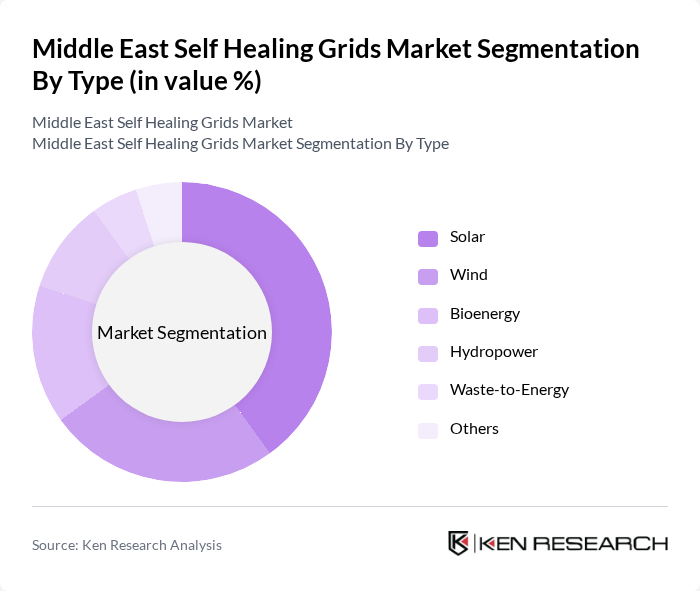
By Type:The segmentation by type includes various energy sources utilized in self-healing grids. The primary subsegments are Solar, Wind, Bioenergy, Hydropower, Waste-to-Energy, and Others. Among these, Solar energy is currently the leading subsegment due to its abundant availability and decreasing costs, making it a preferred choice for both residential and commercial applications. Wind energy is also gaining traction, particularly in coastal regions, while Bioenergy and Waste-to-Energy are emerging as sustainable alternatives.
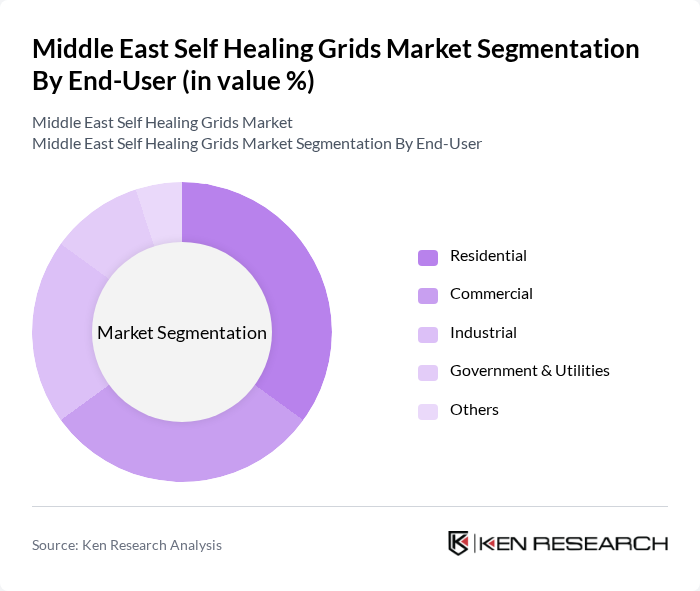
By End-User:The end-user segmentation includes Residential, Commercial, Industrial, Government & Utilities, and Others. The Residential segment is currently the largest due to the increasing adoption of smart home technologies and the growing awareness of energy efficiency among consumers. The Commercial sector is also expanding rapidly as businesses seek to reduce operational costs and enhance sustainability. Industrial applications are gaining momentum as manufacturers invest in advanced energy solutions.
The Middle East Self Healing Grids Market is characterized by a dynamic mix of regional and international players. Leading participants such as Siemens AG, Schneider Electric, ABB Ltd., General Electric, Honeywell International Inc., Mitsubishi Electric Corporation, Eaton Corporation, Enel Green Power, First Solar, Inc., Vestas Wind Systems A/S, NextEra Energy, Inc., Canadian Solar Inc., JinkoSolar Holding Co., Ltd., Trina Solar Limited, Orsted A/S contribute to innovation, geographic expansion, and service delivery in this space.
The future of the Middle East self-healing grids market appears promising, driven by increasing investments in smart grid technologies and a strong push for renewable energy integration. As governments set ambitious renewable energy targets, the demand for innovative grid solutions will rise. Furthermore, advancements in AI and IoT will enhance grid management capabilities, leading to improved reliability and efficiency. The collaboration between public and private sectors will be crucial in overcoming existing challenges and unlocking the full potential of self-healing grids in the region.
| Segment | Sub-Segments |
|---|---|
| By Type (e.g., Solar, Wind, Bioenergy, Hydropower, Waste-to-Energy) | Solar Wind Bioenergy Hydropower Waste-to-Energy Others |
| By End-User (Residential, Commercial, Industrial, Government & Utilities) | Residential Commercial Industrial Government & Utilities Others |
| By Region (Gulf Cooperation Council, Levant, North Africa) | Gulf Cooperation Council Levant North Africa |
| By Technology (Photovoltaic, CSP, Onshore/Offshore Wind, Biomass Gasification) | Photovoltaic CSP Onshore Wind Offshore Wind Biomass Gasification Others |
| By Application (Grid-Connected, Off-Grid, Rooftop Installations, Utility-Scale Projects) | Grid-Connected Off-Grid Rooftop Installations Utility-Scale Projects Others |
| By Investment Source (Domestic, FDI, PPP, Government Schemes) | Domestic FDI PPP Government Schemes Others |
| By Policy Support (Subsidies, Tax Exemptions, RECs) | Subsidies Tax Exemptions RECs Others |
| Scope Item/Segment | Sample Size | Target Respondent Profiles |
|---|---|---|
| Self-Healing Product Users | 120 | Consumers, Wellness Enthusiasts |
| Practitioners of Alternative Therapies | 90 | Holistic Health Coaches, Therapists |
| Health and Wellness Influencers | 70 | Bloggers, Social Media Influencers |
| Retailers of Wellness Products | 60 | Store Managers, Product Buyers |
| Healthcare Professionals | 80 | Doctors, Nutritionists, Wellness Advisors |
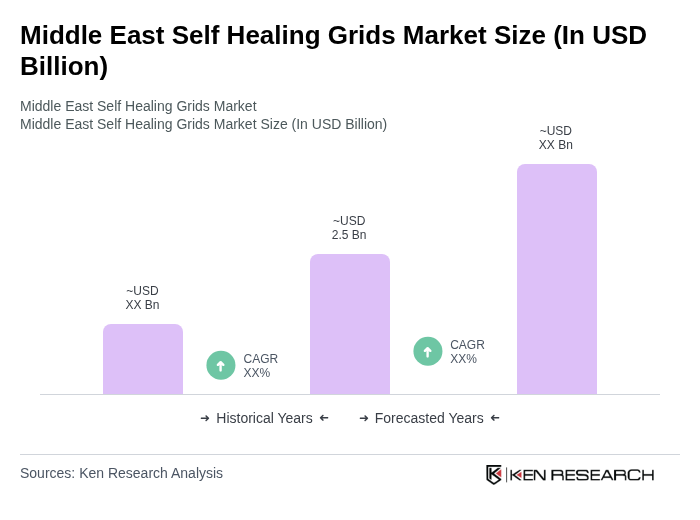
The Middle East Self Healing Grids Market is valued at approximately USD 2.5 billion, driven by the demand for efficient energy distribution systems and investments in smart grid technologies, along with advancements in grid analytics and cybersecurity measures.

What makes us stand out is that our consultants follow Robust, Refine and Result (RRR) methodology. Robust for clear definitions, approaches and sanity checking, Refine for differentiating respondents' facts and opinions, and Result for presenting data with story.

We have set a benchmark in the industry by offering our clients with syndicated and customized market research reports featuring coverage of entire market as well as meticulous research and analyst insights.

While we don't replace traditional research, we flip the method upside down. Our dual approach of Top Bottom & Bottom Top ensures quality deliverable by not just verifying company fundamentals but also looking at the sector and macroeconomic factors.

With one step in the future, our research team constantly tries to show you the bigger picture. We help with some of the tough questions you may encounter along the way: How is the industry positioned? Best marketing channel? KPI's of competitors? By aligning every element, we help maximize success.

Our report gives you instant access to the answers and sources that other companies might choose to hide. We elaborate each steps of research methodology we have used and showcase you the sample size to earn your trust.

If you need any support, we are here! We pride ourselves on universe strength, data quality, and quick, friendly, and professional service.













