About the Report
Base Year 2024New Zealand Foodservice Market Overview
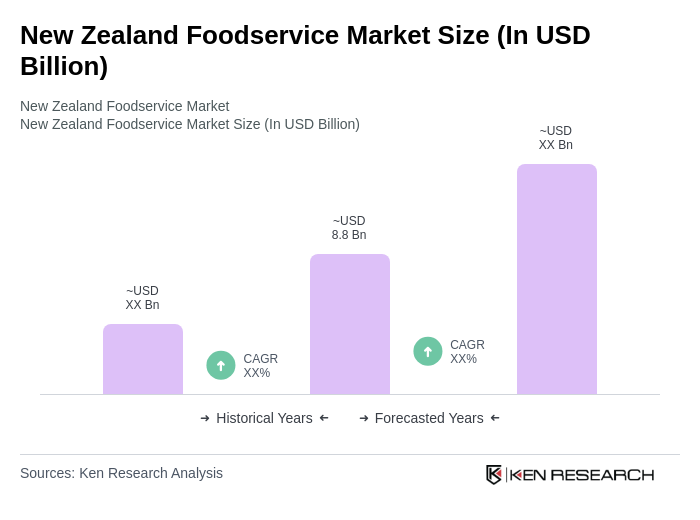
- The New Zealand Foodservice Market is valued at USD 8.8 billion, based on a five-year historical analysis. This growth is primarily driven by increasing consumer demand for diverse dining options, the expansion of food delivery services, and a pronounced trend towards health-conscious and sustainable eating. The market has seen a significant shift towards convenience, quality, and experience-based dining, with consumers willing to spend more on premium and unique food experiences. The rise of online ordering, sustainability initiatives, and menu personalization are further accelerating market development .
- Auckland, Wellington, and Christchurch are the dominant cities in the New Zealand Foodservice Market. Auckland, as the largest city, features a vibrant food culture and a high concentration of restaurants and cafes. Wellington is recognized for its culinary innovation and thriving café scene, while Christchurch has revitalized its food offerings post-earthquake, making these cities key players in the national market .
- The Food Act 2014, administered by the Ministry for Primary Industries, is the principal regulation governing food safety in New Zealand foodservice establishments. This legislation mandates risk-based measures, including registration, regular audits, and compliance with strict hygiene and safety standards for all food businesses. The Act covers all aspects of food preparation and service, ensuring that foodservice operators implement robust food control plans or national programmes, thereby safeguarding public health and enhancing consumer confidence .
New Zealand Foodservice Market Segmentation
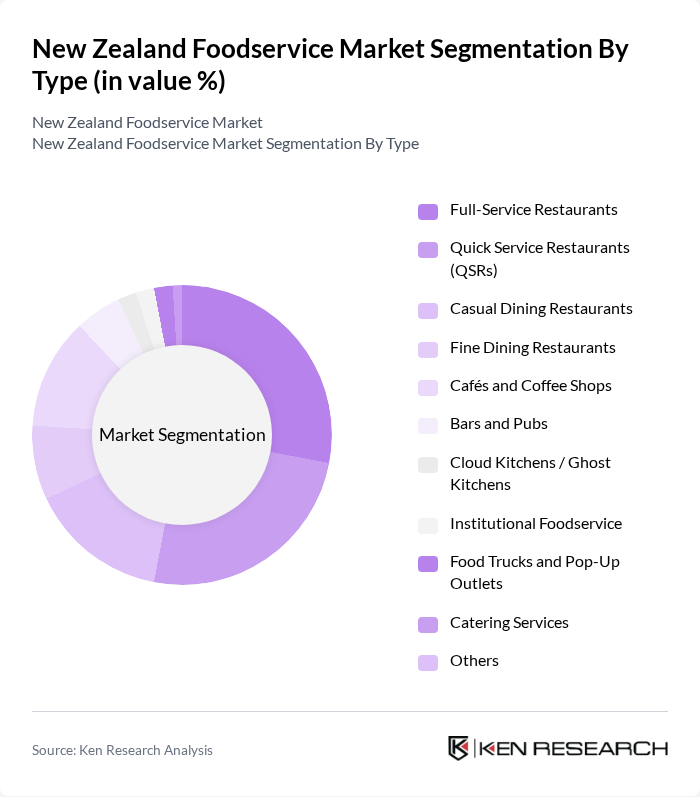
By Type:The foodservice market in New Zealand can be segmented into Full-Service Restaurants, Quick Service Restaurants (QSRs), Casual Dining Restaurants, Fine Dining Restaurants, Cafés and Coffee Shops, Bars and Pubs, Cloud Kitchens / Ghost Kitchens, Institutional Foodservice (Schools, Hospitals, Corporate Cafeterias), Food Trucks and Pop-Up Outlets, Catering Services, and Others. Among these, Full-Service Restaurants represent the leading segment by revenue, supported by strong consumer demand for premium dining experiences. Quick Service Restaurants (QSRs) remain highly competitive, driven by their convenience, affordability, and the rapid adoption of online ordering and delivery platforms. Cafés and Coffee Shops are also prominent, reflecting New Zealand’s strong café culture and preference for specialty coffee and casual dining .
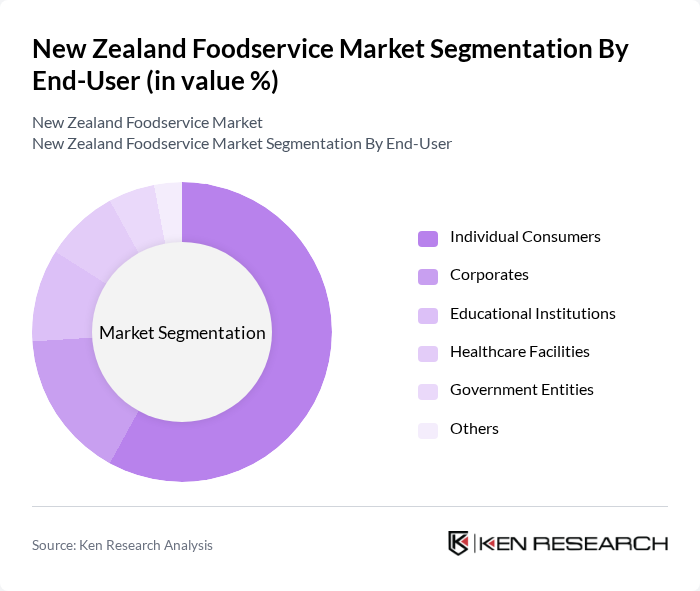
By End-User:The end-user segmentation of the foodservice market includes Individual Consumers, Corporates, Educational Institutions, Healthcare Facilities, Government Entities, and Others. Individual Consumers represent the largest segment, driven by the increasing trend of dining out, the popularity of food delivery services, and the demand for convenience and personalized dining experiences. Corporates and institutions contribute steadily, supported by catering and institutional foodservice contracts .
New Zealand Foodservice Market Competitive Landscape
The New Zealand Foodservice Market is characterized by a dynamic mix of regional and international players. Leading participants such as Restaurant Brands New Zealand Limited, McDonald's New Zealand, Domino's Pizza Enterprises Limited, Foodstuffs North Island Limited, Restaurant Association of New Zealand, Silver Chef Limited, The Coffee Club New Zealand, BurgerFuel Worldwide Limited, Hell Pizza, Pita Pit New Zealand, Nando's New Zealand, KFC New Zealand, Subway New Zealand, St Pierre's Sushi, Little India, Columbus Coffee, Wendy's Supa Sundaes New Zealand, Mexicali Fresh, Lone Star New Zealand, Starbucks New Zealand contribute to innovation, geographic expansion, and service delivery in this space.
New Zealand Foodservice Market Industry Analysis
Growth Drivers
- Increasing Consumer Demand for Convenience:The New Zealand foodservice market is experiencing a surge in consumer demand for convenience, with 60% of consumers preferring ready-to-eat meals. This trend is driven by busy lifestyles, particularly in urban areas like Auckland, where 1.8 million residents seek quick dining options. The convenience sector is projected to grow, supported by a 4% increase in disposable income, allowing consumers to spend more on food services that save time.
- Growth of Online Food Delivery Services:Online food delivery services in New Zealand have seen a remarkable growth, with a market value of NZD 1.3 billion. This growth is fueled by a 30% increase in smartphone penetration, enabling easier access to food delivery apps. Additionally, the COVID-19 pandemic has accelerated this trend, with 45% of consumers now regularly using delivery services, indicating a shift in dining preferences towards digital platforms.
- Rising Health Consciousness Among Consumers:Health consciousness is reshaping the New Zealand foodservice landscape, with 75% of consumers actively seeking healthier menu options. This shift is reflected in the 20% increase in sales of organic and health-focused food items in restaurants. The government’s health initiatives, aiming to reduce obesity rates, further support this trend, encouraging foodservice providers to innovate and offer nutritious meals that cater to health-aware consumers.
Market Challenges
- High Competition Among Foodservice Providers:The New Zealand foodservice market is characterized by intense competition, with over 32,000 registered foodservice establishments. This saturation leads to price wars and reduced profit margins, with average profit margins declining to 4% in the current period. New entrants face significant barriers, including brand loyalty and established customer bases, making it challenging to capture market share in this competitive environment.
- Fluctuating Food Prices:Fluctuating food prices pose a significant challenge for foodservice providers in New Zealand. In the current period, food inflation reached 7%, driven by supply chain disruptions and global commodity price increases. This volatility affects menu pricing strategies, forcing operators to either absorb costs or pass them onto consumers, which can lead to decreased customer satisfaction and reduced sales, particularly in price-sensitive segments of the market.
New Zealand Foodservice Market Future Outlook
The New Zealand foodservice market is poised for dynamic growth, driven by evolving consumer preferences and technological advancements. The increasing integration of digital ordering systems and the rise of ghost kitchens are expected to reshape the competitive landscape. Additionally, the focus on sustainability and local sourcing will likely influence menu offerings, aligning with consumer demand for transparency and ethical practices. As the market adapts, foodservice providers must innovate to meet these changing expectations while navigating regulatory challenges.
Market Opportunities
- Growth in Plant-Based Menu Options:The demand for plant-based menu options is rapidly increasing, with a 25% rise in sales of vegetarian and vegan dishes. This trend presents a significant opportunity for foodservice providers to diversify their offerings and attract health-conscious consumers, particularly in urban areas where dietary preferences are shifting towards sustainable and ethical eating habits.
- Increasing Demand for Sustainable Practices:Sustainability is becoming a key focus for consumers, with 70% of New Zealanders willing to pay more for eco-friendly dining options. This trend encourages foodservice operators to adopt sustainable practices, such as reducing food waste and sourcing local ingredients, which can enhance brand loyalty and attract environmentally conscious customers, ultimately driving growth in this segment.
Scope of the Report
| Segment | Sub-Segments |
|---|---|
| By Type | Full-Service Restaurants Quick Service Restaurants (QSRs) Casual Dining Restaurants Fine Dining Restaurants Cafés and Coffee Shops Bars and Pubs Cloud Kitchens / Ghost Kitchens Institutional Foodservice (Schools, Hospitals, Corporate Cafeterias) Food Trucks and Pop-Up Outlets Catering Services Others |
| By End-User | Individual Consumers Corporates Educational Institutions Healthcare Facilities Government Entities Others |
| By Distribution Channel | Direct Sales Online Delivery Platforms Third-Party Distributors Retail Outlets Others |
| By Cuisine Type | Asian Cuisine European Cuisine American Cuisine Middle Eastern Cuisine Pacific/Polynesian Cuisine Fusion Cuisine Others |
| By Service Style | Dine-In Takeaway Delivery Buffet Others |
| By Price Range | Budget Mid-Range Premium Luxury Others |
| By Customer Demographics | Age Groups Income Levels Family Size Lifestyle Preferences Others |
Key Target Audience
Investors and Venture Capitalist Firms
Government and Regulatory Bodies (e.g., Ministry for Primary Industries, Food Safety Authority)
Manufacturers and Producers
Distributors and Retailers
Foodservice Operators (e.g., Restaurants, Cafés, Catering Services)
Hospitality Management Companies
Industry Associations (e.g., Restaurant Association of New Zealand)
Financial Institutions
Players Mentioned in the Report:
Restaurant Brands New Zealand Limited
McDonald's New Zealand
Domino's Pizza Enterprises Limited
Foodstuffs North Island Limited
Restaurant Association of New Zealand
Silver Chef Limited
The Coffee Club New Zealand
BurgerFuel Worldwide Limited
Hell Pizza
Pita Pit New Zealand
Nando's New Zealand
KFC New Zealand
Subway New Zealand
St Pierre's Sushi
Little India
Columbus Coffee
Wendy's Supa Sundaes New Zealand
Mexicali Fresh
Lone Star New Zealand
Starbucks New Zealand
Table of Contents
Market Assessment Phase
1. Executive Summary and Approach
2. New Zealand Foodservice Market Overview
2.1 Key Insights and Strategic Recommendations
2.2 New Zealand Foodservice Market Overview
2.3 Definition and Scope
2.4 Evolution of Market Ecosystem
2.5 Timeline of Key Regulatory Milestones
2.6 Value Chain & Stakeholder Mapping
2.7 Business Cycle Analysis
2.8 Policy & Incentive Landscape
3. New Zealand Foodservice Market Analysis
3.1 Growth Drivers
3.1.1 Increasing Consumer Demand for Convenience
3.1.2 Growth of Online Food Delivery Services
3.1.3 Rising Health Consciousness Among Consumers
3.1.4 Expansion of International Cuisine Offerings
3.2 Market Challenges
3.2.1 High Competition Among Foodservice Providers
3.2.2 Fluctuating Food Prices
3.2.3 Regulatory Compliance Costs
3.2.4 Labor Shortages in the Hospitality Sector
3.3 Market Opportunities
3.3.1 Growth in Plant-Based Menu Options
3.3.2 Increasing Demand for Sustainable Practices
3.3.3 Expansion of Food Trucks and Pop-Up Restaurants
3.3.4 Technological Innovations in Ordering Systems
3.4 Market Trends
3.4.1 Rise of Ghost Kitchens
3.4.2 Focus on Local Sourcing of Ingredients
3.4.3 Integration of AI in Customer Service
3.4.4 Emphasis on Food Safety and Hygiene Standards
3.5 Government Regulation
3.5.1 Food Safety Standards Compliance
3.5.2 Employment and Labor Laws
3.5.3 Environmental Regulations on Waste Management
3.5.4 Licensing and Permitting Requirements
4. SWOT Analysis
5. Stakeholder Analysis
6. Porter's Five Forces Analysis
7. New Zealand Foodservice Market Market Size, 2019-2024
7.1 By Value
7.2 By Volume
7.3 By Average Selling Price
8. New Zealand Foodservice Market Segmentation
8.1 By Type
8.1.1 Full-Service Restaurants
8.1.2 Quick Service Restaurants (QSRs)
8.1.3 Casual Dining Restaurants
8.1.4 Fine Dining Restaurants
8.1.5 Cafés and Coffee Shops
8.1.6 Bars and Pubs
8.1.7 Cloud Kitchens / Ghost Kitchens
8.1.8 Institutional Foodservice (Schools, Hospitals, Corporate Cafeterias)
8.1.9 Food Trucks and Pop-Up Outlets
8.1.10 Catering Services
8.1.11 Others
8.2 By End-User
8.2.1 Individual Consumers
8.2.2 Corporates
8.2.3 Educational Institutions
8.2.4 Healthcare Facilities
8.2.5 Government Entities
8.2.6 Others
8.3 By Distribution Channel
8.3.1 Direct Sales
8.3.2 Online Delivery Platforms
8.3.3 Third-Party Distributors
8.3.4 Retail Outlets
8.3.5 Others
8.4 By Cuisine Type
8.4.1 Asian Cuisine
8.4.2 European Cuisine
8.4.3 American Cuisine
8.4.4 Middle Eastern Cuisine
8.4.5 Pacific/Polynesian Cuisine
8.4.6 Fusion Cuisine
8.4.7 Others
8.5 By Service Style
8.5.1 Dine-In
8.5.2 Takeaway
8.5.3 Delivery
8.5.4 Buffet
8.5.5 Others
8.6 By Price Range
8.6.1 Budget
8.6.2 Mid-Range
8.6.3 Premium
8.6.4 Luxury
8.6.5 Others
8.7 By Customer Demographics
8.7.1 Age Groups
8.7.2 Income Levels
8.7.3 Family Size
8.7.4 Lifestyle Preferences
8.7.5 Others
9. New Zealand Foodservice Market Competitive Analysis
9.1 Market Share of Key Players
9.2 Cross Comparison of Key Players
9.2.1 Company Name
9.2.2 Group Size (Large, Medium, or Small as per industry convention)
9.2.3 Revenue Growth Rate (YoY %)
9.2.4 Number of Outlets (Nationally)
9.2.5 Customer Retention Rate (%)
9.2.6 Average Order Value (NZD)
9.2.7 Market Penetration Rate (%)
9.2.8 Pricing Strategy (Value, Mid-Range, Premium)
9.2.9 Service Quality Rating (Customer Review Score)
9.2.10 Menu Diversification Index (Number of Cuisines/Menu Items)
9.2.11 Operational Efficiency Ratio (Revenue per Employee or per Outlet)
9.2.12 Digital Engagement (App Downloads, Online Orders %)
9.3 SWOT Analysis of Top Players
9.4 Pricing Analysis
9.5 Detailed Profile of Major Companies
9.5.1 Restaurant Brands New Zealand Limited
9.5.2 McDonald's New Zealand
9.5.3 Domino's Pizza Enterprises Limited
9.5.4 Foodstuffs North Island Limited
9.5.5 Restaurant Association of New Zealand
9.5.6 Silver Chef Limited
9.5.7 The Coffee Club New Zealand
9.5.8 BurgerFuel Worldwide Limited
9.5.9 Hell Pizza
9.5.10 Pita Pit New Zealand
9.5.11 Nando's New Zealand
9.5.12 KFC New Zealand
9.5.13 Subway New Zealand
9.5.14 St Pierre's Sushi
9.5.15 Little India
9.5.16 Columbus Coffee
9.5.17 Wendy's Supa Sundaes New Zealand
9.5.18 Mexicali Fresh
9.5.19 Lone Star New Zealand
9.5.20 Starbucks New Zealand
10. New Zealand Foodservice Market End-User Analysis
10.1 Procurement Behavior of Key Ministries
10.1.1 Budget Allocation Trends
10.1.2 Preferred Suppliers
10.1.3 Contracting Processes
10.1.4 Compliance Requirements
10.2 Corporate Spend on Infrastructure & Energy
10.2.1 Investment in Sustainable Practices
10.2.2 Infrastructure Development Plans
10.2.3 Energy Efficiency Initiatives
10.3 Pain Point Analysis by End-User Category
10.3.1 Quality of Service Issues
10.3.2 Pricing Concerns
10.3.3 Availability of Diverse Menu Options
10.4 User Readiness for Adoption
10.4.1 Technology Adoption Rates
10.4.2 Training and Support Needs
10.5 Post-Deployment ROI and Use Case Expansion
10.5.1 Measurement of Success Metrics
10.5.2 Opportunities for Upselling
11. New Zealand Foodservice Market Future Size, 2025-2030
11.1 By Value
11.2 By Volume
11.3 By Average Selling Price
Go-To-Market Strategy Phase
1. Whitespace Analysis + Business Model Canvas
1.1 Market Gaps Identification
1.2 Value Proposition Development
1.3 Revenue Streams Analysis
1.4 Cost Structure Evaluation
1.5 Key Partnerships Exploration
1.6 Customer Segments Definition
1.7 Channels Strategy
2. Marketing and Positioning Recommendations
2.1 Branding Strategies
2.2 Product USPs
2.3 Target Audience Identification
2.4 Marketing Channels Selection
2.5 Campaign Planning
3. Distribution Plan
3.1 Urban Retail vs Rural NGO Tie-Ups
3.2 Logistics and Supply Chain Management
3.3 Distribution Partnerships
4. Channel & Pricing Gaps
4.1 Underserved Routes
4.2 Pricing Bands
4.3 Competitive Pricing Analysis
5. Unmet Demand & Latent Needs
5.1 Category Gaps
5.2 Consumer Segments
5.3 Emerging Trends
6. Customer Relationship
6.1 Loyalty Programs
6.2 After-Sales Service
6.3 Customer Feedback Mechanisms
7. Value Proposition
7.1 Sustainability
7.2 Integrated Supply Chains
7.3 Unique Selling Points
8. Key Activities
8.1 Regulatory Compliance
8.2 Branding
8.3 Distribution Setup
9. Entry Strategy Evaluation
9.1 Domestic Market Entry Strategy
9.1.1 Product Mix
9.1.2 Pricing Band
9.1.3 Packaging
9.2 Export Entry Strategy
9.2.1 Target Countries
9.2.2 Compliance Roadmap
10. Entry Mode Assessment
10.1 JV
10.2 Greenfield
10.3 M&A
10.4 Distributor Model
11. Capital and Timeline Estimation
11.1 Capital Requirements
11.2 Timelines
12. Control vs Risk Trade-Off
12.1 Ownership vs Partnerships
13. Profitability Outlook
13.1 Breakeven Analysis
13.2 Long-Term Sustainability
14. Potential Partner List
14.1 Distributors
14.2 JVs
14.3 Acquisition Targets
15. Execution Roadmap
15.1 Phased Plan for Market Entry
15.1.1 Market Setup
15.1.2 Market Entry
15.1.3 Growth Acceleration
15.1.4 Scale & Stabilize
15.2 Key Activities and Milestones
15.2.1 Milestone Planning
15.2.2 Activity Tracking
Research Methodology
Phase 1: Approach1
Desk Research
- Analysis of industry reports from New Zealand's Ministry for Primary Industries
- Review of market trends and consumer behavior studies published by Food and Grocery Council
- Examination of trade publications and market analysis from local foodservice associations
Primary Research
- Interviews with key stakeholders in the foodservice industry, including restaurant owners and chefs
- Surveys conducted with food suppliers and distributors to gather insights on market dynamics
- Focus groups with consumers to understand dining preferences and trends in foodservice
Validation & Triangulation
- Cross-validation of findings through multiple data sources, including government statistics and industry reports
- Triangulation of qualitative insights from interviews with quantitative data from surveys
- Sanity checks through expert panel reviews comprising industry veterans and market analysts
Phase 2: Market Size Estimation1
Top-down Assessment
- Estimation of total foodservice market size based on national food expenditure data
- Segmentation of the market by type of foodservice (e.g., full-service restaurants, fast food, catering)
- Incorporation of growth rates from historical data and economic indicators
Bottom-up Modeling
- Collection of sales data from a representative sample of foodservice establishments
- Estimation of average transaction values and customer footfall across different segments
- Calculation of market size based on aggregated data from individual operators
Forecasting & Scenario Analysis
- Development of forecasting models using historical growth rates and economic forecasts
- Scenario analysis based on potential impacts of regulatory changes and consumer trends
- Creation of baseline, optimistic, and pessimistic projections for the next five years
Phase 3: CATI Sample Composition1
| Scope Item/Segment | Sample Size | Target Respondent Profiles |
|---|---|---|
| Full-Service Restaurants | 60 | Restaurant Owners, Head Chefs |
| Fast Food Chains | 50 | Franchise Managers, Operations Directors |
| Catering Services | 40 | Catering Managers, Event Coordinators |
| Food Delivery Services | 45 | Logistics Managers, Marketing Directors |
| Consumer Preferences | 100 | Regular Diners, Food Enthusiasts |
Frequently Asked Questions
What is the current value of the New Zealand Foodservice Market?
The New Zealand Foodservice Market is valued at approximately USD 8.8 billion, reflecting a significant growth trend driven by consumer demand for diverse dining options, food delivery services, and a focus on health-conscious eating.
Which cities are the key players in the New Zealand Foodservice Market?
What are the main segments of the New Zealand Foodservice Market?
What drives growth in the New Zealand Foodservice Market?
Other Regional/Country Reports
Other Adjacent Reports
Egypt Food Delivery Services Market
Malaysia Hospitality Technology Market
Europe Sustainable Packaging Market Size, Share & Forecast 2025-2031Indonesia Plant-Based Food Market
Germany Beverage Manufacturing Market
Thailand Commercial Kitchen Equipment Market
Kuwait Food Safety Compliance Market
Kuwait Catering Services Market Outlook to 2030: Size, Share, Growth and TrendsUAE Tourism Hospitality Market
Malaysia Online Ordering Platform Market
Why Buy From Us?

What makes us stand out is that our consultants follow Robust, Refine and Result (RRR) methodology. Robust for clear definitions, approaches and sanity checking, Refine for differentiating respondents' facts and opinions, and Result for presenting data with story.

We have set a benchmark in the industry by offering our clients with syndicated and customized market research reports featuring coverage of entire market as well as meticulous research and analyst insights.

While we don't replace traditional research, we flip the method upside down. Our dual approach of Top Bottom & Bottom Top ensures quality deliverable by not just verifying company fundamentals but also looking at the sector and macroeconomic factors.

With one step in the future, our research team constantly tries to show you the bigger picture. We help with some of the tough questions you may encounter along the way: How is the industry positioned? Best marketing channel? KPI's of competitors? By aligning every element, we help maximize success.

Our report gives you instant access to the answers and sources that other companies might choose to hide. We elaborate each steps of research methodology we have used and showcase you the sample size to earn your trust.

If you need any support, we are here! We pride ourselves on universe strength, data quality, and quick, friendly, and professional service.