Region:Middle East
Author(s):Shubham
Product Code:KRAA8746
Pages:84
Published On:November 2025
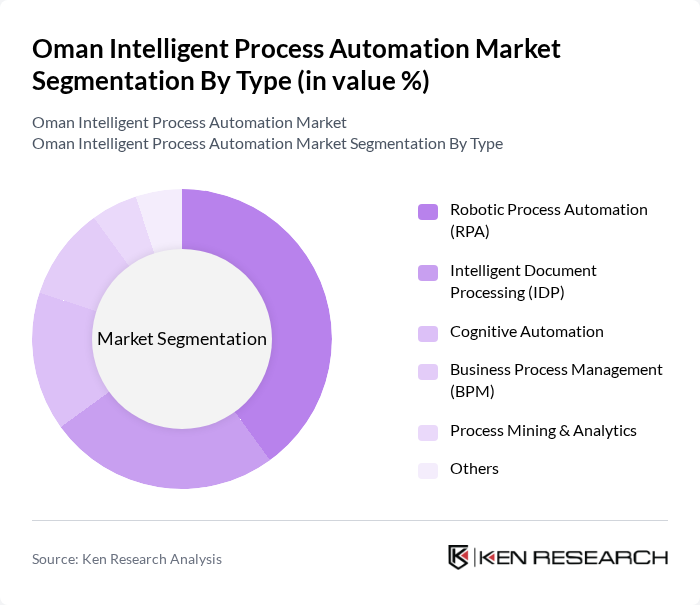
By Type:The market is segmented into various types of intelligent process automation technologies, including Robotic Process Automation (RPA), Intelligent Document Processing (IDP), Cognitive Automation, Business Process Management (BPM), Process Mining & Analytics, and Others. Among these, Robotic Process Automation (RPA) is the leading sub-segment, driven by its ability to automate repetitive tasks and improve operational efficiency across industries. The rising integration of AI and machine learning into RPA platforms further accelerates adoption, enabling advanced analytics, predictive maintenance, and intelligent exception handling .
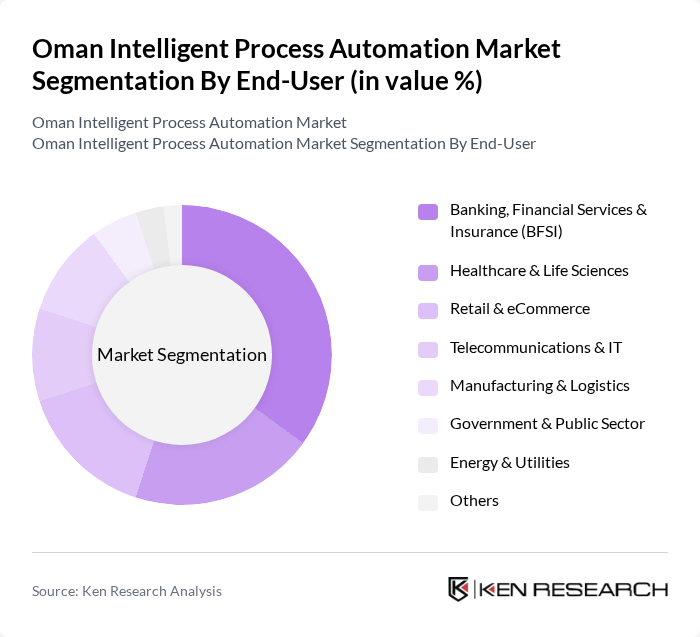
By End-User:The end-user segmentation includes Banking, Financial Services & Insurance (BFSI), Healthcare & Life Sciences, Retail & eCommerce, Telecommunications & IT, Manufacturing & Logistics, Government & Public Sector, Energy & Utilities, and Others. The BFSI sector is the most significant contributor, as financial institutions increasingly adopt automation to enhance customer service, compliance, and operational efficiency. BFSI organizations leverage IPA for loan processing, fraud detection, and regulatory reporting, while other sectors focus on streamlining supply chains, optimizing resource allocation, and improving service delivery .
The Oman Intelligent Process Automation Market is characterized by a dynamic mix of regional and international players. Leading participants such as UiPath, Automation Anywhere, Blue Prism, Pega Systems, WorkFusion, Kofax, IBM, Microsoft, Appian, NICE Systems, ServiceNow, SAP, Oracle, ABBYY, Celonis, WNS Global Services, Emerson Electric Co., Tata Consultancy Services (TCS), Infosys, Oman Data Park, Bahwan CyberTek, Omantel, Ooredoo Oman, Injazat contribute to innovation, geographic expansion, and service delivery in this space.
The future of the Oman intelligent process automation market appears promising, driven by technological advancements and increasing government support. As organizations continue to recognize the benefits of automation, the demand for innovative solutions is expected to rise. Additionally, the integration of advanced technologies such as AI and IoT will further enhance automation capabilities, leading to improved efficiency and productivity across various sectors. This trend is likely to create a more competitive landscape, encouraging continuous investment in automation technologies.
| Segment | Sub-Segments |
|---|---|
| By Type | Robotic Process Automation (RPA) Intelligent Document Processing (IDP) Cognitive Automation Business Process Management (BPM) Process Mining & Analytics Others |
| By End-User | Banking, Financial Services & Insurance (BFSI) Healthcare & Life Sciences Retail & eCommerce Telecommunications & IT Manufacturing & Logistics Government & Public Sector Energy & Utilities Others |
| By Industry Vertical | Oil & Gas Manufacturing Energy and Utilities Transportation and Logistics Government Others |
| By Deployment Model | On-Premises Cloud-Based Hybrid Others |
| By Functionality | IT Process Automation Business Process Automation Customer Service Automation Compliance & Risk Automation Others |
| By Technology | Machine Learning Natural Language Processing (NLP) Computer Vision Low-Code/No-Code Platforms Others |
| By Policy Support | Government Subsidies Tax Incentives Grants for Technology Development Training & Skill Development Initiatives Others |
| Scope Item/Segment | Sample Size | Target Respondent Profiles |
|---|---|---|
| Banking Sector Automation | 100 | IT Managers, Digital Transformation Leads |
| Healthcare Process Automation | 80 | Healthcare Administrators, IT Directors |
| Manufacturing Automation Solutions | 60 | Operations Managers, Production Supervisors |
| Telecommunications Automation Initiatives | 50 | Network Operations Managers, Technology Officers |
| Government Digital Services Automation | 70 | Public Sector IT Managers, Policy Makers |
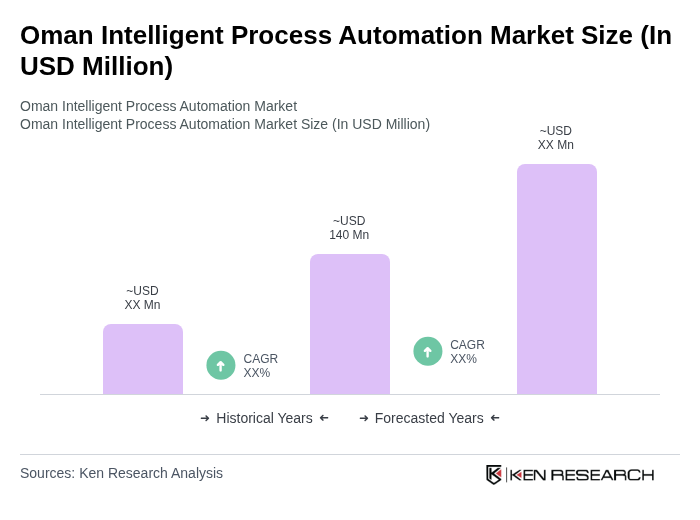
The Oman Intelligent Process Automation Market is valued at approximately USD 140 million, reflecting a significant growth trend driven by the adoption of automation technologies across various sectors, including banking, healthcare, and manufacturing.

What makes us stand out is that our consultants follow Robust, Refine and Result (RRR) methodology. Robust for clear definitions, approaches and sanity checking, Refine for differentiating respondents' facts and opinions, and Result for presenting data with story.

We have set a benchmark in the industry by offering our clients with syndicated and customized market research reports featuring coverage of entire market as well as meticulous research and analyst insights.

While we don't replace traditional research, we flip the method upside down. Our dual approach of Top Bottom & Bottom Top ensures quality deliverable by not just verifying company fundamentals but also looking at the sector and macroeconomic factors.

With one step in the future, our research team constantly tries to show you the bigger picture. We help with some of the tough questions you may encounter along the way: How is the industry positioned? Best marketing channel? KPI's of competitors? By aligning every element, we help maximize success.

Our report gives you instant access to the answers and sources that other companies might choose to hide. We elaborate each steps of research methodology we have used and showcase you the sample size to earn your trust.

If you need any support, we are here! We pride ourselves on universe strength, data quality, and quick, friendly, and professional service.













