About the Report
Base Year 2024Philippines Natural Personal Care Market Overview
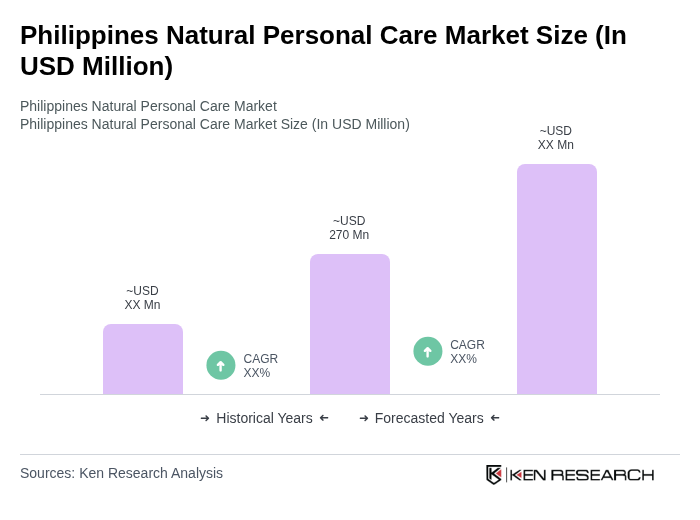
- The Philippines Natural Personal Care Market is valued at USD 270 million, based on a five-year historical analysis of the natural personal care category within the broader beauty and personal care sector. This growth is primarily driven by increasing consumer awareness of health and wellness, alongside a rising demand for eco-friendly and organic products. The shift towards natural ingredients in personal care products has been a significant factor in the market's expansion, as consumers seek safer alternatives to synthetic chemicals and become more attentive to ingredient lists, sustainability claims, and cruelty?free positioning.
- Metro Manila, Cebu, and Davao are the dominant cities in the Philippines Natural Personal Care Market. Metro Manila leads due to its high population density and urban lifestyle, which fosters a greater demand for personal care products. Cebu and Davao follow closely, benefiting from their growing middle-class populations and increasing access to retail outlets and e-commerce platforms; these three cities are also key hubs for skincare and clean beauty consumption in the country.
- In 2023, the Philippines government strengthened sustainable consumption initiatives through the Green Public Procurement Programme, implemented under the Philippine Green Public Procurement Roadmap by the Department of Budget and Management and other agencies, which promotes the purchase of eco-friendly products, including those in personal care and hygiene categories. This framework encourages public entities to prioritize products with lower environmental impact, such as those with natural or sustainably sourced ingredients and compliant packaging standards, thereby supporting demand for environmentally responsible personal care products and creating an enabling environment for local manufacturers that align with these criteria.
Philippines Natural Personal Care Market Segmentation
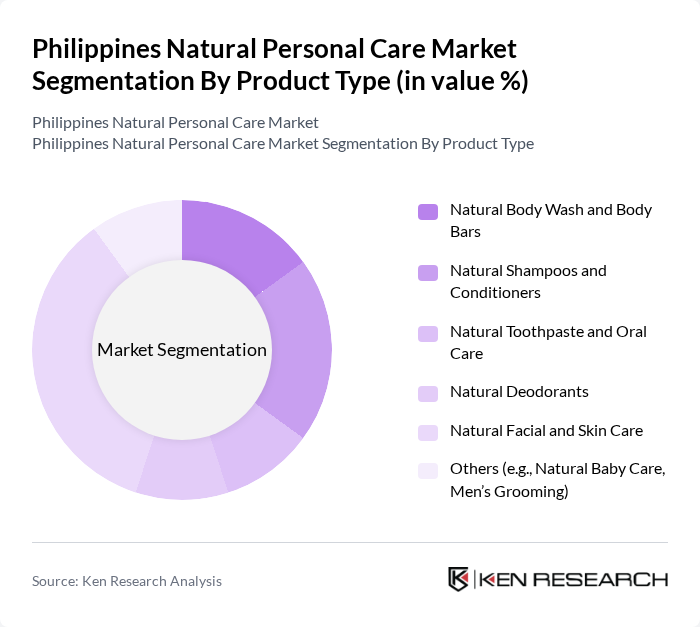
By Product Type:The product type segmentation of the market includes various categories that cater to different consumer needs. The subsegments include Natural Body Wash and Body Bars, Natural Shampoos and Conditioners, Natural Toothpaste and Oral Care, Natural Deodorants, Natural Facial and Skin Care, and Others (e.g., Natural Baby Care, Men’s Grooming). Among these, Natural Facial and Skin Care products dominate the market due to the increasing focus on skincare routines, the influence of the clean beauty trend, and the rising popularity of organic and naturally derived ingredients in moisturizers, serums, sunscreens, and treatment products. Consumers are increasingly inclined towards products that promise natural benefits, shorter ingredient lists, and multi-functional skin benefits, leading to a surge in demand for facial and skin care items positioned as natural or clean.
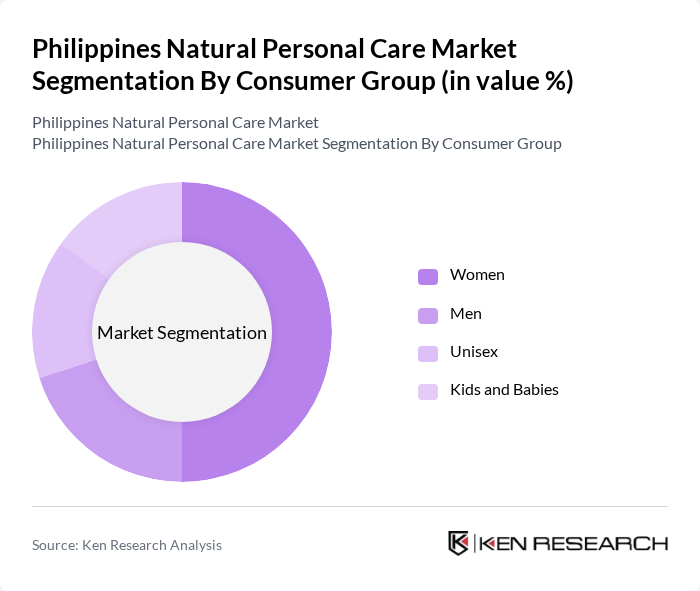
By Consumer Group:This segmentation focuses on the different demographics that utilize natural personal care products. The subsegments include Women, Men, Unisex, and Kids and Babies. Women represent the largest consumer group, driven by a growing interest in skincare and beauty products that are perceived as safer and more effective, as well as strong adoption of natural and clean beauty concepts among female consumers. The trend towards gender-neutral products is also gaining traction, with unisex offerings appealing to a broader audience that values minimalist routines, shared household products, and inclusive branding, while parents increasingly seek natural formulations for kids and babies, particularly in bath, skincare, and hair care products.
Philippines Natural Personal Care Market Competitive Landscape
The Philippines Natural Personal Care Market is characterized by a dynamic mix of regional and international players. Leading participants such as Human Nature (Gandang Kalikasan Inc.), Zenutrients, VMV Hypoallergenics, Snoe Beauty, Pili Ani, Ellana Mineral Cosmetics, Be Organic Bath & Body, Belo Essentials, Ever Bilena (EB Naturals and Related Lines), The Body Shop Philippines, Lush Philippines, Happy Skin, Herbalife Nutrition Philippines (Personal Care Line), Organique, Other Emerging Natural Indie Brands contribute to innovation, geographic expansion, and service delivery in this space.
Philippines Natural Personal Care Market Industry Analysis
Growth Drivers
- Increasing Consumer Awareness of Natural Ingredients:The Philippines has seen a significant rise in consumer awareness regarding the benefits of natural ingredients in personal care products. In future, approximately 65% of consumers reported preferring products with natural components, reflecting a growing trend towards health-conscious choices. This shift is supported by the increasing availability of information through social media and online platforms, which has educated consumers about the harmful effects of synthetic chemicals, driving demand for natural alternatives.
- Rising Demand for Eco-Friendly Products:The demand for eco-friendly personal care products in the Philippines has surged, with the market for sustainable goods projected to reach PHP 15 billion in future. This growth is driven by heightened environmental awareness, as 70% of consumers express a preference for brands that prioritize sustainability. The increasing focus on reducing plastic waste and carbon footprints has prompted brands to innovate and offer biodegradable packaging, further enhancing their appeal to eco-conscious consumers.
- Growth of E-commerce Platforms:E-commerce in the Philippines has expanded rapidly, with online sales of personal care products expected to exceed PHP 10 billion in future. The COVID-19 pandemic accelerated this trend, as consumers shifted to online shopping for convenience and safety. Major platforms like Lazada and Shopee have reported a 150% increase in sales of natural personal care items, indicating a robust market for brands that leverage digital channels to reach consumers effectively.
Market Challenges
- High Competition from Synthetic Products:The natural personal care market in the Philippines faces intense competition from established synthetic product brands, which dominate approximately 75% of the market share. These brands benefit from extensive distribution networks and marketing budgets, making it challenging for natural brands to gain visibility. Additionally, synthetic products often have lower price points, appealing to price-sensitive consumers, which can hinder the growth of natural alternatives.
- Limited Consumer Education on Natural Products:Despite growing interest, many consumers in the Philippines lack comprehensive knowledge about the benefits and efficacy of natural personal care products. A survey indicated that only 40% of consumers could accurately identify natural ingredients, leading to skepticism about their effectiveness. This gap in education poses a significant barrier to market growth, as consumers may opt for familiar synthetic options over less understood natural alternatives.
Philippines Natural Personal Care Market Future Outlook
The future of the natural personal care market in the Philippines appears promising, driven by increasing consumer demand for sustainable and health-conscious products. As awareness of the benefits of natural ingredients continues to rise, brands are likely to innovate and expand their offerings. Additionally, the growth of e-commerce will facilitate greater access to these products, allowing brands to reach a wider audience. Collaborations with influencers and educational campaigns will further enhance consumer understanding and acceptance of natural personal care solutions.
Market Opportunities
- Expansion into Rural Markets:There is a significant opportunity for natural personal care brands to penetrate rural markets, where demand for affordable, natural alternatives is growing. With over 50% of the population residing in rural areas, targeting these consumers can lead to substantial market growth and brand loyalty, especially as awareness of natural products increases.
- Development of Innovative Product Lines:The introduction of innovative product lines, such as organic skincare and wellness-focused items, presents a lucrative opportunity. With the organic personal care market projected to grow by PHP 5 billion in future, brands that invest in research and development to create unique offerings can capture a significant share of this expanding segment.
Scope of the Report
| Segment | Sub-Segments |
|---|---|
| By Product Type | Natural Body Wash and Body Bars Natural Shampoos and Conditioners Natural Toothpaste and Oral Care Natural Deodorants Natural Facial and Skin Care Others (e.g., Natural Baby Care, Men’s Grooming) |
| By Consumer Group | Women Men Unisex Kids and Babies |
| By Distribution Channel | Supermarkets/Hypermarkets Specialty Beauty and Personal Care Stores Pharmacies/Drugstores Convenience Stores E-commerce and Online Marketplaces Direct Selling and Others |
| By Nature/Certification | Natural Organic Vegan/Cruelty-Free Halal-Certified Others (e.g., Dermatologist-Tested, Hypoallergenic) |
| By Price Segment | Mass Mid-Priced Premium |
| By Packaging Format | Bottles and Jars Tubes and Sticks Bars and Solid Formats Refill and Bulk Packs Others (e.g., Sachets, Kits) |
| By End Use | Household/Individual Use Professional Use (Salons, Spas, Dermatology Clinics) Hospitality and Corporate Gifting Others |
Key Target Audience
Investors and Venture Capitalist Firms
Government and Regulatory Bodies (e.g., Department of Health, Food and Drug Administration)
Manufacturers and Producers
Distributors and Retailers
Natural Ingredient Suppliers
Industry Associations (e.g., Philippine Chamber of Commerce and Industry)
Financial Institutions
Export and Import Agencies
Players Mentioned in the Report:
Human Nature (Gandang Kalikasan Inc.)
Zenutrients
VMV Hypoallergenics
Snoe Beauty
Pili Ani
Ellana Mineral Cosmetics
Be Organic Bath & Body
Belo Essentials
Ever Bilena (EB Naturals and Related Lines)
The Body Shop Philippines
Lush Philippines
Happy Skin
Herbalife Nutrition Philippines (Personal Care Line)
Organique
Other Emerging Natural Indie Brands
Table of Contents
Market Assessment Phase
1. Executive Summary and Approach
2. Philippines Natural Personal Care Market Overview
2.1 Key Insights and Strategic Recommendations
2.2 Philippines Natural Personal Care Market Overview
2.3 Definition and Scope
2.4 Evolution of Market Ecosystem
2.5 Timeline of Key Regulatory Milestones
2.6 Value Chain & Stakeholder Mapping
2.7 Business Cycle Analysis
2.8 Policy & Incentive Landscape
3. Philippines Natural Personal Care Market Analysis
3.1 Growth Drivers
3.1.1 Increasing Consumer Awareness of Natural Ingredients
3.1.2 Rising Demand for Eco-Friendly Products
3.1.3 Growth of E-commerce Platforms
3.1.4 Expansion of Local Brands
3.2 Market Challenges
3.2.1 High Competition from Synthetic Products
3.2.2 Limited Consumer Education on Natural Products
3.2.3 Regulatory Hurdles
3.2.4 Price Sensitivity Among Consumers
3.3 Market Opportunities
3.3.1 Expansion into Rural Markets
3.3.2 Development of Innovative Product Lines
3.3.3 Collaborations with Influencers
3.3.4 Increasing Export Potential
3.4 Market Trends
3.4.1 Shift Towards Sustainable Packaging
3.4.2 Growth of Organic Certifications
3.4.3 Rise of DIY Natural Personal Care Products
3.4.4 Increased Focus on Mental Wellness Products
3.5 Government Regulation
3.5.1 Implementation of Natural Product Standards
3.5.2 Labeling Requirements for Natural Ingredients
3.5.3 Tax Incentives for Eco-Friendly Products
3.5.4 Import Regulations on Natural Ingredients
4. SWOT Analysis
5. Stakeholder Analysis
6. Porter's Five Forces Analysis
7. Philippines Natural Personal Care Market Market Size, 2019-2024
7.1 By Value
7.2 By Volume
7.3 By Average Selling Price
8. Philippines Natural Personal Care Market Segmentation
8.1 By Product Type
8.1.1 Natural Body Wash and Body Bars
8.1.2 Natural Shampoos and Conditioners
8.1.3 Natural Toothpaste and Oral Care
8.1.4 Natural Deodorants
8.1.5 Natural Facial and Skin Care
8.1.6 Others (e.g., Natural Baby Care, Men’s Grooming)
8.2 By Consumer Group
8.2.1 Women
8.2.2 Men
8.2.3 Unisex
8.2.4 Kids and Babies
8.3 By Distribution Channel
8.3.1 Supermarkets/Hypermarkets
8.3.2 Specialty Beauty and Personal Care Stores
8.3.3 Pharmacies/Drugstores
8.3.4 Convenience Stores
8.3.5 E-commerce and Online Marketplaces
8.3.6 Direct Selling and Others
8.4 By Nature/Certification
8.4.1 Natural
8.4.2 Organic
8.4.3 Vegan/Cruelty-Free
8.4.4 Halal-Certified
8.4.5 Others (e.g., Dermatologist-Tested, Hypoallergenic)
8.5 By Price Segment
8.5.1 Mass
8.5.2 Mid-Priced
8.5.3 Premium
8.6 By Packaging Format
8.6.1 Bottles and Jars
8.6.2 Tubes and Sticks
8.6.3 Bars and Solid Formats
8.6.4 Refill and Bulk Packs
8.6.5 Others (e.g., Sachets, Kits)
8.7 By End Use
8.7.1 Household/Individual Use
8.7.2 Professional Use (Salons, Spas, Dermatology Clinics)
8.7.3 Hospitality and Corporate Gifting
8.7.4 Others
9. Philippines Natural Personal Care Market Competitive Analysis
9.1 Market Share of Key Players
9.2 Cross Comparison of Key Players
9.2.1 Company Name
9.2.2 Revenue (Philippines, Latest Fiscal Year)
9.2.3 3-Year Revenue CAGR
9.2.4 EBITDA Margin
9.2.5 Gross Margin
9.2.6 Market Share in Philippines Natural Personal Care (%)
9.2.7 Channel Mix (Online vs Offline Share)
9.2.8 Average Selling Price Positioning (Mass/Mid/Premium)
9.2.9 Marketing Spend as % of Revenue
9.2.10 New Product Launches (Number per Year)
9.2.11 Customer Acquisition Cost (CAC)
9.2.12 Customer Lifetime Value (CLV)
9.2.13 Repeat Purchase Rate
9.2.14 Net Promoter Score (NPS)
9.2.15 Digital Reach (Social Media Followers, Website Traffic)
9.3 SWOT Analysis of Top Players
9.4 Pricing Analysis
9.5 Detailed Profile of Major Companies
9.5.1 Human Nature (Gandang Kalikasan Inc.)
9.5.2 Zenutrients
9.5.3 VMV Hypoallergenics
9.5.4 Snoe Beauty
9.5.5 Pili Ani
9.5.6 Ellana Mineral Cosmetics
9.5.7 Be Organic Bath & Body
9.5.8 Belo Essentials
9.5.9 Ever Bilena (EB Naturals and Related Lines)
9.5.10 The Body Shop Philippines
9.5.11 Lush Philippines
9.5.12 Happy Skin
9.5.13 Herbalife Nutrition Philippines (Personal Care Line)
9.5.14 Organique
9.5.15 Other Emerging Natural Indie Brands
10. Philippines Natural Personal Care Market End-User Analysis
10.1 Procurement Behavior of Key Ministries
10.1.1 Government Procurement Policies
10.1.2 Budget Allocations for Natural Products
10.1.3 Supplier Selection Criteria
10.1.4 Contract Management Practices
10.2 Corporate Spend on Infrastructure & Energy
10.2.1 Investment in Sustainable Practices
10.2.2 Budget for Natural Personal Care Products
10.2.3 Partnerships with Local Brands
10.2.4 Others
10.3 Pain Point Analysis by End-User Category
10.3.1 Quality Concerns
10.3.2 Availability of Products
10.3.3 Price Sensitivity
10.3.4 Others
10.4 User Readiness for Adoption
10.4.1 Awareness of Natural Products
10.4.2 Willingness to Pay
10.4.3 Accessibility of Products
10.4.4 Others
10.5 Post-Deployment ROI and Use Case Expansion
10.5.1 Measurement of ROI
10.5.2 Customer Feedback Mechanisms
10.5.3 Opportunities for Product Expansion
10.5.4 Others
11. Philippines Natural Personal Care Market Future Size, 2025-2030
11.1 By Value
11.2 By Volume
11.3 By Average Selling Price
Go-To-Market Strategy Phase
1. Whitespace Analysis + Business Model Canvas
1.1 Market Gaps Identification
1.2 Business Model Framework
2. Marketing and Positioning Recommendations
2.1 Branding Strategies
2.2 Product USPs
3. Distribution Plan
3.1 Urban Retail vs Rural NGO Tie-ups
4. Channel & Pricing Gaps
4.1 Underserved Routes
4.2 Pricing Bands
5. Unmet Demand & Latent Needs
5.1 Category Gaps
5.2 Consumer Segments
6. Customer Relationship
6.1 Loyalty Programs
6.2 After-sales Service
7. Value Proposition
7.1 Sustainability
7.2 Integrated Supply Chains
8. Key Activities
8.1 Regulatory Compliance
8.2 Branding
8.3 Distribution Setup
9. Entry Strategy Evaluation
9.1 Domestic Market Entry Strategy
9.1.1 Product Mix
9.1.2 Pricing Band
9.1.3 Packaging
9.2 Export Entry Strategy
9.2.1 Target Countries
9.2.2 Compliance Roadmap
10. Entry Mode Assessment
10.1 JV
10.2 Greenfield
10.3 M&A
10.4 Distributor Model
11. Capital and Timeline Estimation
11.1 Capital Requirements
11.2 Timelines
12. Control vs Risk Trade-Off
12.1 Ownership vs Partnerships
13. Profitability Outlook
13.1 Breakeven Analysis
13.2 Long-term Sustainability
14. Potential Partner List
14.1 Distributors
14.2 JVs
14.3 Acquisition Targets
15. Execution Roadmap
15.1 Phased Plan for Market Entry
15.1.1 Market Setup
15.1.2 Market Entry
15.1.3 Growth Acceleration
15.1.4 Scale & Stabilize
15.2 Key Activities and Milestones
15.2.1 Milestone Tracking
15.2.2 Activity Scheduling
Research Methodology
Phase 1: Approach1
Desk Research
- Analysis of market reports from industry associations and government publications
- Review of consumer behavior studies and trends in natural personal care products
- Examination of import/export data and trade statistics specific to the Philippines
Primary Research
- Interviews with key stakeholders in the natural personal care industry, including manufacturers and retailers
- Surveys targeting consumers to understand preferences and purchasing behavior
- Focus group discussions with beauty and wellness influencers to gauge market sentiment
Validation & Triangulation
- Cross-validation of findings through multiple data sources, including sales data and consumer feedback
- Triangulation of insights from industry experts and market analysts
- Sanity checks through expert panel reviews to ensure data accuracy and relevance
Phase 2: Market Size Estimation1
Top-down Assessment
- Estimation of market size based on national health and beauty expenditure reports
- Segmentation of the market by product categories such as skincare, haircare, and cosmetics
- Incorporation of growth rates from related sectors, such as organic and sustainable products
Bottom-up Modeling
- Collection of sales data from leading natural personal care brands operating in the Philippines
- Estimation of average selling prices and volume sold across different product lines
- Analysis of distribution channels and their impact on overall market performance
Forecasting & Scenario Analysis
- Utilization of historical growth trends to project future market developments
- Scenario modeling based on potential regulatory changes and consumer trends towards sustainability
- Development of baseline, optimistic, and pessimistic forecasts through 2030
Phase 3: CATI Sample Composition1
| Scope Item/Segment | Sample Size | Target Respondent Profiles |
|---|---|---|
| Consumer Preferences in Natural Skincare | 140 | Women aged 18-45, Skincare Enthusiasts |
| Market Insights from Retailers | 80 | Store Managers, Beauty Product Buyers |
| Trends in Haircare Products | 110 | Haircare Professionals, Salon Owners |
| Consumer Attitudes towards Organic Cosmetics | 70 | Eco-conscious Consumers, Health & Wellness Advocates |
| Distribution Channel Effectiveness | 60 | Distributors, E-commerce Managers |
Frequently Asked Questions
What is the current value of the Philippines Natural Personal Care Market?
The Philippines Natural Personal Care Market is valued at approximately USD 270 million, reflecting a growing trend towards health-conscious and eco-friendly personal care products among consumers.
What factors are driving the growth of the natural personal care market in the Philippines?
Which cities are the main hubs for the natural personal care market in the Philippines?
What types of products are included in the Philippines Natural Personal Care Market?
Other Regional/Country Reports
Other Adjacent Reports
South Africa Beauty and Personal Care Market
Japan Clean Beauty Market
Brazil Organic Cosmetics Market
Belgium Skincare Products Market
Kuwait Hair Care Products Market
Bahrain Oral Care Products Market
Mexico Baby Care Products Market
Kuwait Mens Grooming Market
Singapore Sustainable Packaging Market
UAE Health and Wellness Market
Why Buy From Us?

What makes us stand out is that our consultants follow Robust, Refine and Result (RRR) methodology. Robust for clear definitions, approaches and sanity checking, Refine for differentiating respondents' facts and opinions, and Result for presenting data with story.

We have set a benchmark in the industry by offering our clients with syndicated and customized market research reports featuring coverage of entire market as well as meticulous research and analyst insights.

While we don't replace traditional research, we flip the method upside down. Our dual approach of Top Bottom & Bottom Top ensures quality deliverable by not just verifying company fundamentals but also looking at the sector and macroeconomic factors.

With one step in the future, our research team constantly tries to show you the bigger picture. We help with some of the tough questions you may encounter along the way: How is the industry positioned? Best marketing channel? KPI's of competitors? By aligning every element, we help maximize success.

Our report gives you instant access to the answers and sources that other companies might choose to hide. We elaborate each steps of research methodology we have used and showcase you the sample size to earn your trust.

If you need any support, we are here! We pride ourselves on universe strength, data quality, and quick, friendly, and professional service.