Philippines Public Safety LTE Market Report Size Share Growth Drivers Trends Opportunities & Forecast 2025–2030

Philippines Public Safety LTE market, worth USD 1.1 Bn, grows due to enhanced connectivity needs and regulations like Republic Act 11032, focusing on private and licensed spectrum models.

Region:Asia

Author(s):Shubham

Product Code:KRAA6449

Pages:91

Published On:January 2026
About the Report

Base Year 2025

Philippines Public Safety LTE Market Overview

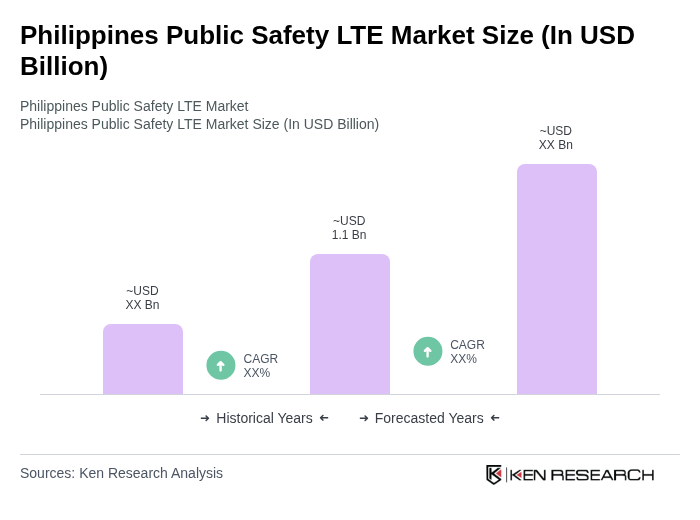
  • The Philippines Public Safety LTE market is valued at approximately USD 1.1 billion, based on a five-year historical analysis. This growth is primarily driven by the increasing demand for reliable communication systems among public safety agencies, coupled with the government's push for modernization in emergency response services. The need for enhanced connectivity and real-time data sharing during emergencies has further propelled investments in LTE technology. Additionally, the global public safety LTE market demonstrates robust expansion, with investments in infrastructure and devices reaching USD 5 billion annually, supported by both new deployments and expansion of existing dedicated and hybrid networks.
  • Metro Manila, Cebu, and Davao are the dominant regions in the Philippines Public Safety LTE market. Metro Manila, being the capital, has a higher concentration of public safety agencies and infrastructure, while Cebu and Davao serve as key urban centers with growing populations and increasing public safety needs. The strategic importance of these cities in terms of economic activity and population density contributes to their market dominance.
  • TheRepublic Act No. 11032, the Public Safety Communications Act, issued by the Philippine Congress, mandates the establishment of a nationwide public safety communication network. This regulation aims to enhance interoperability among various public safety agencies, ensuring efficient communication during emergencies. The act emphasizes the adoption of advanced technologies, including LTE, to improve response times and coordination among agencies, with compliance requirements extending to all national and local government units responsible for emergency management and disaster response operations.
Philippines Public Safety LTE Market Size

Philippines Public Safety LTE Market Segmentation

By Deployment Model:

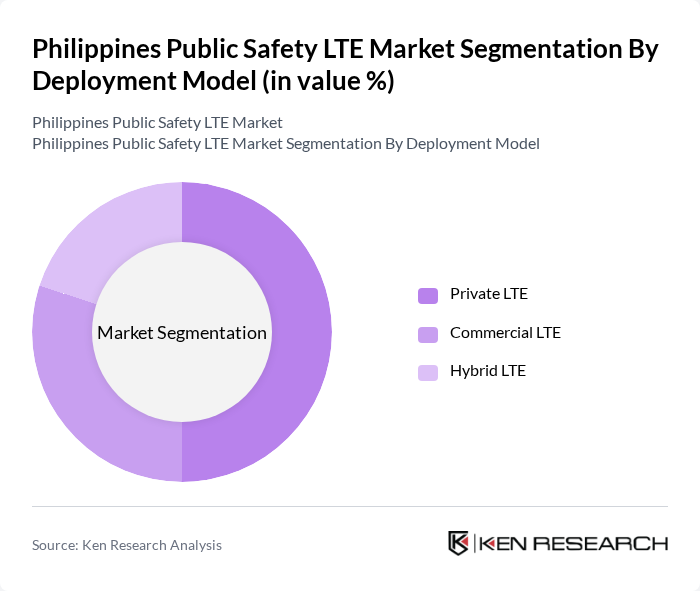
Philippines Public Safety LTE Market segmentation by Deployment Model.

The deployment model segment includes Private LTE, Commercial LTE, and Hybrid LTE. Private LTE is gaining traction among public safety agencies due to its enhanced security and control over communication networks. Commercial LTE is widely used for its cost-effectiveness and scalability, while Hybrid LTE combines the benefits of both private and commercial models, catering to diverse operational needs. The leading subsegment is Private LTE, as agencies prioritize secure and dedicated networks for critical communications.

By Spectrum/Access Model:
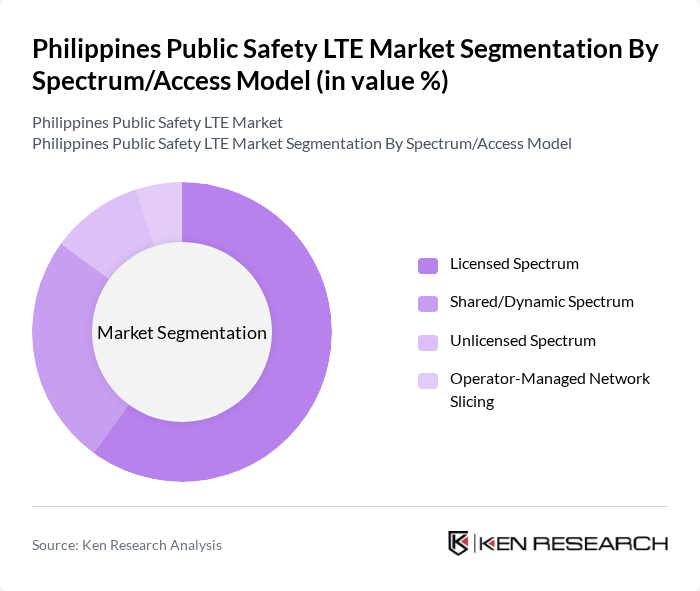
Philippines Public Safety LTE Market segmentation by Spectrum/Access Model.

This segment comprises Licensed Spectrum, Shared/Dynamic Spectrum, Unlicensed Spectrum, and Operator-Managed Network Slicing. Licensed Spectrum is preferred for its reliability and regulatory compliance, while Shared/Dynamic Spectrum offers flexibility in resource allocation. Unlicensed Spectrum is utilized for cost-effective solutions, and Operator-Managed Network Slicing allows for tailored services. The leading subsegment is Licensed Spectrum, as it ensures secure and uninterrupted communication for public safety operations.

Philippines Public Safety LTE Market Competitive Landscape

The Philippines Public Safety LTE Market is characterized by a dynamic mix of regional and international players. Leading participants such as Motorola Solutions, Nokia Corporation, Ericsson, AT&T, Verizon, Samsung Electronics, PLDT Inc., Globe Telecom, Smart Communications, Cisco Systems, Huawei Technologies, ZTE Corporation, NEC Corporation, Thales Group, Siemens AG contribute to innovation, geographic expansion, and service delivery in this space.

Motorola Solutions

1928

Chicago, Illinois, USA

Nokia Corporation

1865

Espoo, Finland

Ericsson

1876

Stockholm, Sweden

AT&T

1983

Dallas, Texas, USA

Verizon

2000

New York City, New York, USA

Company

Establishment Year

Headquarters

Year-over-Year Revenue Growth Rate (%)

Market Share (%)

Customer Acquisition Cost (USD)

Customer Lifetime Value (USD)

Customer Retention Rate (%)

Average Contract Value (USD)

Philippines Public Safety LTE Market Industry Analysis

Growth Drivers

  • Increasing Demand for Reliable Communication Systems:The Philippines has seen a surge in demand for reliable communication systems, particularly in emergency services. In future, the country reported over 1.6 million emergency calls, highlighting the need for efficient communication. The government allocated approximately PHP 2.2 billion for enhancing communication infrastructure, aiming to improve response times and coordination among public safety agencies. This investment is crucial for ensuring that first responders can communicate effectively during emergencies.
  • Government Initiatives for Public Safety Enhancement:The Philippine government has prioritized public safety, launching initiatives such as the "Safe Philippines" project, which received PHP 1.6 billion in funding. This initiative aims to integrate advanced communication technologies into public safety operations. Additionally, the National Telecommunications Commission (NTC) has set guidelines to enhance LTE infrastructure, ensuring that public safety agencies have access to reliable communication networks, which is vital for effective emergency management.
  • Technological Advancements in LTE Infrastructure:The ongoing advancements in LTE technology are significantly enhancing public safety communication. In future, the Philippines is expected to increase its LTE coverage to 96% of urban areas, up from 87% in the previous year. This expansion is supported by investments exceeding PHP 3.5 billion from telecom providers, aimed at upgrading existing infrastructure. Enhanced LTE capabilities enable faster data transmission, which is essential for real-time communication during emergencies, thereby improving overall public safety.

Market Challenges

  • High Initial Investment Costs:One of the primary challenges facing the public safety LTE market in the Philippines is the high initial investment required for infrastructure development. The estimated cost to establish a comprehensive LTE network is around PHP 5.5 billion, which poses a significant barrier for many local government units. This financial hurdle limits the ability of smaller municipalities to invest in necessary technology, potentially leading to disparities in public safety capabilities across regions.
  • Limited Infrastructure in Rural Areas:Rural areas in the Philippines face significant challenges due to limited infrastructure, which hampers the deployment of public safety LTE systems. Approximately 62% of rural municipalities lack adequate communication facilities, making it difficult for emergency services to operate effectively. The government has recognized this issue, but the allocation of resources remains insufficient, with only PHP 600 million earmarked for rural infrastructure improvements in future, which may not meet the growing demand.

Philippines Public Safety LTE Market Future Outlook

The future of the Philippines Public Safety LTE market appears promising, driven by ongoing government initiatives and technological advancements. As urbanization continues, the integration of smart city technologies will enhance public safety communication systems. Furthermore, the increasing collaboration between public and private sectors is expected to foster innovation and funding opportunities. With a focus on improving rural infrastructure, the market is likely to see a more equitable distribution of public safety resources, ultimately enhancing overall community safety.

Market Opportunities

  • Expansion of Smart City Initiatives:The Philippine government is actively promoting smart city initiatives, with an investment of PHP 3.5 billion planned for future. These initiatives aim to integrate advanced technologies into urban planning, enhancing public safety communication systems. By leveraging IoT and data analytics, cities can improve emergency response times and resource allocation, creating safer urban environments for residents.
  • Partnerships with Private Sector for Funding:Collaborations between government agencies and private sector companies are emerging as a viable funding strategy for public safety LTE projects. In future, the government aims to establish partnerships that could generate up to PHP 2.5 billion in additional funding. These partnerships can facilitate the development of innovative solutions tailored to local needs, ultimately enhancing the effectiveness of public safety communications across the country.

Scope of the Report

SegmentSub-Segments
By Deployment Model

Private LTE

Commercial LTE

Hybrid LTE

By Spectrum/Access Model

Licensed Spectrum

Shared/Dynamic Spectrum

Unlicensed Spectrum

Operator-Managed Network Slicing

By Application

Law Enforcement & Border Control

Firefighting Services

Emergency Medical Services

Disaster Management

By Technology Type

LTE FDD

LTE TDD

LTE-Advanced

G-enabled LTE Devices

By Device Type

Rugged Smartphones

Handheld LTE Radios

Vehicle-Mounted Routers

Wearable Devices

Body-Worn Cameras

By End-User

Public Safety Agencies

Industrial

Transport

Utilities

By Region

Luzon

Visayas

Mindanao

Key Target Audience

Investors and Venture Capitalist Firms

Government and Regulatory Bodies (e.g., Department of the Interior and Local Government, National Telecommunications Commission)

Public Safety Agencies (e.g., Philippine National Police, Bureau of Fire Protection)

Telecommunications Service Providers

Emergency Response Organizations (e.g., Philippine Red Cross)

Local Government Units

Infrastructure Development Firms

Public Safety Technology Developers

Players Mentioned in the Report:

Motorola Solutions

Nokia Corporation

Ericsson

AT&T

Verizon

Samsung Electronics

PLDT Inc.

Globe Telecom

Smart Communications

Cisco Systems

Huawei Technologies

ZTE Corporation

NEC Corporation

Thales Group

Siemens AG

Table of Contents

Market Assessment Phase

1. Executive Summary and Approach


2. Philippines Public Safety LTE Market Overview

2.1 Key Insights and Strategic Recommendations

2.2 Philippines Public Safety LTE Market Overview

2.3 Definition and Scope

2.4 Evolution of Market Ecosystem

2.5 Timeline of Key Regulatory Milestones

2.6 Value Chain & Stakeholder Mapping

2.7 Business Cycle Analysis

2.8 Policy & Incentive Landscape


3. Philippines Public Safety LTE Market Analysis

3.1 Growth Drivers

3.1.1 Increasing demand for reliable communication systems
3.1.2 Government initiatives for public safety enhancement
3.1.3 Technological advancements in LTE infrastructure
3.1.4 Rising public awareness of safety and security

3.2 Market Challenges

3.2.1 High initial investment costs
3.2.2 Limited infrastructure in rural areas
3.2.3 Regulatory hurdles and compliance issues
3.2.4 Competition from alternative communication technologies

3.3 Market Opportunities

3.3.1 Expansion of smart city initiatives
3.3.2 Partnerships with private sector for funding
3.3.3 Integration of IoT with public safety systems
3.3.4 Development of customized solutions for local needs

3.4 Market Trends

3.4.1 Shift towards integrated public safety solutions
3.4.2 Increasing use of data analytics in emergency response
3.4.3 Adoption of cloud-based services for scalability
3.4.4 Focus on cybersecurity in public safety communications

3.5 Government Regulation

3.5.1 National Telecommunications Commission (NTC) guidelines
3.5.2 Data privacy laws affecting communication systems
3.5.3 Public safety standards and compliance requirements
3.5.4 Funding programs for public safety technology

4. SWOT Analysis


5. Stakeholder Analysis


6. Porter's Five Forces Analysis


7. Philippines Public Safety LTE Market Market Size, 2019-2024

7.1 By Value

7.2 By Volume

7.3 By Average Selling Price


8. Philippines Public Safety LTE Market Segmentation

8.1 By Deployment Model

8.1.1 Private LTE
8.1.2 Commercial LTE
8.1.3 Hybrid LTE

8.2 By Spectrum/Access Model

8.2.1 Licensed Spectrum
8.2.2 Shared/Dynamic Spectrum
8.2.3 Unlicensed Spectrum
8.2.4 Operator-Managed Network Slicing

8.3 By Application

8.3.1 Law Enforcement & Border Control
8.3.2 Firefighting Services
8.3.3 Emergency Medical Services
8.3.4 Disaster Management

8.4 By Technology Type

8.4.1 LTE FDD
8.4.2 LTE TDD
8.4.3 LTE-Advanced
8.4.4 5G-enabled LTE Devices

8.5 By Device Type

8.5.1 Rugged Smartphones
8.5.2 Handheld LTE Radios
8.5.3 Vehicle-Mounted Routers
8.5.4 Wearable Devices
8.5.5 Body-Worn Cameras

8.6 By End-User

8.6.1 Public Safety Agencies
8.6.2 Industrial
8.6.3 Transport
8.6.4 Utilities

8.7 By Region

8.7.1 Luzon
8.7.2 Visayas
8.7.3 Mindanao

9. Philippines Public Safety LTE Market Competitive Analysis

9.1 Market Share of Key Players

9.2 Cross Comparison of Key Players

9.2.1 Company Name
9.2.2 Year-over-Year Revenue Growth Rate (%)
9.2.3 Market Share (%)
9.2.4 Customer Acquisition Cost (USD)
9.2.5 Customer Lifetime Value (USD)
9.2.6 Customer Retention Rate (%)
9.2.7 Average Contract Value (USD)
9.2.8 Gross Margin (%)
9.2.9 Service Level Agreement Uptime (%)
9.2.10 Net Promoter Score (NPS)

9.3 SWOT Analysis of Top Players

9.4 Pricing Analysis

9.5 Detailed Profile of Major Companies

9.5.1 Motorola Solutions
9.5.2 Nokia Corporation
9.5.3 Ericsson
9.5.4 AT&T
9.5.5 Verizon
9.5.6 Samsung Electronics
9.5.7 PLDT Inc.
9.5.8 Globe Telecom
9.5.9 Smart Communications
9.5.10 Cisco Systems
9.5.11 Huawei Technologies
9.5.12 ZTE Corporation
9.5.13 NEC Corporation
9.5.14 Thales Group
9.5.15 Siemens AG

10. Philippines Public Safety LTE Market End-User Analysis

10.1 Procurement Behavior of Key Ministries

10.1.1 Ministry of Interior and Local Government
10.1.2 Department of National Defense
10.1.3 Department of Health
10.1.4 Others

10.2 Corporate Spend on Infrastructure & Energy

10.2.1 Investment in Communication Technologies
10.2.2 Budget Allocation for Emergency Services
10.2.3 Funding for Public Safety Initiatives
10.2.4 Others

10.3 Pain Point Analysis by End-User Category

10.3.1 Emergency Services
10.3.2 Law Enforcement
10.3.3 Local Government Units
10.3.4 Others

10.4 User Readiness for Adoption

10.4.1 Training and Capacity Building Needs
10.4.2 Technology Familiarity
10.4.3 Infrastructure Readiness
10.4.4 Others

10.5 Post-Deployment ROI and Use Case Expansion

10.5.1 Performance Metrics Evaluation
10.5.2 User Feedback and Adaptation
10.5.3 Expansion into New Use Cases
10.5.4 Others

11. Philippines Public Safety LTE Market Future Size, 2025-2030

11.1 By Value

11.2 By Volume

11.3 By Average Selling Price


Go-To-Market Strategy Phase

12. Whitespace Analysis + Business Model Canvas

12.1 Market Gaps Identification

12.2 Value Proposition Development

12.3 Revenue Streams Analysis

12.4 Cost Structure Evaluation

12.5 Key Partnerships Exploration

12.6 Customer Segmentation

12.7 Channels and Customer Relationships


13. Marketing and Positioning Recommendations

13.1 Branding Strategies

13.2 Product USPs


14. Distribution Plan

14.1 Urban Retail vs Rural NGO Tie-ups


15. Channel & Pricing Gaps

15.1 Underserved Routes

15.2 Pricing Bands


16. Unmet Demand & Latent Needs

16.1 Category Gaps

16.2 Consumer Segments


17. Customer Relationship

17.1 Loyalty Programs

17.2 After-sales Service


18. Value Proposition

18.1 Sustainability

18.2 Integrated Supply Chains


19. Key Activities

19.1 Regulatory Compliance

19.2 Branding

19.3 Distribution Setup


20. Entry Strategy Evaluation

20.1 Domestic Market Entry Strategy

20.1.1 Product Mix
20.1.2 Pricing Band
20.1.3 Packaging

20.2 Export Entry Strategy

20.2.1 Target Countries
20.2.2 Compliance Roadmap

21. Entry Mode Assessment

21.1 JV

21.2 Greenfield

21.3 M&A

21.4 Distributor Model


22. Capital and Timeline Estimation

22.1 Capital Requirements

22.2 Timelines


23. Control vs Risk Trade-Off

23.1 Ownership vs Partnerships


24. Profitability Outlook

24.1 Breakeven Analysis

24.2 Long-term Sustainability


25. Potential Partner List

25.1 Distributors

25.2 JVs

25.3 Acquisition Targets


26. Execution Roadmap

26.1 Phased Plan for Market Entry

26.1.1 Market Setup
26.1.2 Market Entry
26.1.3 Growth Acceleration
26.1.4 Scale & Stabilize

26.2 Key Activities and Milestones

26.2.1 Milestone Planning
26.2.2 Activity Tracking

27. Disclaimer


Research Methodology

ApproachModellingSample

Phase 1: Approach1

Desk Research

  • Analysis of government reports on public safety and telecommunications
  • Review of industry publications and white papers on LTE technology adoption
  • Examination of market statistics from telecommunications regulatory bodies in the Philippines

Primary Research

  • Interviews with key stakeholders in public safety agencies and local government units
  • Surveys with telecommunications providers and infrastructure developers
  • Focus group discussions with end-users, including first responders and emergency services

Validation & Triangulation

  • Cross-validation of findings through multiple data sources, including market reports and expert opinions
  • Triangulation of qualitative insights from interviews with quantitative data from surveys
  • Sanity checks conducted through expert panel reviews and feedback sessions

Phase 2: Market Size Estimation1

Top-down Assessment

  • Estimation of total addressable market based on national public safety budgets
  • Segmentation of market size by region and type of public safety service
  • Incorporation of government initiatives aimed at enhancing public safety communications

Bottom-up Modeling

  • Collection of data on LTE infrastructure investments from major telecom operators
  • Estimation of user adoption rates among public safety agencies and first responders
  • Calculation of revenue potential based on service pricing models and usage patterns

Forecasting & Scenario Analysis

  • Multi-factor regression analysis considering factors such as population growth and urbanization
  • Scenario modeling based on varying levels of government funding and technology adoption rates
  • Development of baseline, optimistic, and pessimistic forecasts through 2030

Phase 3: CATI Sample Composition1

Scope Item/SegmentSample SizeTarget Respondent Profiles
Public Safety Agencies100Chief Safety Officers, Emergency Response Coordinators
Telecommunications Providers80Network Engineers, Business Development Managers
Local Government Units70City Planners, Public Safety Directors
First Responder Organizations60Fire Chiefs, Police Captains
Emergency Management Consultants50Consultants, Policy Advisors

Frequently Asked Questions

What is the current value of the Philippines Public Safety LTE market?

The Philippines Public Safety LTE market is valued at approximately USD 1.1 billion, driven by the increasing demand for reliable communication systems among public safety agencies and government initiatives aimed at modernizing emergency response services.

Which regions dominate the Philippines Public Safety LTE market?

What is the Public Safety Communications Act in the Philippines?

What are the main deployment models in the Philippines Public Safety LTE market?

Other Adjacent Reports

Bahrain Mission Critical Communications Market

Singapore Emergency Response Systems Market

India Wireless Broadband Market Outlook to 2030

Philippines Telecommunication Infrastructure Market

Vietnam Smart City Technology Market

South Korea IoT Public Safety Market

Germany Cybersecurity Solutions Market

Egypt Disaster Management Systems Market

KSA Mobile Network Equipment Market

Vietnam Government IT Services Market

Why Buy From Us?

Refine Robust Result (RRR) Framework

What makes us stand out is that our consultants follow Robust, Refine and Result (RRR) methodology. Robust for clear definitions, approaches and sanity checking, Refine for differentiating respondents' facts and opinions, and Result for presenting data with story.

Our Reach Is Unmatched

We have set a benchmark in the industry by offering our clients with syndicated and customized market research reports featuring coverage of entire market as well as meticulous research and analyst insights.

Shifting the Research Paradigm

While we don't replace traditional research, we flip the method upside down. Our dual approach of Top Bottom & Bottom Top ensures quality deliverable by not just verifying company fundamentals but also looking at the sector and macroeconomic factors.

More Insights-Better Decisions

With one step in the future, our research team constantly tries to show you the bigger picture. We help with some of the tough questions you may encounter along the way: How is the industry positioned? Best marketing channel? KPI's of competitors? By aligning every element, we help maximize success.

Transparency and Trust

Our report gives you instant access to the answers and sources that other companies might choose to hide. We elaborate each steps of research methodology we have used and showcase you the sample size to earn your trust.

Round the Clock Support

If you need any support, we are here! We pride ourselves on universe strength, data quality, and quick, friendly, and professional service.

Why Clients Choose Us?

400000+
Reports in repository
150+
Consulting projects a year
100+
Analysts
8000+
Client Queries in 2022