Philippines Unsecured Lending Market

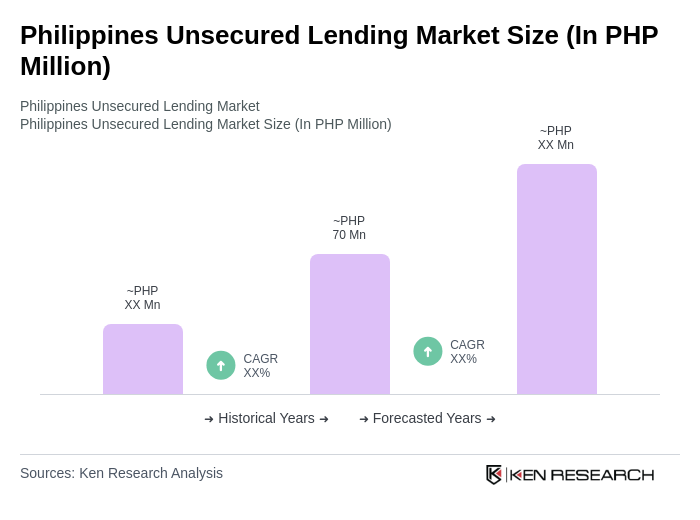
The Philippines unsecured lending market, worth PHP 70 Million, is growing due to rising demand for quick credit, digital lending, and financial inclusion initiatives.

Region:Asia

Author(s):Harsh Saxena

Product Code:KR1543

Pages:90

Published On:October 2025
About the Report

Base Year 2024

Philippines Unsecured Lending Market Overview

  • The Philippines Unsecured Lending Market is valued at PHP 70 million, based on a five-year historical analysis. This growth is primarily driven by rising consumer demand for quick and accessible credit, the proliferation of digital lending platforms, and the increasing adoption of innovative solutions such as Buy Now, Pay Later (BNPL) schemes. The surge in digital lending, which now comprises a significant portion of the market, reflects the shift towards online and app-based borrowing, particularly among younger and tech-savvy consumers.
  • Metro Manila, Cebu, and Davao remain the dominant cities in the Philippines Unsecured Lending Market. Metro Manila leads due to its status as the capital and largest urban center, hosting the majority of financial institutions and a diverse consumer base. Cebu and Davao continue to gain prominence, supported by robust economic growth, increased urbanization, and expanding access to digital financial services.
  • In 2023, the Bangko Sentral ng Pilipinas (BSP) issued Circular No. 1165, Series of 2023, introducing enhanced consumer protection standards for unsecured lending. This regulation mandates clear disclosure of loan terms, caps on interest rates and fees, and stricter transparency requirements for all lenders, including digital and non-bank institutions. The regulation aims to ensure responsible lending, improve borrower outcomes, and reduce abusive practices in the unsecured lending sector.
Philippines Unsecured Lending Market Size

Philippines Unsecured Lending Market Segmentation

By Product Type:The Philippines' unsecured lending market is segmented into Credit Cards, Salary Loans, BNPL & Personal Loans, Microfinance, SME Loans, and OFW Loans. Credit Cards and Salary Loans dominate the landscape, driven by rising e-commerce adoption and growing employer-linked payroll financing. BNPL and Personal Loans are expanding swiftly due to greater merchant acceptance and app-based onboarding. Microfinance caters to low-income and unbanked populations, while SME Loans benefit from data-driven underwriting and top-up products. OFW Loans continue to grow on the back of remittance flows and dedicated banking partnerships.
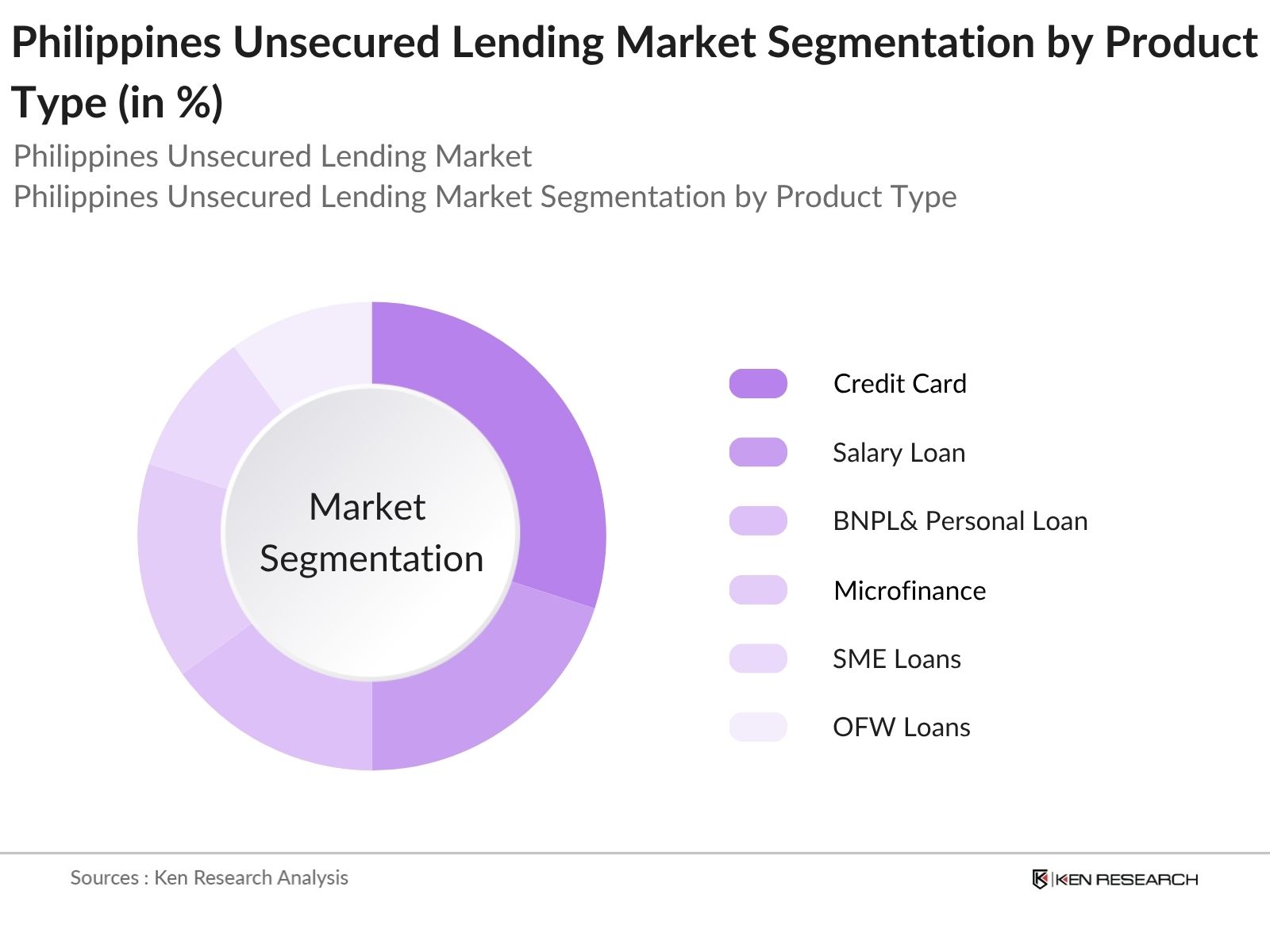
Philippines Unsecured Lending Market Segmentation by Product Type

By Provider Type:The Philippines' unsecured lending market is segmented by provider type into Commercial Banks, Non-Banking Financial Institutions (NBFIs), Co-operative Banks, Microfinance Institutions (MFIs), and FinTechs. Commercial Banks continue to lead the market due to their established customer trust, regulatory support, and digital banking capabilities. NBFIs follow closely, leveraging their reach across underserved regions. FinTechs are emerging as the fastest-growing segment, driven by rapid digital adoption, BNPL expansion, and app-based credit offerings. MFIs and Co-operative Banks maintain a stable presence, catering to low-income and rural borrowers with localized credit solutions.

Philippines Unsecured Lending Market Competitive Landscape

The Philippines Unsecured Lending Market is characterized by a dynamic mix of regional and international players. Leading participants such as BPI Family Savings Bank, Rizal Commercial Banking Corporation (RCBC), UnionBank of the Philippines, EastWest Banking Corporation, Security Bank Corporation, Cebuana Lhuillier, Cashalo, Tala Philippines, Home Credit Philippines, Digido, Asia United Bank (AUB), Maya Bank, GCash (Mynt), LenddoEFL, Grab Financial Services Philippines contribute to innovation, geographic expansion, and service delivery in this space.

GCash

2004

Taguig, Philippines

BillEase

2017

Makati, Philippines

JuanHand

2019

Home Credit

2013

Taguig, Philippines

Esquire Financing Inc.

2011

Makati, Philippines

Company

Establishment Year

Headquarters

Group Size (Large, Medium, or Small as per industry convention)

Customer Acquisition Cost (CAC)

Loan Approval Rate (%)

Average Loan Amount Disbursed (PHP)

Non-Performing Loan (NPL) Ratio (%)

Customer Retention Rate (%)

Philippines Unsecured Lending Market Industry Analysis

Growth Drivers

  • Employment Growth and Digital Wage Access:The Philippines’ employment rate is projected to rise from 59.0% in 2024 to 83.0% by 2030, driven by growth in BPOs, digital services, and formal wage sectors. This expansion is widening access to salary-based credit products like payroll loans, credit cards, and BNPL. As digital wage payments become more mainstream, particularly through QR-enabled payment systems, more salaried workers are entering the pool of credit-eligible borrowers, fueling unsecured lending demand.
  • Household Credit Expansion and Consumption Needs:Household loans grew by 23.4% YoY as of June 2024, with the fastest acceleration seen in unsecured lending. This surge reflects rising reliance on credit to cover essential expenses such as education, rent, health, and emergencies. Household final consumption expenditure also saw a positive uptick from 5.2% in 2023 to 5.5% in 2024, signaling strong consumption behavior and sustained demand for flexible, short-term credit options.
  • Policy Support and Digital Financial Ecosystem Growth:With over 94 million users adopting QR-enabled digital payments by 2025, the Philippines is witnessing increased digitization of financial services. Regulatory reforms around data privacy, interest rates, and anti-money laundering (AML) are improving borrower trust in digital-first lending platforms. These fintech regulations are fostering responsible lending practices while enabling faster onboarding and product scaling across app-based unsecured loan providers.

Market Challenges

  • Elevated NPL Ratios Impacting Credit Risk:The average Non-Performing Loan (NPL) ratio in the Philippines rose sharply from 2.0% in 2018 to a peak of 4.0% in 2021, before easing to 3.2% by end-2022 and 2023. Despite this decline, elevated NPL levels continue to signal stress in asset quality. This has prompted lenders to adopt a more cautious stance toward new unsecured lending, especially for riskier borrower segments such as MSMEs and first-time credit users.
  • Interest Rate Caps Restricting Lending Flexibility:The BSP’s ceiling on credit card interest rates—capped at 3% per month (36% annually)—limits the ability of lenders to reprice loans for higher-risk profiles. This regulatory cap, while protective for consumers, reduces lender margins and discourages credit expansion to underserved or high-risk groups. As a result, financial institutions are becoming more selective in their lending strategies, affecting credit penetration and inclusivity.

Philippines Unsecured Lending Market Future Outlook

The future of the Philippines unsecured lending market appears promising, driven by technological advancements and a growing consumer base. As digital platforms continue to evolve, lenders are expected to leverage artificial intelligence for better credit scoring and risk assessment. Additionally, the increasing integration of financial services with e-commerce will likely enhance loan accessibility, particularly in underserved regions, fostering a more inclusive financial ecosystem that caters to diverse consumer needs.

Market Opportunities

  • Collaborations with Digital-First Fintechs to Scale Lending Access:Partnerships with fintechs like Tonik Bank present traditional lenders with a fast-track to digitization through advanced APIs, AI-based underwriting, and automated KYC/AML. These collaborations reduce onboarding time by up to 70%, enable credit access for over 60% of new-to-credit users, and expand loan distribution through 1,000+ digital touchpoints—making them a key strategy for unlocking underserved borrower segments.
  • Personalized Credit Solutions Backed by AI and Behavioral Data:The shift toward customized lending is gaining momentum with platforms leveraging employer APIs, telecom usage, and retail data for dynamic credit scoring. Lenders can design need-specific products—like medical or education loans—using AI/ML risk models and gamified repayment tools. This not only improves loan stickiness but also drives higher RoC and double-digit loan book growth in underserved markets.

Scope of the Report

SegmentSub-Segments
By Product Type

Credit Card

Salary Loan

BNPL& Personal Loan

Microfinance

SME Loans

OFW Loans

By Provider Type

Commercial Banks

NBFIs

Co-operative Banks

MFIs

FinTechs

By Borrower Type

SME

Salaried Individuals

Self-employed Individuals

OFWs & Beneficiaries

By Region

NCR

Luzon

Visayas

Mindanao

By Tenure

Up to 6 months

6-12 months

12-18 months

Above 18 months

Key Target Audience

Investors and Venture Capitalist Firms

Government and Regulatory Bodies (e.g., Bangko Sentral ng Pilipinas, Securities and Exchange Commission)

Microfinance Institutions

Non-Banking Financial Companies

Peer-to-Peer Lending Platforms

Credit Bureaus

Consumer Finance Companies

Payment Processing Companies

Players Mentioned in the Report:

GCash

BillEase

JuanHand

Home Credit

Esquire Financing Inc.

Table of Contents

Research Methodology

ApproachModellingSample

Phase 1: Approach1

Desk Research

  • Analysis of financial reports from leading unsecured lending institutions in the Philippines
  • Review of government publications and regulatory frameworks affecting unsecured lending
  • Examination of market studies and white papers from financial research organizations

Primary Research

  • Interviews with executives from major banks and fintech companies offering unsecured loans
  • Surveys targeting consumers who have utilized unsecured lending services
  • Focus group discussions with financial advisors and credit analysts

Validation & Triangulation

  • Cross-validation of findings through multiple data sources including market reports and expert opinions
  • Triangulation of consumer insights with lender perspectives to ensure comprehensive understanding
  • Sanity checks through expert panel reviews comprising industry veterans and economists

Phase 2: Market Size Estimation1

Top-down Assessment

  • Estimation of total market size based on national credit statistics and economic indicators
  • Segmentation of the market by loan type, demographic, and geographic distribution
  • Incorporation of macroeconomic factors such as GDP growth and consumer spending trends

Bottom-up Modeling

  • Collection of data on loan disbursement volumes from key players in the unsecured lending space
  • Analysis of average loan amounts and repayment terms across different consumer segments
  • Estimation of market penetration rates based on consumer behavior and financial literacy levels

Forecasting & Scenario Analysis

  • Development of predictive models using historical data and economic forecasts
  • Scenario analysis based on potential regulatory changes and shifts in consumer credit demand
  • Creation of baseline, optimistic, and pessimistic forecasts for the next five years

Phase 3: CATI Sample Composition1

Scope Item/SegmentSample SizeTarget Respondent Profiles
Consumer Unsecured Loan Users120Individuals aged 25-45, recent loan applicants
Small Business Owners60Entrepreneurs seeking unsecured financing
Financial Advisors40Professionals providing credit counseling services
Banking Executives40Senior management from banks and lending institutions
Fintech Company Executives40Executives from digital lending platforms

Frequently Asked Questions

What is the current value of the Philippines Unsecured Lending Market?

The Philippines Unsecured Lending Market is valued at approximately

70 Million, reflecting significant growth driven by consumer demand for accessible credit and the rise of digital lending platforms.

What types of loans are included in the Philippines Unsecured Lending Market?

Which cities dominate the Philippines Unsecured Lending Market?

What regulatory changes have impacted the unsecured lending sector in the Philippines?

Other Regional/Country Reports

Indonesia Unsecured Lending Market

Malaysia Unsecured Lending Market

KSA Unsecured Lending Market

APAC Unsecured Lending Market

SEA Unsecured Lending Market

Vietnam Unsecured Lending Market

Why Buy From Us?

Refine Robust Result (RRR) Framework

What makes us stand out is that our consultants follow Robust, Refine and Result (RRR) methodology. Robust for clear definitions, approaches and sanity checking, Refine for differentiating respondents' facts and opinions, and Result for presenting data with story.

Our Reach Is Unmatched

We have set a benchmark in the industry by offering our clients with syndicated and customized market research reports featuring coverage of entire market as well as meticulous research and analyst insights.

Shifting the Research Paradigm

While we don't replace traditional research, we flip the method upside down. Our dual approach of Top Bottom & Bottom Top ensures quality deliverable by not just verifying company fundamentals but also looking at the sector and macroeconomic factors.

More Insights-Better Decisions

With one step in the future, our research team constantly tries to show you the bigger picture. We help with some of the tough questions you may encounter along the way: How is the industry positioned? Best marketing channel? KPI's of competitors? By aligning every element, we help maximize success.

Transparency and Trust

Our report gives you instant access to the answers and sources that other companies might choose to hide. We elaborate each steps of research methodology we have used and showcase you the sample size to earn your trust.

Round the Clock Support

If you need any support, we are here! We pride ourselves on universe strength, data quality, and quick, friendly, and professional service.

Why Clients Choose Us?

400000+
Reports in repository
150+
Consulting projects a year
100+
Analysts
8000+
Client Queries in 2022








