Region:Middle East
Author(s):Rebecca
Product Code:KRAD2823
Pages:93
Published On:November 2025
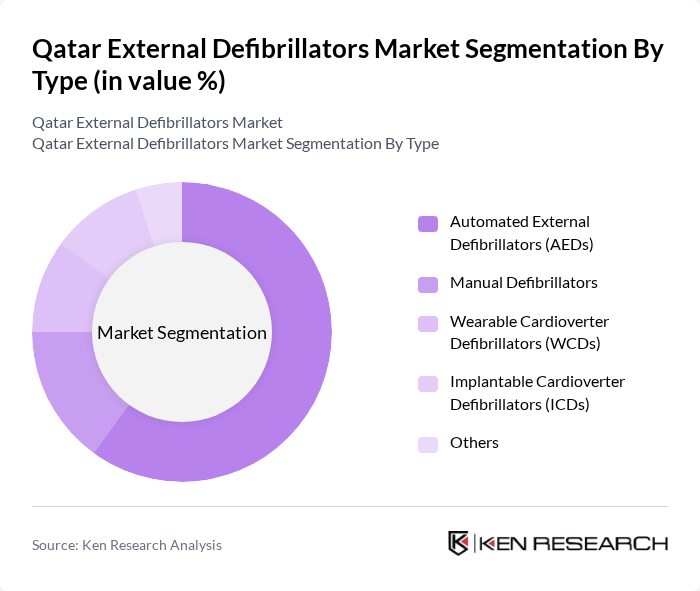
By Type:The market can be segmented into various types of defibrillators, including Automated External Defibrillators (AEDs), Manual Defibrillators, Wearable Cardioverter Defibrillators (WCDs), Implantable Cardioverter Defibrillators (ICDs), and Others. Among these, Automated External Defibrillators (AEDs) are the most widely used due to their ease of use and effectiveness in emergency situations. The increasing number of public access defibrillation programs has further propelled the demand for AEDs, making them a preferred choice in both public and private sectors.
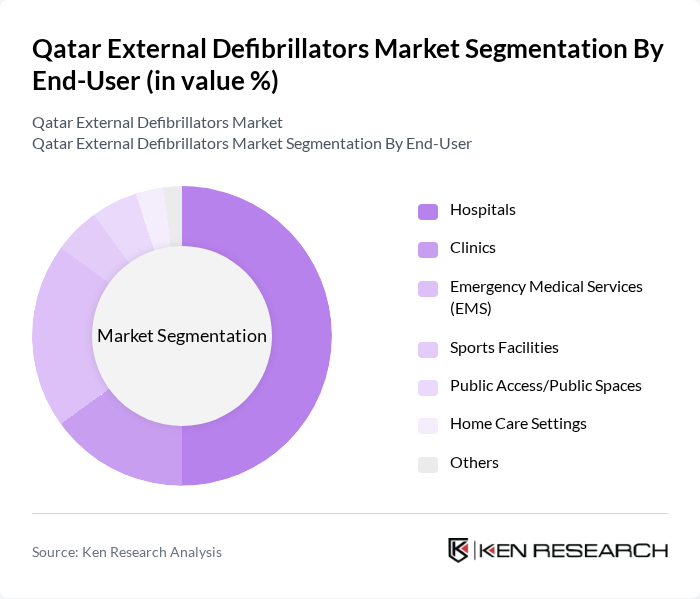
By End-User:The end-user segmentation includes Hospitals, Clinics, Emergency Medical Services (EMS), Sports Facilities, Public Access/Public Spaces, Home Care Settings, and Others. Hospitals are the leading end-users of defibrillators, driven by the need for immediate cardiac care and resuscitation services. The increasing number of cardiac procedures and the emphasis on patient safety in healthcare facilities have led to a higher adoption rate of defibrillators in hospitals.
The Qatar External Defibrillators Market is characterized by a dynamic mix of regional and international players. Leading participants such as Philips Healthcare, ZOLL Medical Corporation, Medtronic plc, Cardiac Science Corporation (now part of ZOLL Medical), Physio-Control (now part of Stryker Corporation), Defibtech LLC, Stryker Corporation, Abbott Laboratories, Boston Scientific Corporation, BIOTRONIK SE & Co. KG, HeartSine Technologies (now part of Stryker Corporation), Laerdal Medical, Nihon Kohden Corporation, GE HealthCare, Schiller AG contribute to innovation, geographic expansion, and service delivery in this space.
The future of the Qatar external defibrillators market appears promising, driven by ongoing government investments in healthcare infrastructure and increasing public awareness of cardiac emergencies. As the healthcare sector continues to evolve, the integration of smart technology in defibrillators is expected to enhance user experience and operational efficiency. Furthermore, partnerships between healthcare providers and educational institutions will likely facilitate training programs, ensuring that more individuals are equipped to respond effectively to cardiac emergencies, ultimately improving survival rates.
| Segment | Sub-Segments |
|---|---|
| By Type | Automated External Defibrillators (AEDs) Manual Defibrillators Wearable Cardioverter Defibrillators (WCDs) Implantable Cardioverter Defibrillators (ICDs) Others |
| By End-User | Hospitals Clinics Emergency Medical Services (EMS) Sports Facilities Public Access/Public Spaces Home Care Settings Others |
| By Distribution Channel | Direct Sales Online Retail Medical Supply Distributors Pharmacies Others |
| By Application | Sudden Cardiac Arrest (SCA) Arrhythmia Management Emergency Response/Resuscitation Training and Education Others |
| By Technology | Biphasic Defibrillation Monophasic Defibrillation Smart/Connected Defibrillators Others |
| By Region | Doha Al Rayyan Al Wakrah Al Khor Others |
| By Policy Support | Government Subsidies Tax Incentives Public Awareness Campaigns Mandatory Public Access Defibrillation Programs Others |
| Scope Item/Segment | Sample Size | Target Respondent Profiles |
|---|---|---|
| Hospital Procurement Departments | 45 | Procurement Managers, Medical Equipment Buyers |
| Emergency Medical Services | 38 | Paramedics, EMT Supervisors |
| Public Health Initiatives | 28 | Public Health Officials, Community Health Workers |
| Cardiology Clinics | 32 | Cardiologists, Clinic Administrators |
| Fitness and Sports Facilities | 22 | Facility Managers, Health and Safety Officers |
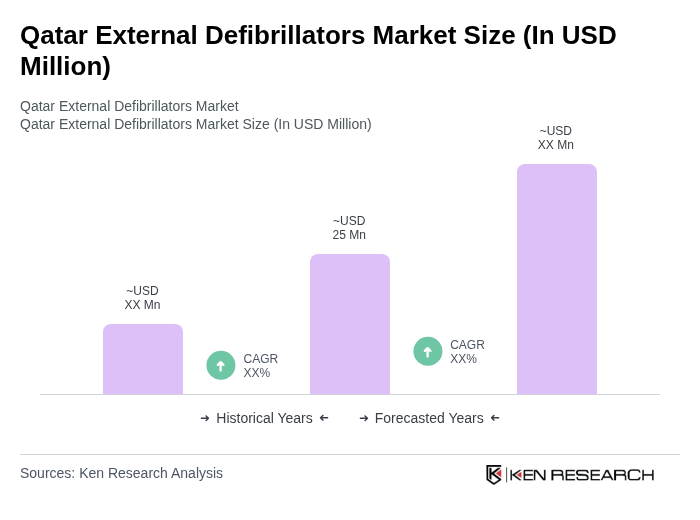
The Qatar External Defibrillators Market is valued at approximately USD 25 million, reflecting a five-year historical analysis. This growth is attributed to the rising prevalence of cardiovascular diseases and increased awareness of sudden cardiac arrest.

What makes us stand out is that our consultants follow Robust, Refine and Result (RRR) methodology. Robust for clear definitions, approaches and sanity checking, Refine for differentiating respondents' facts and opinions, and Result for presenting data with story.

We have set a benchmark in the industry by offering our clients with syndicated and customized market research reports featuring coverage of entire market as well as meticulous research and analyst insights.

While we don't replace traditional research, we flip the method upside down. Our dual approach of Top Bottom & Bottom Top ensures quality deliverable by not just verifying company fundamentals but also looking at the sector and macroeconomic factors.

With one step in the future, our research team constantly tries to show you the bigger picture. We help with some of the tough questions you may encounter along the way: How is the industry positioned? Best marketing channel? KPI's of competitors? By aligning every element, we help maximize success.

Our report gives you instant access to the answers and sources that other companies might choose to hide. We elaborate each steps of research methodology we have used and showcase you the sample size to earn your trust.

If you need any support, we are here! We pride ourselves on universe strength, data quality, and quick, friendly, and professional service.













