Qatar Wireless Earphone Market Size Share Growth Drivers Trends Opportunities & Forecast 2025–2030

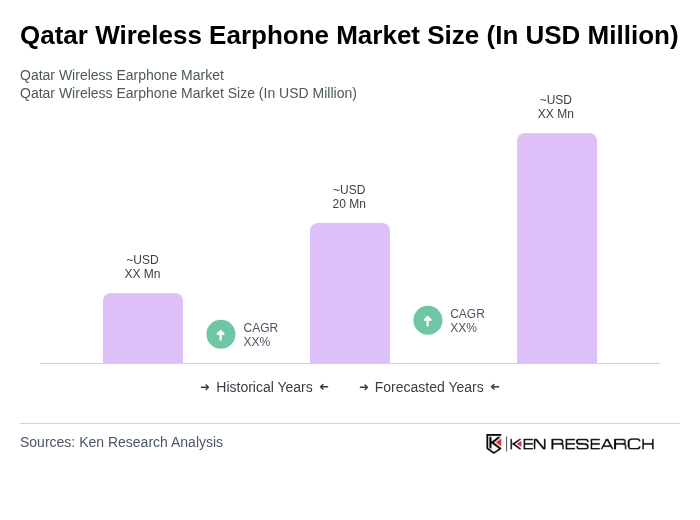
Qatar wireless earphone market, valued at USD 20 million, grows due to wireless tech adoption, fitness trends, and streaming services, led by TWS earbuds.

Region:Middle East

Author(s):Dev

Product Code:KRAA3793

Pages:91

Published On:January 2026
About the Report

Base Year 2024

Qatar Wireless Earphone Market Overview

  • The Qatar Wireless Earphone Market is valued at USD 20 million, based on a five-year historical analysis and benchmarking against regional wireless earphone and GCC wireless earphone estimates. This growth is primarily driven by the increasing adoption of wireless audio technology, rising consumer demand for portable multimedia devices, and the proliferation of smartphones and tablets in Qatar. The market has seen a notable uptick in sales supported by hybrid and remote working arrangements, the expansion of e?learning platforms, and greater use of music and video streaming services, all of which have heightened the need for reliable, high-quality wireless audio devices.
  • Key demand centers in this market include Doha, Al Rayyan, and Lusail, which account for a substantial share of wireless earphone sales due to their high urbanization, concentration of higher-income households, and a young, tech?savvy population. The dense presence of malls, specialty electronics retailers, telecom operator outlets, and online fulfillment hubs in these cities facilitates consumer access to a wide range of global and regional wireless earphone brands, further supporting market growth.
  • In 2023, the Qatari government strengthened consumer protection and product safety requirements in the electronics market, including audio devices such as wireless earphones. Under the Law No. 8 of 2008 on Consumer Protection, implemented and enforced by the Ministry of Commerce and Industry, and the mandatory conformity assessment and safety requirements overseen by Qatar General Organization for Standards and Metrology (QGOSM), electronic products sold in Qatar must comply with specified safety, labeling, and quality standards, and suppliers must ensure clear product information and after?sales guarantees. These measures are designed to enhance consumer confidence in electronic goods, promote fair competition among manufacturers and distributors, and align wireless audio products with national and Gulf standards frameworks.
Qatar Wireless Earphone Market Size

Qatar Wireless Earphone Market Segmentation

By Product Type:The product type segmentation includes various categories of wireless earphones and headphones, each catering to different consumer preferences and usage scenarios. The dominant sub?segment in this category is true wireless (TWS) earbuds, which have gained strong popularity due to their compact, cable?free design, integration of Bluetooth 5.x connectivity, and advanced features such as active noise cancellation (ANC), touch or gesture controls, voice?assistant integration, and multi?device pairing. The increasing trend of fitness and outdoor activities, along with growing participation in gym and wellness programs, has also contributed to the growth of sports and fitness?focused wireless earphones, as consumers seek durable, sweat?resistant, water?resistant (IP?rated) options with secure fit and long battery life.
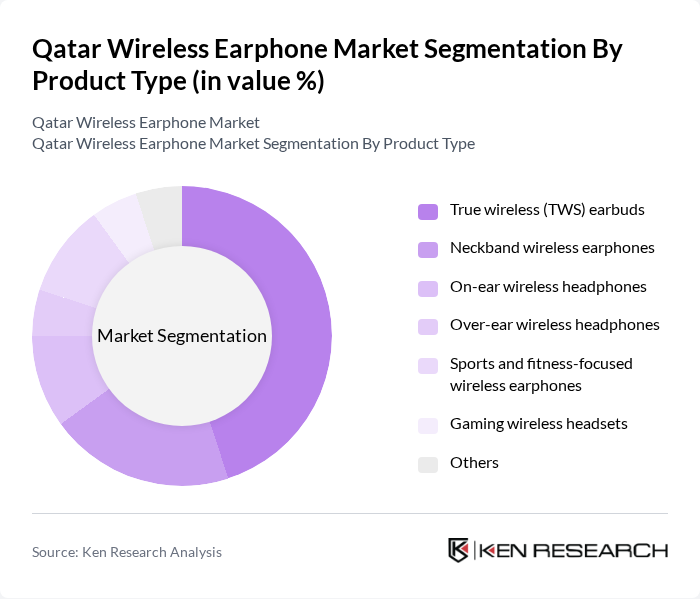
Qatar Wireless Earphone Market segmentation by Product Type.

By End-User:The end?user segmentation encompasses various consumer groups, including individual consumers, corporate users, and educational institutions. Individual consumers represent the largest segment, supported by the growing trend of personal audio consumption through smartphones, tablets, and wearables for music, video, social media, and gaming. Corporate and enterprise users are increasingly adopting wireless earphones and headsets for unified communications, virtual meetings, and customer service applications, especially as video conferencing and collaboration tools become embedded in day?to?day operations. Educational institutions, including schools and higher?education providers, are integrating these devices into digital and blended learning environments to support language labs, remote lectures, and individualized learning, thereby enhancing the audio experience for students.
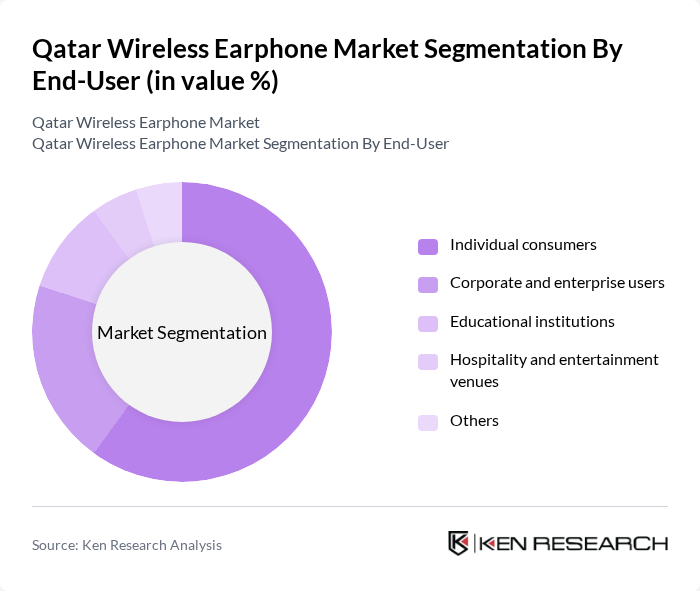
Qatar Wireless Earphone Market segmentation by End-User.

Qatar Wireless Earphone Market Competitive Landscape

The Qatar Wireless Earphone Market is characterized by a dynamic mix of regional and international players. Leading participants such as Apple Inc., Samsung Electronics Co., Ltd., Sony Group Corporation, Bose Corporation, GN Audio A/S (Jabra), Sennheiser electronic GmbH & Co. KG, Anker Innovations Limited, Xiaomi Corporation, Huawei Technologies Co., Ltd., Beats Electronics LLC, Bang & Olufsen A/S, Skullcandy Inc., Plantronics, Inc. (Poly), LG Electronics Inc., OnePlus Technology (Shenzhen) Co., Ltd. contribute to innovation, geographic expansion, and service delivery in this space.

Apple Inc.

1976

Cupertino, California, USA

Samsung Electronics Co., Ltd.

1969

Suwon-si, Gyeonggi-do, South Korea

Sony Group Corporation

1946

Tokyo, Japan

Bose Corporation

1964

Framingham, Massachusetts, USA

GN Audio A/S (Jabra)

1869

Ballerup, Denmark

Company

Establishment Year

Headquarters

Revenue from wireless earphones in Qatar (USD million)

3-year revenue CAGR in Qatar wireless earphones (%)

Market share in Qatar wireless earphone segment (%)

Average selling price (ASP) in Qatar (USD per unit)

Gross margin from wireless earphones in Qatar (%)

R&D spend on audio and wearable devices (% of total revenue)

Qatar Wireless Earphone Market Industry Analysis

Growth Drivers

  • Increasing Consumer Demand for Wireless Convenience:The demand for wireless earphones in Qatar is driven by a growing preference for convenience, with 78% of consumers indicating they prefer wireless options for daily use. The rise in mobile device usage, which reached around 4.9 million subscriptions in future, further fuels this trend. Additionally, the increasing number of commuters, estimated at 1.2 million daily, enhances the need for portable audio solutions, making wireless earphones a preferred choice for on-the-go listening.
  • Rise in Fitness and Health Awareness:The fitness sector in Qatar has seen a significant boost, with a reported 30% increase in gym memberships over the past two years. This trend correlates with the growing popularity of wireless earphones among fitness enthusiasts, who value the freedom of movement they provide. Furthermore, the Qatar National Sports Day, celebrated annually, has encouraged more individuals to engage in physical activities, leading to a higher demand for audio products that enhance workout experiences.
  • Technological Advancements in Audio Quality:The wireless earphone market in Qatar is benefiting from rapid technological advancements, particularly in audio quality. Innovations such as noise cancellation and high-definition audio have become standard features, appealing to discerning consumers. In future, 65% of consumers reported that sound quality was a critical factor in their purchasing decisions. This trend is supported by the increasing availability of high-fidelity streaming services, which further drives demand for superior audio products.

Market Challenges

  • Intense Competition Among Brands:The Qatar wireless earphone market is characterized by fierce competition, with over 50 brands vying for market share. This saturation leads to aggressive pricing strategies, which can erode profit margins. In future, the top five brands accounted for only 40% of the market, indicating a fragmented landscape. As brands strive to differentiate themselves, the challenge lies in maintaining quality while competing on price, which can impact overall market stability.
  • Price Sensitivity Among Consumers:Price sensitivity remains a significant challenge in the Qatar wireless earphone market, with 70% of consumers indicating that price is a primary factor in their purchasing decisions. The average price of wireless earphones in Qatar is approximately QAR 300, which can be a barrier for budget-conscious consumers. This sensitivity is exacerbated by economic fluctuations, as many consumers prioritize essential spending over discretionary purchases, impacting overall sales in the sector.

Qatar Wireless Earphone Market Future Outlook

The future of the Qatar wireless earphone market appears promising, driven by ongoing technological innovations and a shift towards sustainable products. As consumer preferences evolve, brands are likely to invest in eco-friendly materials and smart features, enhancing user experience. Additionally, the integration of artificial intelligence in audio devices is expected to gain traction, providing personalized listening experiences. These trends, coupled with the expansion of e-commerce platforms, will likely facilitate market growth and accessibility for consumers across various demographics.

Market Opportunities

  • Growth in the Gaming and Entertainment Sectors:The gaming industry in Qatar is projected to reach QAR 1 billion in future, creating a substantial opportunity for wireless earphone manufacturers. Gamers increasingly seek high-quality audio solutions for immersive experiences, driving demand for specialized products. This trend presents a lucrative avenue for brands to develop tailored offerings that cater to this expanding market segment.
  • Increasing Adoption of Smart Devices:With smart device penetration in Qatar expected to exceed 90% in future, the demand for compatible wireless earphones is set to rise. As consumers integrate smart technology into their daily lives, the need for seamless connectivity and enhanced audio experiences will create opportunities for brands to innovate and capture market share through advanced product features and integrations.

Scope of the Report

SegmentSub-Segments
By Product Type

True wireless (TWS) earbuds

Neckband wireless earphones

On-ear wireless headphones

Over-ear wireless headphones

Sports and fitness-focused wireless earphones

Gaming wireless headsets

Others

By End-User

Individual consumers

Corporate and enterprise users

Educational institutions

Hospitality and entertainment venues

Others

By Distribution Channel

Online marketplaces and e-commerce

Brand-owned online stores

Consumer electronics retail stores

Hypermarkets and supermarkets

Specialty audio stores

Others

By Price Range

Entry-level (budget)

Mid-range

Premium

Luxury

Others

By Usage Scenario

Daily commuting and casual listening

Sports and fitness

Gaming and e-sports

Professional and enterprise use

Content creation and streaming

Others

By Technology & Features

Bluetooth 5.0 and above

Active noise cancellation (ANC)

Passive noise isolation

Voice assistant integration

Water and sweat resistance

Multipoint and low-latency connectivity

Others

Key Target Audience

Investors and Venture Capitalist Firms

Government and Regulatory Bodies (e.g., Ministry of Transport and Communications, Qatar Communications Regulatory Authority)

Manufacturers and Producers

Distributors and Retailers

Telecommunications Companies

Consumer Electronics Importers

Industry Associations (e.g., Qatar Chamber of Commerce)

Financial Institutions

Players Mentioned in the Report:

Apple Inc.

Samsung Electronics Co., Ltd.

Sony Group Corporation

Bose Corporation

GN Audio A/S (Jabra)

Sennheiser electronic GmbH & Co. KG

Anker Innovations Limited

Xiaomi Corporation

Huawei Technologies Co., Ltd.

Beats Electronics LLC

Bang & Olufsen A/S

Skullcandy Inc.

Plantronics, Inc. (Poly)

LG Electronics Inc.

OnePlus Technology (Shenzhen) Co., Ltd.

Table of Contents

Market Assessment Phase

1. Executive Summary and Approach


2. Qatar Wireless Earphone Market Overview

2.1 Key Insights and Strategic Recommendations

2.2 Qatar Wireless Earphone Market Overview

2.4 Evolution of Market Ecosystem

2.5 Timeline of Key Regulatory Milestones

2.6 Value Chain & Stakeholder Mapping

2.7 Business Cycle Analysis

2.8 Policy & Incentive Landscape


3. Qatar Wireless Earphone Market Analysis

3.1 Growth Drivers

3.1.1 Increasing consumer demand for wireless convenience
3.1.2 Rise in fitness and health awareness
3.1.3 Technological advancements in audio quality
3.1.4 Expansion of e-commerce platforms

3.2 Market Challenges

3.2.1 Intense competition among brands
3.2.2 Price sensitivity among consumers
3.2.3 Rapid technological changes
3.2.4 Supply chain disruptions

3.3 Market Opportunities

3.3.1 Growth in the gaming and entertainment sectors
3.3.2 Increasing adoption of smart devices
3.3.3 Potential for premium product offerings
3.3.4 Expansion into untapped markets

3.4 Market Trends

3.4.1 Shift towards sustainable and eco-friendly products
3.4.2 Integration of AI and smart features
3.4.3 Customization and personalization of audio products
3.4.4 Growth of subscription-based audio services

3.5 Government Regulation

3.5.1 Compliance with international safety standards
3.5.2 Import tariffs and trade regulations
3.5.3 Environmental regulations on electronic waste
3.5.4 Consumer protection laws

4. SWOT Analysis


5. Stakeholder Analysis


6. Porter's Five Forces Analysis


7. Qatar Wireless Earphone Market Market Size, 2019-2024

7.1 By Value

7.2 By Volume

7.3 By Average Selling Price


8. Qatar Wireless Earphone Market Segmentation

8.1 By Product Type

8.1.1 True wireless (TWS) earbuds
8.1.2 Neckband wireless earphones
8.1.3 On-ear wireless headphones
8.1.4 Over-ear wireless headphones
8.1.5 Sports and fitness-focused wireless earphones
8.1.6 Gaming wireless headsets
8.1.7 Others

8.2 By End-User

8.2.1 Individual consumers
8.2.2 Corporate and enterprise users
8.2.3 Educational institutions
8.2.4 Hospitality and entertainment venues
8.2.5 Others

8.3 By Distribution Channel

8.3.1 Online marketplaces and e-commerce
8.3.2 Brand-owned online stores
8.3.3 Consumer electronics retail stores
8.3.4 Hypermarkets and supermarkets
8.3.5 Specialty audio stores
8.3.6 Others

8.4 By Price Range

8.4.1 Entry-level (budget)
8.4.2 Mid-range
8.4.3 Premium
8.4.4 Luxury
8.4.5 Others

8.5 By Usage Scenario

8.5.1 Daily commuting and casual listening
8.5.2 Sports and fitness
8.5.3 Gaming and e-sports
8.5.4 Professional and enterprise use
8.5.5 Content creation and streaming
8.5.6 Others

8.6 By Technology & Features

8.6.1 Bluetooth 5.0 and above
8.6.2 Active noise cancellation (ANC)
8.6.3 Passive noise isolation
8.6.4 Voice assistant integration
8.6.5 Water and sweat resistance
8.6.6 Multipoint and low-latency connectivity
8.6.7 Others

9. Qatar Wireless Earphone Market Competitive Analysis

9.1 Market Share of Key Players

9.2 Cross Comparison of Key Players

9.2.1 Company name
9.2.2 Revenue from wireless earphones in Qatar (USD million)
9.2.3 3-year revenue CAGR in Qatar wireless earphones (%)
9.2.4 Market share in Qatar wireless earphone segment (%)
9.2.5 Average selling price (ASP) in Qatar (USD per unit)
9.2.6 Gross margin from wireless earphones in Qatar (%)
9.2.7 R&D spend on audio and wearable devices (% of total revenue)
9.2.8 Number of active wireless earphone SKUs in Qatar
9.2.9 Online vs offline sales mix in Qatar (% of total sales)
9.2.10 Customer satisfaction / NPS score for wireless earphones in Qatar

9.3 SWOT Analysis of Top Players

9.4 Pricing Analysis

9.5 Detailed Profile of Major Companies

9.5.1 Apple Inc.
9.5.2 Samsung Electronics Co., Ltd.
9.5.3 Sony Group Corporation
9.5.4 Bose Corporation
9.5.5 GN Audio A/S (Jabra)
9.5.6 Sennheiser electronic GmbH & Co. KG
9.5.7 Anker Innovations Limited
9.5.8 Xiaomi Corporation
9.5.9 Huawei Technologies Co., Ltd.
9.5.10 Beats Electronics LLC
9.5.11 Bang & Olufsen A/S
9.5.12 Skullcandy Inc.
9.5.13 Plantronics, Inc. (Poly)
9.5.14 LG Electronics Inc.
9.5.15 OnePlus Technology (Shenzhen) Co., Ltd.

10. Qatar Wireless Earphone Market End-User Analysis

10.1 Procurement Behavior of Key Ministries

10.1.1 Budget allocation for audio devices
10.1.2 Preference for local vs. international brands
10.1.3 Evaluation criteria for procurement
10.1.4 Frequency of procurement cycles

10.2 Corporate Spend on Infrastructure & Energy

10.2.1 Investment in audio technology
10.2.2 Budget for employee wellness programs
10.2.3 Trends in corporate gifting
10.2.4 Others

10.3 Pain Point Analysis by End-User Category

10.3.1 Quality issues
10.3.2 Connectivity problems
10.3.3 Customer service challenges
10.3.4 Others

10.4 User Readiness for Adoption

10.4.1 Awareness of wireless technology
10.4.2 Willingness to pay for premium features
10.4.3 Feedback on existing products
10.4.4 Others

10.5 Post-Deployment ROI and Use Case Expansion

10.5.1 Measurement of user satisfaction
10.5.2 Analysis of usage patterns
10.5.3 Opportunities for upselling
10.5.4 Others

11. Qatar Wireless Earphone Market Future Size, 2025-2030

11.1 By Value

11.2 By Volume

11.3 By Average Selling Price


Go-To-Market Strategy Phase

1. Whitespace Analysis + Business Model Canvas

1.1 Market gaps identification

1.2 Value proposition development

1.3 Revenue model exploration

1.4 Customer segmentation analysis

1.5 Competitive landscape overview

1.6 Key partnerships identification

1.7 Risk assessment


2. Marketing and Positioning Recommendations

2.1 Branding strategies

2.2 Product USPs

2.3 Target audience definition

2.4 Marketing channels selection

2.5 Campaign planning


3. Distribution Plan

3.1 Urban retail vs rural NGO tie-ups

3.2 Online vs offline strategy

3.3 Logistics and supply chain management

3.4 Partnership with distributors

3.5 Inventory management


4. Channel & Pricing Gaps

4.1 Underserved routes

4.2 Pricing bands

4.3 Competitor pricing analysis

4.4 Value-based pricing strategy

4.5 Discount and promotion strategies


5. Unmet Demand & Latent Needs

5.1 Category gaps

5.2 Consumer segments

5.3 Product feature demands

5.4 Service expectations

5.5 Market entry barriers


6. Customer Relationship

6.1 Loyalty programs

6.2 After-sales service

6.3 Customer feedback mechanisms

6.4 Community engagement

6.5 Brand advocacy initiatives


7. Value Proposition

7.1 Sustainability

7.2 Integrated supply chains

7.3 Unique selling points

7.4 Customer-centric approach

7.5 Competitive advantages


8. Key Activities

8.1 Regulatory compliance

8.2 Branding

8.3 Distribution setup

8.4 Marketing execution

8.5 Performance monitoring


9. Entry Strategy Evaluation

9.1 Domestic Market Entry Strategy

9.1.1 Product mix
9.1.2 Pricing band
9.1.3 Packaging

9.2 Export Entry Strategy

9.2.1 Target countries
9.2.2 Compliance roadmap

10. Entry Mode Assessment

10.1 JV

10.2 Greenfield

10.3 M&A

10.4 Distributor Model


11. Capital and Timeline Estimation

11.1 Capital requirements

11.2 Timelines


12. Control vs Risk Trade-Off

12.1 Ownership vs Partnerships


13. Profitability Outlook

13.1 Breakeven analysis

13.2 Long-term sustainability


14. Potential Partner List

14.1 Distributors

14.2 JVs

14.3 Acquisition targets


15. Execution Roadmap

15.1 Phased Plan for Market Entry

15.1.1 Market Setup
15.1.2 Market Entry
15.1.3 Growth Acceleration
15.1.4 Scale & Stabilize

15.2 Key Activities and Milestones

15.2.1 Activity timelines
15.2.2 Milestone tracking

Research Methodology

ApproachModellingSample

Phase 1: Approach1

Desk Research

  • Analysis of market reports from industry associations and trade publications specific to wireless earphones
  • Review of consumer electronics sales data from government and market research databases
  • Examination of online retail platforms for pricing trends and consumer reviews

Primary Research

  • Interviews with product managers at leading audio equipment manufacturers in Qatar
  • Surveys with retailers specializing in consumer electronics to gauge market demand
  • Focus groups with end-users to understand preferences and purchasing behavior

Validation & Triangulation

  • Cross-validation of findings through multiple data sources, including sales figures and consumer feedback
  • Triangulation of insights from industry experts, retailers, and consumers
  • Sanity checks through expert panel reviews to ensure data reliability

Phase 2: Market Size Estimation1

Top-down Assessment

  • Estimation of total market size based on national consumer electronics expenditure
  • Segmentation of the market by product type, including true wireless and over-ear models
  • Incorporation of growth rates from related sectors, such as mobile devices and accessories

Bottom-up Modeling

  • Collection of sales data from major retailers and e-commerce platforms in Qatar
  • Estimation of average selling prices and volume sold across different earphone categories
  • Analysis of consumer purchasing patterns and frequency of replacement purchases

Forecasting & Scenario Analysis

  • Utilization of historical sales data to project future growth trends in the wireless earphone market
  • Scenario analysis based on potential economic changes and shifts in consumer preferences
  • Development of multiple forecasts, including conservative, moderate, and aggressive growth scenarios through 2030

Phase 3: CATI Sample Composition1

Scope Item/SegmentSample SizeTarget Respondent Profiles
Retail Sales of Wireless Earphones120Store Managers, Sales Associates
Consumer Preferences and Trends140End-users, Tech Enthusiasts
Market Insights from Distributors100Distribution Managers, Supply Chain Analysts
Feedback from Audio Equipment Experts75Audio Engineers, Product Reviewers
Insights from E-commerce Platforms90E-commerce Managers, Digital Marketing Specialists

Frequently Asked Questions

What is the current value of the Qatar Wireless Earphone Market?

The Qatar Wireless Earphone Market is valued at approximately USD 20 million, reflecting a five-year historical analysis and regional benchmarking. This growth is attributed to the rising adoption of wireless audio technology and increased consumer demand for portable multimedia devices.

What factors are driving the growth of wireless earphones in Qatar?

Which cities in Qatar are the main demand centers for wireless earphones?

What are the main product types in the Qatar Wireless Earphone Market?

Other Regional/Country Reports

Indonesia Wireless Earphone Market

Malaysia Wireless Earphone Market

KSA Wireless Earphone Market

APAC Wireless Earphone Market

SEA Wireless Earphone Market

Vietnam Wireless Earphone Market

Why Buy From Us?

Refine Robust Result (RRR) Framework

What makes us stand out is that our consultants follow Robust, Refine and Result (RRR) methodology. Robust for clear definitions, approaches and sanity checking, Refine for differentiating respondents' facts and opinions, and Result for presenting data with story.

Our Reach Is Unmatched

We have set a benchmark in the industry by offering our clients with syndicated and customized market research reports featuring coverage of entire market as well as meticulous research and analyst insights.

Shifting the Research Paradigm

While we don't replace traditional research, we flip the method upside down. Our dual approach of Top Bottom & Bottom Top ensures quality deliverable by not just verifying company fundamentals but also looking at the sector and macroeconomic factors.

More Insights-Better Decisions

With one step in the future, our research team constantly tries to show you the bigger picture. We help with some of the tough questions you may encounter along the way: How is the industry positioned? Best marketing channel? KPI's of competitors? By aligning every element, we help maximize success.

Transparency and Trust

Our report gives you instant access to the answers and sources that other companies might choose to hide. We elaborate each steps of research methodology we have used and showcase you the sample size to earn your trust.

Round the Clock Support

If you need any support, we are here! We pride ourselves on universe strength, data quality, and quick, friendly, and professional service.

Why Clients Choose Us?

400000+
Reports in repository
150+
Consulting projects a year
100+
Analysts
8000+
Client Queries in 2022








