About the Report
Base Year 2024Saudi Arabia Cross Border Import E Commerce Market Overview
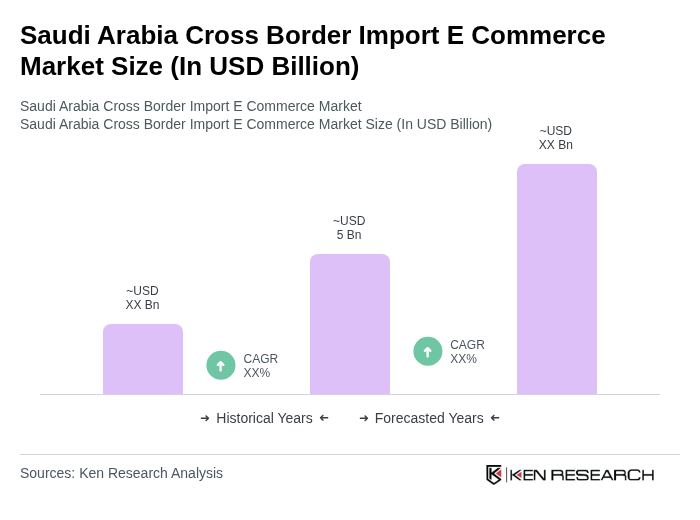
- The Saudi Arabia Cross Border Import E Commerce Market is valued at USD 5 billion, based on a five-year historical analysis. This growth is primarily driven by the increasing internet penetration reaching 99%, a young population, and a growing preference for online shopping. The rise in disposable income, the convenience of cross-border shopping, and high mobile shopping adoption with 78% 5G access have also significantly contributed to the market's expansion.
- Key players in this market include Riyadh, Jeddah, and Dammam, which dominate due to their strategic locations, robust logistics infrastructure, and high consumer spending. These cities serve as major hubs for e-commerce activities, facilitating efficient shipping and delivery services, thus attracting both local and international retailers.
- The E-Commerce Law, 2023 issued by the Ministry of Commerce requires platforms to obtain a commercial register, adhere to data protection standards under the Personal Data Protection Law, and comply with customs thresholds up to SAR 6,000 per shipment for simplified clearance, streamlining cross-border e-commerce operations including unified customs processes to reduce delivery times and enhance the overall shopping experience for consumers.
Saudi Arabia Cross Border Import E Commerce Market Segmentation
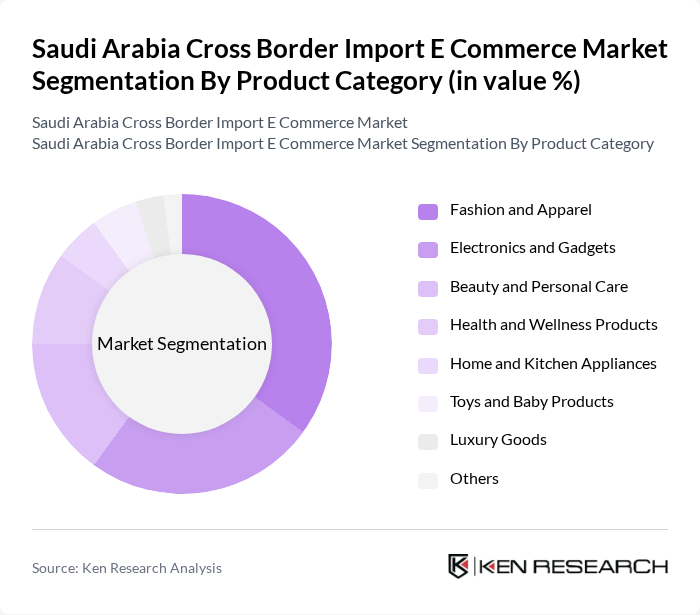
By Product Category:The product categories in the Saudi Arabia Cross Border Import E Commerce Market include Fashion and Apparel, Electronics and Gadgets, Beauty and Personal Care, Health and Wellness Products, Home and Kitchen Appliances, Toys and Baby Products, Luxury Goods, and Others. Among these, Fashion and Apparel is the leading sub-segment, driven by the increasing demand for trendy clothing and accessories among the young population. The rise of social media influencers and online fashion platforms has further fueled consumer interest in this category.
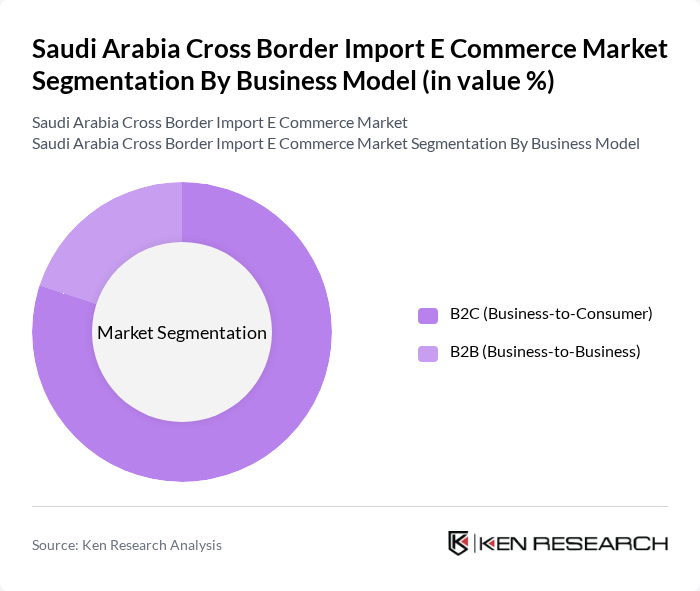
By Business Model:The market is segmented into B2C (Business-to-Consumer) and B2B (Business-to-Business) models. The B2C model is the dominant segment, as it caters directly to consumers who prefer the convenience of online shopping. The increasing number of online retailers and the growing trend of direct-to-consumer sales have significantly contributed to the growth of this segment.
Saudi Arabia Cross Border Import E Commerce Market Competitive Landscape
The Saudi Arabia Cross Border Import E Commerce Market is characterized by a dynamic mix of regional and international players. Leading participants such as Souq.com (Amazon), Noon.com, Amazon.sa, Jarir Bookstore, Extra Stores, Ounass, Namshi, Carrefour, AliExpress, eBay, Jumia, Shein, ASOS, Alibaba, Trendyol contribute to innovation, geographic expansion, and service delivery in this space.
Saudi Arabia Cross Border Import E Commerce Market Industry Analysis
Growth Drivers
- Increasing Internet Penetration:As of future, Saudi Arabia boasts an internet penetration rate of approximately 99%, with around 38 million active internet users. This widespread access facilitates online shopping, enabling consumers to explore international products easily. The rapid growth of mobile internet usage, which accounts for 90% of total internet traffic, further supports this trend. Enhanced connectivity is crucial for the expansion of cross-border e-commerce, allowing consumers to engage with global brands and services seamlessly.
- Rising Consumer Demand for International Products:In future, the demand for international products in Saudi Arabia is projected to reach SAR 35 billion, driven by a growing middle class and increased disposable income. Consumers are increasingly seeking unique and high-quality products not available locally, particularly in categories like fashion, electronics, and beauty. This trend is further fueled by social media influence, where international brands gain visibility, encouraging consumers to purchase from abroad, thus propelling cross-border e-commerce growth.
- Government Initiatives to Boost E Commerce:The Saudi government has implemented various initiatives to enhance the e-commerce landscape, including the National E-Commerce Strategy, which aims to increase the sector's contribution to GDP to SAR 15 billion by future. Additionally, the establishment of the Saudi Arabian E-Commerce Council promotes regulatory frameworks and infrastructure improvements. These initiatives create a conducive environment for cross-border e-commerce, encouraging both local and international businesses to participate in the market.
Market Challenges
- Regulatory Compliance Issues:Navigating the regulatory landscape in Saudi Arabia poses significant challenges for cross-border e-commerce. The country has stringent import regulations, requiring compliance with local standards and certifications. In future, it is estimated that 45% of international sellers face delays due to regulatory hurdles, impacting their ability to enter the market efficiently. This complexity can deter potential entrants and limit the growth of cross-border e-commerce.
- Payment Security Concerns:Payment security remains a critical challenge in the Saudi cross-border e-commerce market. In future, approximately 35% of consumers express concerns about the safety of online transactions, particularly when dealing with international sellers. The prevalence of cyber threats and fraud can undermine consumer trust, leading to hesitance in making purchases. Addressing these security concerns is essential for fostering a secure and reliable e-commerce environment.
Saudi Arabia Cross Border Import E Commerce Market Future Outlook
The future of the Saudi Arabia cross-border import e-commerce market appears promising, driven by technological advancements and evolving consumer preferences. The integration of artificial intelligence and data analytics is expected to enhance personalization, improving customer experiences. Additionally, the rise of mobile commerce will likely facilitate easier access to international products. As the government continues to support e-commerce initiatives, the market is poised for significant growth, attracting both local and international players seeking to capitalize on emerging opportunities.
Market Opportunities
- Expansion of Mobile Commerce:With mobile commerce projected to account for 75% of total e-commerce sales in Saudi Arabia by future, businesses have a significant opportunity to optimize their platforms for mobile users. This shift allows for enhanced user experiences and increased sales conversions, particularly among younger consumers who prefer shopping via mobile devices.
- Growth of Social Media Marketing:Social media platforms are becoming vital channels for e-commerce, with over 85% of Saudi consumers influenced by social media in their purchasing decisions. By leveraging targeted advertising and influencer partnerships, brands can effectively reach potential customers, driving cross-border sales and enhancing brand visibility in the competitive market landscape.
Scope of the Report
| Segment | Sub-Segments |
|---|---|
| By Product Category | Fashion and Apparel Electronics and Gadgets Beauty and Personal Care Health and Wellness Products Home and Kitchen Appliances Toys and Baby Products Luxury Goods Others |
| By Business Model | B2C (Business-to-Consumer) B2B (Business-to-Business) |
| By Platform Type | International Marketplaces Localised Websites Third-Party E-Commerce Platforms Others |
| By Payment Method | Digital Wallets Credit/Debit Cards Cash on Delivery Bank Transfers Others |
| By Sales Channel | Online Offline |
| By Shipping Origin | China/Asia Europe North America Middle East Others |
Key Target Audience
Investors and Venture Capitalist Firms
Government and Regulatory Bodies (e.g., Saudi Arabian General Investment Authority, Ministry of Commerce)
Logistics and Shipping Companies
E-commerce Platforms and Marketplaces
Payment Gateway Providers
Customs and Border Control Authorities
Retail Associations and Trade Organizations
Import and Export Businesses
Players Mentioned in the Report:
Souq.com (Amazon)
Noon.com
Amazon.sa
Jarir Bookstore
Extra Stores
Ounass
Namshi
Carrefour
AliExpress
eBay
Jumia
Shein
ASOS
Alibaba
Trendyol
Table of Contents
Market Assessment Phase
1. Executive Summary and Approach
2. Saudi Arabia Cross Border Import E Commerce Market Overview
2.1 Key Insights and Strategic Recommendations
2.2 Saudi Arabia Cross Border Import E Commerce Market Overview
2.3 Definition and Scope
2.4 Evolution of Market Ecosystem
2.5 Timeline of Key Regulatory Milestones
2.6 Value Chain & Stakeholder Mapping
2.7 Business Cycle Analysis
2.8 Policy & Incentive Landscape
3. Saudi Arabia Cross Border Import E Commerce Market Analysis
3.1 Growth Drivers
3.1.1 Increasing Internet Penetration
3.1.2 Rising Consumer Demand for International Products
3.1.3 Government Initiatives to Boost E Commerce
3.1.4 Enhanced Logistics and Delivery Services
3.2 Market Challenges
3.2.1 Regulatory Compliance Issues
3.2.2 Payment Security Concerns
3.2.3 High Competition from Local and International Players
3.2.4 Cultural and Language Barriers
3.3 Market Opportunities
3.3.1 Expansion of Mobile Commerce
3.3.2 Growth of Social Media Marketing
3.3.3 Development of Niche Markets
3.3.4 Partnerships with Local Retailers
3.4 Market Trends
3.4.1 Shift Towards Sustainable Products
3.4.2 Increasing Use of AI and Data Analytics
3.4.3 Personalization in Customer Experience
3.4.4 Rise of Subscription-Based Models
3.5 Government Regulation
3.5.1 E Commerce Law Implementation
3.5.2 Consumer Protection Regulations
3.5.3 Taxation Policies for Cross Border Transactions
3.5.4 Import Tariffs and Duties
4. SWOT Analysis
5. Stakeholder Analysis
6. Porter's Five Forces Analysis
7. Saudi Arabia Cross Border Import E Commerce Market Market Size, 2019-2024
7.1 By Value
7.2 By Volume
7.3 By Average Selling Price
8. Saudi Arabia Cross Border Import E Commerce Market Segmentation
8.1 By Product Category
8.1.1 Fashion and Apparel
8.1.2 Electronics and Gadgets
8.1.3 Beauty and Personal Care
8.1.4 Health and Wellness Products
8.1.5 Home and Kitchen Appliances
8.1.6 Toys and Baby Products
8.1.7 Luxury Goods
8.1.8 Others
8.2 By Business Model
8.2.1 B2C (Business-to-Consumer)
8.2.2 B2B (Business-to-Business)
8.3 By Platform Type
8.3.1 International Marketplaces
8.3.2 Localised Websites
8.3.3 Third-Party E-Commerce Platforms
8.3.4 Others
8.4 By Payment Method
8.4.1 Digital Wallets
8.4.2 Credit/Debit Cards
8.4.3 Cash on Delivery
8.4.4 Bank Transfers
8.4.5 Others
8.5 By Sales Channel
8.5.1 Online
8.5.2 Offline
8.6 By Shipping Origin
8.6.1 China/Asia
8.6.2 Europe
8.6.3 North America
8.6.4 Middle East
8.6.5 Others
9. Saudi Arabia Cross Border Import E Commerce Market Competitive Analysis
9.1 Market Share of Key Players
9.2 Cross Comparison of Key Players
9.2.1 Company Name
9.2.2 Market Share (%)
9.2.3 Revenue Growth Rate (YoY %)
9.2.4 Gross Margin (%)
9.2.5 Customer Acquisition Cost (CAC)
9.2.6 Average Order Value (AOV)
9.2.7 Customer Lifetime Value (CLV)
9.2.8 Return on Advertising Spend (ROAS)
9.2.9 Net Promoter Score (NPS)
9.2.10 EBITDA Margin (%)
9.3 SWOT Analysis of Top Players
9.4 Pricing Analysis
9.5 Detailed Profile of Major Companies
9.5.1 Souq.com (Amazon)
9.5.2 Noon.com
9.5.3 Amazon.sa
9.5.4 Jarir Bookstore
9.5.5 Extra Stores
9.5.6 Ounass
9.5.7 Namshi
9.5.8 Carrefour
9.5.9 AliExpress
9.5.10 eBay
9.5.11 Jumia
9.5.12 Shein
9.5.13 ASOS
9.5.14 Alibaba
9.5.15 Trendyol
10. Saudi Arabia Cross Border Import E Commerce Market End-User Analysis
10.1 Procurement Behavior of Key Ministries
10.1.1 Ministry of Commerce
10.1.2 Ministry of Finance
10.1.3 Ministry of Communications and Information Technology
10.1.4 Ministry of Health
10.2 Corporate Spend on Infrastructure & Energy
10.2.1 Investment in E Commerce Platforms
10.2.2 Budget Allocation for Digital Marketing
10.2.3 Expenditure on Logistics and Supply Chain
10.3 Pain Point Analysis by End-User Category
10.3.1 Small Businesses
10.3.2 Large Enterprises
10.3.3 Government Entities
10.4 User Readiness for Adoption
10.4.1 Awareness of E Commerce Benefits
10.4.2 Access to Technology
10.4.3 Training and Support Needs
10.5 Post-Deployment ROI and Use Case Expansion
10.5.1 Measurement of Success Metrics
10.5.2 Opportunities for Upselling
10.5.3 Customer Feedback Integration
11. Saudi Arabia Cross Border Import E Commerce Market Future Size, 2025-2030
11.1 By Value
11.2 By Volume
11.3 By Average Selling Price
Go-To-Market Strategy Phase
1. Whitespace Analysis + Business Model Canvas
1.1 Market Gaps Identification
1.2 Business Model Development
2. Marketing and Positioning Recommendations
2.1 Branding Strategies
2.2 Product USPs
3. Distribution Plan
3.1 Urban Retail Strategies
3.2 Rural NGO Tie-Ups
4. Channel & Pricing Gaps
4.1 Underserved Routes
4.2 Pricing Bands Analysis
5. Unmet Demand & Latent Needs
5.1 Category Gaps
5.2 Consumer Segments
6. Customer Relationship
6.1 Loyalty Programs
6.2 After-Sales Service
7. Value Proposition
7.1 Sustainability Initiatives
7.2 Integrated Supply Chains
8. Key Activities
8.1 Regulatory Compliance
8.2 Branding Efforts
8.3 Distribution Setup
9. Entry Strategy Evaluation
9.1 Domestic Market Entry Strategy
9.1.1 Product Mix Considerations
9.1.2 Pricing Band Strategy
9.1.3 Packaging Solutions
9.2 Export Entry Strategy
9.2.1 Target Countries Identification
9.2.2 Compliance Roadmap Development
10. Entry Mode Assessment
10.1 Joint Ventures
10.2 Greenfield Investments
10.3 Mergers & Acquisitions
10.4 Distributor Model Evaluation
11. Capital and Timeline Estimation
11.1 Capital Requirements Analysis
11.2 Timelines for Implementation
12. Control vs Risk Trade-Off
12.1 Ownership Considerations
12.2 Partnerships Evaluation
13. Profitability Outlook
13.1 Breakeven Analysis
13.2 Long-Term Sustainability Strategies
14. Potential Partner List
14.1 Distributors Identification
14.2 Joint Ventures Opportunities
14.3 Acquisition Targets
15. Execution Roadmap
15.1 Phased Plan for Market Entry
15.1.1 Market Setup Activities
15.1.2 Market Entry Steps
15.1.3 Growth Acceleration Strategies
15.1.4 Scale & Stabilize Actions
15.2 Key Activities and Milestones
15.2.1 Milestone Planning
15.2.2 Activity Tracking
Research Methodology
Phase 1: Approach1
Desk Research
- Analysis of e-commerce growth statistics from the Saudi Arabian Monetary Authority
- Review of trade reports and import/export data from the Saudi Customs Authority
- Examination of market trends and consumer behavior studies published by local research firms
Primary Research
- Interviews with key stakeholders in the e-commerce sector, including platform operators and logistics providers
- Surveys targeting consumers who have engaged in cross-border e-commerce transactions
- Focus groups with industry experts and regulatory bodies to understand compliance and market dynamics
Validation & Triangulation
- Cross-validation of findings through comparison with regional e-commerce market reports
- Triangulation of data from consumer surveys, expert interviews, and industry reports
- Sanity checks through feedback from a panel of e-commerce analysts and market experts
Phase 2: Market Size Estimation1
Top-down Assessment
- Estimation of total e-commerce market size based on national GDP and digital penetration rates
- Segmentation of the market by product categories and consumer demographics
- Incorporation of government initiatives promoting digital trade and cross-border e-commerce
Bottom-up Modeling
- Collection of sales data from leading e-commerce platforms operating in Saudi Arabia
- Analysis of shipping and logistics costs associated with cross-border transactions
- Volume estimates based on consumer purchasing patterns and average order values
Forecasting & Scenario Analysis
- Development of growth projections using historical data and market trends
- Scenario modeling based on potential regulatory changes and economic conditions
- Creation of best-case, worst-case, and most-likely scenarios through 2030
Phase 3: CATI Sample Composition1
| Scope Item/Segment | Sample Size | Target Respondent Profiles |
|---|---|---|
| Consumer E-commerce Behavior | 120 | Online Shoppers, Frequent Cross-Border Buyers |
| Logistics and Shipping Insights | 100 | Logistics Managers, Shipping Coordinators |
| Regulatory Compliance Perspectives | 80 | Legal Advisors, Compliance Officers |
| Market Entry Strategies | 70 | Business Development Managers, Market Analysts |
| Payment Solutions and Preferences | 90 | Finance Managers, Payment Gateway Providers |
Frequently Asked Questions
What is the current value of the Saudi Arabia Cross Border Import E Commerce Market?
The Saudi Arabia Cross Border Import E Commerce Market is valued at approximately USD 5 billion, reflecting significant growth driven by factors such as high internet penetration, a young population, and increasing disposable income among consumers.
What are the main drivers of growth in the Saudi Arabia Cross Border Import E Commerce Market?
Which cities are the primary hubs for e-commerce in Saudi Arabia?
What are the product categories in the Saudi Arabia Cross Border Import E Commerce Market?
Other Regional/Country Reports
Other Adjacent Reports
South Africa Social Media Marketing Market
Thailand Fashion and Apparel Market
New Zealand Consumer Electronics Market Size Share Growth Drivers Trends Opportunities & Forecast 2025–2030India Beauty and Personal Care Market Outlook to 2030KSA Health and Wellness Products Market
Italy Home Appliances MarketSouth Korea Luxury Goods MarketWhy Buy From Us?

What makes us stand out is that our consultants follow Robust, Refine and Result (RRR) methodology. Robust for clear definitions, approaches and sanity checking, Refine for differentiating respondents' facts and opinions, and Result for presenting data with story.

We have set a benchmark in the industry by offering our clients with syndicated and customized market research reports featuring coverage of entire market as well as meticulous research and analyst insights.

While we don't replace traditional research, we flip the method upside down. Our dual approach of Top Bottom & Bottom Top ensures quality deliverable by not just verifying company fundamentals but also looking at the sector and macroeconomic factors.

With one step in the future, our research team constantly tries to show you the bigger picture. We help with some of the tough questions you may encounter along the way: How is the industry positioned? Best marketing channel? KPI's of competitors? By aligning every element, we help maximize success.

Our report gives you instant access to the answers and sources that other companies might choose to hide. We elaborate each steps of research methodology we have used and showcase you the sample size to earn your trust.

If you need any support, we are here! We pride ourselves on universe strength, data quality, and quick, friendly, and professional service.