Region:Middle East
Author(s):Dev
Product Code:KRAD1671
Pages:96
Published On:November 2025
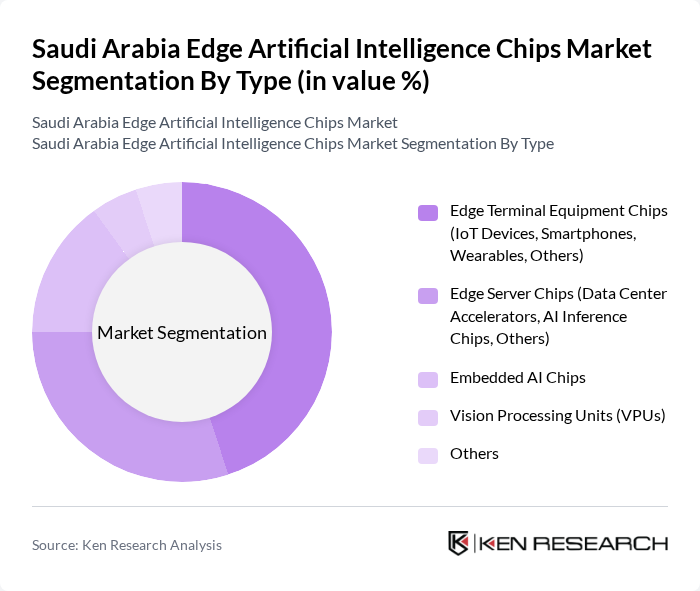
By Type:The market is segmented into Edge Terminal Equipment Chips, Edge Server Chips, Embedded AI Chips, Vision Processing Units, and Others. Among these, Edge Terminal Equipment Chips—which include IoT devices, smartphones, and wearables—are gaining significant traction due to the proliferation of connected devices and the need for efficient, low-latency data processing at the edge. Edge Server Chips are also notable, driven by the expansion of data center accelerators and AI inference solutions for industrial and smart city applications .
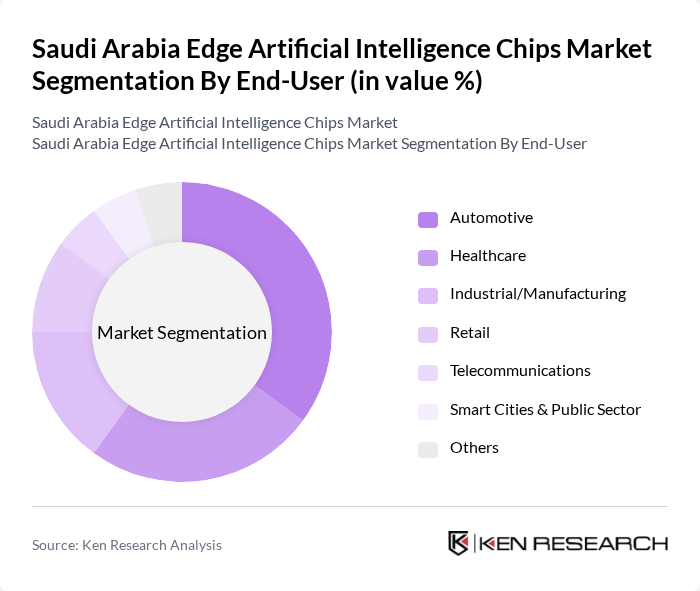
By End-User:The end-user segmentation includes Automotive, Healthcare, Industrial/Manufacturing, Retail, Telecommunications, Smart Cities & Public Sector, and Others. The automotive sector leads due to the rapid integration of AI-enabled safety, driver-assistance, and autonomous vehicle technologies. Healthcare is a major end-user, propelled by the adoption of AI-driven diagnostic imaging, patient monitoring, and hospital automation. Industrial and manufacturing sectors are also expanding their use of edge AI chips for predictive maintenance and process optimization .
The Saudi Arabia Edge Artificial Intelligence Chips Market is characterized by a dynamic mix of regional and international players. Leading participants such as Intel Corporation, NVIDIA Corporation, Qualcomm Technologies, Inc., Advanced Micro Devices, Inc. (AMD), IBM Corporation, Micron Technology, Inc., Xilinx, Inc. (now part of AMD), Texas Instruments Incorporated, ARM Holdings plc, MediaTek Inc., Broadcom Inc., STMicroelectronics N.V., Infineon Technologies AG, Renesas Electronics Corporation, Synaptics Incorporated, ADLINK Technology Inc., Gorilla Technology Group Inc., Alphabet Inc. (Google Edge TPU), Amazon.com, Inc. (AWS Inferentia), Microsoft Corporation contribute to innovation, geographic expansion, and service delivery in this space.
The future of the edge AI chips market in Saudi Arabia appears promising, driven by technological advancements and increasing government support. As the demand for real-time data processing and IoT applications continues to rise, companies are likely to invest in innovative edge computing solutions. Furthermore, the focus on energy-efficient designs and enhanced data privacy measures will shape the development of new products, ensuring that the market remains competitive and aligned with global trends in AI technology.
| Segment | Sub-Segments |
|---|---|
| By Type | Edge Terminal Equipment Chips (IoT Devices, Smartphones, Wearables, Others) Edge Server Chips (Data Center Accelerators, AI Inference Chips, Others) Embedded AI Chips Vision Processing Units (VPUs) Others |
| By End-User | Automotive Healthcare Industrial/Manufacturing Retail Telecommunications Smart Cities & Public Sector Others |
| By Application | Smart Manufacturing & Industrial Automation Smart Home Devices Smart Surveillance & Security Systems Robotics Connected Vehicles (Internet of Vehicles) Others |
| By Distribution Channel | Direct Sales Online Retail Distributors Value-Added Resellers (VARs) Others |
| By Region | Central Region Eastern Region Western Region Southern Region |
| By Technology | Machine Learning Deep Learning Computer Vision Natural Language Processing Robotics Process Automation Others |
| By Policy Support | Government Grants Tax Incentives Research and Development Funding Public-Private Partnerships Others |
| Scope Item/Segment | Sample Size | Target Respondent Profiles |
|---|---|---|
| AI Chip Manufacturers | 45 | Product Managers, Sales Directors |
| Technology Adoption in Automotive Sector | 50 | Chief Technology Officers, Innovation Leads |
| Healthcare Applications of AI Chips | 40 | Healthcare IT Managers, Biomedical Engineers |
| Consumer Electronics Integration | 48 | Product Development Managers, Marketing Heads |
| Government and Regulatory Bodies | 42 | Policy Makers, Regulatory Affairs Specialists |
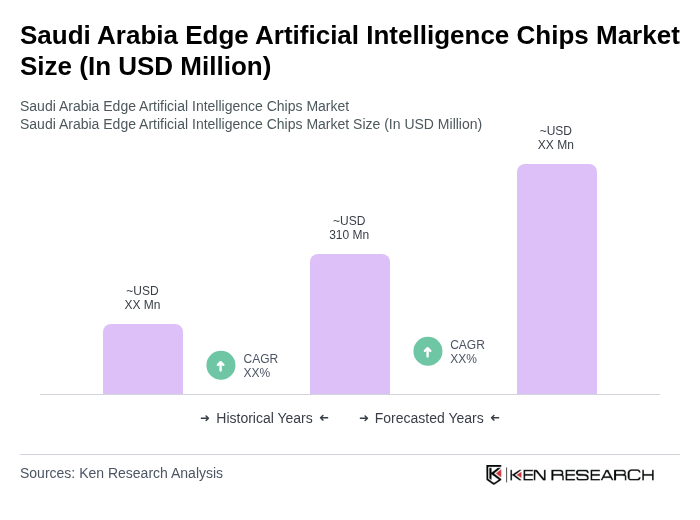
The Saudi Arabia Edge Artificial Intelligence Chips Market is valued at approximately USD 310 million, reflecting significant growth driven by the increasing adoption of IoT devices and advancements in AI technologies across various sectors.

What makes us stand out is that our consultants follow Robust, Refine and Result (RRR) methodology. Robust for clear definitions, approaches and sanity checking, Refine for differentiating respondents' facts and opinions, and Result for presenting data with story.

We have set a benchmark in the industry by offering our clients with syndicated and customized market research reports featuring coverage of entire market as well as meticulous research and analyst insights.

While we don't replace traditional research, we flip the method upside down. Our dual approach of Top Bottom & Bottom Top ensures quality deliverable by not just verifying company fundamentals but also looking at the sector and macroeconomic factors.

With one step in the future, our research team constantly tries to show you the bigger picture. We help with some of the tough questions you may encounter along the way: How is the industry positioned? Best marketing channel? KPI's of competitors? By aligning every element, we help maximize success.

Our report gives you instant access to the answers and sources that other companies might choose to hide. We elaborate each steps of research methodology we have used and showcase you the sample size to earn your trust.

If you need any support, we are here! We pride ourselves on universe strength, data quality, and quick, friendly, and professional service.













