About the Report
Base Year 2024Saudi Arabia Luxury Jewelry Market Overview
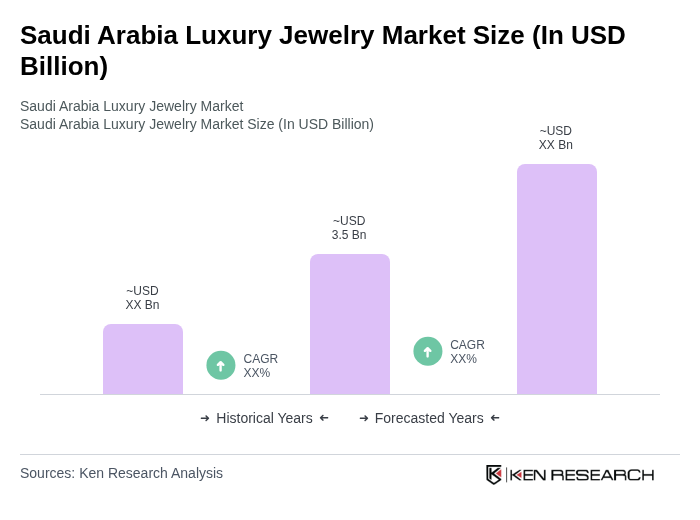
- The Saudi Arabia Luxury Jewelry Market is valued at USD 3.5 billion, based on a five-year historical analysis. This growth is primarily driven by increasing disposable incomes, a growing population of affluent consumers, and a rising demand for luxury goods, particularly among millennials and Gen Z. The market has seen a significant uptick in consumer spending on high-end jewelry, reflecting a broader trend of luxury consumption in the region.
- Key cities such as Riyadh, Jeddah, and Dammam dominate the luxury jewelry market due to their affluent populations and status as commercial hubs. Riyadh, being the capital, serves as a central point for luxury retail, while Jeddah's coastal location attracts tourists and expatriates, further boosting demand. The concentration of high-net-worth individuals in these cities also contributes to their dominance in the market.
- In 2023, the Saudi government implemented regulations aimed at enhancing the transparency and traceability of precious metals and gemstones. This initiative requires all jewelry retailers to provide certification for their products, ensuring that they meet international standards for quality and ethical sourcing. This regulation is expected to bolster consumer confidence and promote sustainable practices within the luxury jewelry sector.
Saudi Arabia Luxury Jewelry Market Segmentation
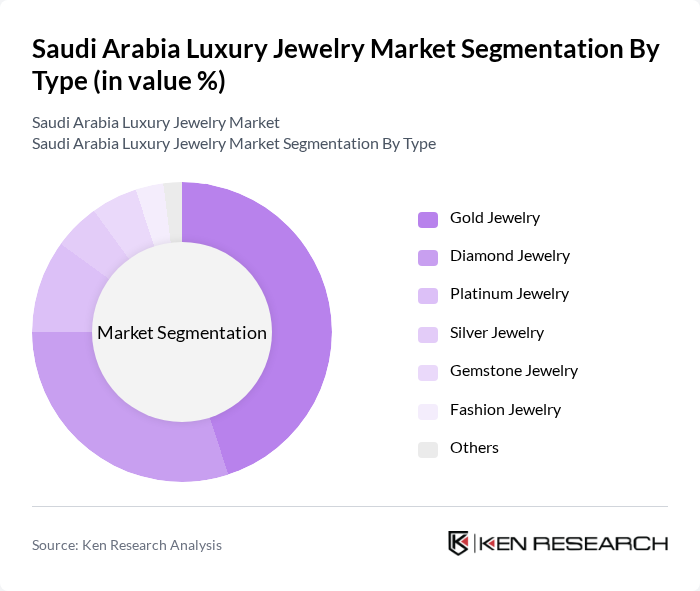
By Type:The luxury jewelry market in Saudi Arabia is segmented into various types, including Gold Jewelry, Diamond Jewelry, Platinum Jewelry, Silver Jewelry, Gemstone Jewelry, Fashion Jewelry, and Others. Among these, Gold Jewelry remains the most dominant segment due to cultural significance and traditional preferences. The demand for gold jewelry is driven by its status as a symbol of wealth and its use in various occasions, particularly weddings and festivals. Diamond Jewelry follows closely, appealing to consumers seeking luxury and exclusivity. The market for Platinum and Silver Jewelry is also growing, albeit at a slower pace, as consumers increasingly seek unique and high-quality pieces.
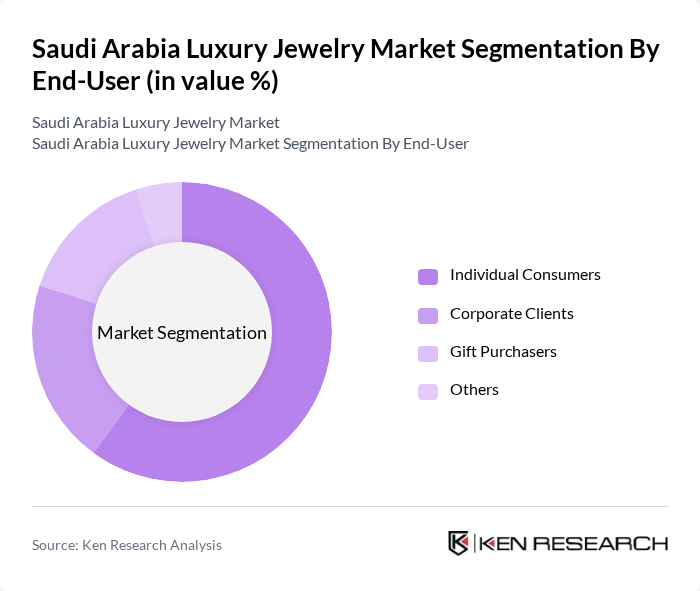
By End-User:The end-user segmentation of the luxury jewelry market includes Individual Consumers, Corporate Clients, Gift Purchasers, and Others. Individual Consumers dominate the market, driven by personal purchases for self-adornment and special occasions. The trend of gifting luxury jewelry for anniversaries, weddings, and other celebrations has also seen a significant rise, making Gift Purchasers a notable segment. Corporate Clients, while smaller in number, contribute to the market through bulk purchases for events and employee recognition programs.
Saudi Arabia Luxury Jewelry Market Competitive Landscape
The Saudi Arabia Luxury Jewelry Market is characterized by a dynamic mix of regional and international players. Leading participants such as Al Haramain Jewelry, L'azurde, Damas Jewelry, Mouawad Jewelry, Tiffany & Co., Cartier, Bvlgari, Chopard, Van Cleef & Arpels, Graff Diamonds, Piaget, Harry Winston, Mikimoto, Buccellati, Roberto Coin contribute to innovation, geographic expansion, and service delivery in this space.
Saudi Arabia Luxury Jewelry Market Industry Analysis
Growth Drivers
- Increasing Disposable Income:The average disposable income in Saudi Arabia is projected to reach approximately SAR 85,000 (USD 22,666) per capita in future, reflecting a 5% increase from the previous year. This rise in income enables consumers to allocate more funds towards luxury purchases, including jewelry. As the economy diversifies and employment opportunities expand, the affluent class is expected to grow, further driving demand for high-end jewelry products that symbolize status and wealth.
- Rising Demand for Luxury Goods:The luxury goods market in Saudi Arabia is anticipated to grow to SAR 22 billion (USD 5.86 billion) in future, with jewelry being a significant segment. This growth is fueled by a cultural shift towards luxury consumption, particularly among younger consumers who prioritize brand prestige and exclusivity. The increasing number of luxury retail outlets and international brands entering the market also contributes to heightened consumer interest in luxury jewelry.
- Cultural Significance of Jewelry in Celebrations:Jewelry plays a vital role in Saudi cultural traditions, especially during weddings and religious celebrations. In future, it is estimated that over 65% of luxury jewelry purchases will be linked to such events, with average spending per wedding reaching SAR 160,000 (USD 42,666). This cultural importance ensures a consistent demand for luxury jewelry, as families invest in high-quality pieces that are often passed down through generations, enhancing their sentimental value.
Market Challenges
- Economic Fluctuations:The Saudi economy is heavily reliant on oil revenues, which can be volatile. In future, oil prices are projected to fluctuate between USD 75 and USD 95 per barrel, impacting government spending and consumer confidence. Economic instability can lead to reduced discretionary spending, affecting the luxury jewelry market as consumers prioritize essential goods over luxury items during downturns.
- High Competition Among Luxury Brands:The luxury jewelry sector in Saudi Arabia is characterized by intense competition, with over 160 international and local brands vying for market share. This saturation leads to aggressive pricing strategies and marketing campaigns, which can dilute brand value. In future, it is expected that the top five brands will account for only 32% of the market, indicating a fragmented landscape that poses challenges for new entrants and established players alike.
Saudi Arabia Luxury Jewelry Market Future Outlook
The Saudi luxury jewelry market is poised for significant transformation, driven by evolving consumer preferences and technological advancements. As sustainability becomes a priority, brands that adopt ethical sourcing practices are likely to gain a competitive edge. Additionally, the integration of augmented reality in retail experiences is expected to enhance customer engagement. With the rise of e-commerce, brands that effectively leverage online platforms will capture a larger share of the market, catering to the tech-savvy younger demographic seeking convenience and personalization.
Market Opportunities
- Expansion of Online Retail Channels:The e-commerce sector in Saudi Arabia is projected to grow to SAR 55 billion (USD 14.67 billion) in future. This growth presents a significant opportunity for luxury jewelry brands to enhance their online presence, offering consumers a seamless shopping experience. By investing in digital marketing and user-friendly platforms, brands can reach a broader audience and cater to the increasing preference for online shopping.
- Customization and Personalization Trends:In future, approximately 45% of luxury jewelry consumers are expected to seek personalized products. This trend offers brands the opportunity to differentiate themselves by providing bespoke services, such as custom designs and engraving. By tapping into this demand for unique pieces, brands can enhance customer loyalty and increase average transaction values, ultimately driving revenue growth in a competitive market.
Scope of the Report
| Segment | Sub-Segments |
|---|---|
| By Type | Gold Jewelry Diamond Jewelry Platinum Jewelry Silver Jewelry Gemstone Jewelry Fashion Jewelry Others |
| By End-User | Individual Consumers Corporate Clients Gift Purchasers Others |
| By Distribution Channel | Online Retail Offline Retail Direct Sales Others |
| By Occasion | Weddings Anniversaries Festivals Everyday Wear Others |
| By Material | Precious Metals Semi-Precious Stones Synthetic Materials Others |
| By Price Range | Luxury Segment Mid-Range Segment Affordable Segment Others |
| By Brand Positioning | High-End Brands Mid-Tier Brands Emerging Brands Others |
Key Target Audience
Investors and Venture Capitalist Firms
Government and Regulatory Bodies (e.g., Saudi Arabian Monetary Authority, Ministry of Commerce)
Luxury Jewelry Manufacturers and Producers
Distributors and Retailers in Luxury Goods
High-Net-Worth Individuals (HNWIs)
Luxury Brand Management Firms
Trade Associations in the Jewelry Sector
Financial Institutions and Banks specializing in Luxury Assets
Players Mentioned in the Report:
Al Haramain Jewelry
L'azurde
Damas Jewelry
Mouawad Jewelry
Tiffany & Co.
Cartier
Bvlgari
Chopard
Van Cleef & Arpels
Graff Diamonds
Piaget
Harry Winston
Mikimoto
Buccellati
Roberto Coin
Table of Contents
Market Assessment Phase
1. Executive Summary and Approach
2. Saudi Arabia Luxury Jewelry Market Overview
2.1 Key Insights and Strategic Recommendations
2.2 Saudi Arabia Luxury Jewelry Market Overview
2.3 Definition and Scope
2.4 Evolution of Market Ecosystem
2.5 Timeline of Key Regulatory Milestones
2.6 Value Chain & Stakeholder Mapping
2.7 Business Cycle Analysis
2.8 Policy & Incentive Landscape
3. Saudi Arabia Luxury Jewelry Market Analysis
3.1 Growth Drivers
3.1.1 Increasing disposable income
3.1.2 Rising demand for luxury goods
3.1.3 Cultural significance of jewelry in celebrations
3.1.4 Growth of e-commerce platforms
3.2 Market Challenges
3.2.1 Economic fluctuations
3.2.2 High competition among luxury brands
3.2.3 Regulatory hurdles
3.2.4 Changing consumer preferences
3.3 Market Opportunities
3.3.1 Expansion of online retail channels
3.3.2 Collaborations with local artisans
3.3.3 Customization and personalization trends
3.3.4 Growing interest in sustainable luxury jewelry
3.4 Market Trends
3.4.1 Increasing popularity of ethical sourcing
3.4.2 Rise of influencer marketing
3.4.3 Shift towards experiential retail
3.4.4 Integration of technology in jewelry design
3.5 Government Regulation
3.5.1 Import tariffs on luxury goods
3.5.2 Consumer protection laws
3.5.3 Regulations on precious metals and stones
3.5.4 Licensing requirements for retailers
4. SWOT Analysis
5. Stakeholder Analysis
6. Porter's Five Forces Analysis
7. Saudi Arabia Luxury Jewelry Market Market Size, 2019-2024
7.1 By Value
7.2 By Volume
7.3 By Average Selling Price
8. Saudi Arabia Luxury Jewelry Market Segmentation
8.1 By Type
8.1.1 Gold Jewelry
8.1.2 Diamond Jewelry
8.1.3 Platinum Jewelry
8.1.4 Silver Jewelry
8.1.5 Gemstone Jewelry
8.1.6 Fashion Jewelry
8.1.7 Others
8.2 By End-User
8.2.1 Individual Consumers
8.2.2 Corporate Clients
8.2.3 Gift Purchasers
8.2.4 Others
8.3 By Distribution Channel
8.3.1 Online Retail
8.3.2 Offline Retail
8.3.3 Direct Sales
8.3.4 Others
8.4 By Occasion
8.4.1 Weddings
8.4.2 Anniversaries
8.4.3 Festivals
8.4.4 Everyday Wear
8.4.5 Others
8.5 By Material
8.5.1 Precious Metals
8.5.2 Semi-Precious Stones
8.5.3 Synthetic Materials
8.5.4 Others
8.6 By Price Range
8.6.1 Luxury Segment
8.6.2 Mid-Range Segment
8.6.3 Affordable Segment
8.6.4 Others
8.7 By Brand Positioning
8.7.1 High-End Brands
8.7.2 Mid-Tier Brands
8.7.3 Emerging Brands
8.7.4 Others
9. Saudi Arabia Luxury Jewelry Market Competitive Analysis
9.1 Market Share of Key Players
9.2 Cross Comparison of Key Players
9.2.1 Company Name
9.2.2 Group Size (Large, Medium, or Small as per industry convention)
9.2.3 Revenue Growth Rate
9.2.4 Customer Retention Rate
9.2.5 Market Penetration Rate
9.2.6 Average Order Value
9.2.7 Pricing Strategy
9.2.8 Brand Equity
9.2.9 Product Diversification
9.2.10 Distribution Network Efficiency
9.3 SWOT Analysis of Top Players
9.4 Pricing Analysis
9.5 Detailed Profile of Major Companies
9.5.1 Al Haramain Jewelry
9.5.2 L'azurde
9.5.3 Damas Jewelry
9.5.4 Mouawad Jewelry
9.5.5 Tiffany & Co.
9.5.6 Cartier
9.5.7 Bvlgari
9.5.8 Chopard
9.5.9 Van Cleef & Arpels
9.5.10 Graff Diamonds
9.5.11 Piaget
9.5.12 Harry Winston
9.5.13 Mikimoto
9.5.14 Buccellati
9.5.15 Roberto Coin
10. Saudi Arabia Luxury Jewelry Market End-User Analysis
10.1 Procurement Behavior of Key Ministries
10.1.1 Government procurement policies
10.1.2 Budget allocation for luxury items
10.1.3 Supplier selection criteria
10.1.4 Contract management practices
10.2 Corporate Spend on Infrastructure & Energy
10.2.1 Investment in luxury branding
10.2.2 Expenditure on corporate gifting
10.2.3 Spending on employee rewards
10.2.4 Others
10.3 Pain Point Analysis by End-User Category
10.3.1 Quality concerns
10.3.2 Availability of designs
10.3.3 Pricing transparency
10.3.4 After-sales service issues
10.4 User Readiness for Adoption
10.4.1 Awareness of luxury brands
10.4.2 Willingness to pay premium prices
10.4.3 Familiarity with online purchasing
10.4.4 Others
10.5 Post-Deployment ROI and Use Case Expansion
10.5.1 Customer satisfaction metrics
10.5.2 Repeat purchase rates
10.5.3 Brand loyalty indicators
10.5.4 Others
11. Saudi Arabia Luxury Jewelry Market Future Size, 2025-2030
11.1 By Value
11.2 By Volume
11.3 By Average Selling Price
Go-To-Market Strategy Phase
1. Whitespace Analysis + Business Model Canvas
1.1 Market gaps identification
1.2 Value proposition development
1.3 Revenue model exploration
1.4 Customer segmentation analysis
1.5 Competitive landscape overview
1.6 Key partnerships identification
1.7 Operational framework design
2. Marketing and Positioning Recommendations
2.1 Branding strategies
2.2 Product USPs
2.3 Target audience definition
2.4 Marketing channels selection
2.5 Campaign planning
2.6 Performance metrics
2.7 Feedback mechanisms
3. Distribution Plan
3.1 Urban retail vs rural NGO tie-ups
3.2 E-commerce strategy
3.3 Logistics and supply chain management
3.4 Retail partnerships
3.5 Inventory management
3.6 Customer service integration
3.7 Distribution channel optimization
4. Channel & Pricing Gaps
4.1 Underserved routes
4.2 Pricing bands
4.3 Competitor pricing analysis
4.4 Value-based pricing strategies
4.5 Discounting strategies
4.6 Price elasticity assessment
4.7 Customer perception of value
5. Unmet Demand & Latent Needs
5.1 Category gaps
5.2 Consumer segments
5.3 Emerging trends analysis
5.4 Customer feedback analysis
5.5 Market research findings
5.6 Innovation opportunities
5.7 Future demand forecasting
6. Customer Relationship
6.1 Loyalty programs
6.2 After-sales service
6.3 Customer engagement strategies
6.4 Feedback collection methods
6.5 Relationship management tools
6.6 Personalization strategies
6.7 Community building initiatives
7. Value Proposition
7.1 Sustainability
7.2 Integrated supply chains
7.3 Unique selling points
7.4 Customer-centric approach
7.5 Brand storytelling
7.6 Quality assurance
7.7 Innovation in product offerings
8. Key Activities
8.1 Regulatory compliance
8.2 Branding
8.3 Distribution setup
8.4 Marketing execution
8.5 Performance monitoring
8.6 Stakeholder engagement
8.7 Continuous improvement processes
9. Entry Strategy Evaluation
9.1 Domestic Market Entry Strategy
9.1.1 Product mix
9.1.2 Pricing band
9.1.3 Packaging
9.2 Export Entry Strategy
9.2.1 Target countries
9.2.2 Compliance roadmap
10. Entry Mode Assessment
10.1 JV
10.2 Greenfield
10.3 M&A
10.4 Distributor Model
11. Capital and Timeline Estimation
11.1 Capital requirements
11.2 Timelines
12. Control vs Risk Trade-Off
12.1 Ownership vs Partnerships
13. Profitability Outlook
13.1 Breakeven analysis
13.2 Long-term sustainability
14. Potential Partner List
14.1 Distributors
14.2 JVs
14.3 Acquisition targets
15. Execution Roadmap
15.1 Phased Plan for Market Entry
15.1.1 Market Setup
15.1.2 Market Entry
15.1.3 Growth Acceleration
15.1.4 Scale & Stabilize
15.2 Key Activities and Milestones
15.2.1 Activity timelines
15.2.2 Milestone tracking
Research Methodology
Phase 1: Approach1
Desk Research
- Analysis of market reports from industry associations and trade publications specific to luxury jewelry in Saudi Arabia
- Review of government publications and economic reports detailing consumer spending trends and luxury goods market dynamics
- Examination of online databases and market intelligence platforms for historical sales data and growth forecasts
Primary Research
- In-depth interviews with key stakeholders including luxury jewelry retailers, manufacturers, and distributors in Saudi Arabia
- Surveys targeting affluent consumers to understand purchasing behavior, preferences, and brand perceptions
- Focus group discussions with jewelry designers and artisans to gather insights on market trends and consumer demands
Validation & Triangulation
- Cross-validation of findings through comparison with international luxury jewelry market trends and consumer behavior studies
- Triangulation of data from primary interviews, consumer surveys, and secondary research to ensure consistency and reliability
- Sanity checks conducted through expert panel reviews comprising industry veterans and market analysts
Phase 2: Market Size Estimation1
Top-down Assessment
- Estimation of the luxury jewelry market size based on national GDP growth and luxury goods consumption patterns
- Segmentation of the market by product categories such as gold, diamonds, and designer pieces
- Incorporation of demographic factors influencing luxury purchases, including income levels and population growth in urban areas
Bottom-up Modeling
- Collection of sales data from leading luxury jewelry retailers to establish baseline revenue figures
- Analysis of average transaction values and purchase frequency among affluent consumers
- Estimation of market share for various brands and product lines based on retailer input and consumer feedback
Forecasting & Scenario Analysis
- Development of growth projections using historical data and current market trends to forecast future demand
- Scenario analysis based on potential economic shifts, changes in consumer preferences, and regulatory impacts on luxury goods
- Creation of multiple forecast scenarios (baseline, optimistic, and pessimistic) to account for market volatility and external factors
Phase 3: CATI Sample Composition1
| Scope Item/Segment | Sample Size | Target Respondent Profiles |
|---|---|---|
| Luxury Jewelry Retailers | 100 | Store Managers, Sales Directors |
| Affluent Consumer Insights | 150 | High Net-Worth Individuals, Luxury Shoppers |
| Jewelry Designers and Artisans | 50 | Designers, Craftspersons |
| Market Analysts and Experts | 30 | Industry Analysts, Economic Advisors |
| Luxury Brand Executives | 40 | Brand Managers, Marketing Directors |
Frequently Asked Questions
What is the current value of the Saudi Arabia Luxury Jewelry Market?
The Saudi Arabia Luxury Jewelry Market is valued at approximately USD 3.5 billion, reflecting a significant increase in consumer spending on high-end jewelry, driven by rising disposable incomes and a growing affluent population.
Which cities dominate the luxury jewelry market in Saudi Arabia?
What are the main types of luxury jewelry in Saudi Arabia?
How has the Saudi government influenced the luxury jewelry market?
Other Regional/Country Reports
Other Adjacent Reports
Egypt Luxury Accessories Market
Philippines Precious Metals Market Size, Share, Growth Drivers, Trends, Opportunities & Forecast 2025–2030Qatar Gemstone Market
Kuwait fashion accessories market report size, share, growth drivers, trends, opportunities & forecast 2025–2030Qatar Luxury Cosmetics Market
Qatar luxury perfume market report size, share, growth drivers, trends, opportunities & forecast 2025–2030USA Wedding Services Market Report Size Share Growth Drivers Trends Opportunities & Forecast 2025–2030Vietnam E-commerce Retail Market
Why Buy From Us?

What makes us stand out is that our consultants follow Robust, Refine and Result (RRR) methodology. Robust for clear definitions, approaches and sanity checking, Refine for differentiating respondents' facts and opinions, and Result for presenting data with story.

We have set a benchmark in the industry by offering our clients with syndicated and customized market research reports featuring coverage of entire market as well as meticulous research and analyst insights.

While we don't replace traditional research, we flip the method upside down. Our dual approach of Top Bottom & Bottom Top ensures quality deliverable by not just verifying company fundamentals but also looking at the sector and macroeconomic factors.

With one step in the future, our research team constantly tries to show you the bigger picture. We help with some of the tough questions you may encounter along the way: How is the industry positioned? Best marketing channel? KPI's of competitors? By aligning every element, we help maximize success.

Our report gives you instant access to the answers and sources that other companies might choose to hide. We elaborate each steps of research methodology we have used and showcase you the sample size to earn your trust.

If you need any support, we are here! We pride ourselves on universe strength, data quality, and quick, friendly, and professional service.