About the Report
Base Year 2024South Korea Luxury Hotels & Resorts Market Overview
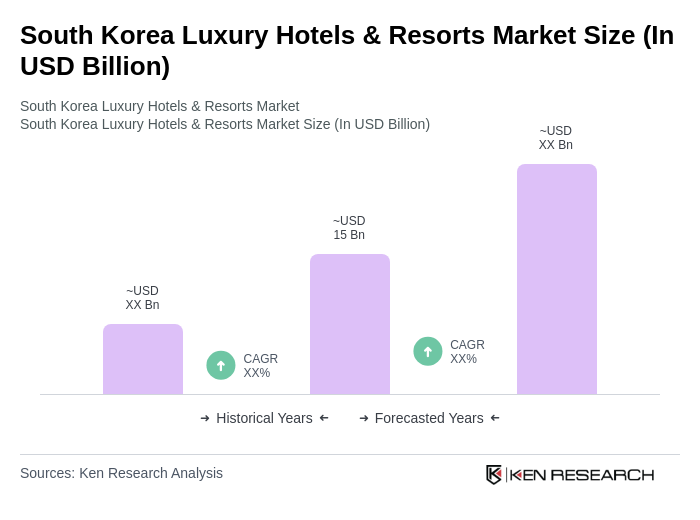
- The South Korea Luxury Hotels & Resorts Market is valued at USD 15 billion, based on a five-year historical analysis. This growth is primarily driven by the increasing influx of international tourists, rising disposable incomes, and a growing preference for premium travel experiences among domestic consumers. The luxury segment has seen a significant uptick in demand, particularly in urban centers and popular tourist destinations.
- Key cities dominating this market include Seoul, Busan, and Jeju Island. Seoul stands out as a global city with a vibrant culture, extensive shopping options, and a bustling business environment, making it a prime location for luxury accommodations. Busan, with its beautiful beaches and international film festival, attracts leisure travelers, while Jeju Island is renowned for its natural beauty and luxury resorts, appealing to both domestic and international tourists.
- In 2023, the South Korean government implemented regulations aimed at enhancing the quality of service in the luxury hotel sector. This includes mandatory training programs for staff to improve customer service standards and the introduction of sustainability practices to promote eco-friendly operations. These regulations are designed to elevate the overall guest experience and ensure that luxury hotels meet international standards.
South Korea Luxury Hotels & Resorts Market Segmentation
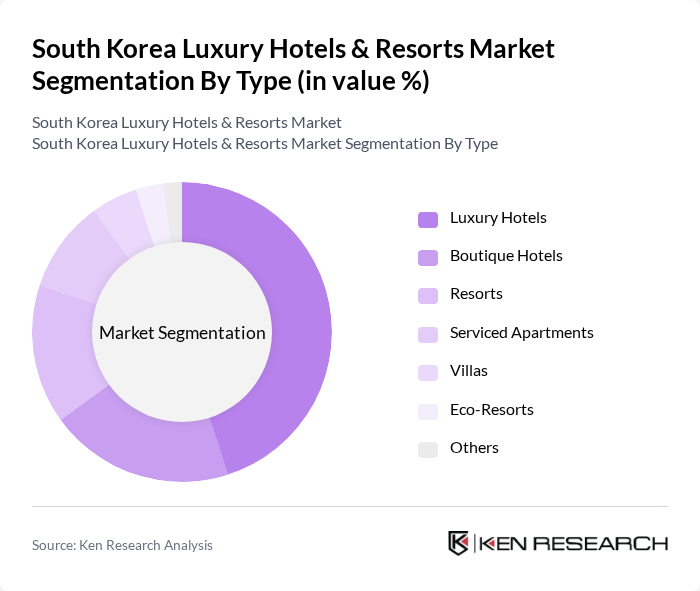
By Type:The luxury hotels and resorts market is segmented into various types, including Luxury Hotels, Boutique Hotels, Resorts, Serviced Apartments, Villas, Eco-Resorts, and Others. Among these, Luxury Hotels dominate the market due to their extensive amenities, brand recognition, and ability to cater to high-end clientele. Boutique Hotels are gaining traction for their unique offerings and personalized services, while Eco-Resorts are becoming increasingly popular as travelers seek sustainable options. The diverse range of accommodations allows consumers to choose based on their preferences and needs.
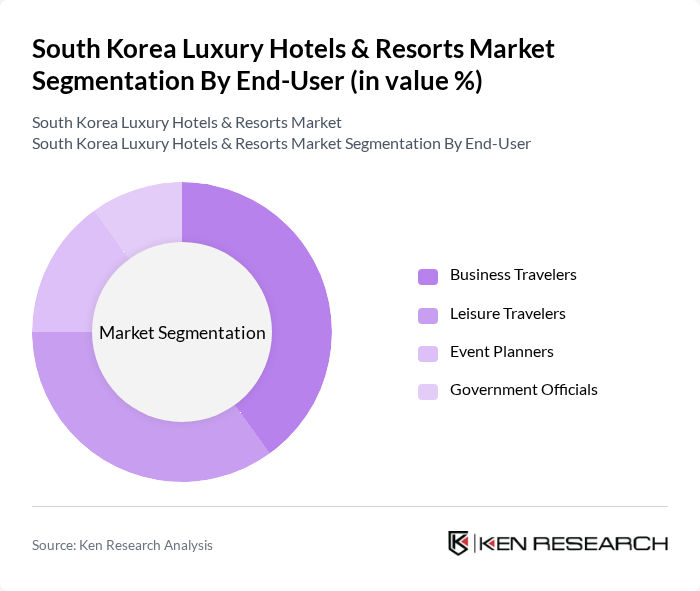
By End-User:The market is also segmented by end-users, including Business Travelers, Leisure Travelers, Event Planners, and Government Officials. Business Travelers represent a significant portion of the market, driven by the increasing number of international conferences and corporate events held in South Korea. Leisure Travelers are also a major segment, attracted by the country's rich culture and attractions. Event Planners and Government Officials contribute to the demand for luxury accommodations, particularly during high-profile events and official visits.
South Korea Luxury Hotels & Resorts Market Competitive Landscape
The South Korea Luxury Hotels & Resorts Market is characterized by a dynamic mix of regional and international players. Leading participants such as The Shilla Hotels and Resorts, Lotte Hotels & Resorts, Park Hyatt Busan, Four Seasons Hotel Seoul, Grand InterContinental Seoul Parnas, Banyan Tree Club & Spa Seoul, Conrad Seoul, Hilton Busan, The Westin Chosun Seoul, JW Marriott Hotel Seoul, InterContinental Alpensia Pyeongchang Resort, The Ritz-Carlton, Seoul, Oakwood Premier Incheon, Grand Hyatt Jeju, The Plaza Seoul contribute to innovation, geographic expansion, and service delivery in this space.
South Korea Luxury Hotels & Resorts Market Industry Analysis
Growth Drivers
- Increasing Disposable Income:The average disposable income in South Korea is projected to reach approximately 3,800 USD per month in future, reflecting a steady increase from previous years. This rise in income allows consumers to allocate more funds towards luxury experiences, including high-end accommodations. As more individuals enter the upper-middle-class bracket, the demand for luxury hotels and resorts is expected to surge, driving growth in this sector significantly.
- Rising International Tourism:South Korea welcomed over 18 million international tourists in future, with projections indicating a further increase to 22 million in future. This influx is driven by the country's rich cultural heritage and modern attractions. The growing number of international visitors is expected to boost occupancy rates in luxury hotels, as travelers seek premium accommodations that offer unique experiences and high-quality services during their stay.
- Growth in Domestic Travel:Domestic travel in South Korea is anticipated to reach 65 million trips in future, up from 58 million in future. This trend is fueled by a growing interest in local tourism, particularly among younger generations. As South Koreans increasingly explore their own country, luxury hotels and resorts are well-positioned to cater to this market, offering tailored experiences that highlight local culture and attractions, thus driving revenue growth.
Market Challenges
- High Operational Costs:The operational costs for luxury hotels in South Korea are projected to rise by 12% in future, primarily due to increased labor costs and rising utility expenses. This financial pressure can significantly impact profit margins, making it challenging for hotels to maintain high service standards while managing expenses. As a result, many establishments may struggle to balance quality service with cost efficiency, affecting overall competitiveness in the market.
- Intense Competition:The luxury hotel sector in South Korea is characterized by fierce competition, with over 220 luxury hotels vying for market share in major cities like Seoul and Busan. This saturation leads to price wars and aggressive marketing strategies, which can dilute brand value and profitability. As new entrants continue to emerge, established hotels must innovate and enhance their offerings to retain customer loyalty and market position.
South Korea Luxury Hotels & Resorts Market Future Outlook
The South Korea luxury hotels and resorts market is poised for significant transformation, driven by evolving consumer preferences and technological advancements. As travelers increasingly seek personalized experiences, hotels will need to adapt by offering bespoke services and unique local experiences. Additionally, the integration of smart technologies in hospitality will enhance operational efficiency and guest satisfaction. Sustainability will also play a crucial role, as eco-conscious travelers demand greener practices, prompting hotels to innovate in their service delivery and environmental impact.
Market Opportunities
- Expansion of Wellness Tourism:The wellness tourism sector in South Korea is expected to grow to 5 billion USD in future, driven by increasing consumer interest in health and well-being. Luxury hotels can capitalize on this trend by offering wellness-focused packages, including spa services, fitness programs, and healthy dining options, thereby attracting health-conscious travelers seeking rejuvenation and relaxation.
- Development of Eco-Friendly Hotels:With a growing emphasis on sustainability, the demand for eco-friendly hotels is projected to rise significantly. In future, approximately 35% of travelers are expected to prioritize environmentally responsible accommodations. Luxury hotels that adopt green practices, such as energy-efficient systems and sustainable sourcing, can differentiate themselves in a competitive market, appealing to eco-conscious consumers and enhancing their brand reputation.
Scope of the Report
| Segment | Sub-Segments |
|---|---|
| By Type | Luxury Hotels Boutique Hotels Resorts Serviced Apartments Villas Eco-Resorts Others |
| By End-User | Business Travelers Leisure Travelers Event Planners Government Officials |
| By Price Range | Premium Mid-Range Luxury Budget Luxury |
| By Location | Urban Areas Coastal Regions Mountain Resorts Cultural Heritage Sites |
| By Amenities Offered | Spa Services Fine Dining Conference Facilities Recreational Activities |
| By Booking Channel | Direct Booking Online Travel Agencies Travel Agents |
| By Customer Loyalty Programs | Membership Programs Reward Points Systems Exclusive Offers |
Key Target Audience
Investors and Venture Capitalist Firms
Government and Regulatory Bodies (e.g., Ministry of Culture, Sports and Tourism)
Real Estate Developers
Tourism Boards and Promotion Agencies (e.g., Korea Tourism Organization)
Hospitality Management Companies
Luxury Travel Agencies
Event and Conference Organizers
Financial Institutions
Players Mentioned in the Report:
The Shilla Hotels and Resorts
Lotte Hotels & Resorts
Park Hyatt Busan
Four Seasons Hotel Seoul
Grand InterContinental Seoul Parnas
Banyan Tree Club & Spa Seoul
Conrad Seoul
Hilton Busan
The Westin Chosun Seoul
JW Marriott Hotel Seoul
InterContinental Alpensia Pyeongchang Resort
The Ritz-Carlton, Seoul
Oakwood Premier Incheon
Grand Hyatt Jeju
The Plaza Seoul
Table of Contents
Market Assessment Phase
1. Executive Summary and Approach
2. South Korea Luxury Hotels & Resorts Market Overview
2.1 Key Insights and Strategic Recommendations
2.2 South Korea Luxury Hotels & Resorts Market Overview
2.3 Definition and Scope
2.4 Evolution of Market Ecosystem
2.5 Timeline of Key Regulatory Milestones
2.6 Value Chain & Stakeholder Mapping
2.7 Business Cycle Analysis
2.8 Policy & Incentive Landscape
3. South Korea Luxury Hotels & Resorts Market Analysis
3.1 Growth Drivers
3.1.1 Increasing disposable income
3.1.2 Rising international tourism
3.1.3 Growth in domestic travel
3.1.4 Enhanced luxury experiences
3.2 Market Challenges
3.2.1 High operational costs
3.2.2 Intense competition
3.2.3 Economic fluctuations
3.2.4 Regulatory compliance issues
3.3 Market Opportunities
3.3.1 Expansion of wellness tourism
3.3.2 Development of eco-friendly hotels
3.3.3 Technological advancements in hospitality
3.3.4 Customized luxury travel packages
3.4 Market Trends
3.4.1 Rise of experiential travel
3.4.2 Increased focus on sustainability
3.4.3 Digital transformation in booking
3.4.4 Growth of boutique hotels
3.5 Government Regulation
3.5.1 Tourism promotion policies
3.5.2 Health and safety regulations
3.5.3 Environmental protection laws
3.5.4 Licensing and operational standards
4. SWOT Analysis
5. Stakeholder Analysis
6. Porter's Five Forces Analysis
7. South Korea Luxury Hotels & Resorts Market Market Size, 2019-2024
7.1 By Value
7.2 By Volume
7.3 By Average Selling Price
8. South Korea Luxury Hotels & Resorts Market Segmentation
8.1 By Type
8.1.1 Luxury Hotels
8.1.2 Boutique Hotels
8.1.3 Resorts
8.1.4 Serviced Apartments
8.1.5 Villas
8.1.6 Eco-Resorts
8.1.7 Others
8.2 By End-User
8.2.1 Business Travelers
8.2.2 Leisure Travelers
8.2.3 Event Planners
8.2.4 Government Officials
8.3 By Price Range
8.3.1 Premium
8.3.2 Mid-Range Luxury
8.3.3 Budget Luxury
8.4 By Location
8.4.1 Urban Areas
8.4.2 Coastal Regions
8.4.3 Mountain Resorts
8.4.4 Cultural Heritage Sites
8.5 By Amenities Offered
8.5.1 Spa Services
8.5.2 Fine Dining
8.5.3 Conference Facilities
8.5.4 Recreational Activities
8.6 By Booking Channel
8.6.1 Direct Booking
8.6.2 Online Travel Agencies
8.6.3 Travel Agents
8.7 By Customer Loyalty Programs
8.7.1 Membership Programs
8.7.2 Reward Points Systems
8.7.3 Exclusive Offers
9. South Korea Luxury Hotels & Resorts Market Competitive Analysis
9.1 Market Share of Key Players
9.2 Cross Comparison of Key Players
9.2.1 Company Name
9.2.2 Group Size (Large, Medium, or Small as per industry convention)
9.2.3 Occupancy Rate
9.2.4 Average Daily Rate (ADR)
9.2.5 Revenue Per Available Room (RevPAR)
9.2.6 Customer Satisfaction Score
9.2.7 Market Penetration Rate
9.2.8 Pricing Strategy
9.2.9 Brand Recognition Index
9.2.10 Employee Satisfaction Rate
9.3 SWOT Analysis of Top Players
9.4 Pricing Analysis
9.5 Detailed Profile of Major Companies
9.5.1 The Shilla Hotels and Resorts
9.5.2 Lotte Hotels & Resorts
9.5.3 Park Hyatt Busan
9.5.4 Four Seasons Hotel Seoul
9.5.5 Grand InterContinental Seoul Parnas
9.5.6 Banyan Tree Club & Spa Seoul
9.5.7 Conrad Seoul
9.5.8 Hilton Busan
9.5.9 The Westin Chosun Seoul
9.5.10 JW Marriott Hotel Seoul
9.5.11 InterContinental Alpensia Pyeongchang Resort
9.5.12 The Ritz-Carlton, Seoul
9.5.13 Oakwood Premier Incheon
9.5.14 Grand Hyatt Jeju
9.5.15 The Plaza Seoul
10. South Korea Luxury Hotels & Resorts Market End-User Analysis
10.1 Procurement Behavior of Key Ministries
10.1.1 Government travel policies
10.1.2 Budget allocation for official travel
10.1.3 Preferred hotel partnerships
10.2 Corporate Spend on Infrastructure & Energy
10.2.1 Investment in luxury accommodations
10.2.2 Spending on corporate events
10.2.3 Budget for employee travel
10.3 Pain Point Analysis by End-User Category
10.3.1 Quality of service
10.3.2 Availability of amenities
10.3.3 Pricing transparency
10.4 User Readiness for Adoption
10.4.1 Awareness of luxury offerings
10.4.2 Willingness to pay premium
10.4.3 Preference for personalized services
10.5 Post-Deployment ROI and Use Case Expansion
10.5.1 Return on investment from luxury stays
10.5.2 Expansion of loyalty programs
10.5.3 Increased customer retention rates
11. South Korea Luxury Hotels & Resorts Market Future Size, 2025-2030
11.1 By Value
11.2 By Volume
11.3 By Average Selling Price
Go-To-Market Strategy Phase
1. Whitespace Analysis + Business Model Canvas
1.1 Market gaps identification
1.2 Value proposition development
1.3 Revenue model exploration
1.4 Customer segment analysis
1.5 Key partnerships identification
1.6 Cost structure assessment
1.7 Competitive landscape overview
2. Marketing and Positioning Recommendations
2.1 Branding strategies
2.2 Product USPs
3. Distribution Plan
3.1 Urban retail vs rural NGO tie-ups
4. Channel & Pricing Gaps
4.1 Underserved routes
4.2 Pricing bands
5. Unmet Demand & Latent Needs
5.1 Category gaps
5.2 Consumer segments
6. Customer Relationship
6.1 Loyalty programs
6.2 After-sales service
7. Value Proposition
7.1 Sustainability
7.2 Integrated supply chains
8. Key Activities
8.1 Regulatory compliance
8.2 Branding
8.3 Distribution setup
9. Entry Strategy Evaluation
9.1 Domestic Market Entry Strategy
9.1.1 Product mix
9.1.2 Pricing band
9.1.3 Packaging
9.2 Export Entry Strategy
9.2.1 Target countries
9.2.2 Compliance roadmap
10. Entry Mode Assessment
10.1 JV
10.2 Greenfield
10.3 M&A
10.4 Distributor Model
11. Capital and Timeline Estimation
11.1 Capital requirements
11.2 Timelines
12. Control vs Risk Trade-Off
12.1 Ownership vs Partnerships
13. Profitability Outlook
13.1 Breakeven analysis
13.2 Long-term sustainability
14. Potential Partner List
14.1 Distributors
14.2 JVs
14.3 Acquisition targets
15. Execution Roadmap
15.1 Phased Plan for Market Entry
15.1.1 Market Setup
15.1.2 Market Entry
15.1.3 Growth Acceleration
15.1.4 Scale & Stabilize
15.2 Key Activities and Milestones
15.2.1 Activity timelines
15.2.2 Milestone tracking
Research Methodology
Phase 1: Approach1
Desk Research
- Analysis of industry reports from hospitality associations and tourism boards in South Korea
- Review of market trends and consumer behavior studies published by research firms
- Examination of government publications on tourism statistics and luxury market growth
Primary Research
- Interviews with hotel managers and executives from leading luxury hotel chains
- Surveys conducted with frequent travelers and luxury consumers to gauge preferences
- Focus groups with travel agents specializing in luxury travel to understand market dynamics
Validation & Triangulation
- Cross-validation of findings through multiple data sources including consumer surveys and industry reports
- Triangulation of qualitative insights from interviews with quantitative data from surveys
- Sanity checks through expert panel reviews comprising industry veterans and market analysts
Phase 2: Market Size Estimation1
Top-down Assessment
- Estimation of total luxury hotel revenue based on national tourism expenditure data
- Segmentation of market size by region, type of accommodation, and customer demographics
- Incorporation of growth rates from historical data and projected tourism trends
Bottom-up Modeling
- Collection of occupancy rates and average daily rates from luxury hotels across South Korea
- Analysis of revenue per available room (RevPAR) metrics from industry benchmarks
- Calculation of total market size based on aggregated data from individual hotel performance
Forecasting & Scenario Analysis
- Multi-variable forecasting using economic indicators, travel trends, and luxury spending patterns
- Scenario analysis based on potential impacts of global events on tourism and luxury travel
- Development of baseline, optimistic, and pessimistic forecasts through 2030
Phase 3: CATI Sample Composition1
| Scope Item/Segment | Sample Size | Target Respondent Profiles |
|---|---|---|
| Luxury Hotel Guests | 150 | Frequent Travelers, Affluent Consumers |
| Travel Agents Specializing in Luxury | 100 | Luxury Travel Advisors, Agency Owners |
| Hotel Management Professionals | 80 | General Managers, Operations Directors |
| Tourism Industry Experts | 60 | Market Analysts, Tourism Board Officials |
| Luxury Brand Representatives | 70 | Marketing Managers, Brand Strategists |
Frequently Asked Questions
What is the current value of the South Korea Luxury Hotels & Resorts Market?
The South Korea Luxury Hotels & Resorts Market is valued at approximately USD 15 billion, reflecting a significant growth driven by increasing international tourism, rising disposable incomes, and a preference for premium travel experiences among domestic consumers.
Which cities are the main hubs for luxury hotels in South Korea?
What regulations has the South Korean government implemented for luxury hotels?
What types of accommodations are included in the luxury hotels and resorts market?
Other Adjacent Reports
South Africa Boutique Hotels Market
Qatar Eco-Resorts Market
Mexico Event Planning Market
Kuwait Fine Dining Market
Thailand High-End Real Estate Market
Indonesia Travel Technology Market
Thailand Sustainable Hospitality Market
UAE MICE Tourism MarketWhy Buy From Us?

What makes us stand out is that our consultants follow Robust, Refine and Result (RRR) methodology. Robust for clear definitions, approaches and sanity checking, Refine for differentiating respondents' facts and opinions, and Result for presenting data with story.

We have set a benchmark in the industry by offering our clients with syndicated and customized market research reports featuring coverage of entire market as well as meticulous research and analyst insights.

While we don't replace traditional research, we flip the method upside down. Our dual approach of Top Bottom & Bottom Top ensures quality deliverable by not just verifying company fundamentals but also looking at the sector and macroeconomic factors.

With one step in the future, our research team constantly tries to show you the bigger picture. We help with some of the tough questions you may encounter along the way: How is the industry positioned? Best marketing channel? KPI's of competitors? By aligning every element, we help maximize success.

Our report gives you instant access to the answers and sources that other companies might choose to hide. We elaborate each steps of research methodology we have used and showcase you the sample size to earn your trust.

If you need any support, we are here! We pride ourselves on universe strength, data quality, and quick, friendly, and professional service.