About the Report
Base Year 2024Thailand Heat Treated Steel Plates Market Overview
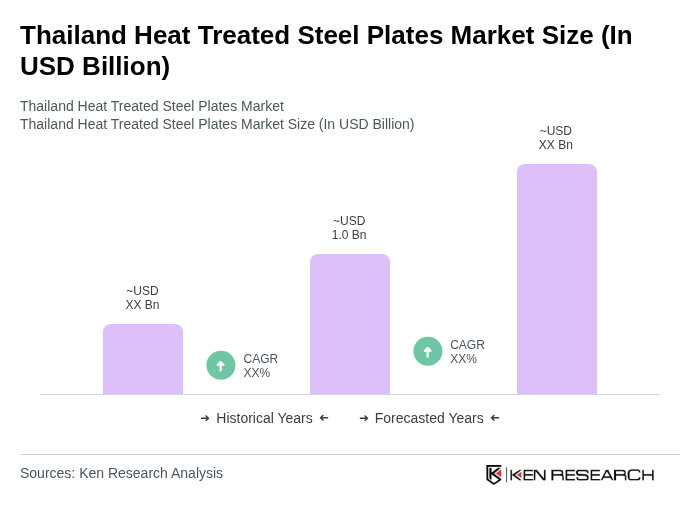
- The Thailand Heat Treated Steel Plates market is valued at approximately USD 1.0 billion, based on a five-year analysis of Thailand’s overall steel and structural steel markets and the share typically accounted for by higher-value plate products used in construction, automotive, shipbuilding, and machinery applications. The growth is primarily attributed to rising industrial activities, large-scale infrastructure development under initiatives such as the Eastern Economic Corridor (EEC), and ongoing urbanization, which necessitate the use of high-strength, heat-treated steel plates for enhanced durability, load-bearing capacity, and performance in critical structures.
- Key regions dominating the market include Bangkok, Chonburi, and Rayong. Bangkok serves as the economic and administrative hub, attracting significant investments in commercial, residential, transport, and industrial construction. Chonburi and Rayong are vital due to the concentration of industrial estates within the Eastern Economic Corridor, their sizable automotive, petrochemical, and machinery clusters, and proximity to deep-sea ports such as Laem Chabang and Map Ta Phut, which facilitate efficient distribution and export logistics for steel products.
- The Thai government has implemented technical regulations and standards that promote the use of high-quality and structurally reliable steel plates in construction projects. The key framework is the Ministerial Regulation on the Determination of Buildings that Must Comply with the Standard for Steel Structures in Buildings B.E. 2559 (2016), issued by the Ministry of Interior under the Building Control Act, which requires designated building types to use structural steel and steel products conforming to Thai Industrial Standards (TIS) and relevant design codes, covering aspects such as material strength, quality certification, and safety factors for public infrastructure and large buildings.
Thailand Heat Treated Steel Plates Market Segmentation
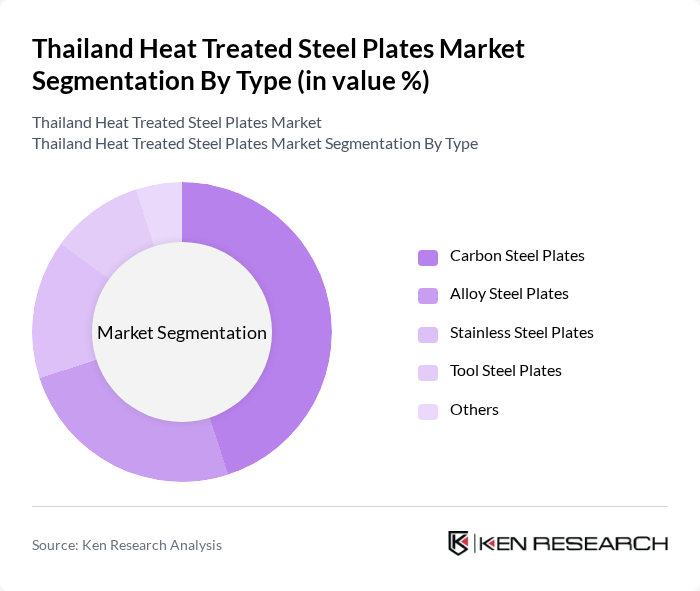
By Type:The market is segmented into various types of heat-treated steel plates, including Carbon Steel Plates, Alloy Steel Plates, Stainless Steel Plates, Tool Steel Plates, and Others. Carbon Steel Plates account for the largest share, reflecting their broad use in building frames, bridges, storage tanks, heavy equipment, and general fabrication where a balance of strength and cost is required. Alloy Steel Plates are gaining traction in pressure vessels, energy, petrochemical, and heavy machinery applications that demand higher strength, toughness, and improved temperature or wear resistance, while Stainless Steel Plates are increasingly used in chemical processing, food, marine, and architectural applications where corrosion resistance is critical.
By End-User:The end-user segmentation includes Construction, Automotive, Shipbuilding, Machinery Manufacturing, and Others. The Construction sector holds the largest share, in line with Thailand’s strong structural steel demand profile and the dominance of non-residential and infrastructure projects such as industrial plants, logistics facilities, mass transit, and public buildings that rely heavily on structural and heat-treated plate. The Automotive industry is also significant, supported by Thailand’s role as a major vehicle production hub in ASEAN, where heat-treated plates and other flat steel products are used in chassis, frames, suspension components, and tooling. Shipbuilding and machinery manufacturing are steadily growing users, particularly for heavy-duty, wear-resistant, and high-tensile plates in ship hulls, offshore structures, cranes, mining and construction machinery, while the Others segment covers energy, petrochemical, and general engineering applications.

Thailand Heat Treated Steel Plates Market Competitive Landscape
The Thailand Heat Treated Steel Plates Market is characterized by a dynamic mix of regional and international players. Leading participants such as Thai Steel Industry Co., Ltd., Sahaviriya Steel Industries Public Company Limited, Siam Yamato Steel Co., Ltd., G Steel Public Company Limited, Steel Authority of Thailand (SAT), Thai Metal Trade Public Company Limited, TIS Steel Group, Charoen Pokphand Group, Bangkok Steel Industry Co., Ltd., PTT Global Chemical Public Company Limited, Thai Nippon Steel & Sumikin Co., Ltd., Saha-Union Public Company Limited, Thai Metal Sheet Co., Ltd., Sritrang Steel Co., Ltd., Thai Steel Manufacturing Co., Ltd. contribute to innovation, geographic expansion, and service delivery in this space.
Thailand Heat Treated Steel Plates Market Industry Analysis
Growth Drivers
- Increasing Demand from Construction and Infrastructure Projects:The construction sector in Thailand is projected to grow by 5.5% in future, driven by government investments in infrastructure projects worth approximately THB 1.5 trillion. This surge in construction activities is expected to significantly increase the demand for heat-treated steel plates, which are essential for structural integrity and durability in building projects. The government's focus on urban development and transportation infrastructure further supports this growth trajectory.
- Rising Automotive Industry Requirements:Thailand's automotive industry, a key economic driver, is anticipated to produce over 2 million vehicles in future, reflecting a 4% increase from the previous year. This growth necessitates high-quality heat-treated steel plates for manufacturing components that require enhanced strength and durability. The automotive sector's shift towards electric vehicles also demands advanced materials, further propelling the demand for specialized steel products in the market.
- Technological Advancements in Steel Processing:The adoption of innovative steel processing technologies, such as advanced heat treatment methods, is expected to enhance product quality and efficiency. In future, investments in automation and digitalization in the steel industry are projected to reach THB 10 billion, improving production capabilities. These advancements not only increase the competitiveness of Thai manufacturers but also cater to the growing demand for high-performance steel plates in various applications.
Market Challenges
- Fluctuating Raw Material Prices:The volatility in raw material prices, particularly iron ore and scrap steel, poses a significant challenge for manufacturers in Thailand. In future, iron ore prices are expected to fluctuate between USD 100 to USD 130 per ton, impacting production costs. This unpredictability can lead to tighter profit margins and may hinder the ability of companies to maintain competitive pricing in the heat-treated steel plates market.
- Intense Competition from Local and International Players:The Thai heat-treated steel plates market is characterized by intense competition, with over 50 local and international manufacturers vying for market share. This competitive landscape is expected to intensify in future, as new entrants emerge and existing players expand their product offerings. Companies must innovate and differentiate their products to maintain market position, which can strain resources and profitability.
Thailand Heat Treated Steel Plates Market Future Outlook
The future of the Thailand heat-treated steel plates market appears promising, driven by ongoing investments in infrastructure and the automotive sector. As manufacturers increasingly adopt advanced technologies, the quality and efficiency of production are expected to improve significantly. Additionally, the growing emphasis on sustainability and eco-friendly practices will likely shape product development, encouraging companies to innovate and meet evolving consumer demands. Overall, the market is poised for growth, supported by favorable economic conditions and industry advancements.
Market Opportunities
- Expansion into Emerging Markets:Thai manufacturers have the opportunity to expand their reach into emerging markets in Southeast Asia, where demand for heat-treated steel plates is rising. Countries like Vietnam and Indonesia are experiencing rapid industrialization, creating a significant market for high-quality steel products. This expansion can enhance revenue streams and diversify market risks for Thai companies.
- Development of High-Strength Steel Products:There is a growing demand for high-strength steel products in various industries, including construction and automotive. By investing in R&D to develop advanced steel alloys and heat treatment processes, Thai manufacturers can cater to this niche market. This focus on innovation can lead to higher profit margins and establish a competitive edge in the regional market.
Scope of the Report
| Segment | Sub-Segments |
|---|---|
| By Type | Carbon Steel Plates Alloy Steel Plates Stainless Steel Plates Tool Steel Plates Others |
| By End-User | Construction Automotive Shipbuilding Machinery Manufacturing Others |
| By Application | Structural Applications Pressure Vessels Heavy Equipment Oil & Gas Industry Others |
| By Thickness | Thin Plates Medium Plates Thick Plates Others |
| By Surface Treatment | Hot Rolled Cold Rolled Coated Others |
| By Distribution Channel | Direct Sales Distributors Online Sales Others |
| By Region | Central Thailand Northern Thailand Northeastern Thailand Southern Thailand Others |
Key Target Audience
Investors and Venture Capitalist Firms
Government and Regulatory Bodies (e.g., Ministry of Industry, Department of Industrial Works)
Manufacturers and Producers
Distributors and Retailers
Construction and Infrastructure Companies
Automotive and Aerospace Industries
Industry Associations (e.g., Thai Steel Industry Association)
Financial Institutions
Players Mentioned in the Report:
Thai Steel Industry Co., Ltd.
Sahaviriya Steel Industries Public Company Limited
Siam Yamato Steel Co., Ltd.
G Steel Public Company Limited
Steel Authority of Thailand (SAT)
Thai Metal Trade Public Company Limited
TIS Steel Group
Charoen Pokphand Group
Bangkok Steel Industry Co., Ltd.
PTT Global Chemical Public Company Limited
Thai Nippon Steel & Sumikin Co., Ltd.
Saha-Union Public Company Limited
Thai Metal Sheet Co., Ltd.
Sritrang Steel Co., Ltd.
Thai Steel Manufacturing Co., Ltd.
Table of Contents
Market Assessment Phase
1. Executive Summary and Approach
2. Thailand Heat Treated Steel Plates Market Overview
2.1 Key Insights and Strategic Recommendations
2.2 Thailand Heat Treated Steel Plates Market Overview
2.3 Definition and Scope
2.4 Evolution of Market Ecosystem
2.5 Timeline of Key Regulatory Milestones
2.6 Value Chain & Stakeholder Mapping
2.7 Business Cycle Analysis
2.8 Policy & Incentive Landscape
3. Thailand Heat Treated Steel Plates Market Analysis
3.1 Growth Drivers
3.1.1 Increasing demand from construction and infrastructure projects
3.1.2 Rising automotive industry requirements
3.1.3 Technological advancements in steel processing
3.1.4 Government initiatives promoting manufacturing
3.2 Market Challenges
3.2.1 Fluctuating raw material prices
3.2.2 Intense competition from local and international players
3.2.3 Regulatory compliance and environmental concerns
3.2.4 Supply chain disruptions
3.3 Market Opportunities
3.3.1 Expansion into emerging markets
3.3.2 Development of high-strength steel products
3.3.3 Collaborations with technology providers
3.3.4 Increasing focus on sustainability and eco-friendly practices
3.4 Market Trends
3.4.1 Shift towards automation in manufacturing processes
3.4.2 Growing preference for customized steel solutions
3.4.3 Adoption of digital technologies in supply chain management
3.4.4 Rising awareness of product quality and certifications
3.5 Government Regulation
3.5.1 Standards for steel quality and safety
3.5.2 Environmental regulations on emissions
3.5.3 Import tariffs and trade policies
3.5.4 Incentives for local manufacturing
4. SWOT Analysis
5. Stakeholder Analysis
6. Porter's Five Forces Analysis
7. Thailand Heat Treated Steel Plates Market Size, 2019-2024
7.1 By Value
7.2 By Volume
7.3 By Average Selling Price
8. Thailand Heat Treated Steel Plates Market Segmentation
8.1 By Type
8.1.1 Carbon Steel Plates
8.1.2 Alloy Steel Plates
8.1.3 Stainless Steel Plates
8.1.4 Tool Steel Plates
8.1.5 Others
8.2 By End-User
8.2.1 Construction
8.2.2 Automotive
8.2.3 Shipbuilding
8.2.4 Machinery Manufacturing
8.2.5 Others
8.3 By Application
8.3.1 Structural Applications
8.3.2 Pressure Vessels
8.3.3 Heavy Equipment
8.3.4 Oil & Gas Industry
8.3.5 Others
8.4 By Thickness
8.4.1 Thin Plates
8.4.2 Medium Plates
8.4.3 Thick Plates
8.4.4 Others
8.5 By Surface Treatment
8.5.1 Hot Rolled
8.5.2 Cold Rolled
8.5.3 Coated
8.5.4 Others
8.6 By Distribution Channel
8.6.1 Direct Sales
8.6.2 Distributors
8.6.3 Online Sales
8.6.4 Others
8.7 By Region
8.7.1 Central Thailand
8.7.2 Northern Thailand
8.7.3 Northeastern Thailand
8.7.4 Southern Thailand
8.7.5 Others
9. Thailand Heat Treated Steel Plates Market Competitive Analysis
9.1 Market Share of Key Players
9.2 Cross Comparison of Key Players
9.2.1 Company Name
9.2.2 Group Size (Large, Medium, or Small as per industry convention)
9.2.3 Revenue Growth Rate
9.2.4 Market Penetration Rate
9.2.5 Customer Retention Rate
9.2.6 Pricing Strategy
9.2.7 Production Efficiency
9.2.8 Product Quality Index
9.2.9 Innovation Rate
9.2.10 Distribution Network Strength
9.3 SWOT Analysis of Top Players
9.4 Pricing Analysis
9.5 Detailed Profile of Major Companies
9.5.1 Thai Steel Industry Co., Ltd.
9.5.2 Sahaviriya Steel Industries Public Company Limited
9.5.3 Siam Yamato Steel Co., Ltd.
9.5.4 G Steel Public Company Limited
9.5.5 Steel Authority of Thailand (SAT)
9.5.6 Thai Metal Trade Public Company Limited
9.5.7 TIS Steel Group
9.5.8 Charoen Pokphand Group
9.5.9 Bangkok Steel Industry Co., Ltd.
9.5.10 PTT Global Chemical Public Company Limited
9.5.11 Thai Nippon Steel & Sumikin Co., Ltd.
9.5.12 Saha-Union Public Company Limited
9.5.13 Thai Metal Sheet Co., Ltd.
9.5.14 Sritrang Steel Co., Ltd.
9.5.15 Thai Steel Manufacturing Co., Ltd.
10. Thailand Heat Treated Steel Plates Market End-User Analysis
10.1 Procurement Behavior of Key Ministries
10.1.1 Government procurement policies
10.1.2 Budget allocation for infrastructure projects
10.1.3 Supplier selection criteria
10.1.4 Contract management practices
10.2 Corporate Spend on Infrastructure & Energy
10.2.1 Investment trends in infrastructure
10.2.2 Energy sector spending patterns
10.2.3 Budget forecasts for upcoming projects
10.2.4 Corporate partnerships and collaborations
10.3 Pain Point Analysis by End-User Category
10.3.1 Quality assurance issues
10.3.2 Delivery timelines
10.3.3 Cost management challenges
10.3.4 Technical support requirements
10.4 User Readiness for Adoption
10.4.1 Awareness of heat treated steel benefits
10.4.2 Training and skill development needs
10.4.3 Infrastructure readiness
10.4.4 Financial readiness for investment
10.5 Post-Deployment ROI and Use Case Expansion
10.5.1 Measurement of ROI metrics
10.5.2 Case studies of successful implementations
10.5.3 Future expansion plans
10.5.4 Feedback mechanisms for continuous improvement
11. Thailand Heat Treated Steel Plates Market Future Size, 2025-2030
11.1 By Value
11.2 By Volume
11.3 By Average Selling Price
Go-To-Market Strategy Phase
1. Whitespace Analysis + Business Model Canvas
1.1 Market gaps identification
1.2 Value proposition development
1.3 Revenue model exploration
1.4 Customer segmentation analysis
1.5 Competitive landscape assessment
1.6 Key partnerships identification
1.7 Risk assessment and mitigation strategies
2. Marketing and Positioning Recommendations
2.1 Branding strategies
2.2 Product USPs
2.3 Target market identification
2.4 Communication strategies
2.5 Digital marketing initiatives
2.6 Trade show participation
2.7 Customer engagement tactics
3. Distribution Plan
3.1 Urban retail strategies
3.2 Rural NGO tie-ups
3.3 E-commerce integration
3.4 Logistics and supply chain management
3.5 Distribution channel optimization
3.6 Partnership with local distributors
3.7 Inventory management practices
4. Channel & Pricing Gaps
4.1 Underserved routes
4.2 Pricing bands analysis
4.3 Competitor pricing strategies
4.4 Customer willingness to pay
4.5 Discounting strategies
4.6 Bundling opportunities
4.7 Price elasticity assessment
5. Unmet Demand & Latent Needs
5.1 Category gaps identification
5.2 Consumer segments analysis
5.3 Product development opportunities
5.4 Market entry barriers
5.5 Customer feedback incorporation
5.6 Future trends anticipation
5.7 Innovation opportunities
6. Customer Relationship
6.1 Loyalty programs
6.2 After-sales service
6.3 Customer feedback mechanisms
6.4 Relationship management strategies
6.5 Community engagement initiatives
6.6 Customer education programs
6.7 Personalization strategies
7. Value Proposition
7.1 Sustainability initiatives
7.2 Integrated supply chains
7.3 Cost-benefit analysis
7.4 Unique selling propositions
7.5 Customer-centric approach
7.6 Innovation in product offerings
7.7 Long-term partnerships
8. Key Activities
8.1 Regulatory compliance
8.2 Branding efforts
8.3 Distribution setup
8.4 Market research activities
8.5 Training and development
8.6 Performance monitoring
8.7 Stakeholder engagement
9. Entry Strategy Evaluation
9.1 Domestic Market Entry Strategy
9.1.1 Product mix considerations
9.1.2 Pricing band analysis
9.1.3 Packaging strategies
9.2 Export Entry Strategy
9.2.1 Target countries identification
9.2.2 Compliance roadmap development
10. Entry Mode Assessment
10.1 Joint Ventures
10.2 Greenfield Investments
10.3 Mergers & Acquisitions
10.4 Distributor Model
11. Capital and Timeline Estimation
11.1 Capital requirements analysis
11.2 Timelines for market entry
12. Control vs Risk Trade-Off
12.1 Ownership considerations
12.2 Partnerships evaluation
13. Profitability Outlook
13.1 Breakeven analysis
13.2 Long-term sustainability strategies
14. Potential Partner List
14.1 Distributors identification
14.2 Joint Ventures opportunities
14.3 Acquisition targets
15. Execution Roadmap
15.1 Phased Plan for Market Entry
15.1.1 Market Setup
15.1.2 Market Entry
15.1.3 Growth Acceleration
15.1.4 Scale & Stabilize
15.2 Key Activities and Milestones
15.2.1 Activity timelines
15.2.2 Milestone tracking
Research Methodology
Phase 1: Approach1
Desk Research
- Industry reports from Thai Steel Association and relevant trade bodies
- Market analysis publications focusing on heat-treated steel applications
- Government publications on infrastructure projects and steel demand forecasts
Primary Research
- Interviews with key decision-makers in manufacturing firms utilizing heat-treated steel
- Surveys with procurement managers in construction and automotive sectors
- Field interviews with engineers and product developers in steel processing plants
Validation & Triangulation
- Cross-validation of data from multiple industry sources and reports
- Triangulation of insights from primary interviews with secondary data findings
- Sanity checks through expert panel discussions and feedback sessions
Phase 2: Market Size Estimation1
Top-down Assessment
- Analysis of national steel consumption trends and heat-treated steel share
- Segmentation by end-user industries such as construction, automotive, and manufacturing
- Incorporation of government infrastructure spending plans and their impact on steel demand
Bottom-up Modeling
- Volume estimates based on production capacities of major steel manufacturers in Thailand
- Cost analysis derived from pricing models of heat-treated steel products
- Estimation of market size based on production volume and average selling price
Forecasting & Scenario Analysis
- Multi-variable regression analysis considering economic growth and industrial demand
- Scenario planning based on potential regulatory changes and market dynamics
- Development of baseline, optimistic, and pessimistic forecasts through 2030
Phase 3: CATI Sample Composition1
| Scope Item/Segment | Sample Size | Target Respondent Profiles |
|---|---|---|
| Construction Sector Steel Usage | 100 | Project Managers, Procurement Officers |
| Automotive Manufacturing Insights | 80 | Production Managers, Quality Control Engineers |
| Heavy Machinery Applications | 70 | Design Engineers, Operations Managers |
| Infrastructure Development Projects | 90 | Government Officials, Civil Engineers |
| Steel Distribution Channels | 60 | Supply Chain Managers, Sales Directors |
Frequently Asked Questions
What is the current value of the Thailand Heat Treated Steel Plates market?
The Thailand Heat Treated Steel Plates market is valued at approximately USD 1.0 billion, driven by industrial activities, infrastructure development, and urbanization, which require high-strength steel plates for various applications.
What are the primary applications of heat-treated steel plates in Thailand?
Which regions in Thailand dominate the heat-treated steel plates market?
What factors are driving the growth of the heat-treated steel plates market in Thailand?
Other Regional/Country Reports
Other Adjacent Reports
Singapore Automotive Steel Market
Singapore Shipbuilding Steel Market
Singapore Machinery Manufacturing Market
Global Alloy Steel MarketUAE Stainless Steel MarketGermany Tool Steel Market
India Construction Materials Market Outlook to 2030South Africa Petrochemical Equipment Market
Belgium Infrastructure Development Market
Why Buy From Us?

What makes us stand out is that our consultants follow Robust, Refine and Result (RRR) methodology. Robust for clear definitions, approaches and sanity checking, Refine for differentiating respondents' facts and opinions, and Result for presenting data with story.

We have set a benchmark in the industry by offering our clients with syndicated and customized market research reports featuring coverage of entire market as well as meticulous research and analyst insights.

While we don't replace traditional research, we flip the method upside down. Our dual approach of Top Bottom & Bottom Top ensures quality deliverable by not just verifying company fundamentals but also looking at the sector and macroeconomic factors.

With one step in the future, our research team constantly tries to show you the bigger picture. We help with some of the tough questions you may encounter along the way: How is the industry positioned? Best marketing channel? KPI's of competitors? By aligning every element, we help maximize success.

Our report gives you instant access to the answers and sources that other companies might choose to hide. We elaborate each steps of research methodology we have used and showcase you the sample size to earn your trust.

If you need any support, we are here! We pride ourselves on universe strength, data quality, and quick, friendly, and professional service.