About the Report
Base Year 2024Listen to the audio summary
Thailand Hospital Emergency Department Market Overview
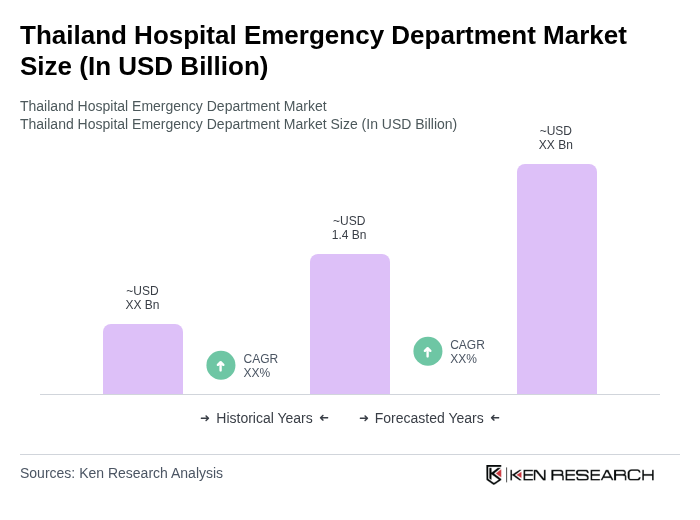
- The Thailand Hospital Emergency Department Market is valued at USD 1.4 billion, based on a five-year historical analysis and in alignment with the scale of the overall Thailand hospital services market, which generated revenue of about USD 33,308.7 million from hospital services in the country. This growth is primarily driven by the increasing demand for emergency medical services, rising population, and the prevalence of chronic diseases, including cardiovascular disease, stroke, diabetes, and respiratory conditions, which contribute significantly to emergency visit volumes. The expansion of healthcare infrastructure, including new tertiary facilities and upgraded emergency units, together with advancements in diagnostic imaging, point?of?care testing, tele-triage, and digital emergency department information systems, has also contributed significantly to the market's growth.
- Key cities such as Bangkok, Chiang Mai, and Phuket dominate the market due to their high population density, concentration of tertiary and university hospitals, and the presence of advanced healthcare facilities serving both domestic patients and international medical tourists. Bangkok, being the capital, has a concentration of large public teaching hospitals and private hospital groups offering 24?hour emergency and trauma care, making it a hub for emergency medical care in Thailand.
- The regulatory framework for emergency care is anchored in the Emergency Medical Services Act B.E. 2551 (2008), issued by the Ministry of Public Health and the National Institute for Emergency Medicine (NIEM), which establishes the national Emergency Medical System (EMS) and governs pre?hospital and hospital emergency care nationwide. This Act sets requirements for licensing and operation of EMS units, defines roles of EMS providers and hospitals in the emergency referral network, mandates standardized response, triage, and transport procedures, and provides for funding mechanisms to ensure timely and effective emergency care access for all eligible patients.
Thailand Hospital Emergency Department Market Segmentation
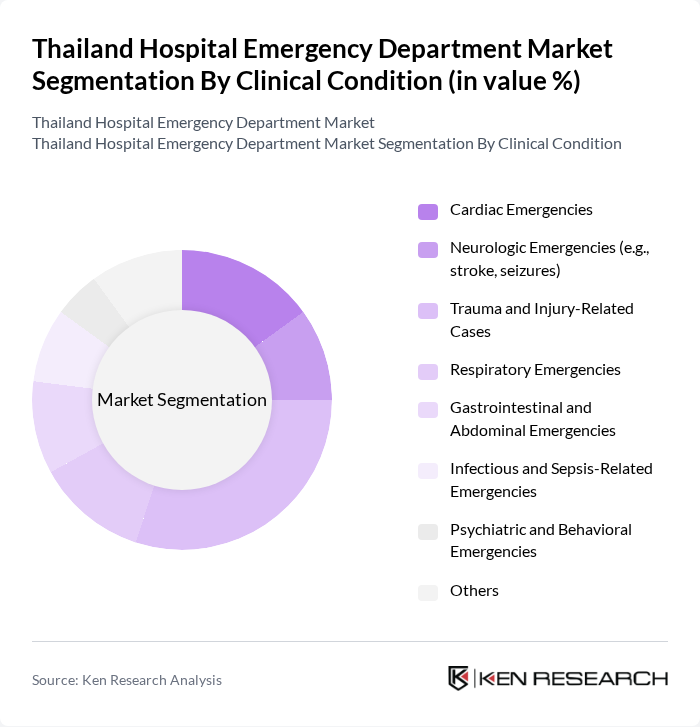
By Clinical Condition:The clinical conditions treated in emergency departments encompass a wide range of medical issues. The subsegments include Cardiac Emergencies, Neurologic Emergencies (e.g., stroke, seizures), Trauma and Injury-Related Cases, Respiratory Emergencies, Gastrointestinal and Abdominal Emergencies, Infectious and Sepsis-Related Emergencies, Psychiatric and Behavioral Emergencies, and Others. Among these, Trauma and Injury-Related Cases dominate the market due to the high incidence of road traffic accidents and injury-related emergencies in Thailand, which remain a major cause of mortality and emergency utilization.
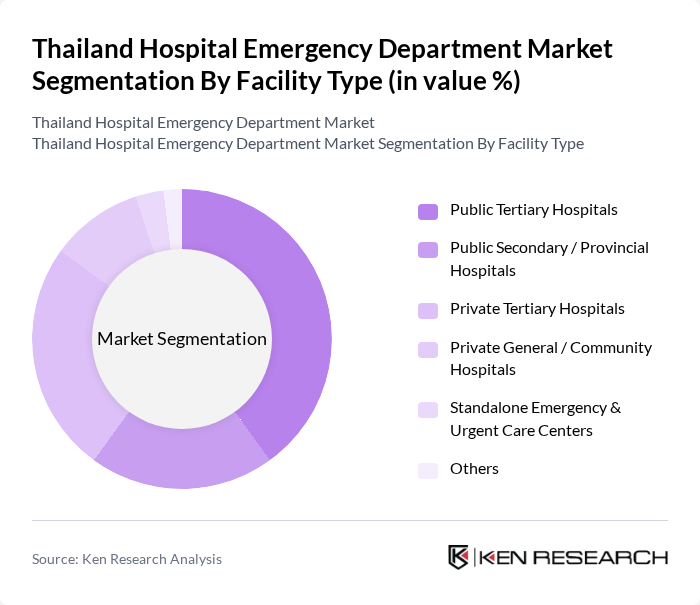
By Facility Type:The facility types providing emergency services include Public Tertiary Hospitals, Public Secondary / Provincial Hospitals, Private Tertiary Hospitals, Private General / Community Hospitals, Standalone Emergency & Urgent Care Centers, and Others. Public Tertiary Hospitals lead the market due to their comprehensive services, advanced medical technology, academic and trauma center capabilities, and their role as referral hubs handling complex emergency and critical care cases under Thailand’s universal coverage schemes.
Thailand Hospital Emergency Department Market Competitive Landscape
The Thailand Hospital Emergency Department Market is characterized by a dynamic mix of regional and international players. Leading participants such as Bangkok Hospital (Bangkok Dusit Medical Services Public Company Limited – BDMS), Bumrungrad International Hospital, Siriraj Hospital (Mahidol University), King Chulalongkorn Memorial Hospital, Ramathibodi Hospital, Samitivej Sukhumvit Hospital, Vejthani Hospital, Phyathai 1 Hospital, Bangkok Christian Hospital, Piyavate Hospital, BNH Hospital, Thonburi Hospital, MedPark Hospital, Samitivej Sriracha Hospital, Bangkok Hospital Pattaya contribute to innovation, geographic expansion, and service delivery in this space.
Thailand Hospital Emergency Department Market Industry Analysis
Growth Drivers
- Increasing Patient Volume Due to Urbanization:Thailand's urban population is projected to reach 51 million in future, driving demand for emergency services. Urban areas, which account for slightly over 50% of the population, experience higher incidences of accidents and health emergencies. The World Bank reports that urbanization contributes to a 15% increase in emergency department visits annually, necessitating expanded capacity and resources in hospitals to accommodate this growing patient volume.
- Rising Prevalence of Chronic Diseases:Chronic diseases such as diabetes and hypertension are on the rise, affecting approximately 35% of the Thai population. The Ministry of Public Health indicates that emergency departments are increasingly treating complications from these conditions, leading to a 10% annual increase in emergency visits. This trend underscores the need for enhanced emergency care capabilities to manage chronic disease-related emergencies effectively.
- Government Initiatives to Improve Healthcare Access:The Thai government allocated THB 250 billion (approximately USD 7.5 billion) for healthcare improvements in future, focusing on emergency services. Initiatives include expanding hospital infrastructure and increasing the number of emergency medical technicians. These efforts aim to enhance access to emergency care, particularly in rural areas, where access is currently limited, thereby increasing overall patient volume in emergency departments.
Market Challenges
- Limited Funding for Public Hospitals:Public hospitals in Thailand face significant funding constraints, with only THB 120 billion (about USD 3.6 billion) allocated for emergency services in future. This funding gap results in inadequate resources, affecting the quality of care and leading to longer wait times. The lack of investment hampers the ability to upgrade facilities and hire sufficient staff, posing a challenge to meeting the growing demand for emergency services.
- Shortage of Trained Emergency Medical Personnel:Thailand currently has only 2.0 emergency medical personnel per 1,000 population, significantly below the recommended 3 per 1,000. This shortage is exacerbated by high turnover rates and insufficient training programs. The Ministry of Health estimates that an additional 15,000 trained personnel are needed in future to meet the increasing demand for emergency services, highlighting a critical challenge in the healthcare system.
Thailand Hospital Emergency Department Market Future Outlook
The Thailand Hospital Emergency Department market is poised for significant transformation driven by technological advancements and evolving patient needs. The integration of digital health technologies and artificial intelligence is expected to enhance emergency response systems, improving patient outcomes. Additionally, the focus on patient-centered care will likely lead to more tailored emergency services. As the government continues to invest in healthcare infrastructure, the market will adapt to meet the challenges posed by urbanization and chronic disease prevalence, ensuring better access and quality of care.
Market Opportunities
- Expansion of Private Emergency Services:The private sector is increasingly investing in emergency services, with over 60 new private emergency units expected to open in future. This expansion will enhance competition and improve service quality, providing patients with more options and reducing pressure on public hospitals.
- Investment in Telemedicine Solutions:The telemedicine market in Thailand is projected to reach THB 15 billion (approximately USD 450 million) in future. This growth presents an opportunity for emergency departments to integrate telehealth services, allowing for remote consultations and triage, which can alleviate congestion in physical emergency units and improve patient access to care.
Scope of the Report
| Segment | Sub-Segments |
|---|---|
| By Clinical Condition | Cardiac Emergencies Neurologic Emergencies (e.g., stroke, seizures) Trauma and Injury-Related Cases Respiratory Emergencies Gastrointestinal and Abdominal Emergencies Infectious and Sepsis-Related Emergencies Psychiatric and Behavioral Emergencies Others |
| By Facility Type | Public Tertiary Hospitals Public Secondary / Provincial Hospitals Private Tertiary Hospitals Private General / Community Hospitals Standalone Emergency & Urgent Care Centers Others |
| By Patient Age Group | Adult (18–59 Years) Pediatric (0–17 Years) Geriatric (60+ Years) Others |
| By Service Pathway | Walk?in / Self?Presenting Patients Ambulance / EMS?Referred Patients Inter?facility Transfers Tele?Emergency / Virtual Triage Services Others |
| By Acuity Level (Triage Category) | Resuscitation & Life?Threatening (High Acuity) Urgent but Stable Non?Urgent / Primary Care Substitutes Others |
| By Region | Bangkok Metropolitan Region Central Region (Excl. Bangkok) Northern Region Northeastern Region Southern Region Eastern & Western Regions |
| By Payer / Insurance Coverage | Universal Coverage Scheme (UCS) Social Security Scheme (SSS) Civil Servant Medical Benefit Scheme (CSMBS) Private Insurance Self?Pay / Out?of?Pocket Others |
Key Target Audience
Investors and Venture Capitalist Firms
Government and Regulatory Bodies (e.g., Ministry of Public Health, National Health Security Office)
Healthcare Providers and Hospital Administrators
Medical Equipment Manufacturers
Pharmaceutical Companies
Health Insurance Companies
Emergency Medical Services (EMS) Organizations
Healthcare Technology Solution Providers
Players Mentioned in the Report:
Bangkok Hospital (Bangkok Dusit Medical Services Public Company Limited BDMS)
Bumrungrad International Hospital
Siriraj Hospital (Mahidol University)
King Chulalongkorn Memorial Hospital
Ramathibodi Hospital
Samitivej Sukhumvit Hospital
Vejthani Hospital
Phyathai 1 Hospital
Bangkok Christian Hospital
Piyavate Hospital
BNH Hospital
Thonburi Hospital
MedPark Hospital
Samitivej Sriracha Hospital
Bangkok Hospital Pattaya
Table of Contents
Market Assessment Phase
1. Executive Summary and Approach
2. Thailand Hospital Emergency Department Market Overview
2.1 Key Insights and Strategic Recommendations
2.2 Thailand Hospital Emergency Department Market Overview
2.3 Definition and Scope
2.4 Evolution of Market Ecosystem
2.5 Timeline of Key Regulatory Milestones
2.6 Value Chain & Stakeholder Mapping
2.7 Business Cycle Analysis
2.8 Policy & Incentive Landscape
3. Thailand Hospital Emergency Department Market Analysis
3.1 Growth Drivers
3.1.1 Increasing patient volume due to urbanization
3.1.2 Rising prevalence of chronic diseases
3.1.3 Government initiatives to improve healthcare access
3.1.4 Technological advancements in emergency care
3.2 Market Challenges
3.2.1 Limited funding for public hospitals
3.2.2 High operational costs
3.2.3 Shortage of trained emergency medical personnel
3.2.4 Regulatory compliance issues
3.3 Market Opportunities
3.3.1 Expansion of private emergency services
3.3.2 Investment in telemedicine solutions
3.3.3 Partnerships with international healthcare providers
3.3.4 Development of specialized emergency care units
3.4 Market Trends
3.4.1 Increasing adoption of digital health technologies
3.4.2 Focus on patient-centered care
3.4.3 Integration of AI in emergency response systems
3.4.4 Growth of mobile emergency units
3.5 Government Regulation
3.5.1 National Health Security Act
3.5.2 Emergency Medical Services Act
3.5.3 Hospital Accreditation Standards
3.5.4 Medical Device Regulations
4. SWOT Analysis
5. Stakeholder Analysis
6. Porter's Five Forces Analysis
7. Thailand Hospital Emergency Department Market Market Size, 2019-2024
7.1 By Value
7.2 By Volume
7.3 By Average Selling Price
8. Thailand Hospital Emergency Department Market Segmentation
8.1 By Clinical Condition
8.1.1 Cardiac Emergencies
8.1.2 Neurologic Emergencies (e.g., stroke, seizures)
8.1.3 Trauma and Injury-Related Cases
8.1.4 Respiratory Emergencies
8.1.5 Gastrointestinal and Abdominal Emergencies
8.1.6 Infectious and Sepsis-Related Emergencies
8.1.7 Psychiatric and Behavioral Emergencies
8.1.8 Others
8.2 By Facility Type
8.2.1 Public Tertiary Hospitals
8.2.2 Public Secondary / Provincial Hospitals
8.2.3 Private Tertiary Hospitals
8.2.4 Private General / Community Hospitals
8.2.5 Standalone Emergency & Urgent Care Centers
8.2.6 Others
8.3 By Patient Age Group
8.3.1 Adult (18–59 Years)
8.3.2 Pediatric (0–17 Years)
8.3.3 Geriatric (60+ Years)
8.3.4 Others
8.4 By Service Pathway
8.4.1 Walk?in / Self?Presenting Patients
8.4.2 Ambulance / EMS?Referred Patients
8.4.3 Inter?facility Transfers
8.4.4 Tele?Emergency / Virtual Triage Services
8.4.5 Others
8.5 By Acuity Level (Triage Category)
8.5.1 Resuscitation & Life?Threatening (High Acuity)
8.5.2 Urgent but Stable
8.5.3 Non?Urgent / Primary Care Substitutes
8.5.4 Others
8.6 By Region
8.6.1 Bangkok Metropolitan Region
8.6.2 Central Region (Excl. Bangkok)
8.6.3 Northern Region
8.6.4 Northeastern Region
8.6.5 Southern Region
8.6.6 Eastern & Western Regions
8.7 By Payer / Insurance Coverage
8.7.1 Universal Coverage Scheme (UCS)
8.7.2 Social Security Scheme (SSS)
8.7.3 Civil Servant Medical Benefit Scheme (CSMBS)
8.7.4 Private Insurance
8.7.5 Self?Pay / Out?of?Pocket
8.7.6 Others
9. Thailand Hospital Emergency Department Market Competitive Analysis
9.1 Market Share of Key Players
9.2 Cross Comparison of Key Players
9.2.1 Company Name
9.2.2 Group Size (Large, Medium, or Small as per industry convention)
9.2.3 Annual Emergency Department Visits
9.2.4 Emergency Department Revenue
9.2.5 Average Revenue per ED Visit
9.2.6 Average Emergency Response / Door?to?Doctor Time
9.2.7 ED Bed Occupancy Rate
9.2.8 Left?Without?Being?Seen (LWBS) Rate
9.2.9 72?Hour Revisit Rate
9.2.10 In?ED Mortality Rate
9.2.11 Patient Satisfaction / Net Promoter Score (ED?Specific)
9.2.12 Staff?to?Patient Ratio in ED
9.2.13 Technology Adoption Index (EHR, PACS, Tele?ED, AI Triage)
9.2.14 3–5 Year ED Revenue CAGR
9.3 SWOT Analysis of Top Players
9.4 Pricing Analysis
9.5 Detailed Profile of Major Companies
9.5.1 Bangkok Hospital (Bangkok Dusit Medical Services Public Company Limited – BDMS)
9.5.2 Bumrungrad International Hospital
9.5.3 Siriraj Hospital (Mahidol University)
9.5.4 King Chulalongkorn Memorial Hospital
9.5.5 Ramathibodi Hospital
9.5.6 Samitivej Sukhumvit Hospital
9.5.7 Vejthani Hospital
9.5.8 Phyathai 1 Hospital
9.5.9 Bangkok Christian Hospital
9.5.10 Piyavate Hospital
9.5.11 BNH Hospital
9.5.12 Thonburi Hospital
9.5.13 MedPark Hospital
9.5.14 Samitivej Sriracha Hospital
9.5.15 Bangkok Hospital Pattaya
10. Thailand Hospital Emergency Department Market End-User Analysis
10.1 Procurement Behavior of Key Ministries
10.1.1 Ministry of Public Health
10.1.2 Ministry of Finance
10.1.3 Ministry of Education
10.1.4 Others
10.2 Corporate Spend on Infrastructure & Energy
10.2.1 Hospital Infrastructure Development
10.2.2 Emergency Equipment Procurement
10.2.3 Energy Management Solutions
10.2.4 Others
10.3 Pain Point Analysis by End-User Category
10.3.1 Public Hospitals
10.3.2 Private Hospitals
10.3.3 Urgent Care Centers
10.3.4 Others
10.4 User Readiness for Adoption
10.4.1 Training and Development Needs
10.4.2 Technology Acceptance
10.4.3 Infrastructure Readiness
10.4.4 Others
10.5 Post-Deployment ROI and Use Case Expansion
10.5.1 Cost Savings Analysis
10.5.2 Patient Outcome Improvement
10.5.3 Service Expansion Opportunities
10.5.4 Others
11. Thailand Hospital Emergency Department Market Future Size, 2025-2030
11.1 By Value
11.2 By Volume
11.3 By Average Selling Price
Go-To-Market Strategy Phase
1. Whitespace Analysis + Business Model Canvas
1.1 Market Gaps Identification
1.2 Value Proposition Development
1.3 Revenue Streams Analysis
1.4 Cost Structure Evaluation
1.5 Key Partnerships Identification
1.6 Customer Segmentation
1.7 Channels of Distribution
2. Marketing and Positioning Recommendations
2.1 Branding Strategies
2.2 Product USPs
3. Distribution Plan
3.1 Urban retail vs rural NGO tie-ups
4. Channel & Pricing Gaps
4.1 Underserved routes
4.2 Pricing bands
5. Unmet Demand & Latent Needs
5.1 Category gaps
5.2 Consumer segments
6. Customer Relationship
6.1 Loyalty programs
6.2 After-sales service
7. Value Proposition
7.1 Sustainability
7.2 Integrated supply chains
8. Key Activities
8.1 Regulatory compliance
8.2 Branding
8.3 Distribution setup
9. Entry Strategy Evaluation
9.1 Domestic Market Entry Strategy
9.1.1 Product mix
9.1.2 Pricing band
9.1.3 Packaging
9.2 Export Entry Strategy
9.2.1 Target countries
9.2.2 Compliance roadmap
10. Entry Mode Assessment
10.1 JV
10.2 Greenfield
10.3 M&A
10.4 Distributor Model
11. Capital and Timeline Estimation
11.1 Capital requirements
11.2 Timelines
12. Control vs Risk Trade-Off
12.1 Ownership vs Partnerships
13. Profitability Outlook
13.1 Breakeven analysis
13.2 Long-term sustainability
14. Potential Partner List
14.1 Distributors
14.2 JVs
14.3 Acquisition targets
15. Execution Roadmap
15.1 Phased Plan for Market Entry
15.1.1 Market Setup
15.1.2 Market Entry
15.1.3 Growth Acceleration
15.1.4 Scale & Stabilize
15.2 Key Activities and Milestones
15.2.1 Milestone Planning
15.2.2 Activity Scheduling
Research Methodology
Phase 1: Approach1
Desk Research
- Analysis of government health statistics and reports from the Ministry of Public Health in Thailand
- Review of published studies and white papers on emergency department trends and patient demographics
- Examination of hospital accreditation reports and performance metrics from the Healthcare Accreditation Institute
Primary Research
- Interviews with emergency department heads and hospital administrators across various regions in Thailand
- Surveys conducted with healthcare professionals, including doctors and nurses, to gather insights on operational challenges
- Focus group discussions with patients to understand their experiences and expectations from emergency services
Validation & Triangulation
- Cross-validation of findings through comparison with international emergency care standards and practices
- Triangulation of data from government sources, hospital reports, and expert interviews
- Sanity check through feedback from a panel of healthcare experts and industry stakeholders
Phase 2: Market Size Estimation1
Top-down Assessment
- Estimation of total healthcare expenditure in Thailand and allocation to emergency services
- Analysis of patient visit trends to emergency departments across urban and rural hospitals
- Incorporation of demographic data to project future demand for emergency services
Bottom-up Modeling
- Collection of operational data from a sample of hospitals regarding patient throughput and service costs
- Estimation of average treatment costs per patient visit in emergency departments
- Volume x cost analysis to derive revenue potential for emergency services
Forecasting & Scenario Analysis
- Multi-factor regression analysis incorporating population growth, urbanization rates, and healthcare access
- Scenario modeling based on potential changes in healthcare policy and funding for emergency services
- Baseline, optimistic, and pessimistic projections for emergency department utilization through 2030
Phase 3: CATI Sample Composition1
| Scope Item/Segment | Sample Size | Target Respondent Profiles |
|---|---|---|
| Urban Emergency Departments | 120 | Emergency Department Heads, Hospital Administrators |
| Rural Healthcare Facilities | 90 | Healthcare Providers, Community Health Workers |
| Patient Experience in Emergency Services | 140 | Patients who have utilized emergency services in the last year |
| Emergency Medical Services (EMS) Operations | 60 | EMS Managers, Paramedics |
| Healthcare Policy Experts | 40 | Health Economists, Policy Makers |
Frequently Asked Questions
What is the current value of the Thailand Hospital Emergency Department Market?
The Thailand Hospital Emergency Department Market is valued at approximately USD 1.4 billion, reflecting the increasing demand for emergency medical services driven by urbanization, chronic diseases, and advancements in healthcare infrastructure.
What factors are driving the growth of the emergency department market in Thailand?
Which cities in Thailand dominate the emergency department market?
What are the main clinical conditions treated in Thailand's emergency departments?
Other Regional/Country Reports
Other Adjacent Reports
Qatar Point-of-Care Testing Market
Africa Telemedicine Market Size, Share & Opportunity Analysis, By Service Type, Care Setting & Technology, 2025-2032Saudi Arabia Emergency Medical Services Market Size, Share & Forecast, By Service Type, Care Setting & Customer Type, 2026-2032Bahrain Healthcare IT Solutions Market
Egypt Cardiovascular Care Market
UAE trauma devices market Size, Share, Growth Drivers, Trends, Opportunities & Forecast 2025–2030Germany Respiratory Devices Market
Vietnam Urgent Care Market Size, Share & Forecast, By Facility Type, Care Setting & Payer, 2025-2032Japan Medical Tourism Market Size, Share & Forecast, By Service Type & Care Setting, 2025-2032Why Buy From Us?

What makes us stand out is that our consultants follow Robust, Refine and Result (RRR) methodology. Robust for clear definitions, approaches and sanity checking, Refine for differentiating respondents' facts and opinions, and Result for presenting data with story.

We have set a benchmark in the industry by offering our clients with syndicated and customized market research reports featuring coverage of entire market as well as meticulous research and analyst insights.

While we don't replace traditional research, we flip the method upside down. Our dual approach of Top Bottom & Bottom Top ensures quality deliverable by not just verifying company fundamentals but also looking at the sector and macroeconomic factors.

With one step in the future, our research team constantly tries to show you the bigger picture. We help with some of the tough questions you may encounter along the way: How is the industry positioned? Best marketing channel? KPI's of competitors? By aligning every element, we help maximize success.

Our report gives you instant access to the answers and sources that other companies might choose to hide. We elaborate each steps of research methodology we have used and showcase you the sample size to earn your trust.

If you need any support, we are here! We pride ourselves on universe strength, data quality, and quick, friendly, and professional service.