Uae Ethylene Vinyl Acetate Copolymer Market Size, Share, Growth Drivers, Trends, Opportunities & Forecast 2025–2030

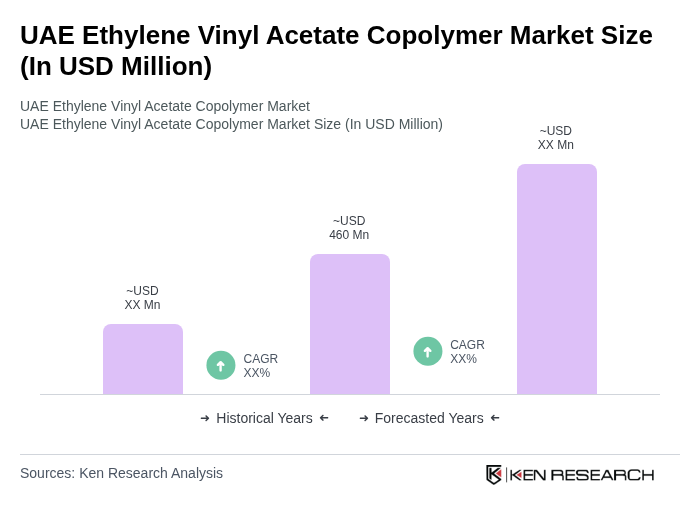
The UAE Ethylene Vinyl Acetate Copolymer Market, valued at USD 460 million, is growing due to applications in films, adhesives, and solar encapsulation, supported by eco-friendly regulations.

Region:Middle East

Author(s):Shubham

Product Code:KRAD1075

Pages:95

Published On:November 2025
About the Report

Base Year 2024

UAE Ethylene Vinyl Acetate Copolymer Market Overview

  • The UAE Ethylene Vinyl Acetate Copolymer Market is valued at USD 460 million, based on a five-year historical analysis. This growth is primarily driven by the increasing demand for EVA in packaging, automotive, construction, and renewable energy applications, supported by the rising adoption of sustainable materials across manufacturing sectors. The healthcare sector and solar energy projects also contribute to market expansion, reflecting global trends toward eco-friendly solutions .
  • Key cities such as Dubai and Abu Dhabi continue to dominate the market, leveraging robust industrial infrastructure, strategic trade locations, and substantial investments in construction and renewable energy initiatives. These factors sustain strong demand for EVA copolymers in packaging, automotive, and solar encapsulation, aligning with the region’s focus on industrial diversification and sustainability .
  • In 2023, the UAE government reinforced regulations promoting the use of eco-friendly materials in construction and packaging through the “UAE Green Building Regulations and Specifications” issued by the Emirates Authority for Standardization and Metrology (ESMA), 2023. This regulatory framework mandates the adoption of recyclable and low-impact materials, including EVA copolymers, in building and packaging sectors. Manufacturers are required to comply with minimum recycled content thresholds and product labeling standards, further enhancing the market’s growth potential .
UAE Ethylene Vinyl Acetate Copolymer Market Size

UAE Ethylene Vinyl Acetate Copolymer Market Segmentation

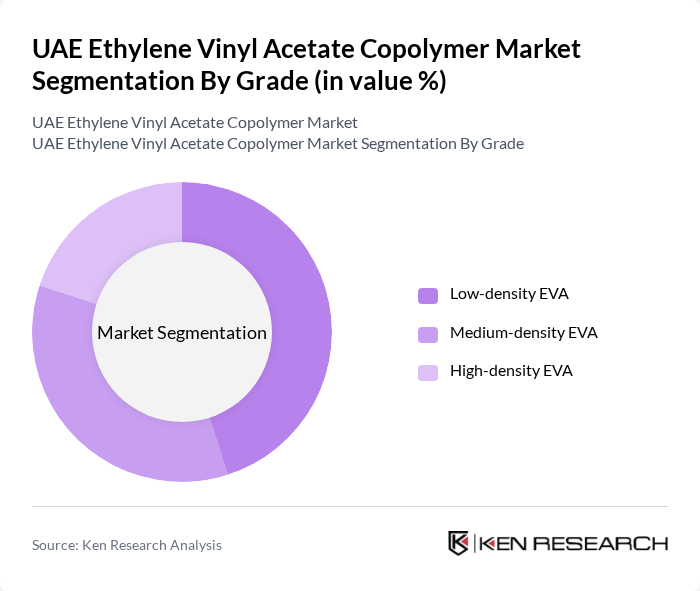
By Grade:The market is segmented into three grades of Ethylene Vinyl Acetate Copolymer: Low-density EVA, Medium-density EVA, and High-density EVA. Each grade is tailored for specific applications based on their flexibility, toughness, and barrier properties. Low-density EVA is preferred for films and adhesives due to its superior flexibility and transparency, while medium-density EVA is utilized in foams and cable insulation, and high-density EVA finds use in solar cell encapsulation and specialty packaging .
UAE Ethylene Vinyl Acetate Copolymer Market segmentation by Grade.

The Low-density EVA segment dominates the market, driven by its extensive use in films and adhesives for packaging and construction. Its flexibility, clarity, and excellent adhesion make it the preferred choice for manufacturers seeking lightweight and durable materials. The growing demand for efficient packaging and construction solutions further accelerates the adoption of low-density EVA .

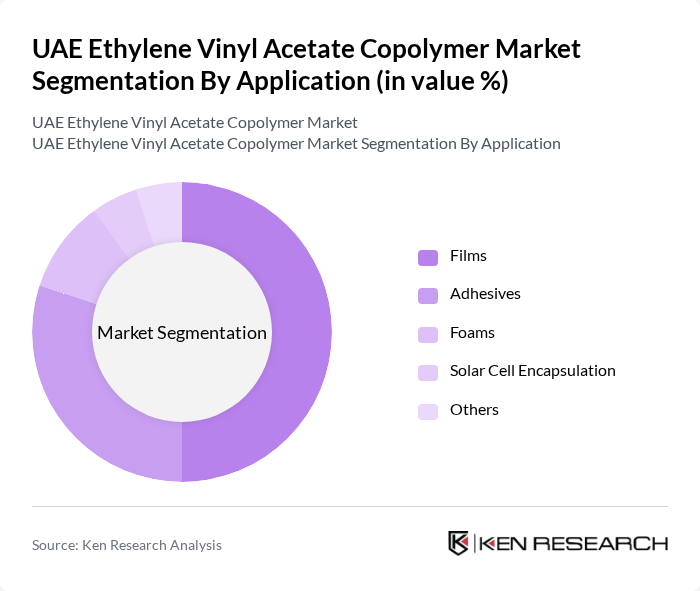
By Application:The applications of Ethylene Vinyl Acetate Copolymer include Films, Adhesives, Foams, Solar Cell Encapsulation, and Others. EVA’s versatility enables its use in flexible packaging, pressure-sensitive adhesives, cushioning foams, and solar panel encapsulation, meeting the diverse requirements of multiple industries .
UAE Ethylene Vinyl Acetate Copolymer Market segmentation by Application.

The Films application segment leads the market, propelled by rising demand for flexible packaging in food, beverage, and consumer goods. EVA films offer lightweight, moisture-resistant, and durable solutions, supporting product preservation and shelf-life extension. The expansion of e-commerce and online retail further boosts the need for advanced packaging, reinforcing the dominance of this segment .

UAE Ethylene Vinyl Acetate Copolymer Market Competitive Landscape

The UAE Ethylene Vinyl Acetate Copolymer Market is characterized by a dynamic mix of regional and international players. Leading participants such as SABIC, Borouge, DuPont, ExxonMobil, LyondellBasell, Hanwha Solutions, LG Chem, Braskem, TotalEnergies, Eastman Chemical Company, BASF, Chevron Phillips Chemical, INEOS, Solvay, Mitsubishi Chemical, Arkema contribute to innovation, geographic expansion, and service delivery in this space.

SABIC

1976

Riyadh, Saudi Arabia

Borouge

1998

Abu Dhabi, UAE

DuPont

1802

Wilmington, Delaware, USA

ExxonMobil

1870

Irving, Texas, USA

LyondellBasell

2007

Houston, Texas, USA

Company

Establishment Year

Headquarters

Group Size (Large, Medium, or Small as per industry convention)

Revenue Growth Rate (UAE EVA Segment)

Market Share in UAE EVA Market

Capacity Utilization Rate (UAE Operations)

Product Portfolio Breadth (EVA Grades/Applications)

R&D Investment as % of Revenue

UAE Ethylene Vinyl Acetate Copolymer Market Industry Analysis

Growth Drivers

  • Increasing Demand in Packaging Applications:The UAE's packaging sector is projected to reach AED 20 billion by 2024, driven by the growing retail and food industries. Ethylene vinyl acetate copolymer (EVA) is favored for its flexibility and durability, making it ideal for packaging solutions. The rise in e-commerce, which saw a 20% increase in future, further fuels demand for EVA in protective packaging, ensuring product safety during transit and storage.
  • Growth in the Automotive Sector:The UAE automotive industry is expected to grow to AED 12 billion by 2024, with a significant shift towards lightweight materials. EVA copolymer is increasingly used in automotive applications for its excellent impact resistance and thermal stability. The government's push for electric vehicles, with a target of 25% of all vehicles by future, is also driving demand for innovative materials like EVA that enhance vehicle efficiency and performance.
  • Rising Consumer Preference for Eco-Friendly Materials:As sustainability becomes a priority, the UAE's market for eco-friendly materials is projected to grow by 10% annually. Consumers are increasingly seeking products made from renewable resources, and EVA copolymer, which can be produced with bio-based feedstocks, aligns with this trend. The UAE's commitment to reducing carbon emissions by 30% by future further supports the shift towards sustainable materials in various industries.

Market Challenges

  • Fluctuating Raw Material Prices:The volatility in the prices of raw materials, particularly ethylene and vinyl acetate, poses a significant challenge for EVA manufacturers. In future, ethylene prices surged by 20% due to supply chain disruptions, impacting production costs. This unpredictability can lead to increased prices for end products, potentially reducing demand as manufacturers seek cost-effective alternatives, thereby affecting market stability.
  • Stringent Environmental Regulations:The UAE has implemented strict environmental regulations aimed at reducing plastic waste, which can hinder the growth of the EVA market. The introduction of the UAE's National Plastic Action Plan in future mandates recycling targets and limits on single-use plastics. Compliance with these regulations requires significant investment in sustainable practices, which may strain smaller manufacturers and limit their market competitiveness.

UAE Ethylene Vinyl Acetate Copolymer Market Future Outlook

The UAE Ethylene Vinyl Acetate Copolymer market is poised for significant transformation, driven by technological advancements and a growing emphasis on sustainability. As manufacturers innovate with bio-based EVA formulations, the market is likely to see increased adoption across various sectors, including packaging and automotive. Additionally, the government's initiatives to promote renewable energy and eco-friendly materials will further enhance market dynamics, creating a favorable environment for growth and collaboration among industry stakeholders.

Market Opportunities

  • Development of Innovative Product Formulations:There is a substantial opportunity for manufacturers to develop new EVA formulations that cater to specific industry needs, such as enhanced thermal stability for automotive applications. This innovation can lead to increased market share and customer loyalty, as companies that invest in R&D are likely to outperform competitors in a rapidly evolving market.
  • Expansion into Emerging Markets:The UAE's strategic location provides access to emerging markets in the Middle East and North Africa (MENA) region. By leveraging this geographical advantage, EVA manufacturers can tap into growing demand in these markets, particularly in construction and packaging, where the need for durable and sustainable materials is on the rise, thus driving revenue growth.

Scope of the Report

SegmentSub-Segments
By Grade

Low-density EVA

Medium-density EVA

High-density EVA

By Application

Films

Adhesives

Foams

Solar Cell Encapsulation

Others

By End-Use Industry

Packaging

Photovoltaic

Agriculture

Footwear and Sporting Goods

Construction

Electronics

Consumer Goods

Medical

Others

By Distribution Channel

Direct Sales

Distributors

Online Sales

Others

By Region

Abu Dhabi

Dubai

Sharjah

Others

By Product Form

Granules

Sheets

Films

Others

Key Target Audience

Investors and Venture Capitalist Firms

Government and Regulatory Bodies (e.g., Ministry of Climate Change and Environment, Abu Dhabi Department of Economic Development)

Manufacturers and Producers

Distributors and Retailers

Raw Material Suppliers

Packaging Companies

Construction and Building Material Firms

Automotive Industry Stakeholders

Players Mentioned in the Report:

SABIC

Borouge

DuPont

ExxonMobil

LyondellBasell

Hanwha Solutions

LG Chem

Braskem

TotalEnergies

Eastman Chemical Company

BASF

Chevron Phillips Chemical

INEOS

Solvay

Mitsubishi Chemical

Arkema

Table of Contents

Market Assessment Phase

1. Executive Summary and Approach


2. UAE Ethylene Vinyl Acetate Copolymer Market Overview

2.1 Key Insights and Strategic Recommendations

2.2 UAE Ethylene Vinyl Acetate Copolymer Market Overview

2.3 Definition and Scope

2.4 Evolution of Market Ecosystem

2.5 Timeline of Key Regulatory Milestones

2.6 Value Chain & Stakeholder Mapping

2.7 Business Cycle Analysis

2.8 Policy & Incentive Landscape


3. UAE Ethylene Vinyl Acetate Copolymer Market Analysis

3.1 Growth Drivers

3.1.1 Increasing demand in packaging applications
3.1.2 Growth in the automotive sector
3.1.3 Rising consumer preference for eco-friendly materials
3.1.4 Expansion of the construction industry

3.2 Market Challenges

3.2.1 Fluctuating raw material prices
3.2.2 Stringent environmental regulations
3.2.3 Competition from alternative materials
3.2.4 Limited awareness among end-users

3.3 Market Opportunities

3.3.1 Development of innovative product formulations
3.3.2 Expansion into emerging markets
3.3.3 Collaborations with research institutions
3.3.4 Increasing investment in renewable energy projects

3.4 Market Trends

3.4.1 Shift towards sustainable and biodegradable materials
3.4.2 Technological advancements in production processes
3.4.3 Growing popularity of lightweight materials in automotive
3.4.4 Rising demand for EVA in medical applications

3.5 Government Regulation

3.5.1 Implementation of recycling mandates
3.5.2 Regulations on VOC emissions
3.5.3 Standards for product safety and quality
3.5.4 Incentives for using sustainable materials

4. SWOT Analysis


5. Stakeholder Analysis


6. Porter's Five Forces Analysis


7. UAE Ethylene Vinyl Acetate Copolymer Market Market Size, 2019-2024

7.1 By Value

7.2 By Volume

7.3 By Average Selling Price


8. UAE Ethylene Vinyl Acetate Copolymer Market Segmentation

8.1 By Grade

8.1.1 Low-density EVA
8.1.2 Medium-density EVA
8.1.3 High-density EVA

8.2 By Application

8.2.1 Films
8.2.2 Adhesives
8.2.3 Foams
8.2.4 Solar Cell Encapsulation
8.2.5 Others

8.3 By End-Use Industry

8.3.1 Packaging
8.3.2 Photovoltaic
8.3.3 Agriculture
8.3.4 Footwear and Sporting Goods
8.3.5 Construction
8.3.6 Electronics
8.3.7 Consumer Goods
8.3.8 Medical
8.3.9 Others

8.4 By Distribution Channel

8.4.1 Direct Sales
8.4.2 Distributors
8.4.3 Online Sales
8.4.4 Others

8.5 By Region

8.5.1 Abu Dhabi
8.5.2 Dubai
8.5.3 Sharjah
8.5.4 Others

8.6 By Product Form

8.6.1 Granules
8.6.2 Sheets
8.6.3 Films
8.6.4 Others

9. UAE Ethylene Vinyl Acetate Copolymer Market Competitive Analysis

9.1 Market Share of Key Players

9.2 KPIs for Cross Comparison of Key Players

9.2.1 Company Name
9.2.2 Group Size (Large, Medium, or Small as per industry convention)
9.2.3 Revenue Growth Rate (UAE EVA Segment)
9.2.4 Market Share in UAE EVA Market
9.2.5 Capacity Utilization Rate (UAE Operations)
9.2.6 Product Portfolio Breadth (EVA Grades/Applications)
9.2.7 R&D Investment as % of Revenue
9.2.8 Distribution Network Coverage (UAE)
9.2.9 Customer Base Diversity (Key End-Use Sectors)
9.2.10 Sustainability/ESG Score

9.3 SWOT Analysis of Top Players

9.4 Pricing Analysis

9.5 Detailed Profile of Major Companies

9.5.1 SABIC
9.5.2 Borouge
9.5.3 DuPont
9.5.4 ExxonMobil
9.5.5 LyondellBasell
9.5.6 Hanwha Solutions
9.5.7 LG Chem
9.5.8 Braskem
9.5.9 TotalEnergies
9.5.10 Eastman Chemical Company
9.5.11 BASF
9.5.12 Chevron Phillips Chemical
9.5.13 INEOS
9.5.14 Solvay
9.5.15 Mitsubishi Chemical
9.5.16 Arkema

10. UAE Ethylene Vinyl Acetate Copolymer Market End-User Analysis

10.1 Procurement Behavior of Key Ministries

10.1.1 Government procurement policies
10.1.2 Budget allocation for materials
10.1.3 Supplier selection criteria
10.1.4 Contract management practices

10.2 Corporate Spend on Infrastructure & Energy

10.2.1 Investment trends in infrastructure
10.2.2 Energy consumption patterns
10.2.3 Budgeting for sustainable materials
10.2.4 Corporate social responsibility initiatives

10.3 Pain Point Analysis by End-User Category

10.3.1 Supply chain disruptions
10.3.2 Quality assurance challenges
10.3.3 Cost management issues
10.3.4 Regulatory compliance hurdles

10.4 User Readiness for Adoption

10.4.1 Awareness of EVA benefits
10.4.2 Training and support needs
10.4.3 Infrastructure readiness
10.4.4 Financial readiness for investment

10.5 Post-Deployment ROI and Use Case Expansion

10.5.1 Measurement of ROI
10.5.2 Case studies of successful implementations
10.5.3 Opportunities for scaling
10.5.4 Feedback mechanisms for improvement

11. UAE Ethylene Vinyl Acetate Copolymer Market Future Size, 2025-2030

11.1 By Value

11.2 By Volume

11.3 By Average Selling Price


Go-To-Market Strategy Phase

1. Whitespace Analysis + Business Model Canvas

1.1 Market gaps identification

1.2 Value proposition development

1.3 Revenue model exploration

1.4 Customer segmentation analysis

1.5 Key partnerships identification

1.6 Cost structure analysis

1.7 Competitive advantage assessment


2. Marketing and Positioning Recommendations

2.1 Branding strategies

2.2 Product USPs

2.3 Target market identification

2.4 Communication strategies

2.5 Digital marketing initiatives

2.6 Customer engagement tactics

2.7 Performance metrics


3. Distribution Plan

3.1 Urban retail strategies

3.2 Rural NGO tie-ups

3.3 E-commerce integration

3.4 Logistics optimization

3.5 Channel partner selection

3.6 Inventory management

3.7 Distribution cost analysis


4. Channel & Pricing Gaps

4.1 Underserved routes

4.2 Pricing bands analysis

4.3 Competitor pricing strategies

4.4 Customer willingness to pay

4.5 Price elasticity assessment

4.6 Discounting strategies

4.7 Value-based pricing


5. Unmet Demand & Latent Needs

5.1 Category gaps identification

5.2 Consumer segments analysis

5.3 Product development opportunities

5.4 Market entry barriers

5.5 Customer feedback incorporation

5.6 Trend analysis

5.7 Future demand forecasting


6. Customer Relationship

6.1 Loyalty programs

6.2 After-sales service

6.3 Customer feedback loops

6.4 Relationship management strategies

6.5 Customer satisfaction metrics

6.6 Engagement through social media

6.7 Community building initiatives


7. Value Proposition

7.1 Sustainability initiatives

7.2 Integrated supply chains

7.3 Cost-saving measures

7.4 Quality assurance processes

7.5 Innovation in product offerings

7.6 Customer-centric approach

7.7 Competitive differentiation


8. Key Activities

8.1 Regulatory compliance

8.2 Branding efforts

8.3 Distribution setup

8.4 Market research activities

8.5 Training and development

8.6 Performance monitoring

8.7 Stakeholder engagement


9. Entry Strategy Evaluation

9.1 Domestic Market Entry Strategy

9.1.1 Product mix considerations
9.1.2 Pricing band analysis
9.1.3 Packaging strategies

9.2 Export Entry Strategy

9.2.1 Target countries selection
9.2.2 Compliance roadmap development

10. Entry Mode Assessment

10.1 Joint Ventures

10.2 Greenfield investments

10.3 Mergers & Acquisitions

10.4 Distributor Model

10.5 Risk assessment

10.6 Strategic fit evaluation

10.7 Long-term partnership considerations


11. Capital and Timeline Estimation

11.1 Capital requirements

11.2 Timelines for market entry

11.3 Budget allocation

11.4 Financial projections

11.5 Funding sources

11.6 Cost-benefit analysis

11.7 Risk management strategies


12. Control vs Risk Trade-Off

12.1 Ownership considerations

12.2 Partnership dynamics

12.3 Risk mitigation strategies

12.4 Control mechanisms

12.5 Long-term sustainability

12.6 Exit strategies

12.7 Performance evaluation


13. Profitability Outlook

13.1 Breakeven analysis

13.2 Long-term sustainability

13.3 Profit margin assessment

13.4 Revenue growth projections

13.5 Cost management strategies

13.6 Financial health indicators

13.7 Market share growth


14. Potential Partner List

14.1 Distributors

14.2 Joint Ventures

14.3 Acquisition targets

14.4 Strategic alliances

14.5 Industry collaborations

14.6 Research partnerships

14.7 Supply chain partners


15. Execution Roadmap

15.1 Phased Plan for Market Entry

15.1.1 Market Setup
15.1.2 Market Entry
15.1.3 Growth Acceleration
15.1.4 Scale & Stabilize

15.2 Key Activities and Milestones

15.2.1 Timeline for key activities
15.2.2 Milestone tracking
15.2.3 Performance metrics
15.2.4 Resource allocation

Research Methodology

ApproachModellingSample

Phase 1: Approach1

Desk Research

  • Industry reports from the Gulf Petrochemicals and Chemicals Association (GPCA)
  • Market analysis from government publications and trade associations in the UAE
  • Academic journals and white papers focusing on polymer applications and innovations

Primary Research

  • Interviews with product managers at leading EVA manufacturers in the UAE
  • Surveys with distributors and suppliers in the polymer supply chain
  • Field interviews with end-users in sectors such as packaging and automotive

Validation & Triangulation

  • Cross-validation of data through multiple industry sources and expert opinions
  • Triangulation of market size estimates from production, consumption, and trade data
  • Sanity checks through feedback from industry experts and stakeholders

Phase 2: Market Size Estimation1

Top-down Assessment

  • Analysis of national production statistics for ethylene and vinyl acetate
  • Segmentation of the market by application areas such as packaging, automotive, and construction
  • Incorporation of macroeconomic indicators influencing demand for EVA products

Bottom-up Modeling

  • Volume estimates based on production capacities of key manufacturers in the UAE
  • Cost analysis derived from raw material prices and production processes
  • Estimation of market share based on sales data from major distributors

Forecasting & Scenario Analysis

  • Utilization of time-series analysis to project future demand trends
  • Scenario modeling based on potential regulatory changes and environmental policies
  • Development of best-case, worst-case, and most-likely scenarios through 2030

Phase 3: CATI Sample Composition1

Scope Item/SegmentSample SizeTarget Respondent Profiles
Packaging Industry Applications100Product Managers, Packaging Engineers
Automotive Component Manufacturing80Procurement Managers, R&D Engineers
Construction Material Usage60Construction Project Managers, Material Suppliers
Consumer Goods Sector70Brand Managers, Supply Chain Analysts
Medical and Healthcare Applications50Quality Assurance Managers, Product Development Specialists

Frequently Asked Questions

What is the current value of the UAE Ethylene Vinyl Acetate Copolymer Market?

The UAE Ethylene Vinyl Acetate Copolymer Market is valued at approximately USD 460 million, reflecting a robust growth trajectory driven by increasing demand across various sectors, including packaging, automotive, and renewable energy applications.

What are the primary applications of Ethylene Vinyl Acetate Copolymer in the UAE?

Which cities in the UAE are leading in the Ethylene Vinyl Acetate Copolymer market?

What factors are driving the growth of the UAE Ethylene Vinyl Acetate Copolymer market?

Other Regional/Country Reports

Indonesia Ethylene Vinyl Acetate Copolymer Market

Malaysia Ethylene Vinyl Acetate Copolymer Market

KSA Ethylene Vinyl Acetate Copolymer Market

APAC Ethylene Vinyl Acetate Copolymer Market

SEA Ethylene Vinyl Acetate Copolymer Market

Vietnam Ethylene Vinyl Acetate Copolymer Market

Why Buy From Us?

Refine Robust Result (RRR) Framework

What makes us stand out is that our consultants follow Robust, Refine and Result (RRR) methodology. Robust for clear definitions, approaches and sanity checking, Refine for differentiating respondents' facts and opinions, and Result for presenting data with story.

Our Reach Is Unmatched

We have set a benchmark in the industry by offering our clients with syndicated and customized market research reports featuring coverage of entire market as well as meticulous research and analyst insights.

Shifting the Research Paradigm

While we don't replace traditional research, we flip the method upside down. Our dual approach of Top Bottom & Bottom Top ensures quality deliverable by not just verifying company fundamentals but also looking at the sector and macroeconomic factors.

More Insights-Better Decisions

With one step in the future, our research team constantly tries to show you the bigger picture. We help with some of the tough questions you may encounter along the way: How is the industry positioned? Best marketing channel? KPI's of competitors? By aligning every element, we help maximize success.

Transparency and Trust

Our report gives you instant access to the answers and sources that other companies might choose to hide. We elaborate each steps of research methodology we have used and showcase you the sample size to earn your trust.

Round the Clock Support

If you need any support, we are here! We pride ourselves on universe strength, data quality, and quick, friendly, and professional service.

Why Clients Choose Us?

400000+
Reports in repository
150+
Consulting projects a year
100+
Analysts
8000+
Client Queries in 2022








