Region:Middle East
Author(s):Dev
Product Code:KRAA3642
Pages:90
Published On:January 2026
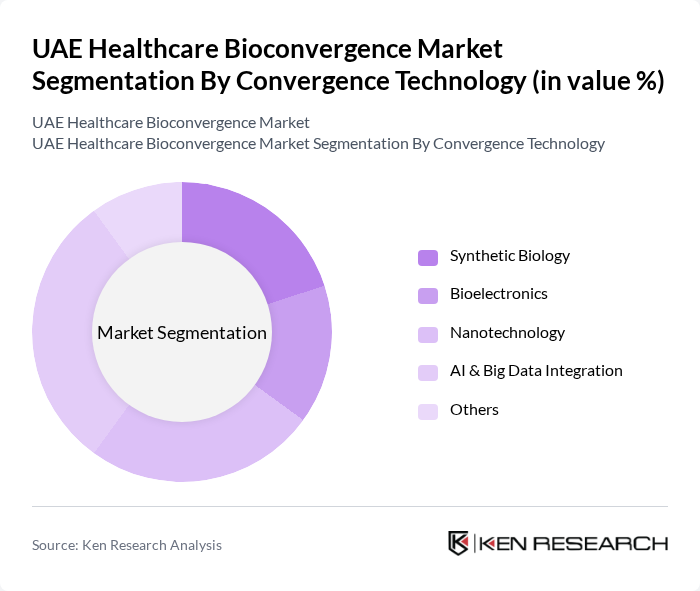
By Convergence Technology:This segmentation includes various technologies that converge biology with engineering and data science. The subsegments are Synthetic Biology, Bioelectronics, Nanotechnology, AI & Big Data Integration, and Others. Each of these technologies plays a crucial role in enhancing healthcare solutions, with AI & Big Data Integration currently leading the market due to its ability to analyze vast amounts of health data for better decision-making and its central role in predictive analytics, precision diagnostics, and treatment optimization.
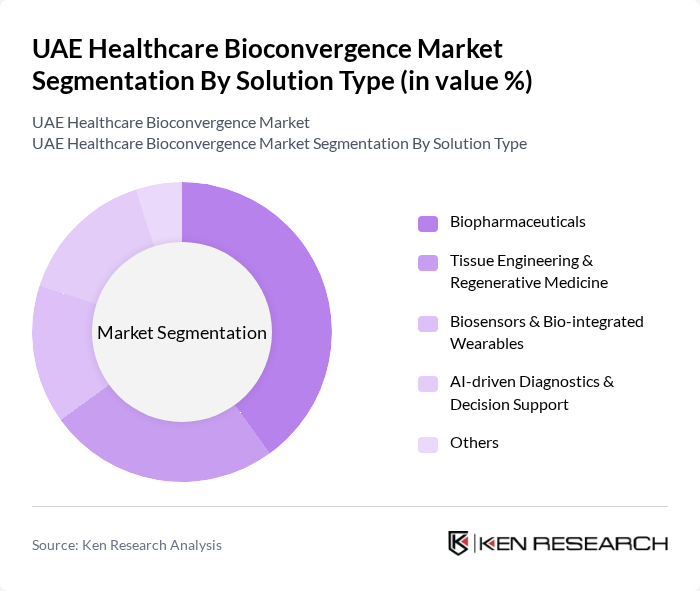
By Solution Type:This segmentation encompasses various solutions offered in the bioconvergence market, including Biopharmaceuticals, Tissue Engineering & Regenerative Medicine, Biosensors & Bio-integrated Wearables, AI-driven Diagnostics & Decision Support, and Others. Biopharmaceuticals are currently the leading solution type, driven by the increasing demand for innovative targeted therapies, biologics, and gene-based treatments, as well as the rapid uptake of advanced regenerative and cell-based therapies within the broader healthcare bioconvergence framework. Biosensors, bio-integrated wearables, and AI-driven diagnostics are also gaining momentum as they enable continuous monitoring, early disease detection, and data-driven clinical support in the UAE healthcare ecosystem.
The UAE Healthcare Bioconvergence Market is characterized by a dynamic mix of regional and international players. Leading participants such as Siemens Healthineers, Philips Healthcare, GE HealthCare, F. Hoffmann-La Roche Ltd, Abbott Laboratories, Medtronic plc, Johnson & Johnson, Novartis AG, Bayer AG, Merck KGaA, GSK plc (GlaxoSmithKline), Amgen Inc., Biogen Inc., Stryker Corporation, Thermo Fisher Scientific Inc. contribute to innovation, geographic expansion, and service delivery in this space.
The future of the UAE healthcare bioconvergence market appears promising, driven by ongoing advancements in technology and a strong focus on personalized medicine. As the government continues to invest in digital health initiatives and biotechnology, the integration of AI and data analytics will enhance patient care and operational efficiency. Furthermore, the growing collaboration between healthcare providers and tech firms is expected to foster innovation, leading to the development of new solutions that address the unique healthcare challenges faced by the UAE population.
| Segment | Sub-Segments |
|---|---|
| By Convergence Technology | Synthetic Biology Bioelectronics Nanotechnology AI & Big Data Integration Others |
| By Solution Type | Biopharmaceuticals Tissue Engineering & Regenerative Medicine Biosensors & Bio?integrated Wearables AI-driven Diagnostics & Decision Support Others |
| By Application | Drug Discovery & Development Precision & Personalized Medicine Regenerative Medicine Advanced Diagnostics & Imaging Digital Therapeutics & Remote Monitoring Others |
| By End-User | Public Hospitals & Health Systems Private Hospitals & Specialty Clinics Research & Academic Institutes Digital Health Platforms & Telehealth Providers Others |
| By Deployment Model | On-premise Solutions Cloud-based Platforms Hybrid Models Others |
| By Region | Abu Dhabi Dubai Sharjah & Northern Emirates Others |
| By Policy & Funding Support | Government Grants & R&D Programs Tax Incentives & Free Zone Benefits Innovation Funds & Venture Capital Public–Private Partnerships Others |
| Scope Item/Segment | Sample Size | Target Respondent Profiles |
|---|---|---|
| Healthcare Providers | 120 | Doctors, Hospital Administrators |
| Biopharmaceutical Companies | 80 | R&D Managers, Product Development Leads |
| Medical Device Manufacturers | 60 | Product Managers, Regulatory Affairs Specialists |
| Patients and Healthcare Consumers | 100 | Patients, Caregivers |
| Health Technology Startups | 50 | Founders, CTOs |
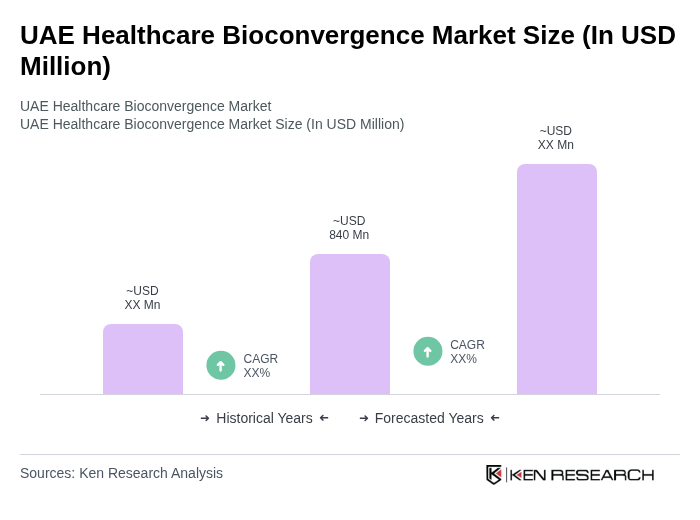
The UAE Healthcare Bioconvergence Market is valued at approximately USD 840 million, reflecting significant growth driven by advancements in biotechnology, increased healthcare infrastructure investments, and a rising demand for personalized medicine.

What makes us stand out is that our consultants follow Robust, Refine and Result (RRR) methodology. Robust for clear definitions, approaches and sanity checking, Refine for differentiating respondents' facts and opinions, and Result for presenting data with story.

We have set a benchmark in the industry by offering our clients with syndicated and customized market research reports featuring coverage of entire market as well as meticulous research and analyst insights.

While we don't replace traditional research, we flip the method upside down. Our dual approach of Top Bottom & Bottom Top ensures quality deliverable by not just verifying company fundamentals but also looking at the sector and macroeconomic factors.

With one step in the future, our research team constantly tries to show you the bigger picture. We help with some of the tough questions you may encounter along the way: How is the industry positioned? Best marketing channel? KPI's of competitors? By aligning every element, we help maximize success.

Our report gives you instant access to the answers and sources that other companies might choose to hide. We elaborate each steps of research methodology we have used and showcase you the sample size to earn your trust.

If you need any support, we are here! We pride ourselves on universe strength, data quality, and quick, friendly, and professional service.













