UAE Precipitated Silica Market Size Share Growth Drivers Trends Opportunities & Forecast 2025–2030

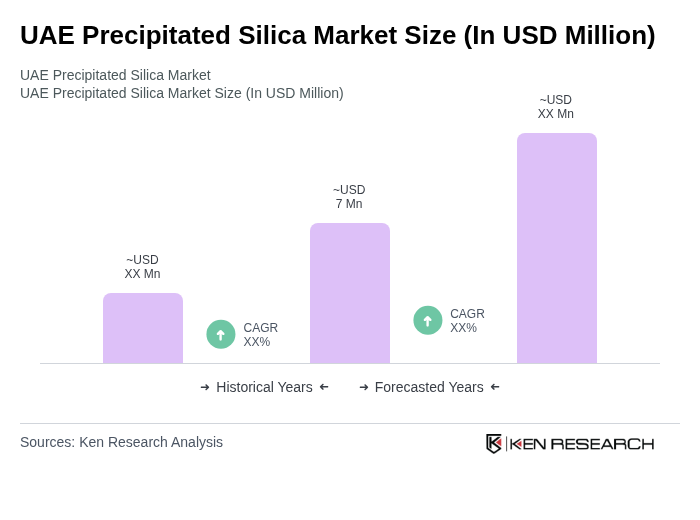
UAE Precipitated Silica Market, valued at USD 7 million, is expanding due to rising demand in tires, rubber products, and food applications, supported by sustainability regulations and industrial growth.

Region:Middle East

Author(s):Dev

Product Code:KRAA3871

Pages:91

Published On:January 2026
About the Report

Base Year 2024

UAE Precipitated Silica Market Overview

  • The UAE Precipitated Silica Market is valued at USD 7 million, based on a five-year historical analysis. This growth is primarily driven by the increasing demand for high-performance materials in various industries, including automotive, personal care, and food processing. The rising awareness of the benefits of precipitated silica, such as its use as a reinforcing agent in rubber and as an anti-caking agent in food products, along with its role as a thickening and cleaning agent in oral care formulations, has further fueled market expansion.
  • Key cities dominating the market include Dubai and Abu Dhabi, which serve as major industrial and commercial hubs in the UAE. The presence of advanced manufacturing facilities, large-scale logistics and free zones such as Jebel Ali and KIZAD, coupled with a robust logistics network, enhances the accessibility of precipitated silica products and imported specialty chemicals. Additionally, the growing construction, automotive, and packaging sectors in these cities, supported by infrastructure investment and rising vehicle parc, contribute significantly to the demand for precipitated silica, particularly in tires, coatings, sealants, and polymer applications.
  • In 2023, the UAE government implemented regulations aimed at promoting sustainable practices in the manufacturing sector. A key instrument is Federal Decree-Law No. 12 of 2018 on Integrated Waste Management, issued by the UAE Ministry of Climate Change and Environment, which sets requirements for waste minimization, safe handling of chemical substances, and promotion of recycling and resource efficiency in industrial operations. In parallel, the UAE Green Agenda 2030 and related implementation programs encourage the use of eco-friendly and energy-efficient materials in manufacturing and product design, which has led to an increased focus on high-dispersion, low-rolling-resistance precipitated silica in tire compounds and other sustainable applications, thereby boosting its market presence.
UAE Precipitated Silica Market Size

UAE Precipitated Silica Market Segmentation

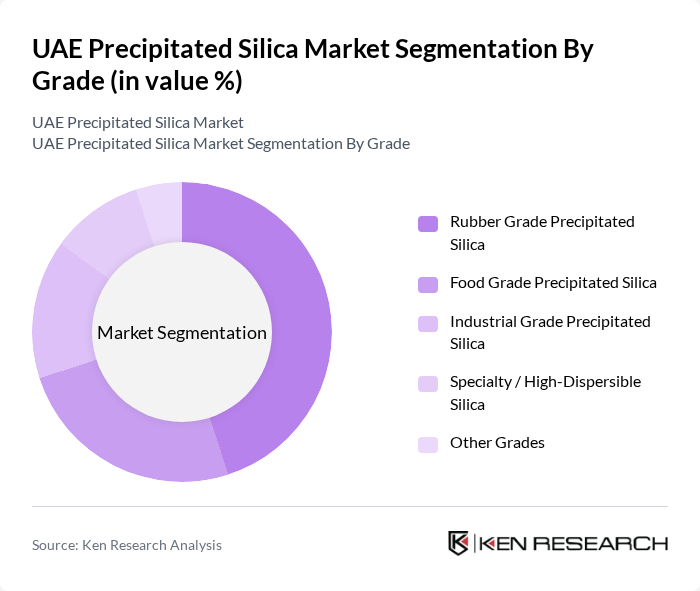
By Grade:The market is segmented into various grades of precipitated silica, including Rubber Grade, Food Grade, Industrial Grade, Specialty/High-Dispersible Silica, and Other Grades. Rubber Grade Precipitated Silica is the most dominant due to its extensive use in tire manufacturing and other rubber products, in line with global trends where rubber applications account for the largest share of precipitated silica demand. The increasing demand for high-performance and fuel-efficient tires, driven by the automotive industry's growth and the shift toward low-rolling-resistance and “green” tires, has significantly contributed to the market's expansion in this segment.
UAE Precipitated Silica Market segmentation by Grade.

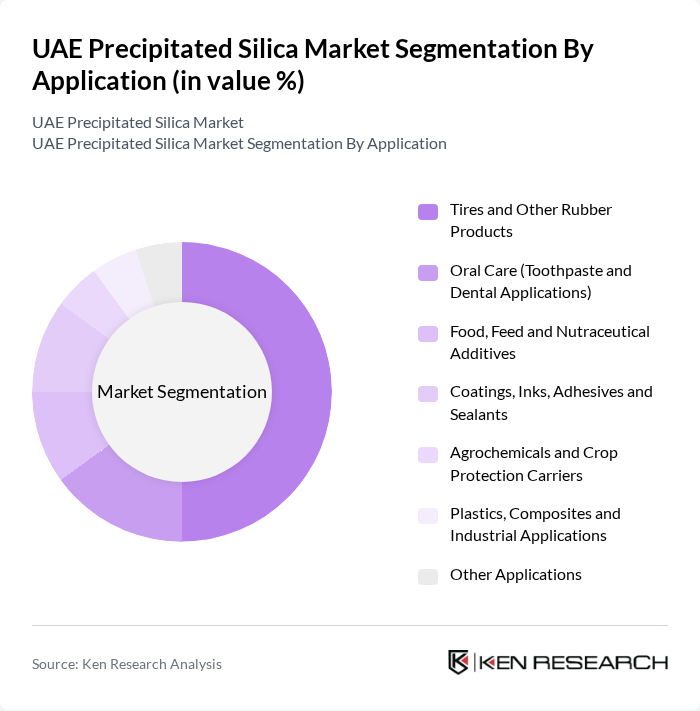
By Application:The applications of precipitated silica are diverse, including Tires and Other Rubber Products, Oral Care (Toothpaste and Dental Applications), Food, Feed and Nutraceutical Additives, Coatings, Inks, Adhesives and Sealants, Agrochemicals and Crop Protection Carriers, Plastics, Composites and Industrial Applications, and Other Applications. The Tires and Other Rubber Products segment leads the market, consistent with UAE and global patterns where rubber is the largest application segment. This leadership is supported by increasing production and consumption of vehicles in the wider GCC, rising replacement tire demand, and the adoption of precipitated silica in tread and sidewall compounds to improve wet grip, abrasion resistance, and fuel efficiency.
UAE Precipitated Silica Market segmentation by Application.

UAE Precipitated Silica Market Competitive Landscape

The UAE Precipitated Silica Market is characterized by a dynamic mix of regional and international players. Leading participants such as Evonik Industries AG, PPG Industries, Inc., Cabot Corporation, Wacker Chemie AG, Solvay S.A., Nouryon (formerly AkzoNobel Specialty Chemicals), Imerys S.A., J.M. Huber Corporation (Huber Engineered Materials), Fuso Chemical Co., Ltd., Tokuyama Corporation, SiSiB Silica, W. R. Grace & Co. (Grace Materials Technologies), Kemitura A/S, Dalian Fuchang Chemical Co., Ltd., Jiangxi Black Cat Carbon Black Inc. contribute to innovation, geographic expansion, and service delivery in this space, with several of these companies identified as key global suppliers to the UAE and wider Middle East precipitated silica market.

Evonik Industries AG

2007

Essen, Germany

PPG Industries, Inc.

1883

Pittsburgh, USA

Cabot Corporation

1882

Boston, USA

Wacker Chemie AG

1914

Munich, Germany

Solvay S.A.

1863

Brussels, Belgium

Company

Establishment Year

Headquarters

UAE Revenue (USD Million) and 3-Year CAGR

EBITDA Margin (%)

Return on Invested Capital (ROIC, %)

Market Share in UAE Precipitated Silica (%)

Capacity Utilization Rate (%) – UAE Facilities

Average Realized Price (USD/MT) – Key Grades

UAE Precipitated Silica Market Industry Analysis

Growth Drivers

  • Increasing Demand from the Rubber Industry:The UAE rubber industry is projected to reach a value of AED 1.5 billion, driven by the automotive and construction sectors. This growth is significantly boosting the demand for precipitated silica, which is essential for enhancing the performance and durability of rubber products. The increasing production of tires, which accounted for 60% of rubber consumption, is a key factor in this demand surge, highlighting the importance of precipitated silica in the industry.
  • Expansion of the Automotive Sector:The UAE automotive sector is expected to grow at a rate of 4.5% annually, reaching AED 25 billion. This expansion is largely attributed to rising consumer demand for vehicles and increased investments in infrastructure. As precipitated silica is crucial for tire manufacturing and other automotive components, this growth directly correlates with heightened demand for precipitated silica, positioning it as a vital material in the automotive supply chain.
  • Rising Use in Food and Beverage Applications:The food and beverage sector in the UAE is projected to grow to AED 100 billion, with precipitated silica being increasingly utilized as an anti-caking agent and clarifying agent. This trend is driven by the growing consumer preference for processed foods and beverages, which require additives to enhance quality and shelf life. The rising demand for food safety and quality assurance further propels the need for precipitated silica in this sector.

Market Challenges

  • Fluctuating Raw Material Prices:The prices of raw materials used in the production of precipitated silica, such as sodium silicate, have shown significant volatility, with fluctuations of up to 20%. This instability poses a challenge for manufacturers in the UAE, as it affects production costs and profit margins. Companies must navigate these price changes carefully to maintain competitiveness in the market while ensuring product quality.
  • Environmental Regulations:Stricter environmental regulations in the UAE, particularly regarding emissions and waste management, are impacting the precipitated silica industry. Compliance costs have increased by approximately 15% due to the need for advanced filtration and waste treatment technologies. These regulations, while essential for sustainability, pose challenges for manufacturers striving to balance compliance with operational efficiency and cost-effectiveness.

UAE Precipitated Silica Market Future Outlook

The future of the UAE precipitated silica market appears promising, driven by technological advancements and a growing emphasis on sustainability. As manufacturers adopt innovative production techniques, efficiency is expected to improve, reducing costs and environmental impact. Additionally, the increasing focus on eco-friendly products across various industries will likely enhance the demand for precipitated silica, particularly in rubber and food applications. This trend indicates a robust growth trajectory for the market in the future, fostering opportunities for expansion and innovation.

Market Opportunities

  • Technological Advancements in Production:Innovations in production processes, such as the development of more efficient synthesis methods, present significant opportunities for the precipitated silica market. These advancements can lead to reduced production costs and improved product quality, enabling manufacturers to meet the growing demand in various sectors, including automotive and food.
  • Increasing Export Potential:The UAE's strategic location and trade agreements enhance its export potential for precipitated silica. With a projected increase in exports to neighboring regions, particularly the GCC, manufacturers can capitalize on this opportunity to expand their market reach and boost revenue, further solidifying the UAE's position as a key player in the global precipitated silica market.

Scope of the Report

SegmentSub-Segments
By Grade

Rubber Grade Precipitated Silica

Food Grade Precipitated Silica

Industrial Grade Precipitated Silica

Specialty / High-Dispersible Silica

Other Grades

By Application

Tires and Other Rubber Products

Oral Care (Toothpaste and Dental Applications)

Food, Feed and Nutraceutical Additives

Coatings, Inks, Adhesives and Sealants

Agrochemicals and Crop Protection Carriers

Plastics, Composites and Industrial Applications

Other Applications

By End-Use Industry

Automotive and Transportation

Personal Care and Oral Care

Food, Beverages and Animal Feed

Industrial and Chemical Manufacturing

Agriculture and Horticulture

Construction and Building Materials

Other End-Use Industries

By Distribution Channel

Direct Sales to OEMs and Large Industrials

Local Distributors and Trading Companies

International Traders and Importers

Online / Digital Procurement Platforms

Other Channels

By Geography

Abu Dhabi

Dubai

Sharjah

Ajman

Ras Al Khaimah, Fujairah & Umm Al Quwain

By Product Form

Powder

Granules

Micropearl / Beads

Other Forms

By Packaging Type

Small & Medium Bags (?25 kg)

Jumbo Bags / FIBCs

Bulk Containers and Tankers

Other Packaging Types

Key Target Audience

Investors and Venture Capitalist Firms

Government and Regulatory Bodies (e.g., Ministry of Economy, Ministry of Climate Change and Environment)

Manufacturers and Producers

Distributors and Retailers

Raw Material Suppliers

Industry Associations (e.g., UAE Chemical Industries Council)

Financial Institutions

Importers and Exporters

Players Mentioned in the Report:

Evonik Industries AG

PPG Industries, Inc.

Cabot Corporation

Wacker Chemie AG

Solvay S.A.

Nouryon (formerly AkzoNobel Specialty Chemicals)

Imerys S.A.

J.M. Huber Corporation (Huber Engineered Materials)

Fuso Chemical Co., Ltd.

Tokuyama Corporation

SiSiB Silica

W. R. Grace & Co. (Grace Materials Technologies)

Kemitura A/S

Dalian Fuchang Chemical Co., Ltd.

Jiangxi Black Cat Carbon Black Inc.

Table of Contents

Market Assessment Phase

1. Executive Summary and Approach


2. UAE Precipitated Silica Market Overview

2.1 Key Insights and Strategic Recommendations

2.2 UAE Precipitated Silica Market Overview

2.3 Definition and Scope

2.4 Evolution of Market Ecosystem

2.5 Timeline of Key Regulatory Milestones

2.6 Value Chain & Stakeholder Mapping

2.7 Business Cycle Analysis

2.8 Policy & Incentive Landscape


3. UAE Precipitated Silica Market Analysis

3.1 Growth Drivers

3.1.1 Increasing Demand from the Rubber Industry
3.1.2 Expansion of the Automotive Sector
3.1.3 Rising Use in Food and Beverage Applications
3.1.4 Growth in Construction Activities

3.2 Market Challenges

3.2.1 Fluctuating Raw Material Prices
3.2.2 Environmental Regulations
3.2.3 Competition from Alternative Materials
3.2.4 Limited Awareness of Product Benefits

3.3 Market Opportunities

3.3.1 Technological Advancements in Production
3.3.2 Increasing Export Potential
3.3.3 Growing Demand in Personal Care Products
3.3.4 Expansion into Emerging Markets

3.4 Market Trends

3.4.1 Shift Towards Sustainable Products
3.4.2 Increasing Investment in R&D
3.4.3 Rising Popularity of Eco-Friendly Packaging
3.4.4 Growth of E-commerce in Industrial Supplies

3.5 Government Regulation

3.5.1 Stricter Environmental Compliance Standards
3.5.2 Import Tariffs on Raw Materials
3.5.3 Incentives for Sustainable Manufacturing
3.5.4 Regulations on Product Safety and Quality

4. SWOT Analysis


5. Stakeholder Analysis


6. Porter's Five Forces Analysis


7. UAE Precipitated Silica Market Market Size, 2019-2024

7.1 By Value

7.2 By Volume

7.3 By Average Selling Price


8. UAE Precipitated Silica Market Segmentation

8.1 By Grade

8.1.1 Rubber Grade Precipitated Silica
8.1.2 Food Grade Precipitated Silica
8.1.3 Industrial Grade Precipitated Silica
8.1.4 Specialty / High-Dispersible Silica
8.1.5 Other Grades

8.2 By Application

8.2.1 Tires and Other Rubber Products
8.2.2 Oral Care (Toothpaste and Dental Applications)
8.2.3 Food, Feed and Nutraceutical Additives
8.2.4 Coatings, Inks, Adhesives and Sealants
8.2.5 Agrochemicals and Crop Protection Carriers
8.2.6 Plastics, Composites and Industrial Applications
8.2.7 Other Applications

8.3 By End-Use Industry

8.3.1 Automotive and Transportation
8.3.2 Personal Care and Oral Care
8.3.3 Food, Beverages and Animal Feed
8.3.4 Industrial and Chemical Manufacturing
8.3.5 Agriculture and Horticulture
8.3.6 Construction and Building Materials
8.3.7 Other End-Use Industries

8.4 By Distribution Channel

8.4.1 Direct Sales to OEMs and Large Industrials
8.4.2 Local Distributors and Trading Companies
8.4.3 International Traders and Importers
8.4.4 Online / Digital Procurement Platforms
8.4.5 Other Channels

8.5 By Geography

8.5.1 Abu Dhabi
8.5.2 Dubai
8.5.3 Sharjah
8.5.4 Ajman
8.5.5 Ras Al Khaimah, Fujairah & Umm Al Quwain

8.6 By Product Form

8.6.1 Powder
8.6.2 Granules
8.6.3 Micropearl / Beads
8.6.4 Other Forms

8.7 By Packaging Type

8.7.1 Small & Medium Bags (?25 kg)
8.7.2 Jumbo Bags / FIBCs
8.7.3 Bulk Containers and Tankers
8.7.4 Other Packaging Types

9. UAE Precipitated Silica Market Competitive Analysis

9.1 Market Share of Key Players

9.2 Cross Comparison of Key Players

9.2.1 Company Name
9.2.2 UAE Revenue (USD Million) and 3-Year CAGR
9.2.3 EBITDA Margin (%)
9.2.4 Return on Invested Capital (ROIC, %)
9.2.5 Market Share in UAE Precipitated Silica (%)
9.2.6 Capacity Utilization Rate (%) – UAE Facilities
9.2.7 Average Realized Price (USD/MT) – Key Grades
9.2.8 R&D Spend as % of Sales
9.2.9 Customer Concentration (Top 5 Customers’ Share, %)
9.2.10 UAE Export Share of Total Sales (%)

9.3 SWOT Analysis of Top Players

9.4 Pricing Analysis

9.5 Detailed Profile of Major Companies

9.5.1 Evonik Industries AG
9.5.2 PPG Industries, Inc.
9.5.3 Cabot Corporation
9.5.4 Wacker Chemie AG
9.5.5 Solvay S.A.
9.5.6 Nouryon (formerly AkzoNobel Specialty Chemicals)
9.5.7 Imerys S.A.
9.5.8 J.M. Huber Corporation (Huber Engineered Materials)
9.5.9 Fuso Chemical Co., Ltd.
9.5.10 Tokuyama Corporation
9.5.11 SiSiB Silica
9.5.12 W. R. Grace & Co. (Grace Materials Technologies)
9.5.13 Kemitura A/S
9.5.14 Dalian Fuchang Chemical Co., Ltd.
9.5.15 Jiangxi Black Cat Carbon Black Inc.

10. UAE Precipitated Silica Market End-User Analysis

10.1 Procurement Behavior of Key Ministries

10.1.1 Ministry of Industry and Advanced Technology
10.1.2 Ministry of Climate Change and Environment
10.1.3 Ministry of Economy
10.1.4 Ministry of Energy and Infrastructure

10.2 Corporate Spend on Infrastructure & Energy

10.2.1 Investment Trends in Construction
10.2.2 Energy Sector Expenditure
10.2.3 R&D Budget Allocations
10.2.4 Sustainability Initiatives Funding

10.3 Pain Point Analysis by End-User Category

10.3.1 Automotive Sector Challenges
10.3.2 Food and Beverage Industry Concerns
10.3.3 Construction Sector Issues
10.3.4 Personal Care Product Demands

10.4 User Readiness for Adoption

10.4.1 Awareness Levels
10.4.2 Training and Support Needs
10.4.3 Financial Readiness
10.4.4 Infrastructure Availability

10.5 Post-Deployment ROI and Use Case Expansion

10.5.1 ROI Measurement Techniques
10.5.2 Case Studies of Successful Implementations
10.5.3 Future Use Case Opportunities
10.5.4 Feedback Mechanisms for Improvement

11. UAE Precipitated Silica Market Future Size, 2025-2030

11.1 By Value

11.2 By Volume

11.3 By Average Selling Price


Go-To-Market Strategy Phase

1. Whitespace Analysis + Business Model Canvas

1.1 Market Gaps Identification

1.2 Business Model Framework


2. Marketing and Positioning Recommendations

2.1 Branding Strategies

2.2 Product USPs


3. Distribution Plan

3.1 Urban Retail Strategies

3.2 Rural NGO Tie-ups


4. Channel & Pricing Gaps

4.1 Underserved Routes

4.2 Pricing Bands Analysis


5. Unmet Demand & Latent Needs

5.1 Category Gaps

5.2 Consumer Segments


6. Customer Relationship

6.1 Loyalty Programs

6.2 After-sales Service


7. Value Proposition

7.1 Sustainability Initiatives

7.2 Integrated Supply Chains


8. Key Activities

8.1 Regulatory Compliance

8.2 Branding Efforts

8.3 Distribution Setup


9. Entry Strategy Evaluation

9.1 Domestic Market Entry Strategy

9.1.1 Product Mix Considerations
9.1.2 Pricing Band Strategy
9.1.3 Packaging Solutions

9.2 Export Entry Strategy

9.2.1 Target Countries
9.2.2 Compliance Roadmap

10. Entry Mode Assessment

10.1 Joint Ventures

10.2 Greenfield Investments

10.3 Mergers & Acquisitions

10.4 Distributor Model


11. Capital and Timeline Estimation

11.1 Capital Requirements

11.2 Timelines for Implementation


12. Control vs Risk Trade-Off

12.1 Ownership Considerations

12.2 Partnerships Evaluation


13. Profitability Outlook

13.1 Breakeven Analysis

13.2 Long-term Sustainability Strategies


14. Potential Partner List

14.1 Distributors

14.2 Joint Ventures

14.3 Acquisition Targets


15. Execution Roadmap

15.1 Phased Plan for Market Entry

15.1.1 Market Setup
15.1.2 Market Entry
15.1.3 Growth Acceleration
15.1.4 Scale & Stabilize

15.2 Key Activities and Milestones

15.2.1 Milestone Planning
15.2.2 Activity Tracking

Research Methodology

ApproachModellingSample

Phase 1: Approach1

Desk Research

  • Industry reports from the UAE Ministry of Economy and relevant trade associations
  • Market analysis publications from chemical industry journals and databases
  • Statistical data from the UAE Federal Competitiveness and Statistics Authority

Primary Research

  • Interviews with key stakeholders in the silica production sector, including manufacturers and suppliers
  • Surveys targeting end-users in industries such as rubber, plastics, and coatings
  • Field interviews with technical experts and R&D personnel in silica applications

Validation & Triangulation

  • Cross-validation of findings through multiple data sources, including trade publications and government reports
  • Triangulation of market insights from primary interviews and secondary data analysis
  • Sanity checks conducted through expert panel discussions and feedback sessions

Phase 2: Market Size Estimation1

Top-down Assessment

  • Analysis of the overall chemical market size in the UAE and its growth trajectory
  • Segmentation of the silica market by application areas such as rubber, coatings, and food additives
  • Incorporation of macroeconomic indicators and industry growth forecasts

Bottom-up Modeling

  • Estimation of production capacities and output from major silica manufacturers in the UAE
  • Cost analysis based on production processes and raw material sourcing
  • Volume estimates derived from sales data and distribution channels

Forecasting & Scenario Analysis

  • Utilization of time-series analysis to project future market trends based on historical data
  • Scenario modeling based on potential regulatory changes and environmental policies
  • Development of best-case, worst-case, and most-likely market scenarios through 2030

Phase 3: CATI Sample Composition1

Scope Item/SegmentSample SizeTarget Respondent Profiles
Rubber Industry Applications80Procurement Managers, Production Supervisors
Coatings and Paints Sector70Product Development Managers, Quality Control Analysts
Food and Beverage Additives50Food Safety Officers, R&D Managers
Plastics Manufacturing80Operations Managers, Supply Chain Coordinators
Construction Materials60Project Managers, Material Engineers

Frequently Asked Questions

What is the current value of the UAE Precipitated Silica Market?

The UAE Precipitated Silica Market is valued at approximately USD 7 million, reflecting a five-year historical analysis. This valuation highlights the growing demand for high-performance materials across various industries, including automotive and food processing.

What are the main applications of precipitated silica in the UAE?

Which cities are key players in the UAE Precipitated Silica Market?

What factors are driving the growth of the UAE Precipitated Silica Market?

Other Regional/Country Reports

Saudi Arabia Precipitated Silica Market Size, Share, Growth Drivers, Trends, Opportunities & Forecast 2025–2030

Indonesia Precipitated Silica Market

Malaysia Precipitated Silica Market

APAC Precipitated Silica Market

SEA Precipitated Silica Market

Vietnam Precipitated Silica Market

Why Buy From Us?

Refine Robust Result (RRR) Framework

What makes us stand out is that our consultants follow Robust, Refine and Result (RRR) methodology. Robust for clear definitions, approaches and sanity checking, Refine for differentiating respondents' facts and opinions, and Result for presenting data with story.

Our Reach Is Unmatched

We have set a benchmark in the industry by offering our clients with syndicated and customized market research reports featuring coverage of entire market as well as meticulous research and analyst insights.

Shifting the Research Paradigm

While we don't replace traditional research, we flip the method upside down. Our dual approach of Top Bottom & Bottom Top ensures quality deliverable by not just verifying company fundamentals but also looking at the sector and macroeconomic factors.

More Insights-Better Decisions

With one step in the future, our research team constantly tries to show you the bigger picture. We help with some of the tough questions you may encounter along the way: How is the industry positioned? Best marketing channel? KPI's of competitors? By aligning every element, we help maximize success.

Transparency and Trust

Our report gives you instant access to the answers and sources that other companies might choose to hide. We elaborate each steps of research methodology we have used and showcase you the sample size to earn your trust.

Round the Clock Support

If you need any support, we are here! We pride ourselves on universe strength, data quality, and quick, friendly, and professional service.

Why Clients Choose Us?

400000+
Reports in repository
150+
Consulting projects a year
100+
Analysts
8000+
Client Queries in 2022








