United Arab Emirates Healthcare Professional Training Market Report Size Share Growth Drivers Trends Opportunities & Forecast 2025–2030

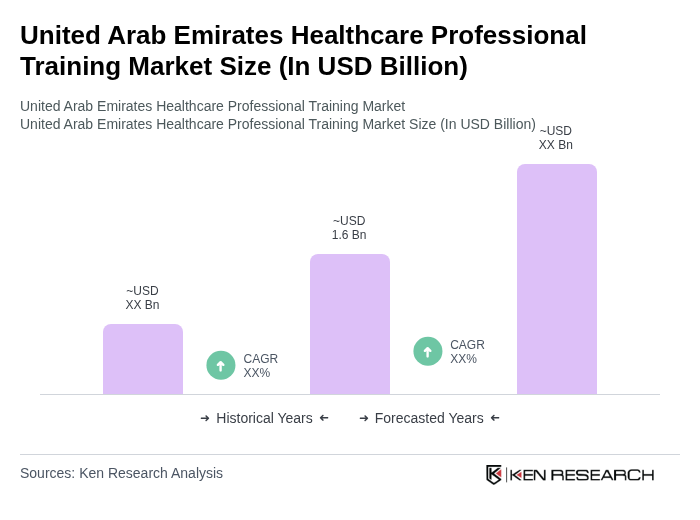
The UAE Healthcare Professional Training Market, valued at USD 1.6 billion, is growing due to rising demand for skilled staff and mandatory CPD requirements in key cities like Dubai and Abu Dhabi.

Region:Middle East

Author(s):Shubham

Product Code:KRAC5175

Pages:84

Published On:January 2026
About the Report

Base Year 2024

United Arab Emirates Healthcare Professional Training Market Overview

  • The United Arab Emirates Healthcare Professional Training Market is valued at USD 1.6 billion, based on a five-year historical analysis. This value is consistent with the rapid expansion of the UAE healthcare providers market and related education and training services, supported by strong growth in healthcare expenditure, digital health, and corporate training across the region. This growth is primarily driven by the increasing demand for skilled healthcare professionals, significant investments in hospital and clinic capacity, advancements in medical and digital health technology, and a system-wide focus on continuous professional development to meet international accreditation and quality standards.
  • Key cities dominating this market include Dubai and Abu Dhabi, which are recognized for their advanced healthcare infrastructure, high concentration of tertiary and quaternary care facilities, academic medical centers, and government-led initiatives aimed at enhancing healthcare services and medical education. These cities host flagship entities such as Dubai Academic Health Corporation, Cleveland Clinic Abu Dhabi, SEHA facilities, and major private hospital groups, attracting both local and international healthcare professionals seeking quality training, residency programs, fellowships, and continuing education.
  • In 2014, the UAE Ministry of Health and Prevention, Department of Health – Abu Dhabi, and Dubai Health Authority adopted unified continuing professional development requirements under the Continuing Professional Development (CPD) Unified Credit System, which mandate that licensed healthcare professionals obtain a specified minimum number of CPD/CME credit hours in each license renewal cycle, generally equivalent to at least 20–50 hours over a two to three?year period depending on professional category and emirate. These requirements, set out in the Unified Healthcare Professional Qualification Requirements and related CPD regulations issued by the national and emirate health authorities, ensure that healthcare providers remain current with evolving clinical guidelines, technology, and patient safety standards, thereby enhancing care quality and risk management across the system.
United Arab Emirates Healthcare Professional Training Market Size

United Arab Emirates Healthcare Professional Training Market Segmentation

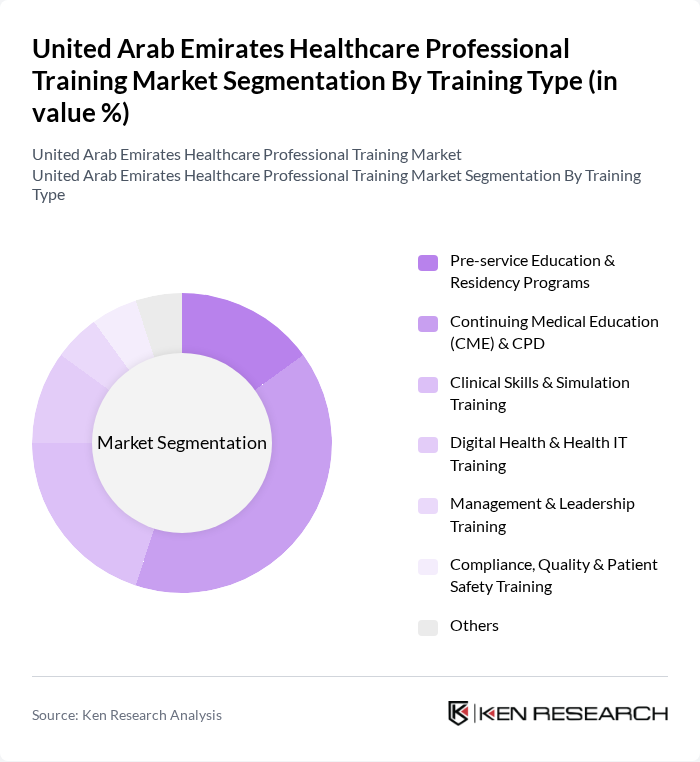
By Training Type:The training type segmentation includes various categories such as Pre-service Education & Residency Programs, Continuing Medical Education (CME) & CPD, Clinical Skills & Simulation Training, Digital Health & Health IT Training, Management & Leadership Training, Compliance, Quality & Patient Safety Training, and Others. Among these, Continuing Medical Education (CME) & CPD is the leading sub-segment, driven by mandatory CPD/CME credit requirements for license renewal, the expansion of accredited providers, and the increasing emphasis on lifelong learning, evidence-based practice, and digital learning modalities (including e-learning and virtual simulation) in the healthcare sector.
United Arab Emirates Healthcare Professional Training Market segmentation by Training Type.

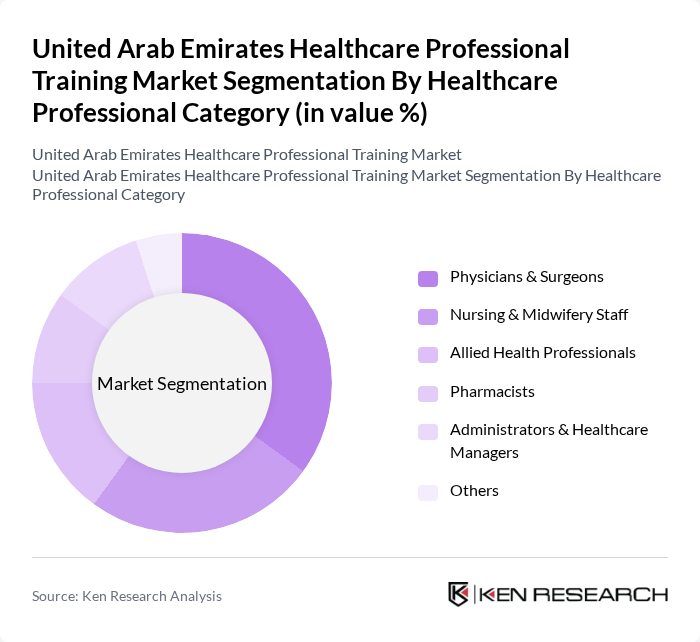
By Healthcare Professional Category:This segmentation includes Physicians & Surgeons, Nursing & Midwifery Staff, Allied Health Professionals, Pharmacists, Administrators & Healthcare Managers, and Others. The Physicians & Surgeons category dominates the market due to the high demand for specialized and subspecialty training, fellowships, and procedure?focused skill development, supported by the growth of complex tertiary and quaternary care services in the UAE. Nursing & Midwifery and Allied Health Professionals also represent significant and rapidly expanding segments, reflecting national workforce localization goals, competency frameworks, and structured professional development pathways for these roles.
United Arab Emirates Healthcare Professional Training Market segmentation by Healthcare Professional Category.

United Arab Emirates Healthcare Professional Training Market Competitive Landscape

The United Arab Emirates Healthcare Professional Training Market is characterized by a dynamic mix of regional and international players. Leading participants such as Mohammed Bin Rashid University of Medicine and Health Sciences (MBRU), Dubai Academic Health Corporation (DAHC), Gulf Medical University, University of Sharjah – College of Medicine & Health Sciences, Abu Dhabi University, Sheikh Shakhbout Medical City (SSMC), SEHA (Abu Dhabi Health Services Company), Emirates Health Services (EHS), Dubai Health Authority (DHA) – Training & Development Center, Mediclinic Middle East, NMC Healthcare, Cleveland Clinic Abu Dhabi, Aster DM Healthcare, Thumbay Healthcare & Education Group, and other emerging simulation and EdTech providers contribute to innovation, geographic expansion, interprofessional education, simulation-based training, and blended digital learning models in this space.

Mohammed Bin Rashid University of Medicine and Health Sciences (MBRU)

2014

Dubai, UAE

Dubai Academic Health Corporation (DAHC)

2021

Dubai, UAE

Gulf Medical University

1998

Ajman, UAE

University of Sharjah – College of Medicine & Health Sciences

1997

Sharjah, UAE

Abu Dhabi University

2003

Abu Dhabi, UAE

Company

Establishment Year

Headquarters

Group Size (by UAE healthcare training revenue)

3-year Revenue CAGR from Training Services

EBITDA Margin from Training & Education Business

Number of Healthcare Professionals Trained per Year

Average Revenue per Learner (ARPU)

Share of Digital / Online Training in Total Revenues

United Arab Emirates Healthcare Professional Training Market Industry Analysis

Growth Drivers

  • Increasing Demand for Skilled Healthcare Professionals:The United Arab Emirates (UAE) is experiencing a significant rise in healthcare demand, driven by a population growth rate of around 1.0% annually, with the population currently estimated at about 10 million residents. This surge necessitates a skilled workforce, with the Ministry of Health and Prevention projecting a need for an additional 20,000 healthcare professionals in the near future. The growing prevalence of chronic diseases further amplifies this demand, necessitating specialized training programs to equip professionals with necessary skills.
  • Government Initiatives to Enhance Healthcare Standards:The UAE government has committed over AED 10 billion (approximately USD 2.72 billion) to improve healthcare infrastructure and training programs in future. Initiatives such as the "UAE Vision 2021" aim to elevate healthcare standards, emphasizing the importance of continuous professional development. This investment is expected to create a robust framework for training healthcare professionals, ensuring they meet international standards and are equipped to handle emerging health challenges.
  • Technological Advancements in Training Methodologies:The integration of advanced technologies in training methodologies is transforming healthcare education in the UAE. In future, the market for e-learning in healthcare training is projected to reach AED 1.5 billion (approximately USD 408 million), driven by the adoption of online platforms and simulation-based training. These innovations enhance learning experiences, making training more accessible and effective, particularly for remote healthcare professionals who require flexible learning options.

Market Challenges

  • Limited Access to Training Resources in Remote Areas:Despite advancements, many remote areas in the UAE face significant barriers to accessing quality training resources. Approximately 30% of healthcare professionals in these regions report difficulties in obtaining necessary training due to geographical constraints. This lack of access hampers the overall skill development of healthcare workers, leading to disparities in healthcare service delivery across the nation.
  • High Costs Associated with Advanced Training Programs:The financial burden of advanced training programs poses a significant challenge for many healthcare professionals in the UAE. On average, specialized training courses can cost between AED 15,000 to AED 50,000 (USD 4,080 to USD 13,600), making them unaffordable for a substantial portion of the workforce. This financial barrier limits participation in essential training, ultimately affecting the quality of healthcare services provided.

United Arab Emirates Healthcare Professional Training Market Future Outlook

The future of the UAE healthcare professional training market appears promising, driven by ongoing government support and technological innovations. As the healthcare sector continues to expand, the demand for skilled professionals will likely increase, necessitating the development of more comprehensive training programs. Additionally, the integration of artificial intelligence and virtual reality in training methodologies is expected to enhance learning outcomes, making training more effective and engaging for healthcare professionals across the region.

Market Opportunities

  • Expansion of Online Training Platforms:The growth of online training platforms presents a significant opportunity for the UAE healthcare training market. With an estimated internet penetration rate very close to universal among the resident population, these platforms can reach a broader audience, particularly in remote areas. This accessibility can facilitate continuous learning and professional development, ultimately improving healthcare service delivery across the nation.
  • Collaboration with International Training Institutions:Collaborating with international training institutions can enhance the quality of healthcare training in the UAE. Such partnerships can provide access to global best practices and advanced training methodologies. By leveraging these collaborations, local institutions can develop specialized programs that meet international standards, thereby improving the competency of healthcare professionals in the region.

Scope of the Report

SegmentSub-Segments
By Training Type

Pre-service Education & Residency Programs

Continuing Medical Education (CME) & CPD

Clinical Skills & Simulation Training

Digital Health & Health IT Training

Management & Leadership Training

Compliance, Quality & Patient Safety Training

Others

By Healthcare Professional Category

Physicians & Surgeons

Nursing & Midwifery Staff

Allied Health Professionals

Pharmacists

Administrators & Healthcare Managers

Others

By Training Delivery Mode

Onsite / Classroom-Based Training

Online / E-Learning

Hybrid / Blended Learning

Simulation & Lab-Based Training

On-the-Job / In-situ Training

Others

By Training Sponsor

Employer-Funded (Hospitals & Providers)

Government / Regulator-Funded

Self-Paid by Professionals

Industry & Pharma-Sponsored

Others

By Certification & Accreditation

MOHAP / DOH / DHA-Accredited Programs

Internationally Accredited Programs (e.g., ACGME-I, JCI, RCSEd)

In-house Hospital & University Certifications

Non-Certified Short Courses & Workshops

Others

By Care Setting

Public Hospitals & Health Systems

Private Hospitals & Clinics

Academic Medical Centers & Universities

Primary Care & Ambulatory Centers

Telehealth & Digital Health Providers

Others

By Emirate

Abu Dhabi

Dubai

Sharjah

Ajman

Ras Al Khaimah

Fujairah & Umm Al Quwain

Key Target Audience

Investors and Venture Capitalist Firms

Government and Regulatory Bodies (e.g., Ministry of Health and Prevention, Dubai Health Authority)

Healthcare Providers and Hospitals

Medical Device Manufacturers

Pharmaceutical Companies

Healthcare Technology Companies

Professional Medical Associations

Insurance Companies

Players Mentioned in the Report:

Mohammed Bin Rashid University of Medicine and Health Sciences (MBRU)

Dubai Academic Health Corporation (DAHC)

Gulf Medical University

University of Sharjah College of Medicine & Health Sciences

Abu Dhabi University

Sheikh Shakhbout Medical City (SSMC)

SEHA (Abu Dhabi Health Services Company)

Emirates Health Services (EHS)

Dubai Health Authority (DHA) Training & Development Center

Mediclinic Middle East

NMC Healthcare

Cleveland Clinic Abu Dhabi

Aster DM Healthcare

Thumbay Healthcare & Education Group

Other Emerging Simulation & EdTech Providers

Table of Contents

Market Assessment Phase

1. Executive Summary and Approach


2. United Arab Emirates Healthcare Professional Training Market Overview

2.1 Key Insights and Strategic Recommendations

2.2 United Arab Emirates Healthcare Professional Training Market Overview

2.3 Definition and Scope

2.4 Evolution of Market Ecosystem

2.5 Timeline of Key Regulatory Milestones

2.6 Value Chain & Stakeholder Mapping

2.7 Business Cycle Analysis

2.8 Policy & Incentive Landscape


3. United Arab Emirates Healthcare Professional Training Market Analysis

3.1 Growth Drivers

3.1.1 Increasing demand for skilled healthcare professionals
3.1.2 Government initiatives to enhance healthcare standards
3.1.3 Technological advancements in training methodologies
3.1.4 Rising healthcare expenditure

3.2 Market Challenges

3.2.1 Limited access to training resources in remote areas
3.2.2 High costs associated with advanced training programs
3.2.3 Regulatory hurdles in certification processes
3.2.4 Shortage of qualified trainers

3.3 Market Opportunities

3.3.1 Expansion of online training platforms
3.3.2 Collaboration with international training institutions
3.3.3 Development of specialized training programs
3.3.4 Increased focus on continuous professional development

3.4 Market Trends

3.4.1 Growth of simulation-based training
3.4.2 Integration of AI and VR in training programs
3.4.3 Emphasis on soft skills training for healthcare professionals
3.4.4 Rise of personalized learning experiences

3.5 Government Regulation

3.5.1 Licensing requirements for healthcare trainers
3.5.2 Accreditation standards for training programs
3.5.3 Compliance with international training standards
3.5.4 Funding and grants for healthcare training initiatives

4. SWOT Analysis


5. Stakeholder Analysis


6. Porter's Five Forces Analysis


7. United Arab Emirates Healthcare Professional Training Market Market Size, 2019-2024

7.1 By Value

7.2 By Volume

7.3 By Average Selling Price


8. United Arab Emirates Healthcare Professional Training Market Segmentation

8.1 By Training Type

8.1.1 Pre-service Education & Residency Programs
8.1.2 Continuing Medical Education (CME) & CPD
8.1.3 Clinical Skills & Simulation Training
8.1.4 Digital Health & Health IT Training
8.1.5 Management & Leadership Training
8.1.6 Compliance, Quality & Patient Safety Training
8.1.7 Others

8.2 By Healthcare Professional Category

8.2.1 Physicians & Surgeons
8.2.2 Nursing & Midwifery Staff
8.2.3 Allied Health Professionals
8.2.4 Pharmacists
8.2.5 Administrators & Healthcare Managers
8.2.6 Others

8.3 By Training Delivery Mode

8.3.1 Onsite / Classroom-Based Training
8.3.2 Online / E-Learning
8.3.3 Hybrid / Blended Learning
8.3.4 Simulation & Lab-Based Training
8.3.5 On-the-Job / In-situ Training
8.3.6 Others

8.4 By Training Sponsor

8.4.1 Employer-Funded (Hospitals & Providers)
8.4.2 Government / Regulator-Funded
8.4.3 Self-Paid by Professionals
8.4.4 Industry & Pharma-Sponsored
8.4.5 Others

8.5 By Certification & Accreditation

8.5.1 MOHAP / DOH / DHA-Accredited Programs
8.5.2 Internationally Accredited Programs (e.g., ACGME-I, JCI, RCSEd)
8.5.3 In-house Hospital & University Certifications
8.5.4 Non-Certified Short Courses & Workshops
8.5.5 Others

8.6 By Care Setting

8.6.1 Public Hospitals & Health Systems
8.6.2 Private Hospitals & Clinics
8.6.3 Academic Medical Centers & Universities
8.6.4 Primary Care & Ambulatory Centers
8.6.5 Telehealth & Digital Health Providers
8.6.6 Others

8.7 By Emirate

8.7.1 Abu Dhabi
8.7.2 Dubai
8.7.3 Sharjah
8.7.4 Ajman
8.7.5 Ras Al Khaimah
8.7.6 Fujairah & Umm Al Quwain

9. United Arab Emirates Healthcare Professional Training Market Competitive Analysis

9.1 Market Share of Key Players

9.2 Cross Comparison of Key Players

9.2.1 Company Name
9.2.2 Group Size (by UAE healthcare training revenue)
9.2.3 3-year Revenue CAGR from Training Services
9.2.4 EBITDA Margin from Training & Education Business
9.2.5 Number of Healthcare Professionals Trained per Year
9.2.6 Average Revenue per Learner (ARPU)
9.2.7 Share of Digital / Online Training in Total Revenues
9.2.8 Customer Retention / Renewal Rate
9.2.9 Number of Accredited Programs (Local & International)
9.2.10 Average Contract Tenure with Key Institutional Clients

9.3 SWOT Analysis of Top Players

9.4 Pricing Analysis

9.5 Detailed Profile of Major Companies

9.5.1 Mohammed Bin Rashid University of Medicine and Health Sciences (MBRU)
9.5.2 Dubai Academic Health Corporation (DAHC)
9.5.3 Gulf Medical University
9.5.4 University of Sharjah – College of Medicine & Health Sciences
9.5.5 Abu Dhabi University
9.5.6 Sheikh Shakhbout Medical City (SSMC)
9.5.7 SEHA (Abu Dhabi Health Services Company)
9.5.8 Emirates Health Services (EHS)
9.5.9 Dubai Health Authority (DHA) – Training & Development Center
9.5.10 Mediclinic Middle East
9.5.11 NMC Healthcare
9.5.12 Cleveland Clinic Abu Dhabi
9.5.13 Aster DM Healthcare
9.5.14 Thumbay Healthcare & Education Group
9.5.15 Other Emerging Simulation & EdTech Providers

10. United Arab Emirates Healthcare Professional Training Market End-User Analysis

10.1 Procurement Behavior of Key Ministries

10.1.1 Ministry of Health and Prevention
10.1.2 Ministry of Education
10.1.3 Ministry of Finance
10.1.4 Others

10.2 Corporate Spend on Infrastructure & Energy

10.2.1 Healthcare Infrastructure Investments
10.2.2 Training Facility Upgrades
10.2.3 Technology Integration Costs
10.2.4 Others

10.3 Pain Point Analysis by End-User Category

10.3.1 Hospitals
10.3.2 Clinics
10.3.3 Educational Institutions
10.3.4 Government Bodies
10.3.5 Others

10.4 User Readiness for Adoption

10.4.1 Awareness of Training Programs
10.4.2 Willingness to Invest in Training
10.4.3 Availability of Resources
10.4.4 Others

10.5 Post-Deployment ROI and Use Case Expansion

10.5.1 Measurement of Training Effectiveness
10.5.2 Long-term Benefits of Training
10.5.3 Opportunities for Upskilling
10.5.4 Others

11. United Arab Emirates Healthcare Professional Training Market Future Size, 2025-2030

11.1 By Value

11.2 By Volume

11.3 By Average Selling Price


Go-To-Market Strategy Phase

1. Whitespace Analysis + Business Model Canvas

1.1 Market Gaps Identification

1.2 Business Model Development


2. Marketing and Positioning Recommendations

2.1 Branding Strategies

2.2 Product USPs


3. Distribution Plan

3.1 Urban Retail vs Rural NGO Tie-ups


4. Channel & Pricing Gaps

4.1 Underserved Routes

4.2 Pricing Bands


5. Unmet Demand & Latent Needs

5.1 Category Gaps

5.2 Consumer Segments


6. Customer Relationship

6.1 Loyalty Programs

6.2 After-sales Service


7. Value Proposition

7.1 Sustainability

7.2 Integrated Supply Chains


8. Key Activities

8.1 Regulatory Compliance

8.2 Branding

8.3 Distribution Setup


9. Entry Strategy Evaluation

9.1 Domestic Market Entry Strategy

9.1.1 Product Mix
9.1.2 Pricing Band
9.1.3 Packaging

9.2 Export Entry Strategy

9.2.1 Target Countries
9.2.2 Compliance Roadmap

10. Entry Mode Assessment

10.1 JV

10.2 Greenfield

10.3 M&A

10.4 Distributor Model


11. Capital and Timeline Estimation

11.1 Capital Requirements

11.2 Timelines


12. Control vs Risk Trade-Off

12.1 Ownership vs Partnerships


13. Profitability Outlook

13.1 Breakeven Analysis

13.2 Long-term Sustainability


14. Potential Partner List

14.1 Distributors

14.2 JVs

14.3 Acquisition Targets


15. Execution Roadmap

15.1 Phased Plan for Market Entry

15.1.1 Market Setup
15.1.2 Market Entry
15.1.3 Growth Acceleration
15.1.4 Scale & Stabilize

15.2 Key Activities and Milestones

15.2.1 Milestone Planning
15.2.2 Activity Tracking

Research Methodology

ApproachModellingSample

Phase 1: Approach1

Desk Research

  • Analysis of government healthcare reports and statistics from the UAE Ministry of Health and Prevention
  • Review of industry publications and white papers from healthcare associations in the UAE
  • Examination of market trends and forecasts from reputable healthcare market research firms

Primary Research

  • Interviews with healthcare training providers and educational institutions in the UAE
  • Surveys with healthcare professionals regarding their training needs and preferences
  • Focus groups with hospital administrators to understand training program effectiveness

Validation & Triangulation

  • Cross-validation of findings through multiple data sources, including government and private sector reports
  • Triangulation of qualitative insights from interviews with quantitative data from surveys
  • Sanity checks through expert panel reviews consisting of healthcare educators and policymakers

Phase 2: Market Size Estimation1

Top-down Assessment

  • Estimation of total healthcare expenditure in the UAE and its allocation to training and development
  • Analysis of the growth rate of healthcare professionals and corresponding training needs
  • Incorporation of government initiatives aimed at enhancing healthcare workforce capabilities

Bottom-up Modeling

  • Data collection on training program enrollment figures from leading healthcare training institutions
  • Cost analysis of various training programs offered across different healthcare sectors
  • Volume x cost basis for estimating total market value of healthcare professional training

Forecasting & Scenario Analysis

  • Multi-factor regression analysis considering population growth, healthcare demand, and policy changes
  • Scenario modeling based on potential shifts in healthcare regulations and funding
  • Baseline, optimistic, and pessimistic projections for the healthcare training market through 2030

Phase 3: CATI Sample Composition1

Scope Item/SegmentSample SizeTarget Respondent Profiles
Healthcare Training Providers60Training Program Directors, Curriculum Developers
Healthcare Professionals120Nurses, Physicians, Allied Health Professionals
Hospital Administrators50HR Managers, Training Coordinators
Regulatory Bodies40Policy Makers, Compliance Officers
Healthcare Educators70University Professors, Training Facilitators

Frequently Asked Questions

What is the current value of the UAE Healthcare Professional Training Market?

The UAE Healthcare Professional Training Market is valued at approximately USD 1.6 billion, reflecting significant growth driven by increasing healthcare expenditure, demand for skilled professionals, and advancements in medical technology and training methodologies.

What factors are driving the growth of the UAE Healthcare Professional Training Market?

Which cities are the main hubs for healthcare professional training in the UAE?

What are the continuing professional development (CPD) requirements for healthcare professionals in the UAE?

Why Buy From Us?

Refine Robust Result (RRR) Framework

What makes us stand out is that our consultants follow Robust, Refine and Result (RRR) methodology. Robust for clear definitions, approaches and sanity checking, Refine for differentiating respondents' facts and opinions, and Result for presenting data with story.

Our Reach Is Unmatched

We have set a benchmark in the industry by offering our clients with syndicated and customized market research reports featuring coverage of entire market as well as meticulous research and analyst insights.

Shifting the Research Paradigm

While we don't replace traditional research, we flip the method upside down. Our dual approach of Top Bottom & Bottom Top ensures quality deliverable by not just verifying company fundamentals but also looking at the sector and macroeconomic factors.

More Insights-Better Decisions

With one step in the future, our research team constantly tries to show you the bigger picture. We help with some of the tough questions you may encounter along the way: How is the industry positioned? Best marketing channel? KPI's of competitors? By aligning every element, we help maximize success.

Transparency and Trust

Our report gives you instant access to the answers and sources that other companies might choose to hide. We elaborate each steps of research methodology we have used and showcase you the sample size to earn your trust.

Round the Clock Support

If you need any support, we are here! We pride ourselves on universe strength, data quality, and quick, friendly, and professional service.

Why Clients Choose Us?

400000+
Reports in repository
150+
Consulting projects a year
100+
Analysts
8000+
Client Queries in 2022








