United Arab Emirates Self Healing Grids Market Report Size Share Growth Drivers Trends Opportunities & Forecast 2025–2030

UAE Self Healing Grids Market reaches USD 90 Mn, fueled by demand for reliable energy, IoT/AI tech, and renewable sources, with solar leading and residential growth.

Region:Middle East

Author(s):Rebecca

Product Code:KRAA6475

Pages:82

Published On:January 2026
About the Report

Base Year 2024

United Arab Emirates Self Healing Grids Market Overview

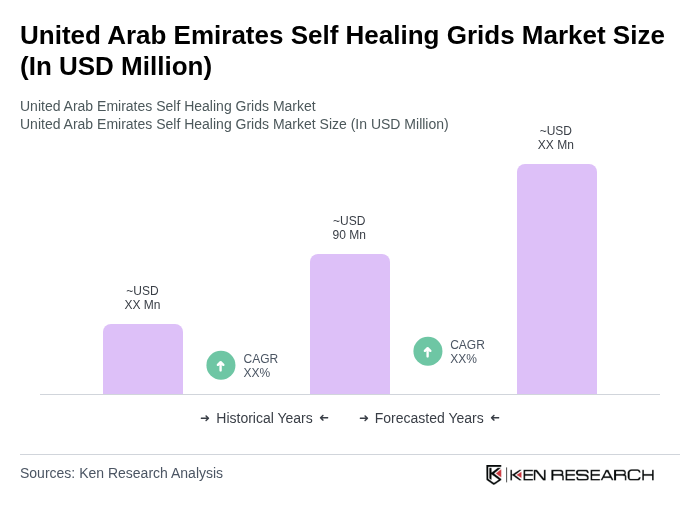
  • The United Arab Emirates Self Healing Grids Market is valued at USD 90 million, based on a five-year historical analysis. This growth is primarily driven by the increasing demand for reliable and efficient energy distribution systems, coupled with the government's commitment to enhancing energy security and sustainability, including renewable energy integration and grid modernization initiatives. The integration of advanced technologies such as IoT, AI, machine learning, and advanced metering infrastructure in grid management has further propelled market expansion.
  • Key players in this market include Abu Dhabi Distribution Company, Dubai Electricity and Water Authority, and Sharjah Electricity and Water Authority. These entities dominate the market due to their extensive infrastructure, government backing, and innovative approaches to energy management, which have established them as leaders in the self-healing grid technology landscape.
  • The Federal Electricity and Water Authority (FEWA) Distribution Network Standards and Guidelines, 2022 issued by the UAE Ministry of Energy and Infrastructure, establish requirements for smart grid deployment including self-healing capabilities, mandating fault detection sensors, automated reconfiguration thresholds above 99.9% uptime, and compliance certification for utilities handling over 10 MW loads to ensure network resilience.
United Arab Emirates Self Healing Grids Market Size

United Arab Emirates Self Healing Grids Market Segmentation

By Type:

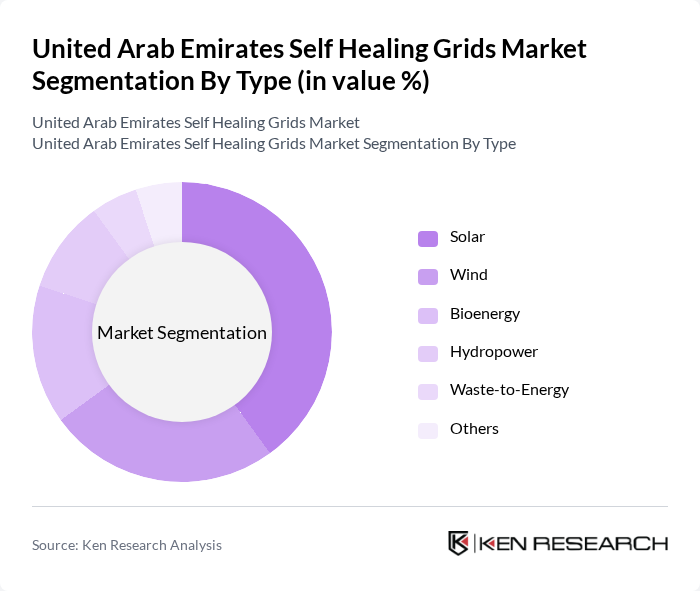
United Arab Emirates Self Healing Grids Market segmentation by Type.

The solar segment is the dominant player in the market, driven by the UAE's abundant sunlight and government incentives promoting renewable energy. The increasing installation of solar panels in residential and commercial sectors has significantly contributed to this growth. Additionally, advancements in solar technology and decreasing costs have made solar energy more accessible, further solidifying its leading position in the self-healing grids market.

By End-User:
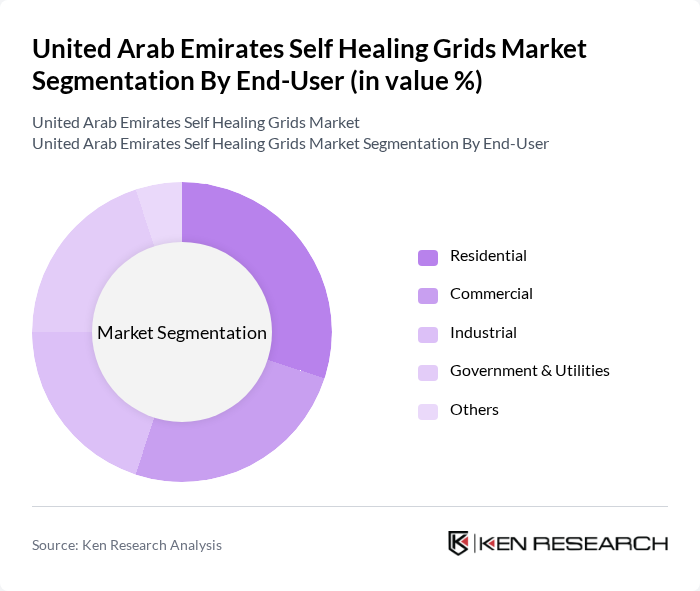
United Arab Emirates Self Healing Grids Market segmentation by End-User.

The residential segment is witnessing significant growth due to increasing consumer awareness regarding energy efficiency and sustainability. Homeowners are increasingly investing in self-healing grid technologies to enhance energy reliability and reduce costs. The trend towards smart homes and the integration of renewable energy sources are also driving the demand in this segment, making it a key player in the overall market.

United Arab Emirates Self Healing Grids Market Competitive Landscape

The United Arab Emirates Self Healing Grids Market is characterized by a dynamic mix of regional and international players. Leading participants such as Siemens AG, Schneider Electric, ABB Ltd., General Electric, Honeywell International Inc., Mitsubishi Electric Corporation, Eaton Corporation, Cisco Systems, Inc., Oracle Corporation, Enel X, First Solar, Inc., NextEra Energy, Inc., Vestas Wind Systems A/S, Canadian Solar Inc., Tesla, Inc. contribute to innovation, geographic expansion, and service delivery in this space.

Siemens AG

1847

Munich, Germany

Schneider Electric

1836

Rueil-Malmaison, France

ABB Ltd.

1988

Zurich, Switzerland

General Electric

1892

Boston, Massachusetts, USA

Honeywell International Inc.

1999

Charlotte, North Carolina, USA

Company

Establishment Year

Headquarters

Group Size (Large, Medium, or Small as per industry convention)

Revenue Growth Rate

Market Penetration Rate

Customer Retention Rate

Pricing Strategy

Operational Efficiency

United Arab Emirates Self Healing Grids Market Industry Analysis

Growth Drivers

  • Increasing Demand for Renewable Energy Sources:The United Arab Emirates (UAE) has set ambitious targets to generate 50% of its energy from renewable sources by 2050, translating to approximately 44 gigawatts (GW) of renewable capacity. This shift is driven by the UAE's commitment to sustainability and reducing carbon emissions, with investments in solar and wind energy expected to exceed AED 600 billion (USD 163 billion) in future. Such initiatives are propelling the adoption of self-healing grid technologies to manage renewable energy efficiently.
  • Government Initiatives Promoting Smart Grid Technologies:The UAE government has launched several initiatives, including the Smart Dubai initiative, which aims to transform Dubai into a smart city in future. This includes investments of over AED 7 billion (USD 1.9 billion) in smart grid technologies. The UAE's Energy Strategy 2050 also emphasizes the integration of smart grids, which is expected to enhance energy efficiency by 40% and reduce carbon emissions by 70%, driving the self-healing grid market forward.
  • Rising Investments in Infrastructure Development:The UAE is investing heavily in infrastructure, with a projected AED 1 trillion (USD 272 billion) earmarked for various projects in future. This includes the development of energy infrastructure, which is crucial for the implementation of self-healing grids. The UAE's focus on modernizing its energy infrastructure is expected to create a conducive environment for the adoption of advanced grid technologies, enhancing reliability and efficiency in energy distribution.

Market Challenges

  • High Initial Investment Costs:The implementation of self-healing grid technologies requires significant upfront capital investment, often exceeding AED 1 billion (USD 272 million) for large-scale projects. This financial barrier can deter utility companies from adopting these technologies, especially in a market where traditional energy sources remain cheaper. The high costs associated with advanced grid infrastructure can limit the pace of adoption and hinder market growth in the UAE.
  • Limited Awareness Among Consumers:Despite the benefits of self-healing grids, there is a notable lack of awareness among consumers regarding their advantages. A survey conducted by the UAE Ministry of Energy revealed that only 30% of consumers understand the concept of smart grids. This limited awareness can lead to resistance to change and slow adoption rates, posing a challenge for utility companies aiming to implement these advanced technologies effectively.

United Arab Emirates Self Healing Grids Market Future Outlook

The future of the self-healing grids market in the UAE appears promising, driven by ongoing technological advancements and government support. As the integration of IoT and AI technologies becomes more prevalent, grid management will become increasingly efficient. Additionally, the push for sustainability and energy efficiency will likely lead to greater investments in smart grid infrastructure. The UAE's commitment to renewable energy and smart city initiatives will further enhance the market's growth potential, creating a robust framework for self-healing grid technologies.

Market Opportunities

  • Expansion of Smart City Projects:The UAE's ongoing smart city initiatives present significant opportunities for self-healing grid technologies. With over AED 50 billion (USD 13.6 billion) allocated for smart city projects, the integration of advanced grid systems can enhance energy management and sustainability, positioning the UAE as a leader in smart energy solutions.
  • Collaborations with Technology Providers:Partnerships between utility companies and technology providers can drive innovation in self-healing grid solutions. By leveraging expertise from global technology firms, the UAE can enhance its grid management capabilities, leading to improved reliability and efficiency in energy distribution, ultimately benefiting consumers and businesses alike.

Scope of the Report

SegmentSub-Segments
By Type (e.g., Solar, Wind, Bioenergy, Hydropower, Waste-to-Energy)

Solar

Wind

Bioenergy

Hydropower

Waste-to-Energy

Others

By End-User (Residential, Commercial, Industrial, Government & Utilities)

Residential

Commercial

Industrial

Government & Utilities

Others

By Region (Emirate of Abu Dhabi, Emirate of Dubai, Emirate of Sharjah, Emirate of Ajman, Emirate of Umm Al-Quwain, Emirate of Fujairah, Emirate of Ras Al Khaimah)

Emirate of Abu Dhabi

Emirate of Dubai

Emirate of Sharjah

Emirate of Ajman

Emirate of Umm Al-Quwain

Emirate of Fujairah

Emirate of Ras Al Khaimah

By Technology (Photovoltaic, CSP, Onshore/Offshore Wind, Biomass Gasification)

Photovoltaic

CSP

Onshore Wind

Offshore Wind

Biomass Gasification

Others

By Application (Grid-Connected, Off-Grid, Rooftop Installations, Utility-Scale Projects)

Grid-Connected

Off-Grid

Rooftop Installations

Utility-Scale Projects

Others

By Investment Source (Domestic, FDI, PPP, Government Schemes)

Domestic

FDI

PPP

Government Schemes

Others

By Policy Support (Subsidies, Tax Exemptions, RECs)

Subsidies

Tax Exemptions

RECs

Others

Key Target Audience

Investors and Venture Capitalist Firms

Government and Regulatory Bodies (e.g., Ministry of Energy and Infrastructure, Federal Authority for Electricity and Water)

Manufacturers and Producers of Self Healing Grid Technologies

Utility Companies and Service Providers

Energy Management Firms

Smart Grid Technology Developers

Industry Associations (e.g., UAE Electricity and Water Authority)

Financial Institutions and Funding Agencies

Players Mentioned in the Report:

Siemens AG

Schneider Electric

ABB Ltd.

General Electric

Honeywell International Inc.

Mitsubishi Electric Corporation

Eaton Corporation

Cisco Systems, Inc.

Oracle Corporation

Enel X

First Solar, Inc.

NextEra Energy, Inc.

Vestas Wind Systems A/S

Canadian Solar Inc.

Tesla, Inc.

Table of Contents

Market Assessment Phase

1. Executive Summary and Approach


2. United Arab Emirates Self Healing Grids Market Overview

2.1 Key Insights and Strategic Recommendations

2.2 United Arab Emirates Self Healing Grids Market Overview

2.3 Definition and Scope

2.4 Evolution of Market Ecosystem

2.5 Timeline of Key Regulatory Milestones

2.6 Value Chain & Stakeholder Mapping

2.7 Business Cycle Analysis

2.8 Policy & Incentive Landscape


3. United Arab Emirates Self Healing Grids Market Analysis

3.1 Growth Drivers

3.1.1 Increasing demand for renewable energy sources
3.1.2 Government initiatives promoting smart grid technologies
3.1.3 Rising investments in infrastructure development
3.1.4 Technological advancements in grid management

3.2 Market Challenges

3.2.1 High initial investment costs
3.2.2 Limited awareness among consumers
3.2.3 Regulatory hurdles and compliance issues
3.2.4 Competition from traditional energy sources

3.3 Market Opportunities

3.3.1 Expansion of smart city projects
3.3.2 Collaborations with technology providers
3.3.3 Development of innovative financing models
3.3.4 Growing interest in sustainability and energy efficiency

3.4 Market Trends

3.4.1 Increasing integration of IoT in grid management
3.4.2 Shift towards decentralized energy systems
3.4.3 Enhanced focus on cybersecurity in energy infrastructure
3.4.4 Adoption of AI and machine learning for predictive maintenance

3.5 Government Regulation

3.5.1 Renewable Energy Law
3.5.2 Smart Grid Policy Framework
3.5.3 Energy Efficiency Standards
3.5.4 Environmental Protection Regulations

4. SWOT Analysis


5. Stakeholder Analysis


6. Porter's Five Forces Analysis


7. United Arab Emirates Self Healing Grids Market Market Size, 2019-2024

7.1 By Value

7.2 By Volume

7.3 By Average Selling Price


8. United Arab Emirates Self Healing Grids Market Segmentation

8.1 By Type (e.g., Solar, Wind, Bioenergy, Hydropower, Waste-to-Energy)

8.1.1 Solar
8.1.2 Wind
8.1.3 Bioenergy
8.1.4 Hydropower
8.1.5 Waste-to-Energy
8.1.6 Others

8.2 By End-User (Residential, Commercial, Industrial, Government & Utilities)

8.2.1 Residential
8.2.2 Commercial
8.2.3 Industrial
8.2.4 Government & Utilities
8.2.5 Others

8.3 By Region (Emirate of Abu Dhabi, Emirate of Dubai, Emirate of Sharjah, Emirate of Ajman, Emirate of Umm Al-Quwain, Emirate of Fujairah, Emirate of Ras Al Khaimah)

8.3.1 Emirate of Abu Dhabi
8.3.2 Emirate of Dubai
8.3.3 Emirate of Sharjah
8.3.4 Emirate of Ajman
8.3.5 Emirate of Umm Al-Quwain
8.3.6 Emirate of Fujairah
8.3.7 Emirate of Ras Al Khaimah

8.4 By Technology (Photovoltaic, CSP, Onshore/Offshore Wind, Biomass Gasification)

8.4.1 Photovoltaic
8.4.2 CSP
8.4.3 Onshore Wind
8.4.4 Offshore Wind
8.4.5 Biomass Gasification
8.4.6 Others

8.5 By Application (Grid-Connected, Off-Grid, Rooftop Installations, Utility-Scale Projects)

8.5.1 Grid-Connected
8.5.2 Off-Grid
8.5.3 Rooftop Installations
8.5.4 Utility-Scale Projects
8.5.5 Others

8.6 By Investment Source (Domestic, FDI, PPP, Government Schemes)

8.6.1 Domestic
8.6.2 FDI
8.6.3 PPP
8.6.4 Government Schemes
8.6.5 Others

8.7 By Policy Support (Subsidies, Tax Exemptions, RECs)

8.7.1 Subsidies
8.7.2 Tax Exemptions
8.7.3 RECs
8.7.4 Others

9. United Arab Emirates Self Healing Grids Market Competitive Analysis

9.1 Market Share of Key Players(Micro, Small, Medium, Large Enterprises)

9.2 Cross Comparison of Key Players

9.2.1 Company Name
9.2.2 Group Size (Large, Medium, or Small as per industry convention)
9.2.3 Revenue Growth Rate
9.2.4 Market Penetration Rate
9.2.5 Customer Retention Rate
9.2.6 Pricing Strategy
9.2.7 Operational Efficiency
9.2.8 Innovation Rate
9.2.9 Brand Recognition
9.2.10 Customer Satisfaction Score

9.3 SWOT Analysis of Top Players

9.4 Pricing Analysis(By Class and Payload)

9.5 Detailed Profile of Major Companies

9.5.1 Siemens AG
9.5.2 Schneider Electric
9.5.3 ABB Ltd.
9.5.4 General Electric
9.5.5 Honeywell International Inc.
9.5.6 Mitsubishi Electric Corporation
9.5.7 Eaton Corporation
9.5.8 Cisco Systems, Inc.
9.5.9 Oracle Corporation
9.5.10 Enel X
9.5.11 First Solar, Inc.
9.5.12 NextEra Energy, Inc.
9.5.13 Vestas Wind Systems A/S
9.5.14 Canadian Solar Inc.
9.5.15 Tesla, Inc.

10. United Arab Emirates Self Healing Grids Market End-User Analysis

10.1 Procurement Behavior of Key Ministries

10.1.1 Ministry of Energy and Infrastructure
10.1.2 Ministry of Climate Change and Environment
10.1.3 Ministry of Finance
10.1.4 Ministry of Industry and Advanced Technology

10.2 Corporate Spend on Infrastructure & Energy

10.2.1 Corporate Investments in Renewable Energy
10.2.2 Budget Allocations for Smart Grid Projects
10.2.3 Partnerships with Private Sector
10.2.4 Funding from International Organizations

10.3 Pain Point Analysis by End-User Category

10.3.1 Residential Users
10.3.2 Commercial Users
10.3.3 Industrial Users
10.3.4 Government Entities

10.4 User Readiness for Adoption

10.4.1 Awareness of Self Healing Grids
10.4.2 Training and Support Needs
10.4.3 Financial Readiness
10.4.4 Technological Infrastructure

10.5 Post-Deployment ROI and Use Case Expansion

10.5.1 Measurement of Energy Savings
10.5.2 Expansion into New Applications
10.5.3 Long-term Maintenance Costs
10.5.4 User Feedback and Improvement

11. United Arab Emirates Self Healing Grids Market Future Size, 2025-2030

11.1 By Value

11.2 By Volume

11.3 By Average Selling Price


Go-To-Market Strategy Phase

1. Whitespace Analysis + Business Model Canvas

1.1 Market Gaps Identification

1.2 Business Model Development


2. Marketing and Positioning Recommendations(Branding strategies, Product USPs)

2.1 Branding Strategies

2.2 Product USPs


3. Distribution Plan(Urban retail vs rural NGO tie-ups)

3.1 Urban Distribution Strategies

3.2 Rural Distribution Strategies


4. Channel & Pricing Gaps(Underserved routes, Pricing bands)

4.1 Channel Analysis

4.2 Pricing Strategy Development


5. Unmet Demand & Latent Needs(Category gaps, Consumer segments)

5.1 Identification of Unmet Needs

5.2 Consumer Segmentation Analysis


6. Customer Relationship(Loyalty programs, After-sales service)

6.1 Loyalty Program Development

6.2 After-sales Service Strategies


7. Value Proposition(Sustainability, Integrated supply chains)

7.1 Sustainability Initiatives

7.2 Supply Chain Integration


8. Key Activities(Regulatory compliance, Branding, Distribution setup)

8.1 Regulatory Compliance Activities

8.2 Branding Activities

8.3 Distribution Setup Activities


9. Entry Strategy Evaluation

9.1 Domestic Market Entry Strategy(Product mix, Pricing band, Packaging)

9.1.1 Product Mix Considerations
9.1.2 Pricing Band Analysis
9.1.3 Packaging Strategies

9.2 Export Entry Strategy(Target countries, Compliance roadmap)

9.2.1 Target Country Selection
9.2.2 Compliance Roadmap Development

10. Entry Mode Assessment(JV, Greenfield, M&A, Distributor Model)

10.1 Joint Ventures

10.2 Greenfield Investments

10.3 Mergers & Acquisitions

10.4 Distributor Models


11. Capital and Timeline Estimation (Capital requirements, Timelines)

11.1 Capital Requirements Analysis

11.2 Timeline Development


12. Control vs Risk Trade-Off (Ownership vs Partnerships)

12.1 Ownership Considerations

12.2 Partnership Considerations


13. Profitability Outlook (Breakeven analysis, Long-term sustainability)

13.1 Breakeven Analysis

13.2 Long-term Sustainability Strategies


14. Potential Partner List (Distributors, JVs, Acquisition targets)

14.1 Distributor Identification

14.2 Joint Venture Opportunities

14.3 Acquisition Targets


15. Execution Roadmap

15.1 Phased Plan for Market Entry (Market Setup ? Market Entry ? Growth Acceleration ? Scale & Stabilize)

15.1.1 Market Setup Activities
15.1.2 Market Entry Activities
15.1.3 Growth Acceleration Activities
15.1.4 Scale & Stabilize Activities

15.2 Key Activities and Milestones

15.2.1 Milestone Identification
15.2.2 Activity Scheduling

Research Methodology

ApproachModellingSample

Phase 1: Approach1

Desk Research

  • Analysis of market reports from industry associations and government publications
  • Review of academic journals and white papers on self-healing technologies
  • Examination of trade publications and news articles related to the UAE self-healing grids market

Primary Research

  • Interviews with industry experts and thought leaders in renewable energy and smart grid technologies
  • Surveys conducted with utility companies and energy providers in the UAE
  • Field interviews with engineers and project managers involved in self-healing grid implementations

Validation & Triangulation

  • Cross-validation of findings through multiple data sources including market reports and expert opinions
  • Triangulation of quantitative data with qualitative insights from interviews
  • Sanity checks through feedback from a panel of industry experts

Phase 2: Market Size Estimation1

Top-down Assessment

  • Estimation of market size based on national energy consumption and grid infrastructure investments
  • Segmentation of the market by application areas such as residential, commercial, and industrial
  • Incorporation of government initiatives and policies promoting smart grid technologies

Bottom-up Modeling

  • Collection of data on installed capacity and projected growth rates from key stakeholders
  • Cost analysis of self-healing grid technologies and their implementation
  • Volume estimates based on the number of projects and average project size in the UAE

Forecasting & Scenario Analysis

  • Development of forecasting models using historical data and market trends
  • Scenario analysis based on potential regulatory changes and technological advancements
  • Creation of baseline, optimistic, and pessimistic forecasts through 2030

Phase 3: CATI Sample Composition1

Scope Item/SegmentSample SizeTarget Respondent Profiles
Utility Companies120Grid Managers, Operations Directors
Energy Technology Providers90Product Development Managers, Sales Executives
Government Regulatory Bodies40Policy Makers, Regulatory Affairs Specialists
Research Institutions50Research Analysts, Academic Researchers
Consulting Firms60Energy Consultants, Market Analysts

Frequently Asked Questions

What is the current value of the United Arab Emirates Self Healing Grids Market?

The United Arab Emirates Self Healing Grids Market is valued at approximately USD 90 million, reflecting a five-year historical analysis that highlights the growing demand for efficient energy distribution systems and government initiatives aimed at enhancing energy security and sustainability.

What are the key drivers of growth in the UAE Self Healing Grids Market?

Who are the major players in the UAE Self Healing Grids Market?

What challenges does the UAE Self Healing Grids Market face?

Why Buy From Us?

Refine Robust Result (RRR) Framework

What makes us stand out is that our consultants follow Robust, Refine and Result (RRR) methodology. Robust for clear definitions, approaches and sanity checking, Refine for differentiating respondents' facts and opinions, and Result for presenting data with story.

Our Reach Is Unmatched

We have set a benchmark in the industry by offering our clients with syndicated and customized market research reports featuring coverage of entire market as well as meticulous research and analyst insights.

Shifting the Research Paradigm

While we don't replace traditional research, we flip the method upside down. Our dual approach of Top Bottom & Bottom Top ensures quality deliverable by not just verifying company fundamentals but also looking at the sector and macroeconomic factors.

More Insights-Better Decisions

With one step in the future, our research team constantly tries to show you the bigger picture. We help with some of the tough questions you may encounter along the way: How is the industry positioned? Best marketing channel? KPI's of competitors? By aligning every element, we help maximize success.

Transparency and Trust

Our report gives you instant access to the answers and sources that other companies might choose to hide. We elaborate each steps of research methodology we have used and showcase you the sample size to earn your trust.

Round the Clock Support

If you need any support, we are here! We pride ourselves on universe strength, data quality, and quick, friendly, and professional service.

Why Clients Choose Us?

400000+
Reports in repository
150+
Consulting projects a year
100+
Analysts
8000+
Client Queries in 2022