About the Report
Base Year 2024US Fibers Specialty Carbohydrates Market Overview
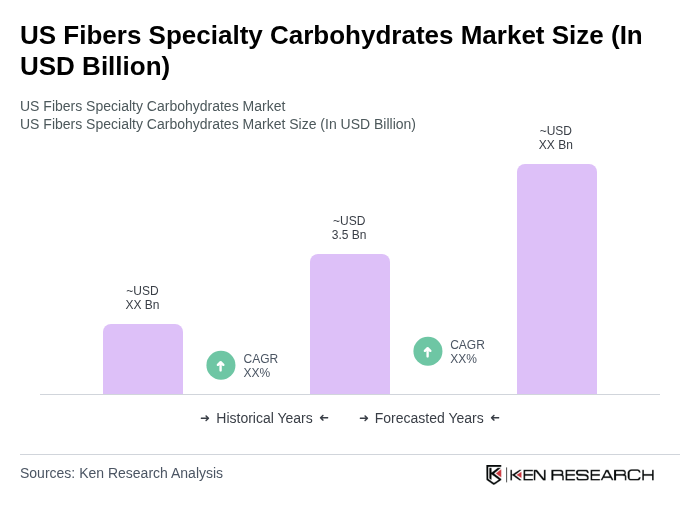
- The US Fibers Specialty Carbohydrates Market is valued at USD 3.5 billion, based on a five-year historical analysis. Recent assessments indicate that the United States fiber and specialty carbohydrates market generated revenue of about USD 3.49 billion, with growth underpinned by rising consumption of functional foods, dietary supplements, and fiber-fortified products. This growth is primarily driven by the increasing consumer demand for health and wellness products, as well as the rising awareness of dietary fibers' benefits in managing health conditions such as obesity, diabetes, and cardiovascular risk, along with benefits for satiety and weight management. The market is also supported by innovations in product formulations that enhance the functional properties of fibers in food and beverages, including clean-label, plant-based, and low-sugar formulations, as well as integration into sports nutrition, medical nutrition, and fortified bakery and beverage applications.
- Key hubs for this market include major metropolitan areas such as New York, Chicago, and Los Angeles, which serve as centers for food and beverage innovation and commercialization. These cities play a leading role due to their large and diverse consumer bases, access to extensive retail and foodservice channels, proximity to R&D centers and universities, and the presence of leading food manufacturers, ingredient companies, and start-ups that drive product development and market trends.
- In the United States, regulatory momentum around labeling and fiber content continues to shape the market. The Food Labeling Modernization Act of 2021, introduced in Congress and overseen in coordination with the US Food and Drug Administration (FDA), seeks to mandate clearer and more prominent labeling of key nutrition attributes, including dietary fiber, on packaged foods to improve consumer understanding and support healthier choices. In parallel, the FDA’s rules on the declaration of dietary fiber in the Nutrition Facts label, established through the “Food Labeling: Revision of the Nutrition and Supplement Facts Labels” final rule issued by the US Food and Drug Administration in 2016, define which isolated or synthetic non-digestible carbohydrates can be counted as dietary fiber and require manufacturers to substantiate physiological benefits such as improved glycemic control, cholesterol reduction, or laxation. These measures collectively aim to enhance transparency on fiber content, align product development with recognized health outcomes, and promote consumption of fiber-rich and specialty carbohydrate-containing foods.
US Fibers Specialty Carbohydrates Market Segmentation
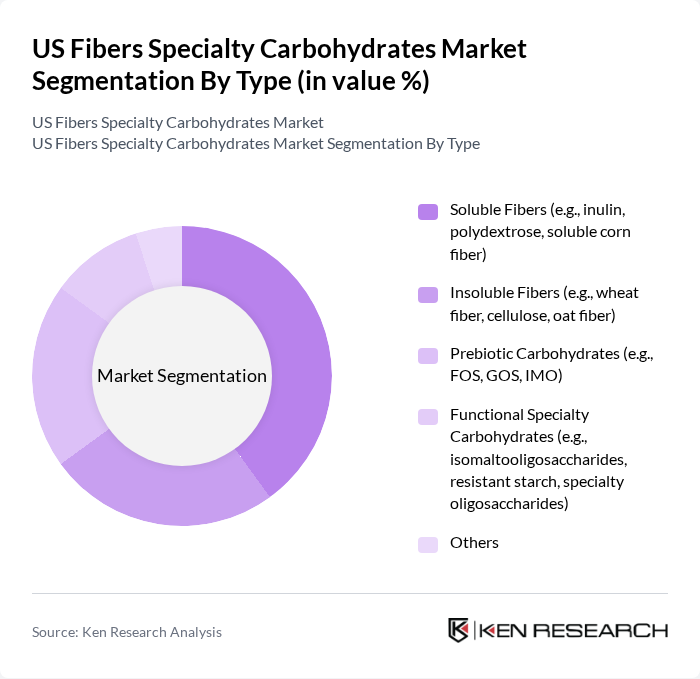
By Type:The market is segmented into various types of fibers specialty carbohydrates, including soluble fibers, insoluble fibers, prebiotic carbohydrates, functional specialty carbohydrates, and others. Among these, soluble fibers, such as inulin and polydextrose, are gaining significant traction due to their health benefits, including improved gut health, support for beneficial microbiota, cholesterol management, and modulation of blood sugar responses. The demand for prebiotic carbohydrates is also on the rise, driven by increasing consumer awareness of gut health, immune support, and the role of prebiotics (such as FOS, GOS, and inulin-type fructans) in supporting digestive health and overall well-being, as well as their incorporation into functional foods, beverages, dietary supplements, and infant nutrition.
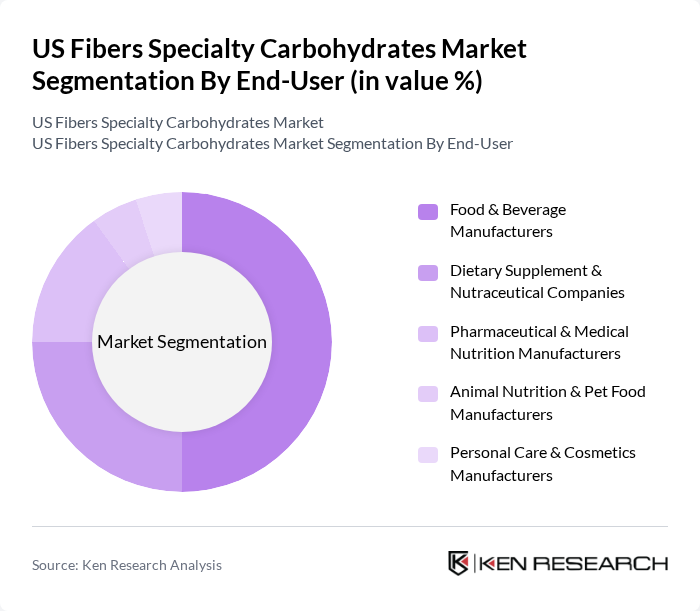
By End-User:The end-user segmentation includes food and beverage manufacturers, dietary supplement and nutraceutical companies, pharmaceutical and medical nutrition manufacturers, animal nutrition and pet food manufacturers, and personal care and cosmetics manufacturers. Food and beverage manufacturers are the leading end-users, driven by the increasing incorporation of fibers and specialty carbohydrates in bakery, cereals, dairy alternatives, beverages, snacks, and sports nutrition to enhance nutritional profiles, deliver digestive and metabolic health benefits, and meet consumer demand for cleaner labels, reduced sugar, and better-for-you formulations.
US Fibers Specialty Carbohydrates Market Competitive Landscape
The US Fibers Specialty Carbohydrates Market is characterized by a dynamic mix of regional and international players. Leading participants such as Ingredion Incorporated, Tate & Lyle PLC, DuPont de Nemours, Inc. (including Danisco heritage business), Archer Daniels Midland Company (ADM), Cargill, Incorporated, BENEO GmbH, Roquette Frères, Fiberstar, Inc., Taiyo Kagaku Co., Ltd. (Sunfiber), Nexira, Kerry Group plc, Emsland Group, DSM-Firmenich AG, Ginkgo Bioworks Holdings, Inc., Cargill Health & Nutrition (Cargill’s specialty health ingredients business) contribute to innovation, geographic expansion, and service delivery in this space.
US Fibers Specialty Carbohydrates Market Industry Analysis
Growth Drivers
- Increasing Health Consciousness:The US population is increasingly prioritizing health, with 75% of consumers actively seeking healthier food options. This trend is supported by the rise in chronic diseases, prompting a shift towards functional foods that incorporate specialty carbohydrates. The health and wellness market is projected to reach $1.7 trillion in future, indicating a robust demand for products that enhance nutritional profiles and promote overall well-being, driving growth in the fibers specialty carbohydrates sector.
- Rising Demand for Natural Ingredients:The natural ingredients market is expected to grow significantly, with a projected value of $250 billion in future. Consumers are increasingly avoiding artificial additives, leading to a surge in demand for specialty carbohydrates derived from natural sources. This shift is evident as 65% of consumers express a preference for products with clean labels, further propelling manufacturers to innovate and incorporate natural fibers into their offerings, thus enhancing market growth.
- Expansion of Functional Foods Market:The functional foods market in the US is anticipated to reach $300 billion in future, driven by consumer interest in foods that provide health benefits beyond basic nutrition. Specialty carbohydrates play a crucial role in this segment, offering benefits such as improved gut health and enhanced satiety. As more consumers seek products that support specific health goals, the demand for fibers and specialty carbohydrates is expected to rise, fueling industry growth.
Market Challenges
- Regulatory Compliance Issues:The specialty carbohydrates market faces significant regulatory hurdles, particularly concerning FDA guidelines on food additives. Compliance with these regulations can be costly and time-consuming, with companies spending an average of $1.2 million annually to ensure adherence. This challenge can hinder innovation and slow down the introduction of new products, impacting overall market growth and competitiveness in the industry.
- High Production Costs:The production of specialty carbohydrates often involves advanced technologies and sourcing of high-quality raw materials, leading to elevated production costs. For instance, the average cost of producing natural fibers can exceed $3,500 per ton, which can limit profit margins for manufacturers. These high costs may deter smaller companies from entering the market, consolidating power among larger players and stifling competition.
US Fibers Specialty Carbohydrates Market Future Outlook
The future of the US fibers specialty carbohydrates market appears promising, driven by ongoing trends in health and wellness. As consumers increasingly prioritize natural and functional foods, manufacturers are likely to invest in innovative product formulations that cater to these preferences. Additionally, advancements in production technologies will enhance efficiency and reduce costs, making specialty carbohydrates more accessible. The market is expected to witness a surge in collaborations between food brands and health-focused companies, further expanding the reach and impact of specialty carbohydrates in the food industry.
Market Opportunities
- Growth in E-commerce Channels:The e-commerce food market is projected to reach $200 billion in future, providing a significant opportunity for specialty carbohydrates. Online platforms enable manufacturers to reach a broader audience, particularly health-conscious consumers seeking convenient purchasing options. This shift towards digital sales channels can enhance market penetration and drive revenue growth for companies specializing in fibers.
- Increasing Investment in R&D:Investment in research and development is expected to exceed $12 billion in the specialty carbohydrates sector in future. This influx of funding will facilitate innovation in product development, allowing companies to create new, health-oriented offerings. Enhanced R&D efforts can lead to the discovery of novel applications for specialty carbohydrates, further expanding their market potential and consumer appeal.
Scope of the Report
| Segment | Sub-Segments |
|---|---|
| By Type | Soluble Fibers (e.g., inulin, polydextrose, soluble corn fiber) Insoluble Fibers (e.g., wheat fiber, cellulose, oat fiber) Prebiotic Carbohydrates (e.g., FOS, GOS, IMO) Functional Specialty Carbohydrates (e.g., isomaltooligosaccharides, resistant starch, specialty oligosaccharides) Others |
| By End-User | Food & Beverage Manufacturers Dietary Supplement & Nutraceutical Companies Pharmaceutical & Medical Nutrition Manufacturers Animal Nutrition & Pet Food Manufacturers Personal Care & Cosmetics Manufacturers |
| By Application | Functional Foods & Beverages Dietary Supplements (capsules, powders, gummies) Bakery & Cereals Dairy & Dairy Alternatives Infant Nutrition & Medical Nutrition Animal Nutrition Others |
| By Distribution Channel | Business-to-Business (B2B) Ingredient Sales Direct Sales to Large Food & Beverage Accounts Specialty Distributors & Blenders Online B2B Platforms Others |
| By Source | Cereal Grains (e.g., corn, wheat, oats) Fruits & Vegetables (e.g., chicory root, citrus, apple, potato) Legumes & Pulses Microbial & Fermentation-Derived Synthetic & Chemically Modified Others |
| By Region | Northeast Midwest South West |
| By Product Form | Powder Liquid/Syrup Granules Agglomerates & Compacted Blends Others |
Key Target Audience
Investors and Venture Capitalist Firms
Government and Regulatory Bodies (e.g., Food and Drug Administration, United States Department of Agriculture)
Manufacturers and Producers
Distributors and Retailers
Food and Beverage Companies
Pharmaceutical Companies
Health and Wellness Organizations
Biotechnology Firms
Players Mentioned in the Report:
Ingredion Incorporated
Tate & Lyle PLC
DuPont de Nemours, Inc. (including Danisco heritage business)
Archer Daniels Midland Company (ADM)
Cargill, Incorporated
BENEO GmbH
Roquette Freres
Fiberstar, Inc.
Taiyo Kagaku Co., Ltd. (Sunfiber)
Nexira
Kerry Group plc
Emsland Group
DSM-Firmenich AG
Ginkgo Bioworks Holdings, Inc.
Cargill Health & Nutrition (Cargills specialty health ingredients business)
Table of Contents
Market Assessment Phase
1. Executive Summary and Approach
2. US Fibers Specialty Carbohydrates Market Overview
2.1 Key Insights and Strategic Recommendations
2.2 US Fibers Specialty Carbohydrates Market Overview
2.3 Definition and Scope
2.4 Evolution of Market Ecosystem
2.5 Timeline of Key Regulatory Milestones
2.6 Value Chain & Stakeholder Mapping
2.7 Business Cycle Analysis
2.8 Policy & Incentive Landscape
3. US Fibers Specialty Carbohydrates Market Analysis
3.1 Growth Drivers
3.1.1 Increasing Health Consciousness
3.1.2 Rising Demand for Natural Ingredients
3.1.3 Expansion of Functional Foods Market
3.1.4 Technological Advancements in Production
3.2 Market Challenges
3.2.1 Regulatory Compliance Issues
3.2.2 High Production Costs
3.2.3 Limited Consumer Awareness
3.2.4 Supply Chain Disruptions
3.3 Market Opportunities
3.3.1 Growth in E-commerce Channels
3.3.2 Increasing Investment in R&D
3.3.3 Expansion into Emerging Markets
3.3.4 Collaborations with Health Brands
3.4 Market Trends
3.4.1 Shift Towards Plant-Based Products
3.4.2 Innovations in Product Formulation
3.4.3 Focus on Sustainability and Eco-Friendly Practices
3.4.4 Customization of Nutritional Products
3.5 Government Regulation
3.5.1 FDA Guidelines on Food Additives
3.5.2 Labeling Requirements for Health Claims
3.5.3 Import Regulations for Specialty Carbohydrates
3.5.4 Environmental Regulations Impacting Production
4. SWOT Analysis
5. Stakeholder Analysis
6. Porter's Five Forces Analysis
7. US Fibers Specialty Carbohydrates Market Market Size, 2019-2024
7.1 By Value
7.2 By Volume
7.3 By Average Selling Price
8. US Fibers Specialty Carbohydrates Market Segmentation
8.1 By Type
8.1.1 Soluble Fibers (e.g., inulin, polydextrose, soluble corn fiber)
8.1.2 Insoluble Fibers (e.g., wheat fiber, cellulose, oat fiber)
8.1.3 Prebiotic Carbohydrates (e.g., FOS, GOS, IMO)
8.1.4 Functional Specialty Carbohydrates (e.g., isomaltooligosaccharides, resistant starch, specialty oligosaccharides)
8.1.5 Others
8.2 By End-User
8.2.1 Food & Beverage Manufacturers
8.2.2 Dietary Supplement & Nutraceutical Companies
8.2.3 Pharmaceutical & Medical Nutrition Manufacturers
8.2.4 Animal Nutrition & Pet Food Manufacturers
8.2.5 Personal Care & Cosmetics Manufacturers
8.3 By Application
8.3.1 Functional Foods & Beverages
8.3.2 Dietary Supplements (capsules, powders, gummies)
8.3.3 Bakery & Cereals
8.3.4 Dairy & Dairy Alternatives
8.3.5 Infant Nutrition & Medical Nutrition
8.3.6 Animal Nutrition
8.3.7 Others
8.4 By Distribution Channel
8.4.1 Business-to-Business (B2B) Ingredient Sales
8.4.2 Direct Sales to Large Food & Beverage Accounts
8.4.3 Specialty Distributors & Blenders
8.4.4 Online B2B Platforms
8.4.5 Others
8.5 By Source
8.5.1 Cereal Grains (e.g., corn, wheat, oats)
8.5.2 Fruits & Vegetables (e.g., chicory root, citrus, apple, potato)
8.5.3 Legumes & Pulses
8.5.4 Microbial & Fermentation-Derived
8.5.5 Synthetic & Chemically Modified
8.5.6 Others
8.6 By Region
8.6.1 Northeast
8.6.2 Midwest
8.6.3 South
8.6.4 West
8.7 By Product Form
8.7.1 Powder
8.7.2 Liquid/Syrup
8.7.3 Granules
8.7.4 Agglomerates & Compacted Blends
8.7.5 Others
9. US Fibers Specialty Carbohydrates Market Competitive Analysis
9.1 Market Share of Key Players
9.2 Cross Comparison of Key Players
9.2.1 Company Name
9.2.2 Company Size (Tier I, Tier II, Tier III based on revenue in US fibers & specialty carbohydrates)
9.2.3 US Fibers & Specialty Carbohydrates Revenue (USD million)
9.2.4 3-Year CAGR in US Fibers & Specialty Carbohydrates Revenue
9.2.5 Share of Fibers & Specialty Carbohydrates in Total US Ingredients Portfolio (%)
9.2.6 Product Portfolio Breadth (number of SKUs / ingredient families offered)
9.2.7 Innovation Intensity (R&D spend as % of segment revenue, new launches per year)
9.2.8 Regulatory & Quality Certifications (e.g., NSF, FSSC 22000, non-GMO, organic)
9.2.9 Key Application Focus (food & beverage, supplements, infant nutrition, animal nutrition)
9.2.10 Distribution Reach in the US (number of key accounts / distribution partners)
9.2.11 Strategic Partnerships & Co-development Projects (count and type)
9.2.12 EBITDA Margin for US Fibers & Specialty Carbohydrates Business (%)
9.3 SWOT Analysis of Top Players
9.4 Pricing Analysis
9.5 Detailed Profile of Major Companies
9.5.1 Ingredion Incorporated
9.5.2 Tate & Lyle PLC
9.5.3 DuPont de Nemours, Inc. (including Danisco heritage business)
9.5.4 Archer Daniels Midland Company (ADM)
9.5.5 Cargill, Incorporated
9.5.6 BENEO GmbH
9.5.7 Roquette Frères
9.5.8 Fiberstar, Inc.
9.5.9 Taiyo Kagaku Co., Ltd. (Sunfiber)
9.5.10 Nexira
9.5.11 Kerry Group plc
9.5.12 Emsland Group
9.5.13 DSM-Firmenich AG
9.5.14 Ginkgo Bioworks Holdings, Inc.
9.5.15 Cargill Health & Nutrition (Cargill’s specialty health ingredients business)
10. US Fibers Specialty Carbohydrates Market End-User Analysis
10.1 Procurement Behavior of Key Ministries
10.1.1 Government Health Initiatives
10.1.2 Nutritional Guidelines Compliance
10.1.3 Budget Allocation for Health Programs
10.1.4 Supplier Selection Criteria
10.2 Corporate Spend on Infrastructure & Energy
10.2.1 Investment in Health and Wellness Programs
10.2.2 Budget for Research and Development
10.2.3 Expenditure on Sustainable Practices
10.2.4 Funding for Nutritional Education
10.3 Pain Point Analysis by End-User Category
10.3.1 Cost Constraints
10.3.2 Quality Assurance Issues
10.3.3 Supply Chain Reliability
10.3.4 Regulatory Compliance Challenges
10.4 User Readiness for Adoption
10.4.1 Awareness of Health Benefits
10.4.2 Availability of Products
10.4.3 Training and Support Needs
10.4.4 Feedback Mechanisms
10.5 Post-Deployment ROI and Use Case Expansion
10.5.1 Measurement of Health Outcomes
10.5.2 Cost-Benefit Analysis
10.5.3 User Experience Feedback
10.5.4 Opportunities for Product Line Expansion
11. US Fibers Specialty Carbohydrates Market Future Size, 2025-2030
11.1 By Value
11.2 By Volume
11.3 By Average Selling Price
Go-To-Market Strategy Phase
1. Whitespace Analysis + Business Model Canvas
1.1 Market Gaps Identification
1.2 Value Proposition Development
1.3 Revenue Streams Analysis
1.4 Cost Structure Evaluation
1.5 Key Partnerships Exploration
1.6 Customer Segmentation
1.7 Channels of Distribution
2. Marketing and Positioning Recommendations
2.1 Branding Strategies
2.2 Product USPs
2.3 Target Market Identification
2.4 Communication Strategies
2.5 Digital Marketing Approaches
2.6 Customer Engagement Tactics
2.7 Performance Metrics
3. Distribution Plan
3.1 Urban Retail Strategies
3.2 Rural NGO Tie-ups
3.3 E-commerce Integration
3.4 Logistics and Supply Chain Management
3.5 Distribution Partnerships
3.6 Inventory Management
3.7 Performance Tracking
4. Channel & Pricing Gaps
4.1 Underserved Routes
4.2 Pricing Bands Analysis
4.3 Competitor Pricing Strategies
4.4 Customer Price Sensitivity
4.5 Value-Based Pricing Models
4.6 Discount Strategies
4.7 Pricing Optimization Techniques
5. Unmet Demand & Latent Needs
5.1 Category Gaps Identification
5.2 Consumer Segments Analysis
5.3 Product Development Opportunities
5.4 Market Entry Strategies
5.5 Customer Feedback Mechanisms
5.6 Trend Analysis
5.7 Future Demand Projections
6. Customer Relationship
6.1 Loyalty Programs
6.2 After-sales Service
6.3 Customer Feedback Systems
6.4 Engagement Strategies
6.5 Retention Strategies
6.6 Relationship Management Tools
6.7 Performance Metrics
7. Value Proposition
7.1 Sustainability Initiatives
7.2 Integrated Supply Chains
7.3 Customer-Centric Approaches
7.4 Competitive Differentiation
7.5 Value-Added Services
7.6 Market Positioning
7.7 Performance Metrics
8. Key Activities
8.1 Regulatory Compliance
8.2 Branding Initiatives
8.3 Distribution Setup
8.4 Marketing Campaigns
8.5 Training and Development
8.6 Performance Monitoring
8.7 Continuous Improvement
9. Entry Strategy Evaluation
9.1 Domestic Market Entry Strategy
9.1.1 Product Mix Considerations
9.1.2 Pricing Band Analysis
9.1.3 Packaging Strategies
9.2 Export Entry Strategy
9.2.1 Target Countries Identification
9.2.2 Compliance Roadmap Development
10. Entry Mode Assessment
10.1 Joint Ventures
10.2 Greenfield Investments
10.3 Mergers & Acquisitions
10.4 Distributor Model Evaluation
11. Capital and Timeline Estimation
11.1 Capital Requirements Analysis
11.2 Timelines for Implementation
12. Control vs Risk Trade-Off
12.1 Ownership vs Partnerships
13. Profitability Outlook
13.1 Breakeven Analysis
13.2 Long-term Sustainability Strategies
14. Potential Partner List
14.1 Distributors
14.2 Joint Ventures
14.3 Acquisition Targets
15. Execution Roadmap
15.1 Phased Plan for Market Entry
15.1.1 Market Setup
15.1.2 Market Entry
15.1.3 Growth Acceleration
15.1.4 Scale & Stabilize
15.2 Key Activities and Milestones
15.2.1 Activity Planning
15.2.2 Milestone Tracking
Research Methodology
Phase 1: Approach1
Desk Research
- Industry reports from the US Department of Agriculture and Food and Drug Administration
- Market analysis publications from trade associations such as the Specialty Carbohydrates Association
- Academic journals and white papers focusing on fiber and carbohydrate innovations
Primary Research
- Interviews with product development managers at leading food and beverage companies
- Surveys with nutritionists and dietitians regarding consumer preferences
- Field interviews with manufacturers of specialty carbohydrates and fibers
Validation & Triangulation
- Cross-validation of data through multiple industry sources and expert opinions
- Triangulation of market trends using sales data, consumer insights, and regulatory impacts
- Sanity checks through feedback from a panel of industry experts and stakeholders
Phase 2: Market Size Estimation1
Top-down Assessment
- Analysis of overall carbohydrate consumption trends in the US food market
- Segmentation of specialty carbohydrates by application areas such as food, pharmaceuticals, and nutraceuticals
- Incorporation of health trends influencing fiber consumption, such as gluten-free and low-carb diets
Bottom-up Modeling
- Volume estimates based on production data from key manufacturers in the specialty carbohydrate sector
- Cost analysis derived from pricing models of various specialty carbohydrate products
- Estimation of market share based on sales data from major distribution channels
Forecasting & Scenario Analysis
- Multi-variable forecasting using trends in health awareness and dietary changes
- Scenario modeling based on potential regulatory changes affecting carbohydrate labeling and health claims
- Development of baseline, optimistic, and pessimistic market growth projections through 2030
Phase 3: CATI Sample Composition1
| Scope Item/Segment | Sample Size | Target Respondent Profiles |
|---|---|---|
| Food and Beverage Manufacturers | 120 | Product Development Managers, Quality Assurance Specialists |
| Nutraceutical Companies | 100 | Research and Development Directors, Regulatory Affairs Managers |
| Health and Wellness Retailers | 80 | Category Managers, Purchasing Agents |
| Dietary Supplement Producers | 70 | Marketing Managers, Sales Directors |
| Food Scientists and Nutritionists | 90 | Registered Dietitians, Food Technologists |
Frequently Asked Questions
What is the current value of the US Fibers Specialty Carbohydrates Market?
The US Fibers Specialty Carbohydrates Market is valued at approximately USD 3.5 billion, reflecting a robust demand driven by the increasing consumption of functional foods, dietary supplements, and fiber-fortified products.
What factors are driving growth in the US Fibers Specialty Carbohydrates Market?
What types of fibers are included in the US Fibers Specialty Carbohydrates Market?
Who are the primary end-users of specialty carbohydrates in the US?
Other Regional/Country Reports
Indonesia Fibers Specialty Carbohydrates Market
Malaysia Fibers Specialty Carbohydrates Market
KSA Fibers Specialty Carbohydrates Market
APAC Fibers Specialty Carbohydrates Market
SEA Fibers Specialty Carbohydrates Market
Vietnam Fibers Specialty Carbohydrates Market
Other Adjacent Reports
Thailand Natural Ingredients Market
Vietnam Sports Nutrition Market Report: Size, Share, Growth Drivers, Trends, Opportunities & Forecast 2025–2030Oman Medical Nutrition Market
UAE Animal Feed Additives Market Size Share Growth Drivers Trends Opportunities & Forecast 2025–2030Thailand Personal Care Ingredients Market
Why Buy From Us?

What makes us stand out is that our consultants follow Robust, Refine and Result (RRR) methodology. Robust for clear definitions, approaches and sanity checking, Refine for differentiating respondents' facts and opinions, and Result for presenting data with story.

We have set a benchmark in the industry by offering our clients with syndicated and customized market research reports featuring coverage of entire market as well as meticulous research and analyst insights.

While we don't replace traditional research, we flip the method upside down. Our dual approach of Top Bottom & Bottom Top ensures quality deliverable by not just verifying company fundamentals but also looking at the sector and macroeconomic factors.

With one step in the future, our research team constantly tries to show you the bigger picture. We help with some of the tough questions you may encounter along the way: How is the industry positioned? Best marketing channel? KPI's of competitors? By aligning every element, we help maximize success.

Our report gives you instant access to the answers and sources that other companies might choose to hide. We elaborate each steps of research methodology we have used and showcase you the sample size to earn your trust.

If you need any support, we are here! We pride ourselves on universe strength, data quality, and quick, friendly, and professional service.