About the Report
Base Year 2024Vietnam Argon Gas Market Overview
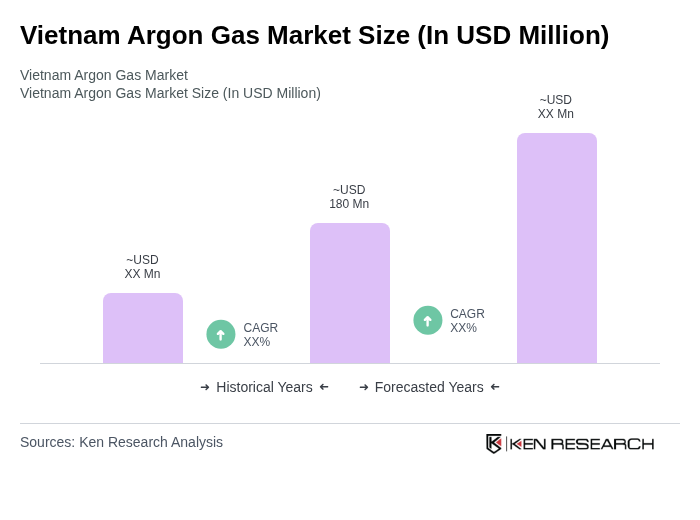
- The Vietnam Argon Gas Market is valued at USD 180 million, based on a five-year historical analysis of revenues reported for argon in the country. This growth is primarily driven by the increasing demand for argon in industrial applications such as welding and metal fabrication, electronics manufacturing, and healthcare, in line with the broader expansion of Vietnam’s industrial gases market. The ongoing expansion of manufacturing sectors, growth in electronics and semiconductor assembly, and rising technological advancements in metal processing and fabrication have significantly contributed to market growth.
- Key cities such as Ho Chi Minh City, Hanoi, and Da Nang dominate the market due to their robust industrial bases and high concentration of manufacturing activities. These urban centers host major industrial parks, electronics assembly plants, steel and metal fabrication facilities, and healthcare institutions, making them pivotal for the distribution and consumption of argon gas and other industrial gases, supported by expanding logistics networks and industrial zones.
- In 2023, the Vietnamese government strengthened the regulatory framework governing the safe production, storage, transport, and use of industrial gases, including argon, through instruments such as Decree No. 136/2020/ND-CP on fire prevention and fighting issued by the Government and guided by the Ministry of Public Security, which sets requirements for design, installation, and operation of gas storage and supply systems, and the National Technical Regulation QCVN 02:2008/BCT on safety in production, storage, and use of industrial gases issued by the Ministry of Industry and Trade. These binding regulations mandate compliance with safety standards on cylinder/cryogenic tank design, pressure limits, site layout, fire protection systems, and operator training, and encourage companies to adopt best practices in gas management, thereby enhancing safety and operational efficiency across the argon value chain.
Vietnam Argon Gas Market Segmentation
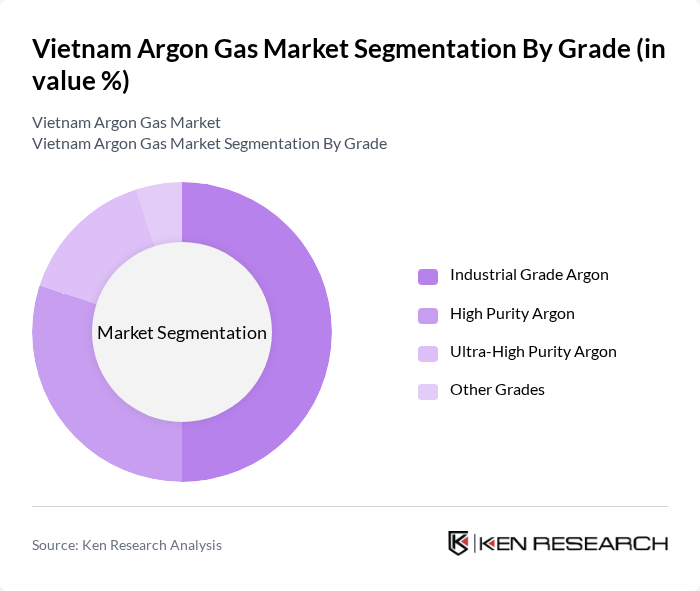
By Grade:The argon gas market can be segmented into various grades, including Industrial Grade Argon, High Purity Argon, Ultra-High Purity Argon, and Other Grades. Industrial Grade Argon is widely used in welding and metal fabrication processes such as MIG/TIG welding and shielding of molten metal, which represent the largest single use of argon worldwide and in Asia Pacific. High Purity Argon is essential for electronics and semiconductor manufacturing, where it is used as an inert atmosphere for crystal pulling, wafer processing, and furnace blanketing in Vietnam’s growing electronics and EMS/ODM industry. Ultra-High Purity Argon is critical for specialized applications in healthcare and research, including gas chromatography, spectroscopy, and controlled laboratory environments. The demand for these grades is influenced by the specific requirements of different industries, with Industrial Grade Argon generally leading the market due to its extensive use in manufacturing and metal fabrication processes.
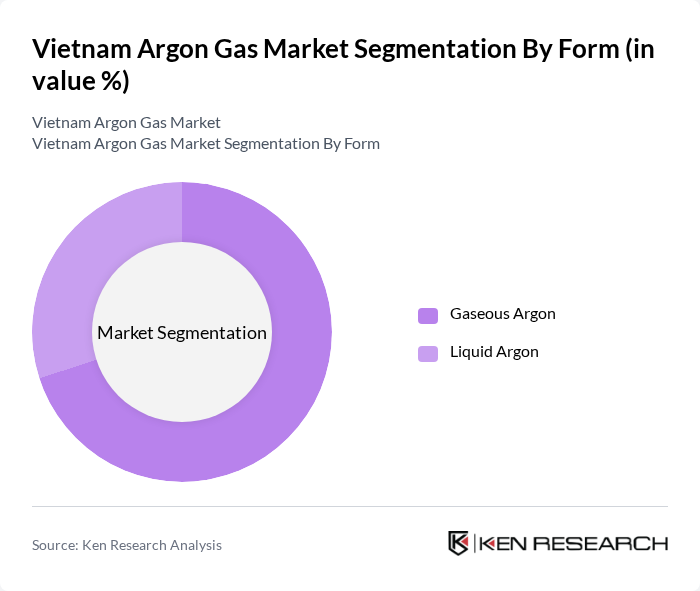
By Form:The argon gas market is also categorized by form, which includes Gaseous Argon and Liquid Argon. Gaseous Argon is predominantly used in welding, cutting, and metal fabrication as a shielding gas and in certain protective-atmosphere heat treatment processes. Liquid Argon is utilized in applications requiring high purity and low temperatures, such as medical and laboratory cryogenic uses and as a bulk supply mode for large industrial users, where it is vaporized on-site into gas. The preference for one form over the other is largely determined by specific application requirements, consumption scale, and the efficiency of gas delivery systems, with bulk liquid supply favored for high-volume industrial users and gaseous cylinders more common among small and medium workshops.
Vietnam Argon Gas Market Competitive Landscape
The Vietnam Argon Gas Market is characterized by a dynamic mix of regional and international players. Leading participants such as Air Liquide Vietnam, Linde Vietnam, Messer Vietnam Industrial Gases, Vietnam Nippon Sanso (Taiyo Nippon Sanso Vietnam), Air Products Vietnam, Vietnam Industrial Gas Joint Stock Company (VIPEGAS), Hyosung Vietnam Industrial Gases, Gia Dinh Gas, Saigon Petro, Petrolimex Gas, Binh Minh Gas, Dong Nai Industrial Gas, Thang Long Industrial Gas, Vigascop (Vietnam Gas Corporation), and other local industrial gas suppliers contribute to innovation, geographic expansion, and service delivery in this space.
Vietnam Argon Gas Market Industry Analysis
Growth Drivers
- Increasing Demand from Industrial Applications:The industrial sector in Vietnam is projected to grow significantly, with a contribution of approximately 37% to the GDP in future, translating to around $120 billion. This growth is driven by the rising use of argon gas in welding, metal fabrication, and manufacturing processes, which are expected to increase by 15% annually. The demand for argon in these applications is crucial for enhancing product quality and operational efficiency.
- Expansion of the Manufacturing Sector:Vietnam's manufacturing sector is anticipated to expand by 8% in future, supported by foreign direct investment (FDI) inflows, which reached $25 billion in future. This expansion is expected to drive the demand for argon gas, particularly in the automotive and electronics industries, where argon is essential for creating inert atmospheres during production processes, thereby ensuring product integrity and safety.
- Technological Advancements in Gas Production:The argon gas production technology in Vietnam is evolving, with investments of approximately $50 million in advanced production facilities expected in future. These advancements are projected to enhance production efficiency by 20%, reducing costs and increasing output. Improved production methods will enable suppliers to meet the growing demand from various sectors, including healthcare and electronics, further driving market growth.
Market Challenges
- High Production Costs:The production costs for argon gas in Vietnam are currently estimated at $1,200 per ton, influenced by rising energy prices and raw material costs. This high cost structure poses a significant challenge for manufacturers, limiting their ability to compete with imported gases, which may be produced at lower costs due to economies of scale in other countries. This situation could hinder market growth and profitability.
- Limited Distribution Infrastructure:Vietnam's distribution infrastructure for industrial gases, including argon, is underdeveloped, with only 30% of regions having reliable access to gas supply networks. This limitation affects the timely delivery of argon to end-users, particularly in remote areas. The lack of efficient logistics and transportation systems can lead to increased operational costs and reduced market penetration for argon suppliers.
Vietnam Argon Gas Market Future Outlook
The Vietnam argon gas market is poised for significant growth, driven by increasing industrial applications and technological advancements. As the manufacturing sector expands, particularly in electronics and automotive industries, the demand for argon gas is expected to rise. Additionally, the government's focus on sustainable practices and clean technology adoption will likely create new opportunities for argon applications, enhancing its market position. Continuous investment in production technologies will further support this growth trajectory.
Market Opportunities
- Growth in Healthcare Applications:The healthcare sector in Vietnam is projected to grow by 10% in future, increasing the demand for argon gas in medical applications such as cryotherapy and laser surgeries. This growth presents a significant opportunity for argon suppliers to expand their market share in the healthcare industry, which is increasingly adopting advanced technologies.
- Increasing Use in Electronics Manufacturing:With Vietnam's electronics manufacturing sector expected to reach $60 billion in future, the demand for argon gas in semiconductor production and other electronic applications is set to rise. This trend offers argon suppliers a lucrative opportunity to cater to the growing needs of this high-tech industry, enhancing their revenue potential.
Scope of the Report
| Segment | Sub-Segments |
|---|---|
| By Grade | Industrial Grade Argon High Purity Argon Ultra-High Purity Argon Other Grades |
| By Form | Gaseous Argon Liquid Argon |
| By Application | Welding and Metal Fabrication Electronics and Semiconductor Manufacturing Inerting and Blanketing Healthcare and Medical Applications Lighting and Other Industrial Uses |
| By End-Use Industry | Metal Manufacturing & Fabrication Electronics & Semiconductors Healthcare & Pharmaceuticals Chemicals & Petrochemicals Food & Beverage Others |
| By Mode of Supply | Tonnage Bulk & Microbulk Cylinders / Packaged Gas On-site Generation |
| By Region | Northern Vietnam Central Vietnam Southern Vietnam |
Key Target Audience
Investors and Venture Capitalist Firms
Government and Regulatory Bodies (e.g., Ministry of Industry and Trade, Ministry of Natural Resources and Environment)
Manufacturers and Producers of Argon Gas
Gas Distribution Companies
Industrial Gas Equipment Suppliers
Energy Sector Stakeholders
Environmental Agencies
Trade Associations in the Gas Industry
Players Mentioned in the Report:
Air Liquide Vietnam
Linde Vietnam
Messer Vietnam Industrial Gases
Vietnam Nippon Sanso (Taiyo Nippon Sanso Vietnam)
Air Products Vietnam
Vietnam Industrial Gas Joint Stock Company (VIPEGAS)
Hyosung Vietnam Industrial Gases
Gia Dinh Gas
Saigon Petro
Petrolimex Gas
Binh Minh Gas
Dong Nai Industrial Gas
Thang Long Industrial Gas
Vigascop (Vietnam Gas Corporation)
Other Local Industrial Gas Suppliers
Table of Contents
Market Assessment Phase
1. Executive Summary and Approach
2. Vietnam Argon Gas Market Overview
2.1 Key Insights and Strategic Recommendations
2.2 Vietnam Argon Gas Market Overview
2.3 Definition and Scope
2.4 Evolution of Market Ecosystem
2.5 Timeline of Key Regulatory Milestones
2.6 Value Chain & Stakeholder Mapping
2.7 Business Cycle Analysis
2.8 Policy & Incentive Landscape
3. Vietnam Argon Gas Market Analysis
3.1 Growth Drivers
3.1.1 Increasing Demand from Industrial Applications
3.1.2 Expansion of the Manufacturing Sector
3.1.3 Technological Advancements in Gas Production
3.1.4 Rising Awareness of Environmental Benefits
3.2 Market Challenges
3.2.1 High Production Costs
3.2.2 Limited Distribution Infrastructure
3.2.3 Regulatory Compliance Issues
3.2.4 Competition from Alternative Gases
3.3 Market Opportunities
3.3.1 Growth in Healthcare Applications
3.3.2 Increasing Use in Electronics Manufacturing
3.3.3 Potential for Export Markets
3.3.4 Development of New Applications
3.4 Market Trends
3.4.1 Shift Towards Sustainable Practices
3.4.2 Increasing Investment in R&D
3.4.3 Adoption of Advanced Production Technologies
3.4.4 Growing Demand for Specialty Gases
3.5 Government Regulation
3.5.1 Emission Standards for Industrial Gases
3.5.2 Safety Regulations for Gas Handling
3.5.3 Incentives for Clean Technology Adoption
3.5.4 Import Tariffs on Argon Gas
4. SWOT Analysis
5. Stakeholder Analysis
6. Porter's Five Forces Analysis
7. Vietnam Argon Gas Market Market Size, 2019-2024
7.1 By Value
7.2 By Volume
7.3 By Average Selling Price
8. Vietnam Argon Gas Market Segmentation
8.1 By Grade
8.1.1 Industrial Grade Argon
8.1.2 High Purity Argon
8.1.3 Ultra-High Purity Argon
8.1.4 Other Grades
8.2 By Form
8.2.1 Gaseous Argon
8.2.2 Liquid Argon
8.3 By Application
8.3.1 Welding and Metal Fabrication
8.3.2 Electronics and Semiconductor Manufacturing
8.3.3 Inerting and Blanketing
8.3.4 Healthcare and Medical Applications
8.3.5 Lighting and Other Industrial Uses
8.4 By End-Use Industry
8.4.1 Metal Manufacturing & Fabrication
8.4.2 Electronics & Semiconductors
8.4.3 Healthcare & Pharmaceuticals
8.4.4 Chemicals & Petrochemicals
8.4.5 Food & Beverage
8.4.6 Others
8.5 By Mode of Supply
8.5.1 Tonnage
8.5.2 Bulk & Microbulk
8.5.3 Cylinders / Packaged Gas
8.5.4 On-site Generation
8.6 By Region
8.6.1 Northern Vietnam
8.6.2 Central Vietnam
8.6.3 Southern Vietnam
9. Vietnam Argon Gas Market Competitive Analysis
9.1 Market Share of Key Players
9.2 Cross Comparison of Key Players
9.2.1 Company Name
9.2.2 Group Size (Large, Medium, or Small as per industry convention)
9.2.3 Vietnam Argon Gas Revenue (Latest Year, USD Million)
9.2.4 3-Year Revenue CAGR (%)
9.2.5 Argon Gas Sales Volume (Kilotons, Latest Year)
9.2.6 Market Share in Vietnam Argon Gas Market (%)
9.2.7 EBITDA Margin from Argon Business (%)
9.2.8 Average Realized Price per Nm³ (USD)
9.2.9 Capacity Utilization Rate (%)
9.2.10 Number of Production Sites in Vietnam
9.2.11 Distribution Network Coverage (Provinces / Industrial Zones Served)
9.2.12 R&D / Technology Investment as % of Revenue
9.3 SWOT Analysis of Top Players
9.4 Pricing Analysis
9.5 Detailed Profile of Major Companies
9.5.1 Air Liquide Vietnam
9.5.2 Linde Vietnam
9.5.3 Messer Vietnam Industrial Gases
9.5.4 Vietnam Nippon Sanso (Taiyo Nippon Sanso Vietnam)
9.5.5 Air Products Vietnam
9.5.6 Vietnam Industrial Gas Joint Stock Company (VIPEGAS)
9.5.7 Hyosung Vietnam Industrial Gases
9.5.8 Gia Dinh Gas
9.5.9 Saigon Petro
9.5.10 Petrolimex Gas
9.5.11 Binh Minh Gas
9.5.12 Dong Nai Industrial Gas
9.5.13 Thang Long Industrial Gas
9.5.14 Vigascop (Vietnam Gas Corporation)
9.5.15 Other Local Industrial Gas Suppliers
10. Vietnam Argon Gas Market End-User Analysis
10.1 Procurement Behavior of Key Ministries
10.1.1 Ministry of Industry and Trade
10.1.2 Ministry of Health
10.1.3 Ministry of Science and Technology
10.1.4 Others
10.2 Corporate Spend on Infrastructure & Energy
10.2.1 Manufacturing Sector Investments
10.2.2 Healthcare Sector Investments
10.2.3 Research and Development Investments
10.2.4 Others
10.3 Pain Point Analysis by End-User Category
10.3.1 Manufacturing Pain Points
10.3.2 Healthcare Pain Points
10.3.3 Electronics Pain Points
10.3.4 Others
10.4 User Readiness for Adoption
10.4.1 Manufacturing Readiness
10.4.2 Healthcare Readiness
10.4.3 Electronics Readiness
10.4.4 Others
10.5 Post-Deployment ROI and Use Case Expansion
10.5.1 Manufacturing Use Cases
10.5.2 Healthcare Use Cases
10.5.3 Electronics Use Cases
10.5.4 Others
11. Vietnam Argon Gas Market Future Size, 2025-2030
11.1 By Value
11.2 By Volume
11.3 By Average Selling Price
Go-To-Market Strategy Phase
1. Whitespace Analysis + Business Model Canvas
1.1 Market Gaps Identification
1.2 Business Model Development
2. Marketing and Positioning Recommendations
2.1 Branding Strategies
2.2 Product USPs
3. Distribution Plan
3.1 Urban Retail Strategies
3.2 Rural NGO Tie-ups
4. Channel & Pricing Gaps
4.1 Underserved Routes
4.2 Pricing Bands
5. Unmet Demand & Latent Needs
5.1 Category Gaps
5.2 Consumer Segments
6. Customer Relationship
6.1 Loyalty Programs
6.2 After-sales Service
7. Value Proposition
7.1 Sustainability Initiatives
7.2 Integrated Supply Chains
8. Key Activities
8.1 Regulatory Compliance
8.2 Branding Efforts
8.3 Distribution Setup
9. Entry Strategy Evaluation
9.1 Domestic Market Entry Strategy
9.1.1 Product Mix
9.1.2 Pricing Band
9.1.3 Packaging
9.2 Export Entry Strategy
9.2.1 Target Countries
9.2.2 Compliance Roadmap
10. Entry Mode Assessment
10.1 Joint Ventures
10.2 Greenfield Investments
10.3 Mergers & Acquisitions
10.4 Distributor Model
11. Capital and Timeline Estimation
11.1 Capital Requirements
11.2 Timelines
12. Control vs Risk Trade-Off
12.1 Ownership vs Partnerships
13. Profitability Outlook
13.1 Breakeven Analysis
13.2 Long-term Sustainability
14. Potential Partner List
14.1 Distributors
14.2 Joint Ventures
14.3 Acquisition Targets
15. Execution Roadmap
15.1 Phased Plan for Market Entry
15.1.1 Market Setup
15.1.2 Market Entry
15.1.3 Growth Acceleration
15.1.4 Scale & Stabilize
15.2 Key Activities and Milestones
15.2.1 Milestone Planning
15.2.2 Activity Tracking
Research Methodology
Phase 1: Approach1
Desk Research
- Analysis of industry reports from the Vietnam Ministry of Industry and Trade
- Review of market studies published by local and international gas associations
- Examination of trade statistics and import/export data from customs authorities
Primary Research
- Interviews with key stakeholders in the argon gas supply chain, including producers and distributors
- Surveys targeting end-users in industries such as manufacturing, healthcare, and electronics
- Field visits to argon gas production facilities and major consumption sites
Validation & Triangulation
- Cross-validation of findings through multiple data sources, including government and industry reports
- Triangulation of market trends with insights from industry experts and academic research
- Sanity checks through feedback from a panel of experts in the gas industry
Phase 2: Market Size Estimation1
Top-down Assessment
- Estimation of total argon gas consumption based on national industrial output data
- Segmentation of the market by end-user industries and application areas
- Incorporation of growth rates from related sectors such as welding and metal fabrication
Bottom-up Modeling
- Volume estimates derived from production capacities of major argon gas suppliers in Vietnam
- Cost analysis based on pricing structures and distribution expenses
- Calculation of market size using a volume x price approach for each segment
Forecasting & Scenario Analysis
- Utilization of time-series analysis to project future demand trends through 2030
- Scenario modeling based on economic growth, regulatory changes, and technological advancements
- Development of best-case, worst-case, and most-likely scenarios for market evolution
Phase 3: CATI Sample Composition1
| Scope Item/Segment | Sample Size | Target Respondent Profiles |
|---|---|---|
| Manufacturing Sector Usage | 100 | Production Managers, Quality Control Supervisors |
| Healthcare Applications | 80 | Medical Gas Coordinators, Hospital Procurement Officers |
| Electronics Industry Consumption | 70 | Process Engineers, Supply Chain Managers |
| Welding and Metal Fabrication | 90 | Welding Supervisors, Operations Managers |
| Research and Development Facilities | 60 | Lab Managers, Research Scientists |
Frequently Asked Questions
What is the current value of the Vietnam Argon Gas Market?
The Vietnam Argon Gas Market is valued at approximately USD 180 million, driven by increasing demand in industrial applications such as welding, electronics manufacturing, and healthcare, reflecting the broader growth of Vietnam's industrial gases market.
What are the primary applications of argon gas in Vietnam?
Which cities are the main consumers of argon gas in Vietnam?
What regulatory measures govern the argon gas market in Vietnam?
Other Regional/Country Reports
Other Adjacent Reports
Mexico Electronics Manufacturing Market
UAE Semiconductor Market Outlook to 2030Middle East Medical Gases Market Size, Share, Growth Drivers, Trends, Opportunities & Forecast 2025–2030KSA cryogenic equipment market Size, Share, Growth Drivers, Trends, Opportunities & Forecast 2025–2030Singapore Steel Production Market
Indonesia Automotive Manufacturing Market Outlook to 2030North America Laser Technology Market Outlook to 2030: Size, Share, Growth and TrendsWhy Buy From Us?

What makes us stand out is that our consultants follow Robust, Refine and Result (RRR) methodology. Robust for clear definitions, approaches and sanity checking, Refine for differentiating respondents' facts and opinions, and Result for presenting data with story.

We have set a benchmark in the industry by offering our clients with syndicated and customized market research reports featuring coverage of entire market as well as meticulous research and analyst insights.

While we don't replace traditional research, we flip the method upside down. Our dual approach of Top Bottom & Bottom Top ensures quality deliverable by not just verifying company fundamentals but also looking at the sector and macroeconomic factors.

With one step in the future, our research team constantly tries to show you the bigger picture. We help with some of the tough questions you may encounter along the way: How is the industry positioned? Best marketing channel? KPI's of competitors? By aligning every element, we help maximize success.

Our report gives you instant access to the answers and sources that other companies might choose to hide. We elaborate each steps of research methodology we have used and showcase you the sample size to earn your trust.

If you need any support, we are here! We pride ourselves on universe strength, data quality, and quick, friendly, and professional service.